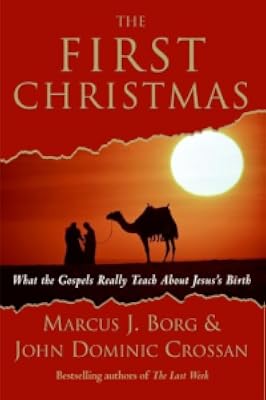
The First Christmas: What the Gospels Really Teach About Jesus's Birth
by Marcus J. Borg, John Dominic Crossan
On This Page
Description
In The First Christmas, two of today's top Jesus scholars, Marcus J. Borg and John Dominic Crossan, join forces to show how history has biased our reading of the nativity story as it appears in the gospels of Matthew and Luke. As they did for Easter in their previous book, The Last Week, here they explore the beginning of the life of Christ, peeling away the sentimentalism that has built up over the last two thousand years around this most well known of all stories to reveal the truth of show more what the gospels actually say. Borg and Crossan help us to see this well-known narrative afresh by answering the question, "What do these stories mean?" in the context of both the first century and the twenty-first century. They successfully show that the Christmas story, read in its original context, is far richer and more challenging than people imagine. show lessTags
Recommendations
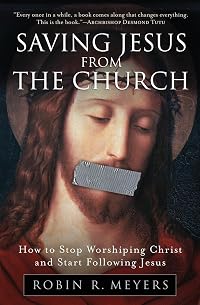
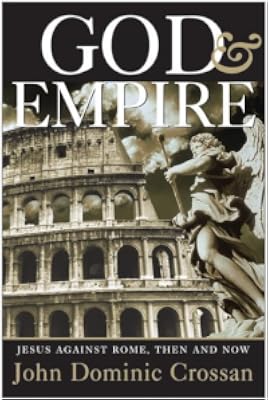
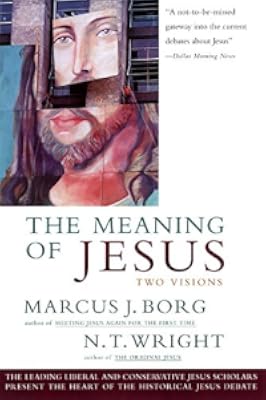
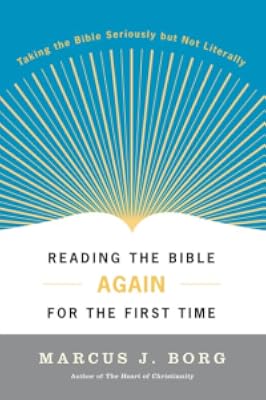




Member Recommendations
Member Reviews
In this fascinating little book, Borg and Crossan explore the historical meaning behind the birth-of-Jesus story. They first point out the factual differences between Matthew's and Luke's versions of the birth story. Then they explain how, after the Enlightenment, many people want everything to be either literally true or false. Many Christians are in denial of the "factual inconsistencies" in the Bible, and the ones who are aware of the inconsistencies often feel a little uncomfortable and don't know quite what to think about them. Borg and Crossan point out that the stories are meant to be parables. They were not meant to be taken as literal truth. They explore a deeper truth within the limits of historical culture.
Borg and Crossan show more study (practically line-by-line at times) each birth story separately, explaining the cultural, literary, or mythological meaning of the Biblical text. For instance, in his story of the Magi and Herod, Matthew was bringing to mind parallels to the Moses story in his Gospel. Like Pharaoh, Herod wanted to kill all the baby boys because he'd heard that one was born who would overthrow him. As with the parents of Moses, Jesus' parents had divine inspiration to have a child despite great obstacles - in the case of Moses' parents, they had to have faith that their son wouldn't die; in the case of Joseph, he had to have faith that Mary was yet a virgin. Against all odds, both boys survived and became great leaders. Such parallels to the Moses story would help justify to first century Christians the divinely-inspired leadership of Jesus.
I really enjoyed learning about the cultural reasons for the choices Matthew and Luke made while writing their gospels. At times, I felt the book didn't translate well to audio, though, because the authors went into great detail in their lists of gospel references (for instance, every reference of to Jesus as "light," and what the word "light" meant in that sense). The lists didn't translate well to audio since they were something I would normally either skim over or use as a Bible study guide. Neither could be done in an audiobook. Regardless, I'm glad I had the chance to listen to this book, and I hope to read their first book The Last Week. I'll save that one for Easter, though. show less
Borg and Crossan show more study (practically line-by-line at times) each birth story separately, explaining the cultural, literary, or mythological meaning of the Biblical text. For instance, in his story of the Magi and Herod, Matthew was bringing to mind parallels to the Moses story in his Gospel. Like Pharaoh, Herod wanted to kill all the baby boys because he'd heard that one was born who would overthrow him. As with the parents of Moses, Jesus' parents had divine inspiration to have a child despite great obstacles - in the case of Moses' parents, they had to have faith that their son wouldn't die; in the case of Joseph, he had to have faith that Mary was yet a virgin. Against all odds, both boys survived and became great leaders. Such parallels to the Moses story would help justify to first century Christians the divinely-inspired leadership of Jesus.
I really enjoyed learning about the cultural reasons for the choices Matthew and Luke made while writing their gospels. At times, I felt the book didn't translate well to audio, though, because the authors went into great detail in their lists of gospel references (for instance, every reference of to Jesus as "light," and what the word "light" meant in that sense). The lists didn't translate well to audio since they were something I would normally either skim over or use as a Bible study guide. Neither could be done in an audiobook. Regardless, I'm glad I had the chance to listen to this book, and I hope to read their first book The Last Week. I'll save that one for Easter, though. show less
This was a fascinating, enlightening read about the story of Jesus's birth - the authors examine in detail the story from the gospels according to Matthew and Luke. They focus on the political climate of the times and put the story and all of its details into its cultural context. For me, the most thought provoking discussion was of "peace" - through the eyes of a Roman emperor - which was "peace through victory" and then through the eyes of Jesus, the "new savior" - which was labeled as "peace through justice." It looks like we STILL haven't gotten that message.......
Does the book affect the "mystery" of the story? Probably. But, if you are a believer, the romantic aspect of the Christmas story should not be dispelled by this treatise show more -- instead, you might find an entirely new level of meaning and understanding in Jesus's message to Man. show less
Does the book affect the "mystery" of the story? Probably. But, if you are a believer, the romantic aspect of the Christmas story should not be dispelled by this treatise show more -- instead, you might find an entirely new level of meaning and understanding in Jesus's message to Man. show less
Another excellent book in Crossan and Borg's ongoing project of providing a carefully grounded historical basis for a revival of social justice theology and politics at the heart of Christianity. Here they make dangerous again the familiar (and almost completely fictional) stories of Christ’s birth that have been largely drained of social and political significance by organized Christianity. They clearly and concisely analyze the historical construction of the Nativity stories found in Mathew and Luke in the now forgotten context of anti-imperial Judeo-Christian politics of first century B.C.E.. While they are careful as always to point out where the paucity of evidence forces them to speculate and interpret, Crossan and Borg do not show more shy away from the theological and political implications of their work for contemporary Christians struggling with new, more powerful and more dominant forms of empire. show less
I very much enjoyed reading this book in the week leading up to Christmas this year. Although it seems to be written for a general audience, the scholarship and analysis are rigorous enough for the more theologically sophisticated reader. The authors did an excellent job in describing the nature of the nativity stories; not that they are or are not historically factual, but that they hold the truth of the Messiah's identity. The idea that much of the text may be a conscious effort to challenge the authority of the Roman Empire is central, possibly over-stated, but it does lead the reader to reflect on the relationship of current-day authority to our Christian lives as individuals and as Church. It is a quick read, and well worth the time.
Marcus Borg and John Dominic Crossan successfully argue that the discrepancies found between Luke and Matthew's Christmas stories are only problematic should one chose to take the biblical narratives literally rather than allegorically. Through a careful analysis of language and symbolic representation, Borg and Crossan reveal how Matthew and Luke both see Jesus Christ as the fulfillment of God's promise to Israel, but communicate this message via different genealogies and troping of the Old Testament.
This book largely supports Borg's message that the Biblical language to describe Jesus was in fact a very intentional attempt to subvert Roman authority. By applying titles used for Roman emperors and nobility to Jesus, Christ is set up as show more an alternative to the Roman "peace through victory" approach.
Those familiar with the author's theses regarding political subversion and what they call "participatory eschatology" might find the book a bit repetitive. The authors are careful to provide several examples and a thorough investigation of both Matthew and Luke, in addition to their Old Testament references. Borg and Crossan write for a general audience, condensing the more weighty theological principles into concise and relevant explanations. Those who are interested in reading the Bible as more than a literal and historical narrative will no doubt find this book to be very engaging and a good study of what Christmas really means. show less
This book largely supports Borg's message that the Biblical language to describe Jesus was in fact a very intentional attempt to subvert Roman authority. By applying titles used for Roman emperors and nobility to Jesus, Christ is set up as show more an alternative to the Roman "peace through victory" approach.
Those familiar with the author's theses regarding political subversion and what they call "participatory eschatology" might find the book a bit repetitive. The authors are careful to provide several examples and a thorough investigation of both Matthew and Luke, in addition to their Old Testament references. Borg and Crossan write for a general audience, condensing the more weighty theological principles into concise and relevant explanations. Those who are interested in reading the Bible as more than a literal and historical narrative will no doubt find this book to be very engaging and a good study of what Christmas really means. show less
The Sunday School class at Highland Presbyterian Church is reading this book, and my biggest question is, For whom is this book intended? Marcus J. Borg, a New Testament scholar and a professor emeritus from Oregon State University, and John Dominic Crossan, another New Testament scholar who co-chaired the Jesus Seminar, which looked into the historical Jesus, authored the book, which led me to have, perhaps, too high hopes for the book. The material seems a bit -- how can I phrase this tactfully? -- too elementary for serious readers of New Testament literature, while being not detailed enough for readers with very little knowledge of the gospels or postmodern hermeneutics.
This book, unfortunately, is neither fish nor fowl. Borg and show more Crossan would have better served academics and laymen with serious Biblical pretensions with a hefty magazine article or a 50-page little book. For a book for a popular audience, those who are new to modern Biblical exegesis, Borg and Crossan would have needed to provide considerably more background than can be crammed in The First Christmas' 272 pages. By trying to write a book for both types of audiences, the authors ended up serving neither. show less
This book, unfortunately, is neither fish nor fowl. Borg and show more Crossan would have better served academics and laymen with serious Biblical pretensions with a hefty magazine article or a 50-page little book. For a book for a popular audience, those who are new to modern Biblical exegesis, Borg and Crossan would have needed to provide considerably more background than can be crammed in The First Christmas' 272 pages. By trying to write a book for both types of audiences, the authors ended up serving neither. show less
12 Books of Christmas
#4 the Nativity
Christmas is for children. Christmas is for memories of old times. Christmas is for music. In the United States, I suppose, Christmas is the holiday celebrated by the most people with the most zest (and the most $$$). But is it really CHRISTmas? For most of my life, an admonition I’ve heard repeated over and over again is “We must put CHRIST back in CHRISTmas.” In a recent survey, 70% of the respondents claimed they celebrate Christmas as a religious holiday; only 27% said that to them it is a secular holiday. Yet from all appearances it is, in fact, another in the long line of festivals that observe the winter solstice – satisfying the need to seek joy and light and hope at the darkest time show more of the year.
Holidays often outlive their original intentions. Labor Day doesn’t celebrate labor any more; Armistice Day has become Veterans’ Day, because we don’t seem to ever have armistices any more. Halloween? Trick or treaters all over the country celebrate in masks and costumes, but hardly a one even knows the meaning of the word. All Hallows Eve? Forget it. Its relationship to All Saints Day. Now, you’re way beyond the pale. And, let’s face it, Christmas just isn’t CHRISTmas. Even those who accept Advent as a part of the church calendar – many of us, at least – probably have very serious doubts that magi and shepherds showed up at a stable in Bethlehem in the dead of winter. Easter is a holy day, a genuinely holy day, with a date certain on the calendar. Christmas, as we know it, came about because some pope and his mistress decided Christians needed an excuse for outdoing their pagan neighbors at the onset of winter.
But the Christmas story? The virgin birth? Joseph and Mary? The magi and the shepherds? Maybe not in December. Maybe not in the year One A.D. But that was the first Christmas, wasn’t it?
Is the Christmas story myth or reality, fact or fiction, history or fable? Right away, the authors insist that’s the wrong question, a false either-or. It’s not the facts of the story, but its meaning that’s important, both to believers and to inquisitors. Borg and Crossan read the stories – for the accounts in Matthew and Luke are indeed different stories – as parables with truths central to the whole. In fact, they see the stories both as overtures to their respective gospels. They announce and illustrate each writer’s themes; they are gospels in miniature.
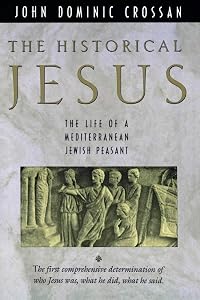
Though these two authors have worked together frequently, particularly in The Last Week, a book on Easter that preceded this one, their voices are quite different, and occasionally you hear one or the other speaking forcefully in their writing. Crossan, formerly a Catholic priest, is argumentative, controversial, and adamant in his scholarly disputation. The book for which he is probably best known is The Historical Jesus: The Life of a Mediterranean Jewish Peasant (1991). He co-founded the Jesus Seminar in which Borg was an active participant. On the other hand, Borg, who grew up in a conservative Lutheran environment, is patient, understated, conciliatory, and more subtle in voicing his scholarly conclusions. He is probably best known for Meeting Jesus Again for the First Time (1994).
In the first section of The First Christmas, Borg’s quiet, less aggressive tone predominates: it doesn’t really matter whether the story is fact or fiction, it is the meaning that’s important. However, in the very first paragraph of the second section, introducing a chapter on the two different genealogies, Crossan’s attitude strikes out: “. . . theological metaphor and symbolic parable rather than actual history and factual information create and dominate the Christmas stories of the conception and infancy of Jesus.” I would wager that the phrasing of the last sentence in that chapter originated with Crossan: “But what is always clear is that ancient genealogy was not about history and poetry, but about prophecy and destiny, not about accuracy but about advertising.” Not about accuracy, but advertising!
What a jarring note! Such genealogies indeed – as used, for instance, by the historian Josephus – may be known more for their advocacy of a position than their accuracy in details. But mere advertising? Are the phrases, “the son of David” and “the son of God” mere slogans to sell the political vision of a Mediterranean Jewish peasant?
Now I must tell you that I find Borg’s voice – or at least what I read as Borg’s voice in the text – not only more palatable, but more persuasive, not only more engaging but more enlightening. An example: the presentation of Luke’s birth story as an overture to Luke’s gospels specifically highlights three themes: (1) his story is told from Mary’s point of view and focuses on her role and response; his gospel more than the others emphasizes the women among Jesus’s followers during his ministry; (2) in his story the angels appear to the shepherds in the field, the lowest of the lowly in those times, his gospel emphasizes the marginalized in society – the poor and outcast – and the obligations of the rich to share with them; (3) perhaps most important, his story makes frequent mention of the Holy Spirit (e.g., the influence on John, “he will be filled with the Holy Spirit”; Mary, “the Holy Spirit will come upon you”; Elizabeth, “filled with the Holy Spirit”; Zechariah, “filled with the Holy Spirit”; Simeon, “the Holy Spirit rested on him.” His gospel likewise, as well as his book of Acts, highlights the promise and the advent of the Holy Spirit. Borg still believes in and zealously reminds us of the spiritual dimensions of the gospels, indeed the active and timeless intercession of Spirit in our own lives.
On the other hand, it is argued (and I use that word advisedly) that Matthew’s story establishes the theme of Jesus as a second Moses. For example, pages of elaborate and complicated evidence are used to show the relationship between Joseph’s rejection of Mary, then his subsequent acceptance of her and Midrashic commentary on the relationship between Moses’ parents, Amram and Jochebed. Matthew is assumed to have inserted Joseph’s accusation of adultery into the story because he “needed to create the suspicion of adultery in order to provide a reason for Joseph to seek a divorce, thus setting in motion that midrashic pattern of divorce, revelation, and remarriage” (p110). As scholarly and weighty as this pile of evidence is, after all it seems to be a bit of a stretch. The same is particularly true of the speculation that all the multiples of five in Matthew’s story have been put there deliberately to allude to the Pentateuch (five books) of Moses.
One has to envison the gospel writers as modernists (a Faulkner or James Joyce or T.S. Eliot) deliberately constructing novelistic substitutes for reality. Or, even more sinister, one is led to envision them as Madison Avenue agents scheming to manipulate masses of people to buy their new religion or, if you will, to “vote for” their new candidate for “savior of humankind – not a Caesar, a son of Aeneas, but a Jesus (savior), a son of David. And behind this figure of the artisan or the PR man, one hears the voice of a Crossan insisting that this is all metaphor, no rational person could ever believe this fundamentalist claptrap.
One never hears such voices in the work of Marus Borg. Read works written by Borg alone; for example, Meeting Jesus Again for the First Time, The God We Never Knew, Reading the Bible Again for the First Time, and The Heart of Christianity. The subtitle of one of those books is Taking the Bible Seriously but Not Literally. That is the heart of his message and method in all his own works – taking the Bible seriously in the modern age. I look forward to the 2010 book, the subtitle of which is A Tale of Modern Faith.
So, of course, what you hear me advising is that you read The First Christmas, listening deliberately for Borg’s voice – a voice that takes the Bible seriously, that takes rational modernism seriously, and most important that takes the spiritual dimension seriously, that takes his “living faith” seriously. Speaking of the divine conception of Jesus, one can hear Borg’s voice: “For Greeks, Romans, Jews, and Christians in that ancient and pre-Enlightenment world, interaction of the human and divine – however imagined, described or micromanaged – could produce a child who would bring transcendental benefits to the human race” (p126). And then, even more explicitly, “We may, of course, deny that ancient explanation for extraordinary individuality, but we must also admit that we moderns have no better one to take its place.” And finally, as he always does, Borg’s voice reverts to what’s ultimately important: “And, therefore, the proper question is not about the biology of the mother but the destiny of the child. What is that destiny and, once you know it, are you willing to commit your life to it? To Caesar the Augustus, for example, or to Jesus the Christ?” (p127)
Let me be even more specific in my advice. Read the first three chapters of the book quickly to get the gist of the authors’ message. Then turn to the last chapter for their final, soaring vision. Then keeping all this in mind, read the other chapters deliberately, but not doggedly. The gist of the message, you will discover early on, centers around two themes. Jesus birth stories prepare readers for both of them.
1. Jesus is the son of God. He teaches that God is the father of us all, an indwelling as well as transcendent Spirit, and that the kingdom of God is upon us and within us. This, indeed, was dangerous teaching in an age in which Caesar Augustus had been proclaimed divine, a good to be adored.
2. Jesus is the son of David, a prince of peace. Caesar Augusts had also been credited with establishing a universal peace. But the peace of the Roman Empire was brought about and is maintained by violence, warfare, tyranny. The Way of Christ’s eschatological vision is through justice and compassion among humankind. For the relevance of this contrast, just remember, for example, that Sepphoris, a major city just four miles north of Nazareth, Jesus’s hometown, had been devastated by Roman invaders. Its inhabitants had fled, or else the men were slaughtered, the women raped, the children enslaved, and their buildings ransacked. THAT was the meaning of Empire; that was the way Roman subjugation maintained “peace.”
The final chapter, significantly entitled “Joy to the World,” concludes with the relevance of the birth stories to our own time. It is a chapter about visionary ideals, but also about the continuing conflict between dark and light, Empire and “the kingdom of God.” Details from the birth stories and information about the era of Jesus' birth and ministry lead the reader to consider these visions:
“On the personal level, Christmas is about light coming into the darkness of our individual lives . . . about inner peace. Indeed, it is about the birth of Christ within us. In the thirteenth century, the Christian mystic Meister Eckhart preached about Christmas as the birth of Christ within us through the union of God’s spirit with out flesh.” (p237)
“Advent and Christmas are about a new world. . . . about the end of this era of war and violence, injustice and oppression. It is about the earth’s transformation, not about its devastation. It is about a world of justice and peace.” (p240)
“We who have seen the star and heard the angels sing are called to participate in the new birth and new world proclaimed by these [nativity] stories. . . . Both personal and political transformation, both the eschatology of rebirth and the eschatology of a new world, require our participation. God will not change us as individuals without our participation, and God will not change the world without our participation.” (p242)
This is the theology of Christmas. This, according to Borg and Crossan, is the truth of the birth stories. show less
#4 the Nativity
Christmas is for children. Christmas is for memories of old times. Christmas is for music. In the United States, I suppose, Christmas is the holiday celebrated by the most people with the most zest (and the most $$$). But is it really CHRISTmas? For most of my life, an admonition I’ve heard repeated over and over again is “We must put CHRIST back in CHRISTmas.” In a recent survey, 70% of the respondents claimed they celebrate Christmas as a religious holiday; only 27% said that to them it is a secular holiday. Yet from all appearances it is, in fact, another in the long line of festivals that observe the winter solstice – satisfying the need to seek joy and light and hope at the darkest time show more of the year.
Holidays often outlive their original intentions. Labor Day doesn’t celebrate labor any more; Armistice Day has become Veterans’ Day, because we don’t seem to ever have armistices any more. Halloween? Trick or treaters all over the country celebrate in masks and costumes, but hardly a one even knows the meaning of the word. All Hallows Eve? Forget it. Its relationship to All Saints Day. Now, you’re way beyond the pale. And, let’s face it, Christmas just isn’t CHRISTmas. Even those who accept Advent as a part of the church calendar – many of us, at least – probably have very serious doubts that magi and shepherds showed up at a stable in Bethlehem in the dead of winter. Easter is a holy day, a genuinely holy day, with a date certain on the calendar. Christmas, as we know it, came about because some pope and his mistress decided Christians needed an excuse for outdoing their pagan neighbors at the onset of winter.
But the Christmas story? The virgin birth? Joseph and Mary? The magi and the shepherds? Maybe not in December. Maybe not in the year One A.D. But that was the first Christmas, wasn’t it?
Is the Christmas story myth or reality, fact or fiction, history or fable? Right away, the authors insist that’s the wrong question, a false either-or. It’s not the facts of the story, but its meaning that’s important, both to believers and to inquisitors. Borg and Crossan read the stories – for the accounts in Matthew and Luke are indeed different stories – as parables with truths central to the whole. In fact, they see the stories both as overtures to their respective gospels. They announce and illustrate each writer’s themes; they are gospels in miniature.
Though these two authors have worked together frequently, particularly in The Last Week, a book on Easter that preceded this one, their voices are quite different, and occasionally you hear one or the other speaking forcefully in their writing. Crossan, formerly a Catholic priest, is argumentative, controversial, and adamant in his scholarly disputation. The book for which he is probably best known is The Historical Jesus: The Life of a Mediterranean Jewish Peasant (1991). He co-founded the Jesus Seminar in which Borg was an active participant. On the other hand, Borg, who grew up in a conservative Lutheran environment, is patient, understated, conciliatory, and more subtle in voicing his scholarly conclusions. He is probably best known for Meeting Jesus Again for the First Time (1994).
In the first section of The First Christmas, Borg’s quiet, less aggressive tone predominates: it doesn’t really matter whether the story is fact or fiction, it is the meaning that’s important. However, in the very first paragraph of the second section, introducing a chapter on the two different genealogies, Crossan’s attitude strikes out: “. . . theological metaphor and symbolic parable rather than actual history and factual information create and dominate the Christmas stories of the conception and infancy of Jesus.” I would wager that the phrasing of the last sentence in that chapter originated with Crossan: “But what is always clear is that ancient genealogy was not about history and poetry, but about prophecy and destiny, not about accuracy but about advertising.” Not about accuracy, but advertising!
What a jarring note! Such genealogies indeed – as used, for instance, by the historian Josephus – may be known more for their advocacy of a position than their accuracy in details. But mere advertising? Are the phrases, “the son of David” and “the son of God” mere slogans to sell the political vision of a Mediterranean Jewish peasant?
Now I must tell you that I find Borg’s voice – or at least what I read as Borg’s voice in the text – not only more palatable, but more persuasive, not only more engaging but more enlightening. An example: the presentation of Luke’s birth story as an overture to Luke’s gospels specifically highlights three themes: (1) his story is told from Mary’s point of view and focuses on her role and response; his gospel more than the others emphasizes the women among Jesus’s followers during his ministry; (2) in his story the angels appear to the shepherds in the field, the lowest of the lowly in those times, his gospel emphasizes the marginalized in society – the poor and outcast – and the obligations of the rich to share with them; (3) perhaps most important, his story makes frequent mention of the Holy Spirit (e.g., the influence on John, “he will be filled with the Holy Spirit”; Mary, “the Holy Spirit will come upon you”; Elizabeth, “filled with the Holy Spirit”; Zechariah, “filled with the Holy Spirit”; Simeon, “the Holy Spirit rested on him.” His gospel likewise, as well as his book of Acts, highlights the promise and the advent of the Holy Spirit. Borg still believes in and zealously reminds us of the spiritual dimensions of the gospels, indeed the active and timeless intercession of Spirit in our own lives.
On the other hand, it is argued (and I use that word advisedly) that Matthew’s story establishes the theme of Jesus as a second Moses. For example, pages of elaborate and complicated evidence are used to show the relationship between Joseph’s rejection of Mary, then his subsequent acceptance of her and Midrashic commentary on the relationship between Moses’ parents, Amram and Jochebed. Matthew is assumed to have inserted Joseph’s accusation of adultery into the story because he “needed to create the suspicion of adultery in order to provide a reason for Joseph to seek a divorce, thus setting in motion that midrashic pattern of divorce, revelation, and remarriage” (p110). As scholarly and weighty as this pile of evidence is, after all it seems to be a bit of a stretch. The same is particularly true of the speculation that all the multiples of five in Matthew’s story have been put there deliberately to allude to the Pentateuch (five books) of Moses.
One has to envison the gospel writers as modernists (a Faulkner or James Joyce or T.S. Eliot) deliberately constructing novelistic substitutes for reality. Or, even more sinister, one is led to envision them as Madison Avenue agents scheming to manipulate masses of people to buy their new religion or, if you will, to “vote for” their new candidate for “savior of humankind – not a Caesar, a son of Aeneas, but a Jesus (savior), a son of David. And behind this figure of the artisan or the PR man, one hears the voice of a Crossan insisting that this is all metaphor, no rational person could ever believe this fundamentalist claptrap.
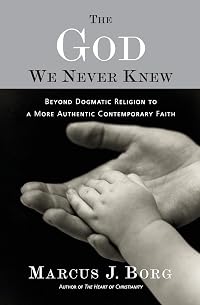
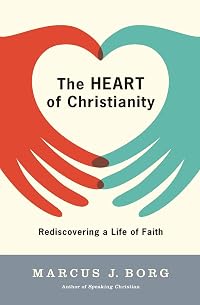
One never hears such voices in the work of Marus Borg. Read works written by Borg alone; for example, Meeting Jesus Again for the First Time, The God We Never Knew, Reading the Bible Again for the First Time, and The Heart of Christianity. The subtitle of one of those books is Taking the Bible Seriously but Not Literally. That is the heart of his message and method in all his own works – taking the Bible seriously in the modern age. I look forward to the 2010 book, the subtitle of which is A Tale of Modern Faith.
So, of course, what you hear me advising is that you read The First Christmas, listening deliberately for Borg’s voice – a voice that takes the Bible seriously, that takes rational modernism seriously, and most important that takes the spiritual dimension seriously, that takes his “living faith” seriously. Speaking of the divine conception of Jesus, one can hear Borg’s voice: “For Greeks, Romans, Jews, and Christians in that ancient and pre-Enlightenment world, interaction of the human and divine – however imagined, described or micromanaged – could produce a child who would bring transcendental benefits to the human race” (p126). And then, even more explicitly, “We may, of course, deny that ancient explanation for extraordinary individuality, but we must also admit that we moderns have no better one to take its place.” And finally, as he always does, Borg’s voice reverts to what’s ultimately important: “And, therefore, the proper question is not about the biology of the mother but the destiny of the child. What is that destiny and, once you know it, are you willing to commit your life to it? To Caesar the Augustus, for example, or to Jesus the Christ?” (p127)
Let me be even more specific in my advice. Read the first three chapters of the book quickly to get the gist of the authors’ message. Then turn to the last chapter for their final, soaring vision. Then keeping all this in mind, read the other chapters deliberately, but not doggedly. The gist of the message, you will discover early on, centers around two themes. Jesus birth stories prepare readers for both of them.
1. Jesus is the son of God. He teaches that God is the father of us all, an indwelling as well as transcendent Spirit, and that the kingdom of God is upon us and within us. This, indeed, was dangerous teaching in an age in which Caesar Augustus had been proclaimed divine, a good to be adored.
2. Jesus is the son of David, a prince of peace. Caesar Augusts had also been credited with establishing a universal peace. But the peace of the Roman Empire was brought about and is maintained by violence, warfare, tyranny. The Way of Christ’s eschatological vision is through justice and compassion among humankind. For the relevance of this contrast, just remember, for example, that Sepphoris, a major city just four miles north of Nazareth, Jesus’s hometown, had been devastated by Roman invaders. Its inhabitants had fled, or else the men were slaughtered, the women raped, the children enslaved, and their buildings ransacked. THAT was the meaning of Empire; that was the way Roman subjugation maintained “peace.”
The final chapter, significantly entitled “Joy to the World,” concludes with the relevance of the birth stories to our own time. It is a chapter about visionary ideals, but also about the continuing conflict between dark and light, Empire and “the kingdom of God.” Details from the birth stories and information about the era of Jesus' birth and ministry lead the reader to consider these visions:
“On the personal level, Christmas is about light coming into the darkness of our individual lives . . . about inner peace. Indeed, it is about the birth of Christ within us. In the thirteenth century, the Christian mystic Meister Eckhart preached about Christmas as the birth of Christ within us through the union of God’s spirit with out flesh.” (p237)
“Advent and Christmas are about a new world. . . . about the end of this era of war and violence, injustice and oppression. It is about the earth’s transformation, not about its devastation. It is about a world of justice and peace.” (p240)
“We who have seen the star and heard the angels sing are called to participate in the new birth and new world proclaimed by these [nativity] stories. . . . Both personal and political transformation, both the eschatology of rebirth and the eschatology of a new world, require our participation. God will not change us as individuals without our participation, and God will not change the world without our participation.” (p242)
This is the theology of Christmas. This, according to Borg and Crossan, is the truth of the birth stories. show less
Members
- Recently Added By
Lists

Nonfiction
41 works; 1 member
Author Information

65+ Works 14,216 Members
Marcus J. Borg was born on March 11, 1942 in Minnesota. He majored in philosophy and political science at Concordia College. He did graduate work at Union Theological Seminary in New York City and at Oxford University. He taught at various Midwest universities before joining the faculty at Oregon State University in 1979. He taught religion there show more until his retirement in 2007. During his lifetime, he wrote or co-wrote 21 books including Jesus: A New Vision, The Meaning of Jesus: Two Visions with N. T. Wright, and Convictions: How I Learned What Matters Most. He died after a prolonged illness on January 21, 2015 at the age of 72. (Bowker Author Biography) show less

73+ Works 11,341 Members
Considered by many to be the most learned scholar on the topic of Jesus Christ, John Dominic Crossan's adversaries question how he reconciles his Catholic faith with 20th century secular study. A former priest, Crossan is the author of The Essential Jesus: Original Sayings and Earliest Images, The Historical Jesus: The Life of a Mediterranean show more Jewish Peasant, Jesus: A Revolutionary Biography; The Birth of Christianity: Discovering What Happened in the Years Immediately After the Execution of Jesus, and The Cross That Spoke: The Origins of the Passion Narrative, among others. (Bowker Author Biography) show less
Common Knowledge
- People/Characters
- Jesus Christ
- Important events
- Birth of Jesus
Classifications
- Genres
- Religion & Spirituality, Nonfiction, History, General Nonfiction
- DDC/MDS
- 232.92 — Religion Christianity Jesus Christ and his family Family and life of Jesus Birth, infancy, childhood of Jesus, Christmas story
- LCC
- BT315.3 .B673 — Philosophy, Psychology and Religion Doctrinal Theology Doctrinal Theology Christology Life of Christ
- BISAC
Statistics
- Members
- 590
- Popularity
- 49,942
- Reviews
- 15
- Rating
- (3.80)
- Languages
- English, Portuguese, Spanish
- Media
- Paper, Audiobook, Ebook
- ISBNs
- 8
- ASINs
- 8