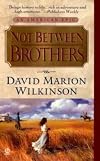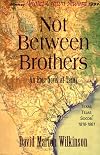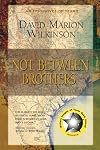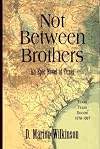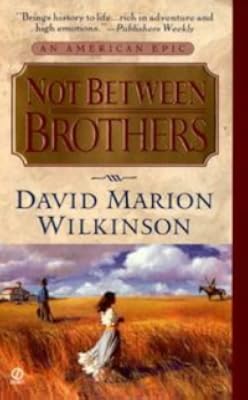
Not Between Brothers
by David Marion Wilkinson
On This Page
Description
An epic that spans a crucial period of American westward expansion, Not Between Brothers is the bloody and gripping tale of the birth of the Lone Star State. Comprising a large cast of characters that includes memorable historical figures such as Stephen Austin and Sam Houston, the novel unfolds through the eyes and experience of Remy Fuqua, an orphan whose understanding of his fellow man is almost as great as his predilection for battle and his fierce national pride. When he marries a show more well-born Tejana, Beatriz Amarante de la Cruz, Fuqua is tempted to abandon the world he comes from until a tragic loss catapults him straight to the front lines in the battle for Texan independence-the landmark battle of San Jacinto. Not Between Brothers is also the story of the fearless Comanche warrior Kills White Bear, whose distrust of the white man turns to enmity when a virulent smallpox plague brought by white traders wipes out his family and decimates his people. His vendetta eventually and inexorably makes Remy his greatest enemy. As the two men stalk each other across the Texas prairie, their struggle pits nation against nation, husband against wife and, unforgettably, brother against brother. show lessTags
Recommendations
















Member Reviews
In Not Between Brother author David Marion Wilkinson relates the epic story of Texas spanning the years from 1816 to 1861. Wilkinson uses the life story of his primary protagonist, Remy Fuqua, to tell the Anglo, Tejano, and to some extent the Mexican parts of the tale. On the other side, Wilkinson puts the reader into a virtual alternate universe by following the life a Comanche warrior named Kills White Bear. The lives of Remy and Kills White Bear become inextricably bound together through a series of unfortunate incidents that are mostly fueled by their mutual desire for vengeance. Indeed, the book closes with one final tragic encounter between them.
On the larger stage of history, Wilkinson's book tells the story of Texas (or Tejas) show more from its days as part of the Spanish colonial empire, through its Mexican statehood, its days as an independent republic, and its annexation to the United States. The book closes as secession fever strikes and the state legislature withdraws Texas from the Union over the objections of its governor, Sam Houston.
Fuqua wants to ranch and by hard work and fortuitous marriage achieves an extraordinary level of success. All the more bitter, then is his struggle against the Mexican government, The Texas Republic, and Confederate Texas to keep what he has built. The eternal struggle, however, is between the Comanche, especially the Penatekas led by Kills White Bear, and the Anglos and Tejanos. The Comanche fiercely defended their hunting grounds and with some degree of success on the sparsely settled Texas plains. Both sides fought viciously - it injury to the truth to romanticize it. In addition to their sheer numbers and technological advantages, the whites brought diseases that no amount of courage or tenacity could resist. On the whole, the Comanche chose to resist, seemingly beyond all reason, rather than submit.
Wilkinson sprinkles his tale with historical characters such as Sam Houston, Buffalo Hump, Santa Anna, Juan Seguin, Indian agent Robert Neighbors, and Captain Jack Hay of the Texas Rangers. Wilkinson also puts the reader in the midst of historic events such as the Alamo (necessarily told second-hand to Remy), the Battle of San Jacinto where Houston won his fame and Texas its independence, and the Council House Fight, where the army's ham-handed handling of treaty negotiations led to a massacre of Penateka chiefs and warriors, which in turn led to the slaughter of captive whites and touched off a major round of Comanche raids.
The one negative review of this book asserted that the author is no McMurtry or' Mitchner' (sic - presumably the reviewer meant James Michener) - a range of literary skills nearly as large as the Texas plains, in the eyes of this reader. Wilkinson does not reach the heights that McMurtry can, but exceeds Michener in developing real characters in an historical setting (as opposed to the rather simplistic characterizations in Michener's `Texas'.
Highly recommended for fans of historical fiction and the American West. The insights into the Comanche and Tejano side of the story set Wilkinson's book apart. show less
On the larger stage of history, Wilkinson's book tells the story of Texas (or Tejas) show more from its days as part of the Spanish colonial empire, through its Mexican statehood, its days as an independent republic, and its annexation to the United States. The book closes as secession fever strikes and the state legislature withdraws Texas from the Union over the objections of its governor, Sam Houston.
Fuqua wants to ranch and by hard work and fortuitous marriage achieves an extraordinary level of success. All the more bitter, then is his struggle against the Mexican government, The Texas Republic, and Confederate Texas to keep what he has built. The eternal struggle, however, is between the Comanche, especially the Penatekas led by Kills White Bear, and the Anglos and Tejanos. The Comanche fiercely defended their hunting grounds and with some degree of success on the sparsely settled Texas plains. Both sides fought viciously - it injury to the truth to romanticize it. In addition to their sheer numbers and technological advantages, the whites brought diseases that no amount of courage or tenacity could resist. On the whole, the Comanche chose to resist, seemingly beyond all reason, rather than submit.
Wilkinson sprinkles his tale with historical characters such as Sam Houston, Buffalo Hump, Santa Anna, Juan Seguin, Indian agent Robert Neighbors, and Captain Jack Hay of the Texas Rangers. Wilkinson also puts the reader in the midst of historic events such as the Alamo (necessarily told second-hand to Remy), the Battle of San Jacinto where Houston won his fame and Texas its independence, and the Council House Fight, where the army's ham-handed handling of treaty negotiations led to a massacre of Penateka chiefs and warriors, which in turn led to the slaughter of captive whites and touched off a major round of Comanche raids.
The one negative review of this book asserted that the author is no McMurtry or' Mitchner' (sic - presumably the reviewer meant James Michener) - a range of literary skills nearly as large as the Texas plains, in the eyes of this reader. Wilkinson does not reach the heights that McMurtry can, but exceeds Michener in developing real characters in an historical setting (as opposed to the rather simplistic characterizations in Michener's `Texas'.
Highly recommended for fans of historical fiction and the American West. The insights into the Comanche and Tejano side of the story set Wilkinson's book apart. show less
Ratings
Members
- Recently Added By
Author Information

4 Works 96 Members
Some Editions
Classifications
Statistics
- Members
- 70
- Popularity
- 449,631
- Reviews
- 1
- Rating
- (4.29)
- Languages
- English
- Media
- Paper, Audiobook
- ISBNs
- 6