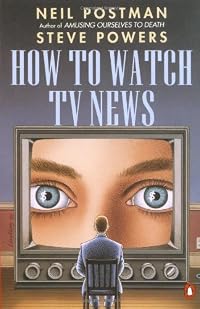
How to Watch TV News
by Neil Postman
On This Page
Description
America is suffering from an information glut. Most Americans are no longer clear about what news is worth remembering or how any of it connects to anything else. Thus, Americans are rapidly becoming the least knowledgeable people in the industrial world. In How to Watch TV News, author and academic Neil Postman and television journalist Steve Powers show how you can become a discerning viewer. They show the difference between entertainment fodder and genuine news, pointing to the symbiotic show more relationship between TV news and advertising. They explain why TV news has become a "cash cow," and stress that anyone who relies exclusively on TV for his or her knowledge of the world is making a serious mistake. show lessTags
Recommendations
















Member Reviews
Like other Postman efforts, it is rather entertaining, in places whimsically humorous. It makes its points well, and helped me identify things that I had realized but hadn't properly formulated.
The first point, stated in the introduction, is that one cannot watch TV news intelligently without already being a reader. The question, then, is why one would want to watch TV news in the first place. But, to continue:
1. Are You Watching Television or is Television Watching You?
If you're not paying you are the product. This is as true about internet services as it was about TV. Sitcoms are expensive, news, although "serious", is relatively cheap. It's the commercials that cost money. Targeted advertising, based on viewing habits, now clicking show more habits, is predicted. There is no real purpose to commercial news shows, other than to get the viewer to pay attention to advertising.
2. What is News?
This problem rears its ugly head in computer science in the "specification" vs. the "implementation" problem. The specification _is_ the implementation; the news is what's on TV. There is no simple answer to the question. Camus had the idea of a meta-newspaper, which would cover the origins of the biases of the other newspapers. This makes me think again of the AI (artificial inanity) generators that Stephenson invented in "Anathem". Television has changed and is different from the internet. When this book was written, there were few networks and they had to cater to everybody. That situation is wholly changed today and channels can cater to any sort of group, so long as it is large enough to pay the bills. This is both good and bad, and Postman can't analyze this.
News is stuff that will become history. This is a good definition actually, but it is often hard to tell. News is the substance of literature. Humans like to read about tragedy and hubris and other human failings. This is a bad definition for me, because I'm less interested in the particulars. News is a measure of the current state of our society. If we get a lot of murder stories, then we can all conclude that we are living among a lot of murderers. That one is really misleading, and numbers might really help here. People watch television and disaster, burning buildings and body bags are good images. This is somehow true; which is why stations send up helicopters to get really poor quality pictures of the aftermath of car accidents, etc. How stupid!
3. Getting Them into the Electronic Tent
Getting them there and keeping them while they are fleeced. News anchors are chosen for looks, not journalistic acumen. This doesn't bother me in itself, as they are reading from prepared scripts. I think of them as being like the town cryer. But the creation of the news family: the heterosexual couple with the banter, the (in Postman's time generally male) sports announcer, all excitable and macho, the humourous weather reporter, that all does get under my skin a bit. There needs to be the high-impact bits to keep you from switching to another channel. He is dead on about how the weather person is questoned in a way that suggests that they somehow control the weather.
4. Donuts, Big Foot, Mules and the Bird
Who reporters are and what they do. It is easy nowadays to get pictures and information to the other side of the world almost instantaneously. So that is how our news is served up. This means, however, that the people who do the reporting are likely to be very uninformed about what they are reporting on as they aren't given the time to gain a better understanding.
5. Behind the Scenes: Nuts and Bolts
How television news spots are made. It may be cheaper than sitcoms but it still requires a lot of technical acumen. So the content gets less attention than the form. This is a problem in programming, where it is so hard to get the code working that the very programmers often lose track of what it is for. The actual technical details are mostly outdated, but the message remains the same.
6. The News Director
These people are forced to take shortcuts. They used canned footage developed by interest groups. They get footage of staged events.
7. Reenactments and Docudramas, or No News is Still News
Reenactments are not clearly labeled as such and after viewing the memory of the viewer does not clearly distinguish. In the context of a real news show, they are pernicious. Postman does not say this, but I would argue that good movies about an historical event are valuable. Intelligent people know that they are not absolutely accurate, but the events presented can intrigue and bring alive what formerly seemed uninteresting, without fundamentally deceiving. The John Adams biopic w/ Paul Giammatti was good in this way. On the other hand, "Sons of Liberty", recently shown, on cable, was a bizarre boy's fantasy. The viewer needs to be intelligent and critical, but we should not always think so little of them as to believe that they will never be so.
8. The Bias of Language, the Bias of Pictures
News presentations are re-presentations. Description, evaluation, and inference must be separated. Why is Fidelity calling the recent changes to the tax laws "reform"; that's the job of their proponents. Pictures are particular; language can handle generalities. This is not really true, on the electronic bulletin boards pictures may be particular, but they are sometimes used to imply generalities, as when half a sentence about the FCC will be illustrated by a young, beautiful, and well-dressed woman using a cell-phone. Why? Constraints of TV news. In Postman's day the television was usually quite small, so images had to be unsubtle. Clint Eastwood could narrow his eyes and induce all sorts of drama on the big screen, but television was usually too small for that. So disasters happening to other people are still good entertainment, if they are big, like an earthquake. Events that are important but not associated with good visuals will necessarily get short shrift. This is why a prepared mind is necessary to make any sense of TV news.
9. The Commercial
Advertising vs. reality. Commercial as parable offering the quick-fix solution. They are a "corrupt modality of spiritual instruction". There is "Original Sin and it consists of having been ignorant of a product that offers happiness. We may achieve a state of grace by attending to the good news about it, which will appear every six or seven minutes. It follows from this that he or she is most devout who knows of the largest array of products; they are heretics who willfully ignore what is there to be used." And back to Huxley's "Brave New World". Nowadays it is the case that people share information about products that is quite rational and about the actual functioning of the project, all this facilitated by Amazon.
10. Television in the Courtroom
Postman is against, for various reasons. It changes the space and may impede the cause of justice. It renders all defendants guilty by making them forever recognizable. It does not diminish the ignorance of the populace because only the exciting bits are shown. It seems really true that fictional shows are actually slightly more informative about the actual legal processes.
11. What Does It All Mean?
Television is open-access, so children can watch it and understand it. This makes it harder to make them believe in goodness or rationality, since television favors stories about crazy people doing awful things. There is probably some truth to this. Children, just like adults, have the problem of too much information and no tools for coping with it. This is almost certainly true. War is entertainment.
12. What Can You Do?
1. Come with a firm idea of what is important, the prepared mind.
2. Remember that it is called a "show" for a reason.
3. Never underestimate the power of commercials.
4. Learn something about the economic and political interests of those who run the stations.
5. Pay special attention to the language of newscasts.
6. Reduce by one third the amount of TV news watched. I can't, it's already 0.
7. Reduce by one third the number of opinions you feel obligated to have.
This one is great! Several years ago I concluded that one of the signs of true adulthood is that you no longer feel an obligation to have an opinion on every subject that anyone addresses you about even if that
subject is actually quite important. Knowing when you don't know enough to have an opinion is a real sign of maturity.
8. Get schools interested in teaching children how to watch a TV news show.
Postman is always on about schools and what they might be able to do, but I haven't read any of his books that specifically address this topic. show less
The first point, stated in the introduction, is that one cannot watch TV news intelligently without already being a reader. The question, then, is why one would want to watch TV news in the first place. But, to continue:
1. Are You Watching Television or is Television Watching You?
If you're not paying you are the product. This is as true about internet services as it was about TV. Sitcoms are expensive, news, although "serious", is relatively cheap. It's the commercials that cost money. Targeted advertising, based on viewing habits, now clicking show more habits, is predicted. There is no real purpose to commercial news shows, other than to get the viewer to pay attention to advertising.
2. What is News?
This problem rears its ugly head in computer science in the "specification" vs. the "implementation" problem. The specification _is_ the implementation; the news is what's on TV. There is no simple answer to the question. Camus had the idea of a meta-newspaper, which would cover the origins of the biases of the other newspapers. This makes me think again of the AI (artificial inanity) generators that Stephenson invented in "Anathem". Television has changed and is different from the internet. When this book was written, there were few networks and they had to cater to everybody. That situation is wholly changed today and channels can cater to any sort of group, so long as it is large enough to pay the bills. This is both good and bad, and Postman can't analyze this.
News is stuff that will become history. This is a good definition actually, but it is often hard to tell. News is the substance of literature. Humans like to read about tragedy and hubris and other human failings. This is a bad definition for me, because I'm less interested in the particulars. News is a measure of the current state of our society. If we get a lot of murder stories, then we can all conclude that we are living among a lot of murderers. That one is really misleading, and numbers might really help here. People watch television and disaster, burning buildings and body bags are good images. This is somehow true; which is why stations send up helicopters to get really poor quality pictures of the aftermath of car accidents, etc. How stupid!
3. Getting Them into the Electronic Tent
Getting them there and keeping them while they are fleeced. News anchors are chosen for looks, not journalistic acumen. This doesn't bother me in itself, as they are reading from prepared scripts. I think of them as being like the town cryer. But the creation of the news family: the heterosexual couple with the banter, the (in Postman's time generally male) sports announcer, all excitable and macho, the humourous weather reporter, that all does get under my skin a bit. There needs to be the high-impact bits to keep you from switching to another channel. He is dead on about how the weather person is questoned in a way that suggests that they somehow control the weather.
4. Donuts, Big Foot, Mules and the Bird
Who reporters are and what they do. It is easy nowadays to get pictures and information to the other side of the world almost instantaneously. So that is how our news is served up. This means, however, that the people who do the reporting are likely to be very uninformed about what they are reporting on as they aren't given the time to gain a better understanding.
5. Behind the Scenes: Nuts and Bolts
How television news spots are made. It may be cheaper than sitcoms but it still requires a lot of technical acumen. So the content gets less attention than the form. This is a problem in programming, where it is so hard to get the code working that the very programmers often lose track of what it is for. The actual technical details are mostly outdated, but the message remains the same.
6. The News Director
These people are forced to take shortcuts. They used canned footage developed by interest groups. They get footage of staged events.
7. Reenactments and Docudramas, or No News is Still News
Reenactments are not clearly labeled as such and after viewing the memory of the viewer does not clearly distinguish. In the context of a real news show, they are pernicious. Postman does not say this, but I would argue that good movies about an historical event are valuable. Intelligent people know that they are not absolutely accurate, but the events presented can intrigue and bring alive what formerly seemed uninteresting, without fundamentally deceiving. The John Adams biopic w/ Paul Giammatti was good in this way. On the other hand, "Sons of Liberty", recently shown, on cable, was a bizarre boy's fantasy. The viewer needs to be intelligent and critical, but we should not always think so little of them as to believe that they will never be so.
8. The Bias of Language, the Bias of Pictures
News presentations are re-presentations. Description, evaluation, and inference must be separated. Why is Fidelity calling the recent changes to the tax laws "reform"; that's the job of their proponents. Pictures are particular; language can handle generalities. This is not really true, on the electronic bulletin boards pictures may be particular, but they are sometimes used to imply generalities, as when half a sentence about the FCC will be illustrated by a young, beautiful, and well-dressed woman using a cell-phone. Why? Constraints of TV news. In Postman's day the television was usually quite small, so images had to be unsubtle. Clint Eastwood could narrow his eyes and induce all sorts of drama on the big screen, but television was usually too small for that. So disasters happening to other people are still good entertainment, if they are big, like an earthquake. Events that are important but not associated with good visuals will necessarily get short shrift. This is why a prepared mind is necessary to make any sense of TV news.
9. The Commercial
Advertising vs. reality. Commercial as parable offering the quick-fix solution. They are a "corrupt modality of spiritual instruction". There is "Original Sin and it consists of having been ignorant of a product that offers happiness. We may achieve a state of grace by attending to the good news about it, which will appear every six or seven minutes. It follows from this that he or she is most devout who knows of the largest array of products; they are heretics who willfully ignore what is there to be used." And back to Huxley's "Brave New World". Nowadays it is the case that people share information about products that is quite rational and about the actual functioning of the project, all this facilitated by Amazon.
10. Television in the Courtroom
Postman is against, for various reasons. It changes the space and may impede the cause of justice. It renders all defendants guilty by making them forever recognizable. It does not diminish the ignorance of the populace because only the exciting bits are shown. It seems really true that fictional shows are actually slightly more informative about the actual legal processes.
11. What Does It All Mean?
Television is open-access, so children can watch it and understand it. This makes it harder to make them believe in goodness or rationality, since television favors stories about crazy people doing awful things. There is probably some truth to this. Children, just like adults, have the problem of too much information and no tools for coping with it. This is almost certainly true. War is entertainment.
12. What Can You Do?
1. Come with a firm idea of what is important, the prepared mind.
2. Remember that it is called a "show" for a reason.
3. Never underestimate the power of commercials.
4. Learn something about the economic and political interests of those who run the stations.
5. Pay special attention to the language of newscasts.
6. Reduce by one third the amount of TV news watched. I can't, it's already 0.
7. Reduce by one third the number of opinions you feel obligated to have.
This one is great! Several years ago I concluded that one of the signs of true adulthood is that you no longer feel an obligation to have an opinion on every subject that anyone addresses you about even if that
subject is actually quite important. Knowing when you don't know enough to have an opinion is a real sign of maturity.
8. Get schools interested in teaching children how to watch a TV news show.
Postman is always on about schools and what they might be able to do, but I haven't read any of his books that specifically address this topic. show less
The first section of the book gets old after a bit--- yes, after a couple of chapters, we get it. The news is a glitzed up, doctored show. But the next bit, that sounds more like Postman, is more valuable. What do we do, now that we know about it? He offers genuine advice based on previous research: [b:The Disappearance of Childhood|79679|The Disappearance of Childhood|Neil Postman|https://i.gr-assets.com/images/S/compressed.photo.goodreads.com/books/1388418954l/79679._SY75_.jpg|986319], [b:Amusing Ourselves to Death: Public Discourse in the Age of Show Business|74034|Amusing Ourselves to Death Public Discourse in the Age of Show Business|Neil show more Postman|https://i.gr-assets.com/images/S/compressed.photo.goodreads.com/books/1568871230l/74034._SY75_.jpg|2337731], [b:The End of Education: Redefining the Value of School|96441|The End of Education Redefining the Value of School|Neil Postman|https://i.gr-assets.com/images/S/compressed.photo.goodreads.com/books/1320523921l/96441._SY75_.jpg|508006]. One of the things I like about Postman is that he doesn't isolate his research. It's all interconnected, just like life, and he's fine with that.
I liked Camus' idea of a prequel to each show, etc. I also think that all of those that cry "Fake news" should do some serious studying of the subject. "Fake"-ness isn't a partisan quality so much as it is related to monetary gain. show less
I liked Camus' idea of a prequel to each show, etc. I also think that all of those that cry "Fake news" should do some serious studying of the subject. "Fake"-ness isn't a partisan quality so much as it is related to monetary gain. show less
The chapter on the narrative arc of TV commercials makes this book worth reading: You are not only deficient in some way, but you lack the knowledge to fix yourself; we will educate you on a product you were unaware of; armed with this knowledge, you will improve your life.
The material on how a TV news program is actually produced is dated, but the explanation of why certain types of stories make the local news -- particularly the notion that pictures that change are most compelling, and fires and explosions create sudden, significant change -- is especially interesting, even for people who already have a working knowledge of journalism.
The material on how a TV news program is actually produced is dated, but the explanation of why certain types of stories make the local news -- particularly the notion that pictures that change are most compelling, and fires and explosions create sudden, significant change -- is especially interesting, even for people who already have a working knowledge of journalism.
Not quite what I was expecting, but not bad at all. This book dissects the work that goes into cobbling together a television news program - from the way that news is gathered to the way that the shows are produced. The actual discussion of the problems with television news programs are confined to the latter chapters, but I can understand the reasoning for this for by the time you get to them you understand what goes into the shows a bit better. Would make an excellent textbook, but requires supplemental material to truly be appreciated.
Has some of Postman's classic humour. A couple of laugh out loud. Very interesting analysis of how we are influenced by the media (specifically by television news) and what we can do about it. The sections on children and televised court cases are particularly interesting.
Ratings
Members
- Recently Added By
Lists

Shaykh Hamza's Book Recommendations
439 works; 3 members
Author Information

32+ Works 12,777 Members
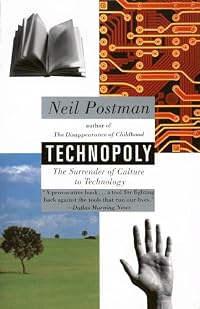
Born in Brooklyn, New York, and educated at the State University of New York and Columbia University, Neil Postman is a communications theorist, educator, and writer who has been deeply involved with the issue of the impact of the media and advanced communications technology on American culture. In his many books, Postman has strongly opposed the show more idea that technology will "save" humanity. In fact, he has focused on the negative ways in which television and computers alter social behavior. In his book Technopoly, Postman argues that the uncontrolled growth of technology destroys humanity by creating a culture with no moral structure. Thus, technology can be a dangerous enemy as well as a good friend. Postman, who is married and has three children, currently is a professor of media ecology at New York University and editor of Et Cetera, the journal of general semantics. In addition to his books, he has contributed to various magazines and periodicals, including Atlantic and The Nation. He has also appeared on the television program Sunrise Semester. Postman is the holder of the Christian Lindback Award for Excellence in Teaching from New YorkUniversity. (Bowker Author Biography) show less
Classifications
- Genres
- Nonfiction, Sociology, General Nonfiction
- DDC/MDS
- 070.195 — Computer science, information & general works News media, journalism & publishing Documentary media, educational media, news media; journalism; publishing Theory And Instruction Broadcast Media Television
- LCC
- PN4888 .T4 .P58 — Language and Literature Literature (General) Literature (General) Journalism. The periodical press, etc. By region or country
- BISAC
Statistics
- Members
- 368
- Popularity
- 84,694
- Reviews
- 5
- Rating
- (3.65)
- Languages
- English
- Media
- Paper, Audiobook, Ebook
- ISBNs
- 7
- ASINs
- 1