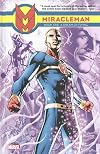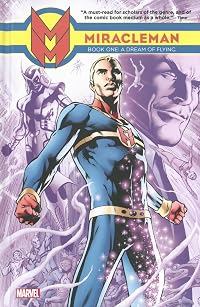
Miracleman Book One: A Dream of Flying
by Alan Moore (Author), Alan Davis (Illustrator), Garry Leach (Illustrator)
Miracleman (Collections and Selections — 1-4)
On This Page
Description
KIMOTA! With one magic word, a long-forgotten legend lives again! Freelance reporter Michael Moran always knew he was meant for something more-now, an unexpected series of events leads him to reclaim his destiny as Miracleman! The groundbreaking graphic novel that heralded a literary revolution begins here in A DREAM OF FLYING. After nearly two decades away, Miracleman uncovers his origins and their connection to the British military's "Project Zarathustra" - while his alter ego, Michael show more Moran, must reconcile his life as the lesser half of a god. COLLECTING: Miracleman 1-4. show lessTags
Recommendations







Member Recommendations

Sr_Moreno British 80s revisionist takes on superheroes, that later "inspired" a number of other comics.
Member Reviews
Many years ago now, I got interested in Alan Moore's 1980s comic Miracleman (a.k.a. Marvelman) as part of a project about superheroes, violence, and utopia; analysis of the series by Peter Paik in his excellent monograph From Utopia to Apocalypse made it sound very relevant. Unfortunately, rights issues meant the book was long out-of-print, and copies of the collected editions so rare, I couldn't get any via interlibrary loan except for the Neil Gaiman–penned follow-up. But, some years later, Marvel acquired and sorted out the rights, eventually reprinting Moore's run in a series of three deluxe hardcovers (with new coloring and lettering) that I picked up as they came out, and some years after that, that I am finally getting around show more to reading.
Clearly one of the things Alan Moore did to the superhero genre that he came along and asked, "What if superheroes were real?" Now, he was not the first to do this, nor the last; I would argue that a great many important works of superhero fiction, at least as early as Amazing Fantasy #15, were premised on this question. But with his work on Watchmen, Moore was the one who asked this question for the 1980s. In the first book of Miracleman, A Dream of Flying, Moore asks the same question in a different way. While Watchmen looks at what kind of people would do something like become a superhero, and what real people would do with that kind of power, and what the real effects of using violence to change the world would be (a theme Moore comes back to a lot; see also V for Vendetta), A Dream of Flying comes at it from the opposite direction.
Instead of taking heroic figures and making them sordid and realistic, A Dream of Flying asks how could a heroic figure exist in a real world. Back in the 1950s and '60s, Mick Anglo wrote the adventures of Marvelman and his friends; Moore imagines that those stories sort of really happened—in the head of Michael Moran and his friends. Moran was abducted for an experiment as a child by a depraved scientist, who used alien technology to give Moran superpowers and held him in a dreamlike state, pumping crudely written superhero stories into his brain to develop him into the weapon he wanted. Eventually things went horribly wrong, Moran lost him memories, and by the 1980s was a fortysomething adult with no idea he had a superpowered alter ego. Miracleman is, both in story and in reality, based on Captain Marvel, and Moore manages to come up with reasonable science fiction explanations for a lot of what happens in Captain Marvel stories; I liked the explanation for body-swapping a lot.
A Dream of Flying begins with Michael's slow rediscovery of his true self, and then his discovery of how he was created and what happened to his friends. It's Alan Moore at the top of his craft, and he has strong artistic collaborators in Garry Leach and Alan Davis. The best parts usually center on Moore's appliance of grounded realism to the character, both in terms of psychology and in terms of sci-fi explanations. This kind of story has been told a lot since, but Moore is very good at it. I particularly liked the stuff about Michael's wife.
In addition to the eleven chapters of A Dream of Flying (most about seven pages), this volume includes a prologue retelling a real Mick Anglo Marvelman tale in Moore's idiom, a flashforward story (set during Book Three, I think) about Miracleman and the Warpsmiths of Phaidon doing some time travel, and two side stories about the Warpsmiths. The first of these is fun, and the flashforward is fine if a bit pointless. The Warpsmith stuff I found largely inscrutable, but I guess I'm glad its in here for completeness's sake.
There's also about sixty pages of "behind-the-scenes" stuff to pad this book out to a marketable length. Most of it is pretty interesting: contemporary house ads, art try-outs, and the like. Original artwork and variant covers are less interesting, but I'm sure some people appreciate this stuff.
I would have, however, preferred a recoloring done in a more genuine 1980s style, rather than the contemporary approach Steve Oliff took.
Overall, this is an interesting start to the Miracleman saga, and highly recommended if you are interested in Alan Moore and/or the history of the superhero genre. show less
Clearly one of the things Alan Moore did to the superhero genre that he came along and asked, "What if superheroes were real?" Now, he was not the first to do this, nor the last; I would argue that a great many important works of superhero fiction, at least as early as Amazing Fantasy #15, were premised on this question. But with his work on Watchmen, Moore was the one who asked this question for the 1980s. In the first book of Miracleman, A Dream of Flying, Moore asks the same question in a different way. While Watchmen looks at what kind of people would do something like become a superhero, and what real people would do with that kind of power, and what the real effects of using violence to change the world would be (a theme Moore comes back to a lot; see also V for Vendetta), A Dream of Flying comes at it from the opposite direction.
Instead of taking heroic figures and making them sordid and realistic, A Dream of Flying asks how could a heroic figure exist in a real world. Back in the 1950s and '60s, Mick Anglo wrote the adventures of Marvelman and his friends; Moore imagines that those stories sort of really happened—in the head of Michael Moran and his friends. Moran was abducted for an experiment as a child by a depraved scientist, who used alien technology to give Moran superpowers and held him in a dreamlike state, pumping crudely written superhero stories into his brain to develop him into the weapon he wanted. Eventually things went horribly wrong, Moran lost him memories, and by the 1980s was a fortysomething adult with no idea he had a superpowered alter ego. Miracleman is, both in story and in reality, based on Captain Marvel, and Moore manages to come up with reasonable science fiction explanations for a lot of what happens in Captain Marvel stories; I liked the explanation for body-swapping a lot.
A Dream of Flying begins with Michael's slow rediscovery of his true self, and then his discovery of how he was created and what happened to his friends. It's Alan Moore at the top of his craft, and he has strong artistic collaborators in Garry Leach and Alan Davis. The best parts usually center on Moore's appliance of grounded realism to the character, both in terms of psychology and in terms of sci-fi explanations. This kind of story has been told a lot since, but Moore is very good at it. I particularly liked the stuff about Michael's wife.
In addition to the eleven chapters of A Dream of Flying (most about seven pages), this volume includes a prologue retelling a real Mick Anglo Marvelman tale in Moore's idiom, a flashforward story (set during Book Three, I think) about Miracleman and the Warpsmiths of Phaidon doing some time travel, and two side stories about the Warpsmiths. The first of these is fun, and the flashforward is fine if a bit pointless. The Warpsmith stuff I found largely inscrutable, but I guess I'm glad its in here for completeness's sake.
There's also about sixty pages of "behind-the-scenes" stuff to pad this book out to a marketable length. Most of it is pretty interesting: contemporary house ads, art try-outs, and the like. Original artwork and variant covers are less interesting, but I'm sure some people appreciate this stuff.
I would have, however, preferred a recoloring done in a more genuine 1980s style, rather than the contemporary approach Steve Oliff took.
Overall, this is an interesting start to the Miracleman saga, and highly recommended if you are interested in Alan Moore and/or the history of the superhero genre. show less
wow, this one was just so much more than i was expecting, having never read any of Miracleman aka Marvelman: Mick Anglo's original, Alan Moore's reboot, or Neil Gaiman's later continuation. i'm not really a fan of superheroes, except when Alan decides to play with them a little, cat and mouse style. anyway this here is the reboot; v2 is to follow, again - this set has been out of print a very long time due to a whole set of legal issues that would make a good comic opera, except for the tragic parts. and it's totally brilliant, combining all the incarnations of the original children's comic, made in the UK during the 50s, into one frame and then taking the concept and the characters completely apart and using them to deconstruct the show more whole idea of superheroes, and then systematically all the issues pertaining. and Alan (here described as The Original Writer, because he's got issues), writing in the early 80s here, before the US Swamp Thing run, moves seamlessly from prosaic description to astonishingly poetic passages. while every story tackles a whole different idea, with Alan in total control of his form and his subject matter. and this is what happens when you just let him go, in any season.
and then, out of the blue, the narrative accelerates out of this universe altogether, riffing off a minor alien character in Miracleman identified glancingly as a Warpsmith. so here we get a whole setup for the Warpsmiths in their own time, their purpose, along with a vignette, and a large number of fully realized characters, doing what they do across a vast sector of space unrelated to our own, with no reference to Miracleman (or his Warpsmith character) at all. and the artwork, by Garry Leach, is unfrigging real, some of the best i've ever seen in any era, still totally ahead of its time all this time later in composition, inks, coloration, characterization. these panels were all remastered by Leach in 1984 and they're beautifully printed here in Ultimate style. some of this was created by the artist via hand-painted color pages overlaid by color panelling and the result still looks incredible and totally original today. one of the very best collaborations between Alan and an artist ever, and they were both obviously inspired by each other's work to try stuff that could not be done. nobody wanted the series at the time. just, wow. show less
and then, out of the blue, the narrative accelerates out of this universe altogether, riffing off a minor alien character in Miracleman identified glancingly as a Warpsmith. so here we get a whole setup for the Warpsmiths in their own time, their purpose, along with a vignette, and a large number of fully realized characters, doing what they do across a vast sector of space unrelated to our own, with no reference to Miracleman (or his Warpsmith character) at all. and the artwork, by Garry Leach, is unfrigging real, some of the best i've ever seen in any era, still totally ahead of its time all this time later in composition, inks, coloration, characterization. these panels were all remastered by Leach in 1984 and they're beautifully printed here in Ultimate style. some of this was created by the artist via hand-painted color pages overlaid by color panelling and the result still looks incredible and totally original today. one of the very best collaborations between Alan and an artist ever, and they were both obviously inspired by each other's work to try stuff that could not be done. nobody wanted the series at the time. just, wow. show less
In November 1982, just as I was rediscovering comics, I picked up a copy of issue #7 of the British black & white anthology title Warrior and was blown away by an installment of a strip called Marvelman that reworked a cheesy 1950s superhero concept with a modern adult sensibility. Written by Alan Moore before he became “Alan Moore,” with atmospheric and hard hitting page design by Gary Leach this collection of the first story arc (retitled Miracleman due to US copyright issue) is both a nostalgia trip for me and an example of the Renaissance of the superhero genre that eventually gave us classics such as Watchmen and more.
The Miracleman comics were interesting. I liked the human drama of remembering who he was and all the consequences of that, but the weird Warp stories at the end were totally unappealing and didn't really make a lot of sense to me.
An ordinary man discovers that he is an immensely powerful comic-book hero who puts his normal life in the shade -- which starts to be a problem. This book delves into the psychology of the superhero vs. the ordinary man; in this case, in the same individual.
The Miracleman comics were interesting. I liked the human drama of remembering who he was and all the consequences of that, but the weird Warp stories at the end were totally unappealing and didn't really make a lot of sense to me.
The Miracleman comics were interesting. I liked the human drama of remembering who he was and all the consequences of that, but the weird Warp stories at the end were totally unappealing and didn't really make a lot of sense to me.
Members
- Recently Added By
Lists

Books Read By artturnerjr - 2014
34 works; 1 member
Author Information

Multiple award-winning author Alan Moore is universally considered the best writer of graphic novels in the medium's history. Among his many awards are the Hugo Award, the Bram Stoker Award, the Eisner Award, and the International Horror Guild Award

All Editions
Series

Belongs to Publisher Series
Work Relationships
Is contained in
Common Knowledge
- Canonical title
- Miracleman Book One: A Dream of Flying
- Original title
- Miracleman Book One: A Dream of Flying
- Alternate titles
- Marvelman Book One
- People/Characters
- Miracleman (Michael Moran); Kid Miracleman (Jonathan "Johnny" Bates); Young Miracleman (Dicky Dauntless); Dennis Archer; Big Ben [in Miracleman]; Guntag Borghelm (illusion) (show all 29); Steven Cambridge; Uxu Chil; Aza Chorn; Evelyn Cream; Gimsestra Dal; Jocsestra Dal; Tenga Dril; Paul Duncan; Emil Gargunza; Garrer (Kommandant); Koma Chatt Krank; Llans Ivo; Hrrin Luli; Phon Mooda; Elizabeth Moran; Sususu Toomisususu; Bob; Darren; Oliver; Seward; Stephanie; Wayne; Michael Moran (Miracleman)
- Important places
- Arctic Circle; Cornwall, England, UK; Cotswolds, England, UK; Dartmoor, Devon, England, UK; Larksmere, Cumbria, England, UK; London, England, UK (show all 9); Mariana Trench; The Moon; Hod
- First words
- In the sodium-lit hour before dawn, the great trucks roll north. Some carry breakfast cereal and some carry ball bearings. Some are empty...and some are not.
- Quotations
- Kimota.
Out of the dark, he is coming...a burning man of power and perfect beauty. - Last words
- (Click to show. Warning: May contain spoilers.)No trace remains behind them.
- Original language
- English
Classifications
- Genre
- Graphic Novels & Comics
- DDC/MDS
- 741.5973 — Arts & recreation Drawing & decorative arts Drawing Comic books, graphic novels, fotonovelas, cartoons, caricatures, comic strips History, geographic treatment, biography North American United States (General)
- LCC
- PN6728 .M57 .M495 — Language and Literature Literature (General) Literature (General) Collections of general literature Comic books, strips, etc.
- BISAC
Statistics
- Members
- 463
- Popularity
- 65,804
- Reviews
- 15
- Rating
- (4.17)
- Languages
- 6 — English, French, German, Italian, Portuguese (Brazil), Spanish
- Media
- Paper, Ebook
- ISBNs
- 14
- ASINs
- 4