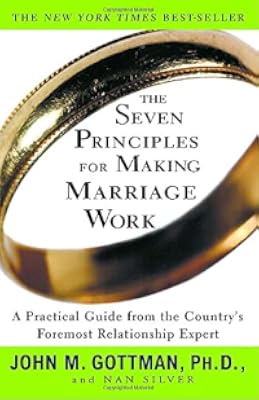
The Seven Principles for Making Marriage Work: A Practical Guide from the Country's Foremost Relationship Expert
by John M. Gottman (Author), Nan Silver (Author)
On This Page
Description
Family & Relationships. Nonfiction. Just as Masters and Johnson were pioneers in the study of human sexuality, so Dr. John Gottman has revolutionized the study of marriage. As a professor of psychology at the University of Washington and the founder and director of the Seattle Marital and Family Institute, he has studied the habits of married couples in unprecedented detail over the course of many years. His findings, and his heavily attended workshops, have already turned around thousands show more of faltering marriages. This book is the culmination of his life's work: the seven principles that guide couples on the path toward a harmonious and long-lasting relationship. Straightforward in their approach, yet profound in their effect, these principles teach partners new and startling strategies for making their marriage work. Gottman helps couples focus on each other, on paying attention to the small day-to-day moments that, strung together, make up the heart and soul of any relationship. Being thoughtful about ordinary matters provides spouses with a solid foundation for resolving conflict when it does occur and finding strategies for living with those issues that cannot be resolved. Including questionnaires, exercises, and quizzes in a supplemental PDF, The Seven Principles for Making Marriage Work is the definitive guide for anyone who wants their relationship to attain its highest potential. show lessTags
Recommendations












Member Recommendations

Member Reviews
It is, perhaps, fitting, that I gave this book 3 stars, placing it between my rating for Why Marriages Succeed or Fail (2 stars) and And Baby Makes Three (5). Gottman's books tend to get better the more recently they are published. The substance does not change dramatically, but the presentation is refined each time. Thus, if I were to recommend a Gottman book of the ones I have read, I recommend And Baby Makes Three. Despite the focus on becoming parents, most of the content is applicable to any romantic relationship, as I noted in my review. And based on the trend, I suspect that 2012's What Makes Love Last? is an even more refined version of the ideas. One question you may ask yourself is: Erika, why do you keep reading Gottman's show more works if they are all similar in content? Largely, it is because the solid relationship advice Gottman gives is valuable to review every few years.
The key ideas of the book are that relationships are built on a sense of trust and we-ness. Four behaviors are strong indicators that trust is degrading to a harmful point in a relationship: criticism, contempt, defensiveness, and stonewalling. Avoiding criticism and contempt does not mean always agreeing with your partner or keeping your negative feelings inside. Rather, it is about avoiding making your complaints about your spouse's personality rather than about your reaction to their behaviors. It's the difference between, "You're always late" (criticism), "You can't be trusted to do anything, even arrive on time" (contempt), and "When you were late for our dinner out, I was really upset because I had been looking forward to it all week" (complaint). Honest complaints are a necessary part of a relationship. Criticism and contempt damage it.
After laying out how these behaviors tend to destroy a relationship, Gottman and Silver go into seven principles for improving relationships. Although these are presented separately, they reinforce each other. The more you practice some, the easier the others become.
First is enhancing love maps. Having a deep understanding of your partner's present and past, hopes and dreams, makes it easier for you to respond to them in an understanding way. It also helps you respond to them in a more positive manner. You are less likely to fall into a pattern of thinking your spouse is unreliable if you remember all the times they were reliable.
Next is to nurture your sense of fondness and admiration for each other. By taking time to remember and observe the things that attracted you to your partner, you strengthen your relationship and your ability to view them positively. One thing that stuck out in this discussion is that couples who are headed for separation often have trouble remember what it was that attracted them to each other in the first place or what it was they enjoyed about their early days together. Often, couples who have troubles seeing the good in each other now can start to reconnect over their past. If they can no longer do this, that is a very negative sign.
Third is turning toward each other. However the authors' presentation of ideas changes, this is one that is always called out as critical. For a relationship to be strong, the participants need to turn toward each other when one of them makes a bid for affection. This includes being responsive when a partner tries to make repair attempts during conflict. Turning toward each other also matters in the day-to-day nurturing of a relationship, such as being responsive to a partner's need to reconnect at the end of the day.
Partners need to accept each other's influence. Gottman and Silver note that both partners need to do this, but also notes that in US culture (that being the one for which he has data), it tends to be men who are not as open to accepting influence. Accepting influence does not mean giving into your partner, especially when you do not agree. Rather, it means treating them as a partner in decision making and taking their concerns seriously when they express them.
The next two principles are related to problem solving. The authors distinguish between solvable problems and persistent problems. Solvable problems are those that are situational and can be fixed. Persistent problems are those where there are underlying issues that are not specific to the situation at hand, although disagreements over them are often triggered by specific situations. Whether a problem is solvable or persistent depends on the feelings that the participants bring to a disagreement. A disagreement about buying a car can be a situational problem about current finances or a persistent problem about attitudes toward money. Also, situational problems can become persistent problems over time if they are not handled.
Solvable problems can generally solved more productively if you approach disagreement in a productive manner. This book's method includes having a soft startup to a discussion, making repair attempts during the discussion, taking time to sooth yourself and each other during a discussion, and finding compromises.
The authors also stresses becoming tolerant of each other's differences. This is relevant for solvable problems but even more so for persistent problems. Persistent problems will probably never be solved. One partner may like order, another want the freedom to not leave their home a bit messy. One partner may be religious and the other not. One may be a spendthrift and the other thrifty. Couples can successfully live with deep differences like this as long as they come to see these as something that they can live with and even appreciate. Maybe your partner is a spendthrift and you are thrifty, but you can learn to appreciate the generosity that comes with that -- and learn how to compromise and set budgets. Likely, you will never see fully eye-to-eye on persistent issues, but you can learn to be ok with that.
The last principle is that successful couples create shared meaning. They find the areas in their life where they can create a deep inner life that belongs to both of them. This can come in the form of shared values, shared traditions, or even shared life missions. In some ways, this sense of shared meaning is the most fundamental of the principles because with it, the rest become easier. It is also the hardest; without all of the others, creating shared meaning is difficult.
P.S. I have also read, and really enjoyed, The Science of Trust. It is distinctly more academic in tone and thus not quite comparable to Gottman's straight-up relationship advice books.
P.P.S. This was a book I'd gotten on Audible years ago when I had some credits to use up. Because of the focus on questionnaires to analyze a relationship and lists of ideas for how to improve things it was actually a terrible choice for an audio book.
P.P.P.S. The language of this book focuses on marriages and is rather heteronormative. I tend to be rather "eh, it was published in 1999" about that, but others may be more annoyed. show less
The key ideas of the book are that relationships are built on a sense of trust and we-ness. Four behaviors are strong indicators that trust is degrading to a harmful point in a relationship: criticism, contempt, defensiveness, and stonewalling. Avoiding criticism and contempt does not mean always agreeing with your partner or keeping your negative feelings inside. Rather, it is about avoiding making your complaints about your spouse's personality rather than about your reaction to their behaviors. It's the difference between, "You're always late" (criticism), "You can't be trusted to do anything, even arrive on time" (contempt), and "When you were late for our dinner out, I was really upset because I had been looking forward to it all week" (complaint). Honest complaints are a necessary part of a relationship. Criticism and contempt damage it.
After laying out how these behaviors tend to destroy a relationship, Gottman and Silver go into seven principles for improving relationships. Although these are presented separately, they reinforce each other. The more you practice some, the easier the others become.
First is enhancing love maps. Having a deep understanding of your partner's present and past, hopes and dreams, makes it easier for you to respond to them in an understanding way. It also helps you respond to them in a more positive manner. You are less likely to fall into a pattern of thinking your spouse is unreliable if you remember all the times they were reliable.
Next is to nurture your sense of fondness and admiration for each other. By taking time to remember and observe the things that attracted you to your partner, you strengthen your relationship and your ability to view them positively. One thing that stuck out in this discussion is that couples who are headed for separation often have trouble remember what it was that attracted them to each other in the first place or what it was they enjoyed about their early days together. Often, couples who have troubles seeing the good in each other now can start to reconnect over their past. If they can no longer do this, that is a very negative sign.
Third is turning toward each other. However the authors' presentation of ideas changes, this is one that is always called out as critical. For a relationship to be strong, the participants need to turn toward each other when one of them makes a bid for affection. This includes being responsive when a partner tries to make repair attempts during conflict. Turning toward each other also matters in the day-to-day nurturing of a relationship, such as being responsive to a partner's need to reconnect at the end of the day.
Partners need to accept each other's influence. Gottman and Silver note that both partners need to do this, but also notes that in US culture (that being the one for which he has data), it tends to be men who are not as open to accepting influence. Accepting influence does not mean giving into your partner, especially when you do not agree. Rather, it means treating them as a partner in decision making and taking their concerns seriously when they express them.
The next two principles are related to problem solving. The authors distinguish between solvable problems and persistent problems. Solvable problems are those that are situational and can be fixed. Persistent problems are those where there are underlying issues that are not specific to the situation at hand, although disagreements over them are often triggered by specific situations. Whether a problem is solvable or persistent depends on the feelings that the participants bring to a disagreement. A disagreement about buying a car can be a situational problem about current finances or a persistent problem about attitudes toward money. Also, situational problems can become persistent problems over time if they are not handled.
Solvable problems can generally solved more productively if you approach disagreement in a productive manner. This book's method includes having a soft startup to a discussion, making repair attempts during the discussion, taking time to sooth yourself and each other during a discussion, and finding compromises.
The authors also stresses becoming tolerant of each other's differences. This is relevant for solvable problems but even more so for persistent problems. Persistent problems will probably never be solved. One partner may like order, another want the freedom to not leave their home a bit messy. One partner may be religious and the other not. One may be a spendthrift and the other thrifty. Couples can successfully live with deep differences like this as long as they come to see these as something that they can live with and even appreciate. Maybe your partner is a spendthrift and you are thrifty, but you can learn to appreciate the generosity that comes with that -- and learn how to compromise and set budgets. Likely, you will never see fully eye-to-eye on persistent issues, but you can learn to be ok with that.
The last principle is that successful couples create shared meaning. They find the areas in their life where they can create a deep inner life that belongs to both of them. This can come in the form of shared values, shared traditions, or even shared life missions. In some ways, this sense of shared meaning is the most fundamental of the principles because with it, the rest become easier. It is also the hardest; without all of the others, creating shared meaning is difficult.
P.S. I have also read, and really enjoyed, The Science of Trust. It is distinctly more academic in tone and thus not quite comparable to Gottman's straight-up relationship advice books.
P.P.S. This was a book I'd gotten on Audible years ago when I had some credits to use up. Because of the focus on questionnaires to analyze a relationship and lists of ideas for how to improve things it was actually a terrible choice for an audio book.
P.P.P.S. The language of this book focuses on marriages and is rather heteronormative. I tend to be rather "eh, it was published in 1999" about that, but others may be more annoyed. show less
I guess I deserve what I get for buying a book that promises to save my marriage when saving my marriage is most assuredly not what I'm trying to do, but all the obvious stuff about getting along and not having contempt for one another that's in here seems to presume that everyone has a lot more good faith and is also just a lot more bumblingly terrible at conducting human relationships than I actually believe to be the case. Like, not that we have bad faith, per se, but it's just not as goddamn simple as "Ohhhhhh, no contempt! Eureka!" I think the detailed lists of questions to ask your "partner" or whatever and exercises to build bonds (providing you opportunities to "make a bid," in Gottman parlance, for your opposite number's show more affection) are fine and all, though the sad catch-22 of broken-down relationships is that the more you need to do stuff to shore up your bond, the less willingness to do so you probably have--but then also in addition to that, they are certainly not exercises made for people with small children, because who's got the time.
Ah, but why am I yelling at you, John Gottman. You're not even real. show less
Ah, but why am I yelling at you, John Gottman. You're not even real. show less
What make some relationships strong and successful while others ultimately crash down and break up? If no one claims having THE miracle recipe to making a relationship work, it doesn't mean that there isn't some basic general principles to help it doing so. The author here being 'a leading research scientist on marriage and family', I particularly liked his counterintuitive approach to tackle the question. Counterintuitive because, while most marriage therapists and counsellors tend to focus on what's wrong in bad relationships, he focuses instead on what's right in good ones.
All couples face broadly the same type of problems (personal differences, children, finances, sex...). So why some are able to deal with them in a way that show more strenghten their bonds while to others they are just ticking time bombs that sooner or later will blow them off? As it appear, the key is NOT in communication. Communication, of course, is important (e.g. so called 'repair attempts' to defuse clashes before they escalate) but it's not the root of the problem. It is, rather, a symptom as, good communication doesn't and cannot pop out of nowhere; but stems from a positive dynamic between partners to start with. Without this positive dynamic from the outset, when disagreements occur couples can try and emotionally intelligently communicate all they want, it will be doomed to fail. THIS is indeed the key:
'the key to reviving or divorce-proofing a relationship is not in how you handle disagreements but in how you are with each other when you're not fighting.'
Seven general principles to help strenghten such dynamic are then outlined, all illustrated by a lot of relevant examples and case studies. Now, of course, it might all sound common sense to the point of being phony! Yet think either about the reasons why you may have experienced break up/ divorce and/ or why, on the contrary, you might be in a striving relationship blossoming over time... And here you are! Love is not granted, it belongs to you as a team to keep it alive. This book will hit home for many. show less
All couples face broadly the same type of problems (personal differences, children, finances, sex...). So why some are able to deal with them in a way that show more strenghten their bonds while to others they are just ticking time bombs that sooner or later will blow them off? As it appear, the key is NOT in communication. Communication, of course, is important (e.g. so called 'repair attempts' to defuse clashes before they escalate) but it's not the root of the problem. It is, rather, a symptom as, good communication doesn't and cannot pop out of nowhere; but stems from a positive dynamic between partners to start with. Without this positive dynamic from the outset, when disagreements occur couples can try and emotionally intelligently communicate all they want, it will be doomed to fail. THIS is indeed the key:
'the key to reviving or divorce-proofing a relationship is not in how you handle disagreements but in how you are with each other when you're not fighting.'
Seven general principles to help strenghten such dynamic are then outlined, all illustrated by a lot of relevant examples and case studies. Now, of course, it might all sound common sense to the point of being phony! Yet think either about the reasons why you may have experienced break up/ divorce and/ or why, on the contrary, you might be in a striving relationship blossoming over time... And here you are! Love is not granted, it belongs to you as a team to keep it alive. This book will hit home for many. show less
Gottman research and this book have been famous for decades. So, I was somewhat familiar with it, but finally got around to reading our paperback copy in 2019. As I read, I kept busy with a highlighter throughout the book. Since then I have bought the kindle edition.
Topics covered:
1. Enhance Your Love Maps. Gottman defines a love map as the place in your brain where you store information pertaining to your partner. This is crucial in really knowing your partner, their dreams, hopes, interests, and maintaining their interest throughout the relationship.
2. Nurture Your Fondness and Admiration. This means laying down a positive view about your spouse, respecting and appreciating their differences.
3. Turn Toward Each Other Instead of show more Away. Acknowledging your partner's small moments in life and orienting yourself towards them will maintain that necessary connection that is vital for the relationship.
4. Let Your Partner Influence You. It is important to maintain your own identity in a relationship, but it is equally important to yield to your partner and give in. If both partners allow one another this influence, then they will learn to respect one another on a deeper level.
5. Solve Your Solvable Problems. It is important to compromise on issues that can be resolved, which Gottman believes can be accomplished by these five steps: soften your startup, learn to make and receive repair attempts, soothe yourself and each other, compromise, and be tolerant of each other’s faults.
6. Overcome Gridlock. Major issues that cannot be resolved because both partners’ views are so fundamentally different involves understanding of the other person and deep communication. The goal is to at least get to a position that allows the other person to empathize with the partner's view, even if a compromise cannot be reached.
7. Create Shared Meaning. Create a shared value system that continually connects the partners through rituals/traditions, shared roles and symbols.
Chapter 2 identifies things that their research found predict divorce. These are to be avoided.
1- Criticism
2- Defensive; opposite: accept responsibility even for a small part of the problem
3- Disrespect & Contempt (superiority) (the best predictor of divorce); opposite: appreciation
4- Stonewalling (emotional withdrawal)
To Improve Relationship
1- Friendship: Three things:
1a- Enhance Love Maps (partner's inner psychological world) You find it out by asking open ended questions.
2- Fondness and Appreciation
3- Turning Toward
If those three are working -> Positive Sentiment Override
Most conflicts (69%) are never resolved. Therefore, the ability to repair is essential.
Love Maps - how well do you know your spouse.
Fondness & Appreciation - it needs to come out the mouth.
Conflict Surprises
-- Most conflicts are never resolved (69%)
Marriages last when you have selected someone whose irritating qualities you can stand. It's not resolving the conflict; it's moving from gridlock to dialog.
If you look at the subtext of what they are arguing about ... you find they are actually arguing about very different things. They are talking about freedom, love, what a home is, what it means to be married. ... If you open these up you would find a dream that would fly out like a bird.
You need to look at the dream within the conflict. What is the history of those dreams, the narrative. Find a way to honor both dreams. You are building love maps at a deeper level.
For the 31% of conflicts that could be resolved we found that the masters were using Gentleness. -- A soft startup. Say it directly; Accept influence from her; move toward compromise. Calming down is a very important part of the equation. show less
Topics covered:
1. Enhance Your Love Maps. Gottman defines a love map as the place in your brain where you store information pertaining to your partner. This is crucial in really knowing your partner, their dreams, hopes, interests, and maintaining their interest throughout the relationship.
2. Nurture Your Fondness and Admiration. This means laying down a positive view about your spouse, respecting and appreciating their differences.
3. Turn Toward Each Other Instead of show more Away. Acknowledging your partner's small moments in life and orienting yourself towards them will maintain that necessary connection that is vital for the relationship.
4. Let Your Partner Influence You. It is important to maintain your own identity in a relationship, but it is equally important to yield to your partner and give in. If both partners allow one another this influence, then they will learn to respect one another on a deeper level.
5. Solve Your Solvable Problems. It is important to compromise on issues that can be resolved, which Gottman believes can be accomplished by these five steps: soften your startup, learn to make and receive repair attempts, soothe yourself and each other, compromise, and be tolerant of each other’s faults.
6. Overcome Gridlock. Major issues that cannot be resolved because both partners’ views are so fundamentally different involves understanding of the other person and deep communication. The goal is to at least get to a position that allows the other person to empathize with the partner's view, even if a compromise cannot be reached.
7. Create Shared Meaning. Create a shared value system that continually connects the partners through rituals/traditions, shared roles and symbols.
Chapter 2 identifies things that their research found predict divorce. These are to be avoided.
1- Criticism
2- Defensive; opposite: accept responsibility even for a small part of the problem
3- Disrespect & Contempt (superiority) (the best predictor of divorce); opposite: appreciation
4- Stonewalling (emotional withdrawal)
To Improve Relationship
1- Friendship: Three things:
1a- Enhance Love Maps (partner's inner psychological world) You find it out by asking open ended questions.
2- Fondness and Appreciation
3- Turning Toward
If those three are working -> Positive Sentiment Override
Most conflicts (69%) are never resolved. Therefore, the ability to repair is essential.
Love Maps - how well do you know your spouse.
Fondness & Appreciation - it needs to come out the mouth.
Conflict Surprises
-- Most conflicts are never resolved (69%)
Marriages last when you have selected someone whose irritating qualities you can stand. It's not resolving the conflict; it's moving from gridlock to dialog.
If you look at the subtext of what they are arguing about ... you find they are actually arguing about very different things. They are talking about freedom, love, what a home is, what it means to be married. ... If you open these up you would find a dream that would fly out like a bird.
You need to look at the dream within the conflict. What is the history of those dreams, the narrative. Find a way to honor both dreams. You are building love maps at a deeper level.
For the 31% of conflicts that could be resolved we found that the masters were using Gentleness. -- A soft startup. Say it directly; Accept influence from her; move toward compromise. Calming down is a very important part of the equation. show less
Having never been married, I couldn't tell you if these recommendations are valid for that particular state or not, however: I liked them. It made sense and I certainly see aspects of these traits in successful marriages that I've observed. I pulled back a bit and observed some of my own relationships based on these principles and I found them to be pretty accurate.
ANYWAY.
I liked it. It's rather like your teeth. You will have to meet the dentist at some point in your life- at least for a cleaning. So why not begin good habits like brushing your teeth before you meet the dentist? So it is with this book. Most people will have a chance for marriage. . . so why not start stacking the cards in your favor and study up on it?
ANYWAY.
I liked it. It's rather like your teeth. You will have to meet the dentist at some point in your life- at least for a cleaning. So why not begin good habits like brushing your teeth before you meet the dentist? So it is with this book. Most people will have a chance for marriage. . . so why not start stacking the cards in your favor and study up on it?
It’s probably just as well I can’t remember who recommended this book to me because I was underwhelmed. I generally enjoy reading practical psychology/self help books, but not this one. I found the author’s tone off putting. After the first few chapters I stopped reading the exercises as I can’t imagine my husband and I using them. Many of the negative examples involved couples with the maturity of middle schoolers. However, I did come away with a renewed sense that our marriage is on the right track and that’s why I gave it 3 stars.
Admittedly, I flipped through most of this, because we're still doing okay. It just seems like common sense to me (catch up with what's going on with each other, be affectionate, don't be critical, learn to compromise), but I think of the toxic relationships I know, and I can see how what I think of as "silly exercises" can really help. Especially the last few chapters of the book, which give examples of frequent points of contention between couples, and show the difference between problems that are solvable, and those that are permanent, and focus on the former, to save yourself a lot of grief.
I am making a mental note though to express more of an interest in my SO's life. So that's my homework.
I am making a mental note though to express more of an interest in my SO's life. So that's my homework.
Members
- Recently Added By
Lists

Books on My Journey
18 works; 1 member

Tom's Bookstore
346 works; 2 members

Men's healing resources
747 works; 1 member
Author Information

John M. Gottman, Ph.D., is a professor of psychology at the University of Washington

Some Editions
Work Relationships
Is a (non-series) prequel to
Common Knowledge
- Original publication date
- 1999; 2011-03-30
Classifications
- Genres
- Nonfiction, General Nonfiction
- DDC/MDS
- 306.81 — Society, government, & culture Social sciences, sociology & anthropology Social Behavior - Dating, Marriage, Divorce Marriage, partnerships, unions; family Marriage and marital status
- LCC
- HQ734 .G7136 — Social sciences The family. Marriage, Women and Sexuality The Family. Marriage. Women The family. Marriage. Home
- BISAC
Statistics
- Members
- 1,727
- Popularity
- 12,834
- Reviews
- 25
- Rating
- (4.03)
- Languages
- 7 — Dutch, English, French, German, Italian, Spanish, Swedish
- Media
- Paper, Audiobook, Ebook
- ISBNs
- 41
- ASINs
- 16