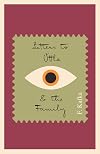
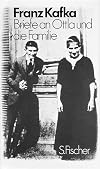
Letters to Ottla and the Family
by Franz Kafka 
On This Page
Description
A reference guide to the composers, publishers, and major performances of significant folk, jazz, rock, blues, and country songs.Tags
Recommendations


















Member Reviews
Ottla Kafka(1892-1943) was Franz Kafka's beloved sister, with whom he maintained a close relationship for much of his adult life. Franz corresponded with her between 1909 and 1924 (when he finally succumbed to tuberculosis). Although Ottla was murdered in the Holocaust by the Nazis, Franz's letters to her were preserved by her husband and children.
The letters include correspondence to Ottla, as well as a few letters to Franz's parents. They were first published in 1974, and an English language edition was published in 1982. In addition to Franz' letters, the book also contains photographs of Franz, Ottla, and others, as well as images from the picture postcards that he sent to her.
Readers under the influence of the Kafka Myth will show more likely be surprised at how very ordinary most of the letters are. They chiefly deal with ordinary things in each of their lives -- work, housing, relationships, the parents, and so on (with no signs of the anguish and torment the more naïve readers of Kafka's fiction might have expected). A few letters give hints into what is happening in Franz' personal life, including his strange and protracted correspondence relationship with Felice Bauer (to whom he was engaged twice and ultimately never married). Some letters are written to Ottla after she has left home to go to school for an advanced degree; and others to her shortly before and then after her marriage to Josef David. Still other letters were sent by Franz to Ottla and to their parents from one of the sanitaria which he visited for his tuberculosis treatments.
Some letters reveal glimpses into his odd personality. In July of 1914, in writing about the confrontation with Felice and her friends (a confrontation during which she broke off the engagement), he writes to Ottla: "Just a few words in haste before I attempt to go to sleep, at which I quite failed last night... I will of course write to you about Berlin. At the moment there is nothing definite to say about the question or about me. I write differently from what I speak, I speak differently from what I think, I think differently from the way I ought to think, and so it all proceeds into the deepest darkness. "
A full six years later, he writes to Ottla of the time Felice first visited Praguer: "I could easily have had time off, but preferred lazing around the office, only spent the afternoon with her, and really did not realize the mistake until much later in Berlin when she reproached me for it; but it had not been lack of love, perhaps fear of being together " Yes, Felice, his fiancé.
In 1914, he penned a long fragment of a letter never sent to his parents, a precursor to the infamous "Brief an den Vater" (Letter to Father). In this early version, he begins to lay out his plan to quit his job, leave Prague, and try to support himself through his writing -- something that he never did have the wherewithal to actually attempt.
Lacking Ottla's letters to Franz (which have disappeared) it is often hard to grasp to what Franz is writing in response. Most of the letters to Ottla are best understood in the context of details of his life, as outlined in the various biographies that have now been published. For this reason and others, this collection of correspondence will chiefly be of interest to Kafka scholars who may use them to seek insights into the life, personality, and psyche of the enigmatic author. show less
The letters include correspondence to Ottla, as well as a few letters to Franz's parents. They were first published in 1974, and an English language edition was published in 1982. In addition to Franz' letters, the book also contains photographs of Franz, Ottla, and others, as well as images from the picture postcards that he sent to her.
Readers under the influence of the Kafka Myth will show more likely be surprised at how very ordinary most of the letters are. They chiefly deal with ordinary things in each of their lives -- work, housing, relationships, the parents, and so on (with no signs of the anguish and torment the more naïve readers of Kafka's fiction might have expected). A few letters give hints into what is happening in Franz' personal life, including his strange and protracted correspondence relationship with Felice Bauer (to whom he was engaged twice and ultimately never married). Some letters are written to Ottla after she has left home to go to school for an advanced degree; and others to her shortly before and then after her marriage to Josef David. Still other letters were sent by Franz to Ottla and to their parents from one of the sanitaria which he visited for his tuberculosis treatments.
Some letters reveal glimpses into his odd personality. In July of 1914, in writing about the confrontation with Felice and her friends (a confrontation during which she broke off the engagement), he writes to Ottla: "Just a few words in haste before I attempt to go to sleep, at which I quite failed last night... I will of course write to you about Berlin. At the moment there is nothing definite to say about the question or about me. I write differently from what I speak, I speak differently from what I think, I think differently from the way I ought to think, and so it all proceeds into the deepest darkness. "
A full six years later, he writes to Ottla of the time Felice first visited Praguer: "I could easily have had time off, but preferred lazing around the office, only spent the afternoon with her, and really did not realize the mistake until much later in Berlin when she reproached me for it; but it had not been lack of love, perhaps fear of being together " Yes, Felice, his fiancé.
In 1914, he penned a long fragment of a letter never sent to his parents, a precursor to the infamous "Brief an den Vater" (Letter to Father). In this early version, he begins to lay out his plan to quit his job, leave Prague, and try to support himself through his writing -- something that he never did have the wherewithal to actually attempt.
Lacking Ottla's letters to Franz (which have disappeared) it is often hard to grasp to what Franz is writing in response. Most of the letters to Ottla are best understood in the context of details of his life, as outlined in the various biographies that have now been published. For this reason and others, this collection of correspondence will chiefly be of interest to Kafka scholars who may use them to seek insights into the life, personality, and psyche of the enigmatic author. show less
Ratings
Members
- Recently Added By
Author Information

1,502+ Works 103,663 Members
Franz Kafka -- July 3, 1883 - June 3, 1924 Franz Kafka was born to middle-class Jewish parents in Prague, Czechoslovakia on July 3, 1883. He received a law degree at the University of Prague. After performing an obligatory year of unpaid service as law clerk for the civil and criminal courts, he obtained a position in the workman's compensation show more division of the Austrian government. Always neurotic, insecure, and filled with a sense of inadequacy, his writing is a search for personal fulfillment and understanding. He wrote very slowly and deliberately, publishing very little in his lifetime. At his death he asked a close friend to burn his remaining manuscripts, but the friend refused the request. Instead the friend arranged for publication Kafka's longer stories, which have since brought him worldwide fame and have influenced many contemporary writers. His works include The Metamorphosis, The Castle, The Trial, and Amerika. Kafka was diagnosed with tuberculosis (TB) in August 1917. As his disease progressed, his throat became affected by the TB and he could not eat regularly because it was painful. He died from starvation in a sanatorium in Kierling, near Vienna, after admitting himself for treatment there on April 10, 1924. He died on June 3 at the age of 40. (Bowker Author Biography) show less
Franz Kafka has a Legacy Library. Legacy libraries are the personal libraries of famous readers, entered by LibraryThing members from the Legacy Libraries group.
All Editions
Some Editions
Awards and Honors
Distinctions
Series
Belongs to Publisher Series
Work Relationships
Common Knowledge
- Original title
- Briefe an Ottla und die Familie
- Original publication date
- 1974
Classifications
- Genres
- Fiction and Literature, Literature Studies and Criticism
- DDC/MDS
- 833.912 — Literature & rhetoric German & related literatures German fiction 1900- 1900-1990 1900-1945
- LCC
- PT2621 .A26 .Z53913 — Language and Literature German, Dutch and Scandinavian literatures German literature Individual authors or works 1860/70-1960
- BISAC
Statistics
- Members
- 69
- Popularity
- 453,546
- Reviews
- 1
- Rating
- (3.17)
- Languages
- 5 — Dutch, English, French, German, Italian
- Media
- Paper, Ebook
- ISBNs
- 7
- ASINs
- 2