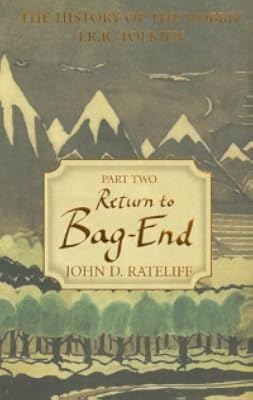
The History of The Hobbit Part Two: Return to Bag-End
by John D. Rateliff, J. R. R. Tolkien
The History of The Hobbit (2)
On This Page
Description
The History of the Hobbit presents for the first time, in two volumes, the complete unpublished text of the original manuscript of J.R.R.Tolkien's The Hobbit, accompanied by John Rateliff's lively and informative account of how the book came to be written and published. As well as recording the numerous changes made to the story both before and after publication, it examines - chapter-by-chapter - why those changes were made and how they reflect Tolkien's ever-growing concept of show more Middle-earth.As well as reproducing the original version of one of literature's most famous stories, both on its own merits and as the foundation for The Lord of the Rings, this new book includes many little-known illustrations and previously unpublished maps for The Hobbit by Tolkien himself. Also featured are extensive annotations and commentaries on the date of composition, how Tolkien's professional and early mythological writings influenced the story, the imaginary geography he created, and how Tolkien came to revise the book years after publication to accommodate events in The Lord of the Rings.This second volume picks up Bilbo Baggins' story half-way through his journey and chronicles how, after much adversity, he must still face the mighty dragon, Smaug, carry out the burglary for which he has been recruited, and return safely home to Bag-End. But not everything goes to plan... show lessTags
Recommendations









Member Reviews
http://nwhyte.livejournal.com/2197888.html
This isn't so much a second volume as a second half of Rateliff's book; the first numbered page is 469! So the two really need to be read as a single unit. Having recovered from this discovery, I still enjoyed the detail on Tolkien's construction of the original text of The Hobbit, the subsequent revisions to bring the Gollum episode and other elements better in line with The Lord of the Rings, and finally his abandonment of an attempt to rewrite the entire thing to get rid of some of the continuity errors (eg, what did the dwarves do with their musical instruments after they played them in Bag End?) at the behest of an unnamed female friend who persuaded him to let the text be.
Rateliff incudes show more more nuggets of analysis of the story's roots in literature and in Tolkien's other writing, in which the Father Christmas Letters, written around the same time, are a prominent source. The best bits were in the first volume, but I did find it interesting to note that Tolkien drew more illustrations of Smaug than of any other character in his legendarium, and Rateliff teases out Tolien's fascination with dragons from the first thing he could recall ever writing, as a small child, through Beowulf and the early versions of what was to become the Silmarillion, to Smaug. There's also an interesting reflection on whether the Arkenstone is a Silmaril: it is, and at the same time it isn't, and the fact that we ask the question at all says interesting things about concepts of canonicity.
The two volumes are really for completists only, but strongly recommended for them. show less
This isn't so much a second volume as a second half of Rateliff's book; the first numbered page is 469! So the two really need to be read as a single unit. Having recovered from this discovery, I still enjoyed the detail on Tolkien's construction of the original text of The Hobbit, the subsequent revisions to bring the Gollum episode and other elements better in line with The Lord of the Rings, and finally his abandonment of an attempt to rewrite the entire thing to get rid of some of the continuity errors (eg, what did the dwarves do with their musical instruments after they played them in Bag End?) at the behest of an unnamed female friend who persuaded him to let the text be.
Rateliff incudes show more more nuggets of analysis of the story's roots in literature and in Tolkien's other writing, in which the Father Christmas Letters, written around the same time, are a prominent source. The best bits were in the first volume, but I did find it interesting to note that Tolkien drew more illustrations of Smaug than of any other character in his legendarium, and Rateliff teases out Tolien's fascination with dragons from the first thing he could recall ever writing, as a small child, through Beowulf and the early versions of what was to become the Silmarillion, to Smaug. There's also an interesting reflection on whether the Arkenstone is a Silmaril: it is, and at the same time it isn't, and the fact that we ask the question at all says interesting things about concepts of canonicity.
The two volumes are really for completists only, but strongly recommended for them. show less
A pretty amazing look at the details, sources, and evolution of the Hobbit. You have to be very into the Hobbit to want to plow through all this detail. I happily am.
Ratings
Members
- Recently Added By
Author Information

21+ Works 1,808 Members
John D. Rateliff is a published scholar. He acquired his Ph.D. at Marquette University. Rateliff has authored titles on the works of J. R. R. Tolkien. His "The History of The Hobbit' won the 2009 Mythopoeic Scholarship Award in Inklings Studies. John is the author or co-author of many other books and role-playing games including The Lord of the show more Rings Roleplaying Game (2002), EverQuest Player's Handbook (2002), Egypt-Children of the World (1992), and Hero Builder's Guidebook - Dungeons & Dragons (2000). Rateliff has worked for TSR Inc., Wizards of the Coast, and Hasbro contributing to a large number of products in the Dungeons and Dragons line. In addition he has freelanced for Decipher Inc., Green Ronin, White Wolf, Guardians of Order, and Chaosium. (Bowker Author Biography) show less

600+ Works 516,572 Members
A writer of fantasies, Tolkien, a professor of language and literature at Oxford University, was always intrigued by early English and the imaginative use of language. In his greatest story, the trilogy The Lord of the Rings (1954--56), Tolkien invented a language with vocabulary, grammar, syntax, even poetry of its own. Though readers have show more created various possible allegorical interpretations, Tolkien has said: "It is not about anything but itself. (Certainly it has no allegorical intentions, general, particular or topical, moral, religious or political.)" In The Adventures of Tom Bombadil (1962), Tolkien tells the story of the "master of wood, water, and hill," a jolly teller of tales and singer of songs, one of the multitude of characters in his romance, saga, epic, or fairy tales about his country of the Hobbits. Tolkien was also a formidable medieval scholar, as evidenced by his work, Beowulf: The Monster and the Critics (1936) and his edition of Anciene Wisse: English Text of the Anciene Riwle. Among his works published posthumously, are The Legend of Sigurd and Gudrún and The Fall of Arthur, which was edited by his son, Christopher. In 2013, his title, TheHobbit (Movie Tie-In) made The New York Times Best Seller List. (Bowker Author Biography) show less
Awards and Honors
Awards
Series

Work Relationships
Common Knowledge
- Canonical title
- The History of The Hobbit Part Two: Return to Bag-End
- Original title
- The History of the Hobbit part two : return to Bag-End
- Original publication date
- 2007-07
- People/Characters
- J. R. R. Tolkien; Bilbo Baggins; Gandalf; Frodo Baggins; Balin; Beowulf (show all 31); Bladorthin; Bombur; Katharine Briggs; Charles Dodgson / Lewis Carroll; Dain II; Dori; Lord Dunsany; Dwalin; Elrond Half-elven; Fili; Kili; Gloin; Gollum; Wayne G. Hammond; C. S. Lewis; Lúthien Tinúviel; Melkor; William Morris; Sauron; Sigurd; Smaug; Thingol; Thorin Oakenshield; Thrain II; Thror
- Important places
- Bag End, Hobbiton, The Shire; Lonely Mountain; Dale, Middle-Earth
Classifications
Statistics
- Members
- 288
- Popularity
- 111,717
- Reviews
- 2
- Rating
- (4.21)
- Languages
- English
- Media
- Paper
- ISBNs
- 3