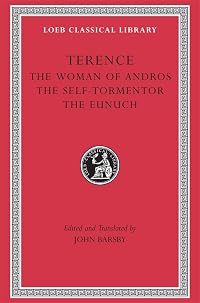
Terence, Volume I. The Woman of Andros. The Self-Tormentor. The Eunuch (Loeb Classical Library No. 22)
by Terence
On This Page
Description
Terence brought to the Roman stage a bright comic voice and a refined sense of style. His six comedies--first produced in the half dozen years before his premature death in 159 BCE--were imaginatively reformulated in Latin plays written by Greek playwrights, especially Menander. For this new Loeb Classical Library edition of Terence, John Barsby gives us a faithful and lively translation with full explanatory notes, facing a freshly edited Latin text. Volume I contains a substantial show more introduction and three plays: The Woman of Andros, a romantic comedy; The Self-Tormentor, which looks at contrasting father-son relationships; and The Eunuch, whose characters include the most sympathetically drawn courtesan in Roman comedy. The other three plays are in Volume II: Phormio, a comedy of intrigue with an engaging trickster; The Mother-in-Law, unique among Terence's plays in that the female characters are the admirable ones; and The Brothers, which explores contrasting approaches to parental education of sons. The Romans highly praised Terence--"whose speech can charm, whose every word delights," in Cicero's words. This new edition of his plays, which replaces the now outdated Loeb translation by John Sargeaunt (first published in 1912), succeeds in capturing his polished style and appeal. show lessTags
Recommendations



Member Reviews
Andria (English: The Girl from Andros) is a comedy adapted and translated through history by Niccolò Machiavelli (see Andria (Machiavelli)), Terence, and Menander. It was both Machiavelli's and Terence's first forays into playwriting. Machiavelli adapted through translation from Terence's play, and Terence adapted through translation from Menander's play. It was first performed at Rome, about 170 BC. It was also the first of Terence's plays to be performed post-antiquity, in Florence in 1476.
Heauton Timorumenos (The Self-Tormentor) has presented academics with some problems. Firstly it is not entirely clear whether Heauton Timorumenos is Terence's second or third play. More importantly, due to the scant survival of Menander's play of show more the same name, there is no simple way to judge how much Terence's version is translation and how much is invention. It is set in a village in the countryside of Attica.
Eunuchus (The Eunuch) is a comedy written by the Roman playwright Terence featuring a complex plot of familial misunderstanding. show less
Heauton Timorumenos (The Self-Tormentor) has presented academics with some problems. Firstly it is not entirely clear whether Heauton Timorumenos is Terence's second or third play. More importantly, due to the scant survival of Menander's play of show more the same name, there is no simple way to judge how much Terence's version is translation and how much is invention. It is set in a village in the countryside of Attica.
Eunuchus (The Eunuch) is a comedy written by the Roman playwright Terence featuring a complex plot of familial misunderstanding. show less
Edition: // Descr: xiii, 351 p. 17 cm. // Series: The Loeb Classical Library Call No. { 872 T27-L vol I. } Series Edited by T.E. Page With an English Translation by John Sargeaunt Contains Latin and English Versions and Bibliography Volume I. // //
Ratings
Members
- Recently Added By
Lists

Book Titles Mentioned In Newberry Medal And Honor Books
884 works; 3 members
Author Information

196+ Works 2,474 Members
Terence was born in Carthage. As a boy, he was the slave of Terentius Lucanus, a Roman senator, who educated him and set him free. He was an intimate friend of the younger Scipio and of the elegant poet Laelius. They were the gilded youth of Rome, and Terence's plays were undoubtedly written for this inner circle, not for the vulgar crowd. They show more were adapted from Menander and other Greek writers of the New Comedy and, in the main, were written seriously on a high literary plane with careful handling of plot and character. The six comedies are all extant. (Bowker Author Biography) show less
Some Editions
Series
Belongs to Publisher Series
Work Relationships
Is contained in
Classifications
Statistics
- Members
- 104
- Popularity
- 311,874
- Reviews
- 2
- Rating
- (3.67)
- Languages
- English, Latin
- Media
- Paper, Ebook
- ISBNs
- 3
- ASINs
- 3