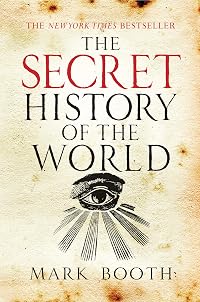
The Secret History of the World: As Laid Down by the Secret Societies
by Mark Booth
On This Page
Description
An intellectual tour of the world's lesser-known histories offers a collection of alternate views that are drawn from a premise that history has been recorded from the corrupted perspectives of its victors.Tags
Recommendations














Member Recommendations

Member Reviews
A terrible mish-mash of a book.
A guy who likes Rudolph Steiner's mish-mash Anthroposophical theories too much has basically read the whole bookcase of books in the New Age section at his local bookstore, thrown in some Joseph Campbell and a few nights at the Mason's lodge, and written a terrible mish-mash of a book.
I really don't know how to describe it. He is really almost a caricature of the "true believing" "Diabolicals" in Umberto Eco's Foucault's Pendulum.
Other reviewers note some of the inanities.
Lucifer is at one point Saturn and at one point Venus; at one point a good guy and at one point a bad guy. And the jewel in the middle of his head is the Holy Grail? Huh? Booth makes jumps in logic and free association that would make show more David Icke blush, and he makes names and personages fit into each other in a way that would make Immanuel Velikovsky blush. At one point he accepts David Rohl's redating of ancient Egypt, and then at another gives old orthodox dating for Akhenaten.
The thesis is odd too. Basically, man gets more enmeshed into solid matter, which was the job of the secret societies. Then, it is the job of the secret societies to get mankind un-enmeshed from solid matter. Huh?
And the dumb assertions: like the Greeks were the first to depict the human form correctly because that's when the human form assumed its current shape (ignoring all previous art); or Dante Alighieri was the first person EVER to fall in love at first sight because mankind didn't think inside their own brains until the 1200s. (Booth has taken Julian Jaynes's 1976 book The Origin of Consciousness in the Breakdown of the Bicameral Mind, which is an intriguing theory, way too too far.)
Anyway, it is a terrible mish-mash of a book. He has strolled through all of his new age, mythology, and fringe history books and tied bits and pieces together into an incoherent story supporting a thesis that makes no sense. The images are neat and some ideas are presented well, there are some cool tidbits here and there. Thus two stars. But, there are no citations, only a tiny-printed bibliographic essay of sorts at the end.
This "un-illustrated" edition is full of black-and-white line illustrations. (Just not as many color images as in the illustrated edition.)
Caveat emptor. show less
A guy who likes Rudolph Steiner's mish-mash Anthroposophical theories too much has basically read the whole bookcase of books in the New Age section at his local bookstore, thrown in some Joseph Campbell and a few nights at the Mason's lodge, and written a terrible mish-mash of a book.
I really don't know how to describe it. He is really almost a caricature of the "true believing" "Diabolicals" in Umberto Eco's Foucault's Pendulum.
Other reviewers note some of the inanities.
Lucifer is at one point Saturn and at one point Venus; at one point a good guy and at one point a bad guy. And the jewel in the middle of his head is the Holy Grail? Huh? Booth makes jumps in logic and free association that would make show more David Icke blush, and he makes names and personages fit into each other in a way that would make Immanuel Velikovsky blush. At one point he accepts David Rohl's redating of ancient Egypt, and then at another gives old orthodox dating for Akhenaten.
The thesis is odd too. Basically, man gets more enmeshed into solid matter, which was the job of the secret societies. Then, it is the job of the secret societies to get mankind un-enmeshed from solid matter. Huh?
And the dumb assertions: like the Greeks were the first to depict the human form correctly because that's when the human form assumed its current shape (ignoring all previous art); or Dante Alighieri was the first person EVER to fall in love at first sight because mankind didn't think inside their own brains until the 1200s. (Booth has taken Julian Jaynes's 1976 book The Origin of Consciousness in the Breakdown of the Bicameral Mind, which is an intriguing theory, way too too far.)
Anyway, it is a terrible mish-mash of a book. He has strolled through all of his new age, mythology, and fringe history books and tied bits and pieces together into an incoherent story supporting a thesis that makes no sense. The images are neat and some ideas are presented well, there are some cool tidbits here and there. Thus two stars. But, there are no citations, only a tiny-printed bibliographic essay of sorts at the end.
This "un-illustrated" edition is full of black-and-white line illustrations. (Just not as many color images as in the illustrated edition.)
Caveat emptor. show less
Well, what a romp. I can only add what I put into a Blog Posting on this one ... " [it] could be read as a cynical attempt to capture interest in the occult, as an occult attempt to re-introduce the 'Hidden Masters' to the wider public, as a 'sinister' ideological project to undermine the Enlightenment, as playfulness, as an attempt to rehabilitate imagination and subjectivity as equal to rational thought, as an experiment in creating a 'grand narrative' for the esoteric or as genuine attempt to create an esoteric morality based on 'art' (pp 380-1) - or all or part or something else."
But, on balance, strongly recommended as a work to stimulate the imagination - but do retain your critical faculties throughout. [The posting is at show more target="_top">http://asithappens.tppr.info/journal/2008/1/30/the-esoteric-and-liberal-conserva.... ] show less
But, on balance, strongly recommended as a work to stimulate the imagination - but do retain your critical faculties throughout. [The posting is at show more target="_top">http://asithappens.tppr.info/journal/2008/1/30/the-esoteric-and-liberal-conserva.... ] show less
Insane book must have been written during a series of drug-induced hallucinations, or perhaps the author is just insane from the start. Presenting disproven theories as fact and combining every religion into a single narrative of human consciousness is a bit of an achievement, I guess. Sort of a "Theory of Everything" for esoteric beliefs. But while you can't read this book as a source of actual fact, it does meander around and introduce a number of interesting tidbits, such as the "Two Jesus" story. In fact, as a source of what really strange deluded people have believed for the last two millennia, this book is somewhat entertaining. I don't find it to be as badly written as some reviewers, but its assertion after assertion of pure show more nonsense does get a bit old after a while. Only by misinterpreting one thing after another does the author get his "coherent" history. I certainly don't know all of the subject matter he draws upon, but anyone who knows anything about how the bible was written and how the perception of Jesus's divinity changed over the centuries immediately sees that Black's interpretation of things is ridiculous. Can he actually believe this, or is it just a (rather hard, I would say) way to make money? Two stars for ambition and shamelessness, at least. show less
This was a fascinating read. It had a kind of charming rambling quality, and definitely covered a great deal of what I imagine is solid academic knowledge as well as a good deal anecdotal picked up over many years of working in and around this field of esoterica and secret societies. The author is a publisher of these kinds of books in London. I am fascinated by the ideas presented about how consciousness has evolved over the millennia. In his novel 'Buddha', Deepok Chopra's even seems to evoke some of the same ideas about how the ancients perceived the world and interacted with all of the formats for god and goddess that have existed since then. So, that makes me think there is a lot of accepted knowledge in this book.
It is clearly a show more Western perspective, and one that speaks to me of the triumphalism, or exceptionalism that we inherited from the Western religious traditions, and that has been used to serve us so well in materialism and exploitation of the planet and its people (and everybody else who lives here too), as well as silence any voices male and especially female who challenge the hegemony of these guys.
I am a bit uncomfortable believing anything in a book like this that implies through the views of adherents to secret societies like the Knights of the Templar, or Freemasons that the Western traditions changed consciousness in a pre-destined, pre-ordained and definitively positive kind of way in our quest to conquer the whole world and all its people and win them over to our way of thinking (literally thinking as in 'practices of consciousness'). If anything, it seems to me the Knights stayed out East for so long precisely because the knowledge and practices of consciousness they picked up in Baghdad and Persepolis were so utterly exciting for them.
I would be happier to read a book by someone who attempts to integrate Hindu, Buddhist, Persian, or Chinese point of view perhaps to balance this Western, Oxford and Eton educated type who wrote this book. I would also welcome anything about the Druids, Aztecs, Incas, and many others too who were all obliterated by our forebears. The Hopi and Navajo have some great texts I've read. Also, the whole perspective of the Sacred Feminine increasingly obviously missing from this so called superior Western consciousness and its overly Yang destroyed world of Wall Street and Washington DC und so weiter. I would love to find books by other scholars from those cultures to balance this one out as a reader myself, if no one has yet written that book.
Given what has happened to the planet under the tutelage of the West, and to the condition of human beings in Western cultures, I cannot believe for a minute that we have a rap on consciousness.
But, it is a good try and has loads of good stuff about our own Western culture from Greece that was buried by the powers that be, way back at the sacking of the libraries at Alexandria. My favorite is Pythagoras. It also paints an interesting hypothesis of the types and sources of inspiration for individuals throughout history who really have 'been the change' they wanted to see. One can wonder a little bit about this given the extreme pressures for conformity in society, and the poverty of mind, scarcity consciousness and ultimately the repetitive destruction that brings time and time again.
Can't help but wonder where we'd be today if we had always had all that stuff present with us and available to inform our consciousness all along the way instead of burned up in smoke by a bunch of control freaks from Constantinople! I do look forward to the day when we can leave our mind control traditions behind that continue to cause so much trouble on the planet . This book does tell a kind of tale about the journey to re-integrate to more holistic practices and habits of mind that reach back to our real roots pre-Rome, pre-Abraham, or pre-Aten which were ultimately taken away from us by Constantine because he found something better to serve his materialistic empire reviving aims we still live with to this very day! Well, maybe not for long if everything made for and by these guys and their spiritual descendants keep falling apart and failing us! More and more of us are breaking out of these mind prisons, and we are also the change we want to see! show less
It is clearly a show more Western perspective, and one that speaks to me of the triumphalism, or exceptionalism that we inherited from the Western religious traditions, and that has been used to serve us so well in materialism and exploitation of the planet and its people (and everybody else who lives here too), as well as silence any voices male and especially female who challenge the hegemony of these guys.
I am a bit uncomfortable believing anything in a book like this that implies through the views of adherents to secret societies like the Knights of the Templar, or Freemasons that the Western traditions changed consciousness in a pre-destined, pre-ordained and definitively positive kind of way in our quest to conquer the whole world and all its people and win them over to our way of thinking (literally thinking as in 'practices of consciousness'). If anything, it seems to me the Knights stayed out East for so long precisely because the knowledge and practices of consciousness they picked up in Baghdad and Persepolis were so utterly exciting for them.
I would be happier to read a book by someone who attempts to integrate Hindu, Buddhist, Persian, or Chinese point of view perhaps to balance this Western, Oxford and Eton educated type who wrote this book. I would also welcome anything about the Druids, Aztecs, Incas, and many others too who were all obliterated by our forebears. The Hopi and Navajo have some great texts I've read. Also, the whole perspective of the Sacred Feminine increasingly obviously missing from this so called superior Western consciousness and its overly Yang destroyed world of Wall Street and Washington DC und so weiter. I would love to find books by other scholars from those cultures to balance this one out as a reader myself, if no one has yet written that book.
Given what has happened to the planet under the tutelage of the West, and to the condition of human beings in Western cultures, I cannot believe for a minute that we have a rap on consciousness.
But, it is a good try and has loads of good stuff about our own Western culture from Greece that was buried by the powers that be, way back at the sacking of the libraries at Alexandria. My favorite is Pythagoras. It also paints an interesting hypothesis of the types and sources of inspiration for individuals throughout history who really have 'been the change' they wanted to see. One can wonder a little bit about this given the extreme pressures for conformity in society, and the poverty of mind, scarcity consciousness and ultimately the repetitive destruction that brings time and time again.
Can't help but wonder where we'd be today if we had always had all that stuff present with us and available to inform our consciousness all along the way instead of burned up in smoke by a bunch of control freaks from Constantinople! I do look forward to the day when we can leave our mind control traditions behind that continue to cause so much trouble on the planet . This book does tell a kind of tale about the journey to re-integrate to more holistic practices and habits of mind that reach back to our real roots pre-Rome, pre-Abraham, or pre-Aten which were ultimately taken away from us by Constantine because he found something better to serve his materialistic empire reviving aims we still live with to this very day! Well, maybe not for long if everything made for and by these guys and their spiritual descendants keep falling apart and failing us! More and more of us are breaking out of these mind prisons, and we are also the change we want to see! show less
This is a wonderful book that combines many allegorical histories of mankind into one potent, modern myth about the evolution and nature of human consciousness.
I read it straight through 3 times - something I have never done with anything other than a text I was studying for school. Booth based his work on the highly symbolic histories of the theosophists and other occult, hermetic, and mystery groups and schools. These 'histories' are to be understood as allegorical explanations of the evolution of human consciousness. The author took these myths and skillfully wove them into one trenchant and potent myth that allows us to explore the evolution and nature of human consciousness within ourselves. Some friends have asked me if I show more 'believe' this version of history or if I think the author 'believes' it. My answer is a question, 'Do you 'believe' in Timaeus? Do you think that Plato 'believed' in Timaeus?' show less
I read it straight through 3 times - something I have never done with anything other than a text I was studying for school. Booth based his work on the highly symbolic histories of the theosophists and other occult, hermetic, and mystery groups and schools. These 'histories' are to be understood as allegorical explanations of the evolution of human consciousness. The author took these myths and skillfully wove them into one trenchant and potent myth that allows us to explore the evolution and nature of human consciousness within ourselves. Some friends have asked me if I show more 'believe' this version of history or if I think the author 'believes' it. My answer is a question, 'Do you 'believe' in Timaeus? Do you think that Plato 'believed' in Timaeus?' show less
This book has me very divided. On one hand it did make me think again about my spirituality and about the occult history that is lurking but more in terms of arguing with the author mentally. I now understand the people on wikipedia who go around randomly scattering 'citation please' comments. This book made me want to do that.
Basically Mr Black or Mr Booth (he openly admits to the pseudonym on the cover) looks at the world and divides the progress of the world into semi-digestible chunks. He argues that our view of the world has become more rigid curtesy of science and that we are missing out on a lot of stuff that could give more meaning to life by sticking with this rigidity.
However, and it's a big however, this reads like that show more friend you have who has read way too much in a subject and you mention a historic figure and they're off. And you can't interrupt them because they've found a person to discuss this topic with and they will, at length. This almost comes across as the transcript of their side of the conversation.
Interesting? Yes, often in ways where it makes you want to look up other stories and tales about the people mentioned. Sparks off an urge to look deeper.
Flawed? Yes, almost completely ignores the female principle of things. The bibliography is written in very small font and nothing is cited, ever. He lurches from topic to topic without any real pathway.
But overall a springboard for someone who has stagnated in their research. Something to make you want to hunt up some of his bibliography and read further, stretch your mental muscles and learn more. show less
Basically Mr Black or Mr Booth (he openly admits to the pseudonym on the cover) looks at the world and divides the progress of the world into semi-digestible chunks. He argues that our view of the world has become more rigid curtesy of science and that we are missing out on a lot of stuff that could give more meaning to life by sticking with this rigidity.
However, and it's a big however, this reads like that show more friend you have who has read way too much in a subject and you mention a historic figure and they're off. And you can't interrupt them because they've found a person to discuss this topic with and they will, at length. This almost comes across as the transcript of their side of the conversation.
Interesting? Yes, often in ways where it makes you want to look up other stories and tales about the people mentioned. Sparks off an urge to look deeper.
Flawed? Yes, almost completely ignores the female principle of things. The bibliography is written in very small font and nothing is cited, ever. He lurches from topic to topic without any real pathway.
But overall a springboard for someone who has stagnated in their research. Something to make you want to hunt up some of his bibliography and read further, stretch your mental muscles and learn more. show less
For anyone interested in esoteric matters, mysteries, legends and many of the "is it true?" questions that haunt the world's myths and legends, this book is a must. From the world's beginnings, back in the mists of time, right through to present day, the author unfolds an ideology that many will find riveting, but equally as many will find either incomprehensible or down right unacceptable. True, some of the ideas tease the imagination and here the author warns sceptical readers to skip certain portions. For my part, I would advise them to press on. The cover copy suggests that Dan Brown may have used this as his reference guide to The Lost Symbol. I would agree, and also say that The Secret History of the World is far more intriguing show more and exciting than The Lost Symbol. The author delves into Freemason matters, and offers a balanced view of their not-secret secret society. But that's not the main thrust of this work. He also links many of the ideas of the world's superheroes of legend, science, the arts and literature in an incredible way. His ideas on why certain individuals have emerged in world history as charismatic forces either for good or evil are thought provoking. To say more would be to spoil the book for potential readers. My only complaint was that the book could have been double in size. The author tends to skim over areas that really begged for more explanation and I can only think this is because the author assumes the readers already have a knowledge of such matters. Fascinating topic and equally fascinating book! show less
Members
- Recently Added By
Lists

Secret Histories
28 works; 8 members

el
1,139 works; 1 member
Author Information
5+ Works 1,601 Members
Common Knowledge
- Canonical title
- The Secret History of the World: As Laid Down by the Secret Societies
- Original publication date
- 2008
- First words
- Intro:
This is the history of the world that has been taught down the ages in certain secret societies.
Once upon a time there was no time at all. - Last words
- (Click to show. Warning: May contain spoilers.)Imagination is the key.
- Publisher's editor
- Freestone, Sue
- Blurbers
- Hancock, Graham
Classifications
Statistics
- Members
- 1,395
- Popularity
- 17,012
- Reviews
- 31
- Rating
- (3.16)
- Languages
- 8 — Dutch, English, French, German, Hungarian, Polish, Portuguese, Spanish
- Media
- Paper, Audiobook, Ebook
- ISBNs
- 32
- ASINs
- 12
