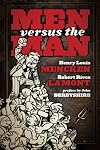
Men Versus the Man: A Correspondence Between Robert Rives La Monte, Socialist, and H. L. Mencken, Individualist
by H. L. Mencken (Co-author), Robert Rives La Monte (Co-author)
10 Members (5.00)
On This Page
Description
There is no irony in the fact that H.L. Mencken is a tall figure in the history of letters, and Robert Rives La Monte is wholly forgotten. La Monte, who worked at the Baltimore News as well as being an editor for the International Socialist Review, was a true believer in the promise of Socialism. Here he writes six letters trying to convince H.L. Mencken to reject his selfish ways and become a comrade in the revolution, to usher in a perfect world of total equality and universal brotherhood. show more Mencken, long time writer for the Baltimore Sun, editor of The American Mercury, and prolific author and essayist, was the absolute worst choice of target for an evangelist of the common man. There have been few who were as openly resolved to a robust Nietzschean individualism. And so, in one of the turn of the last centuries greatest "flame wars," we have the Bard of Baltimore's six responses to those appeals. The battle of the "collective good" versus "individual liberty" still rages in pitched battles. La Monte's voice is rightfully now just one of many faceless advocates of class-warfare, and Mencken's personality survives as the greatest advocate of social Darwinism and thus ultimately Mencken's own views. "(It) shows how (Mencken's) political thinking had solidified-hardened, really. The law of the survival of the fittest, he declares, is "immutable," thus making socialism an absurdity; human progress is the product of the will to power, and all social arrangements failing to take this fact into account are doomed to failure; inequality is natural, even desirable, both in and of itself and as an alternative to mob rule; the world exists to be run by "the first-caste man." -Terry Teachout, The Skeptic: A Life of H.L. Mencken "The argument of Men versus the Man is one we are still having today. The content of the argument is the relative desirability of two approaches to our social life. On the one hand is proposed a society of men: a society in which none is allowed to rise too high above another, a society that subtracts great resources from the more able in an effort to raise up the less able. On the other hand is a society of the man: a society in which individuals are left to do what they can with their inherited capabilities, in conditions of maximum personal freedom and minimal state control." -John Derbyshire, from the preface show lessTags
Member Reviews
Members
- Recently Added By
Author Information

H. L. Mencken 1880-1956 H. L. (Henry Louis) Mencken was born in Baltimore, Maryland, on September 12, 1880. He considered Maryland to be his home despite his many years in New York. As a child he attended Professor Friedrich Knapp's Institute, a private school for children of German descent. He completed his secondary education at Baltimore show more Polytechnic Institute, from which he graduated at the age of 16. Mencken wanted to be a writer but was obligated to work in his father's cigar factory. When his father died suddenly in 1899, Mencken immediately sought a job at the Baltimore Herald. Through he began with no experience in journalism, he quickly learned every job at the newspaper and at age 25 became its editor. Mencken went on to build himself a reputation as one of America's most brilliant writers and literary critics. His basic approach was to question everything and to accept no limits on personal freedom. He attacked organized religion, American cultural and literary standards, and every aspect of American life that he found shallow, ignorant, or false - which was almost everything. From the 1920's until his death, Mencken's sharp wit and penetrating social commentary made him one of the most highly regarded - and fiercely hated - of American social critics. He was later memorialized in the dramatic portrait of the cynical journalist in the play and film Inherit the Wind. Shortly after World War I, Mencken began a project that was to fascinate him for the rest of his life: a study of American language and how it had evolved from British English. In 1919 he published The American Language: A Preliminary Inquiry into the Development of English in the United States. To this and his publisher's surprise, the book sold out quickly; its wit and nonscholarly approach attracted many readers who would not normally buy a book on such a subject. In 1936, a revised and enlarged edition was published, and in 1945 and 1948, supplements were added. The work shows not only how American English differs from British English but how the 300 year American experience shaped American dialect. Thus the book, still considered a classic in its field, is both a linguistic and social history of the United States. Mencken died in his sleep on January 29, 1956. He was interred in Baltimore's Loudon Park Cemetery. (Bowker Author Biography) show less
Some Editions
Common Knowledge
- Original publication date
- 1910
Classifications
Statistics
- Members
- 10
- Popularity
- 2,143,976
- Rating
- (5.00)
- Languages
- English
- Media
- Paper, Ebook
- ISBNs
- 5
- ASINs
- 1