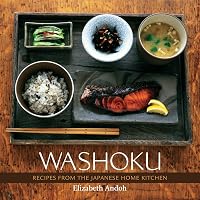
Washoku: Recipes from the Japanese Home Kitchen
by Elizabeth Andoh
On This Page
Description
In 1975,Gourmet magazine published a series on traditional Japanese food --the first of its kind in a major American food magazine -- written by a graduate of the prestigious Yanagihara School of classical cuisine in Tokyo. Today, the author of that groundbreaking series, Elizabeth Andoh, is recognized as the leading English-language authority on the subject. She shares her knowledge and passion for the food culture of Japan in WASHOKU, an authoritative, deeply personal tribute to one of the show more world's most distinctive culinary traditions. Andoh begins by setting forth the ethos of washoku (traditional Japanese food), exploring its nuanced approach to balancing flavor, applying technique, and considering aesthetics hand-in-hand with nutrition. With detailed descriptions of ingredients complemented by stunning full-color photography, the book's comprehensive chapter on the Japanese pantry is practically a book unto itself. The recipes for soups, rice dishes and noodles, meat and poultry, seafood, and desserts are models of clarity and precision, and the rich cultural context and practical notes that Andoh provides help readers master the rhythm and flow of the washoku kitchen. Much more than just a collection of recipes, WASHOKU is a journey through a cuisine that is rich in history and as handsome as it is healthful. Awards2006 IACP Award WinnerReviews"This extensive volume is clearly intended for the cook serious about Japanese food."--Minneapolis Star Tribune". . . scholarly, yet inspirational . . . a foodie might just sit back and read for sheer enjoyment and edification."--Milwaukee Journal Sentinel show lessTags
Recommendations





Member Reviews
This cookbook is more practical than it first appears. I was afraid it would be more of a coffee-table book than something I could actually use, but it has useful guides to Japanese ingredients, cooking equipment, and techniques. The recipes sounded a bit exotic, but once I started reading my way through them, I saw that Andoh's guides gave all the information necessary and that the recipes weren't all that arcane after all. The major drawback I see, however, is that Andoh assumes that you can get your hands on authentic Japanese ingredients and doesn't offer many tips on substituting if you can't. This is good if you want to create authentic Japanese dishes, but if you just don't have easy access to iriko or Japanese mountain yams, the show more recipes may seem forbidding. show less
The first thing I noticed about this oversized tome was that it has a very lengthy and excellent section on ingredients (pp. 11-64). The ingredients are generally given with both the Japanese and the English names (when there is one), and when appropriate, Andoh covers selection, preparation, storage, varieties, and just about any other piece of information one could imagine (that is, assuming one is not writing a whole book on the topic). I do, however, wish she had mentioned her favorite brands.
Ratings
Members
- Recently Added By
Author Information

6 Works 606 Members
Awards and Honors
Classifications
Statistics
- Members
- 314
- Popularity
- 101,581
- Reviews
- 2
- Rating
- (3.95)
- Languages
- English
- Media
- Paper, Ebook
- ISBNs
- 3
- ASINs
- 1