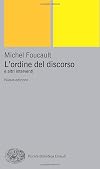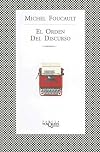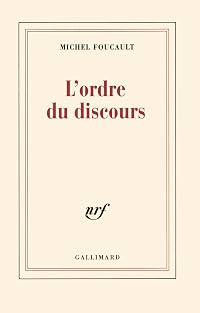
The Order of Discourse
by Michel Foucault
On This Page
Description
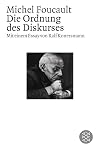
In der Antrittsvorlesung, die der 1984 verstorbene Philosoph und Historiker anlä lich seiner Berufung an das Collège de France am 2. Dezember 1970 gehalten hat, ist das geschichtsphilosophische Programm, aus dem sich seine späteren gro en Werke speisen sollten, in den Grundzügen bereits entworfen. Sie ist ein Schlüsseltext der modernen Ideengeschichte. In einer subtilen Analyse der literarischen und wissenschaftlichen Institutionen und Mechanismen, die das Geschriebene und Gesprochene show more einschränken, kontrollieren und determinieren, entwickelt Foucault hier den theoretischen "Diskurs", der ihn nachmals berühmt gemacht und mit dem er die Grenzen zwischen Historiographie, Literaturwissenschaft, Philosophie und Rhetorik überschritten hat. Ralf Konersmann zeichnet in einem ebenso scharfsichtigen wie kenntnisreichen Essay die Fahndungsmethoden des Foucaultschen Denkens und die Gründe für dessen andauernde fächerübergreifende Wirkung nach.. show lessTags
Recommendations






































Member Reviews
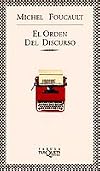
En 1970 Michel Foucault sucedió a Jean Hypolite en el Collége de France, donde se hizo cargo de la cátedra de historia de los sistemas del pensamiento. El orden del discurso fue su lección inaugural del curso. Preocupado siempre por las complejas relaciones entre el saber y el origen del poder, Foucault resumió en este texto el núcleo de sus investigaciones y adelantó todo un programa futuro de trabajo. A través de un minucioso análisis de las variadas formas de acceso (o de las prohibiciones y tabúes) a la palabra, de la marginalidad de determinados discursos (la locura, la delincuencia) o la controvertida voluntad de verdad de la cultura occidental, este opúsculo consigue poner de manifiesto la inquietante fragilidad de show more categorías filosóficas aparentemente sacrosantas, como las de sujeto, conciencia e historia. A casi 30 años vista, este polémico y ejemplar «discurso» mantiene toda la espontaneidad creadora de una auténtica obra filosófica. show less
Excelente
Non Fiction, Philosophy, Knowledge, Inaugurary lesson at the College de France, The constraints, even the repressions, that institutions impose on what can be said, "In every society the production of discourse is at once controlled, selected, organized and redistributed according to a certain number of procedures, whose role is to avert its powers and its dangers", Society manifests a kind of fear of the word, against which it seeks to protect itself by such strategies of exclusion and limitation, The order of discourse is situated on the unstable border between language as a system (langue) and social practices, First published by Gallimard, Paris, 1971, "L'Ordre du discours", First Italian edition "L'ordine del discorso", Torino, show more Einaudi, 1972; First UK edition as an appendix to "The Archeology of Knowledge", London, Tavistock, 1972, translated by A. M. Sheridan-Smith; First published as "The Order of Discourse.", translated by Ian McLeod, in "Untying the Text: A Post-Structuralist Reader", Ed Robert Young, Boston and London, Routledge, Kegan Paul, 1981; also released as "The Order of Discourse", by Sackville, New Brunswick, Twelve Copy Press, 1998, translated by Cyril Welch show less
Ratings
Members
- Recently Added By
Lists

Filosofía - Clásicos
217 works; 1 member
Author Information

362+ Works 50,131 Members
Michel Foucault was born on October 15, 1926, in Poitiers, France, and was educated at the Sorbonne, in Paris. He taught at colleges all across Europe, including the Universities of Lill, Uppsala, Hamburg, and Warsaw, before returning to France. There he taught at the University of Paris and the College of France, where he served as the chairman show more of History of Systems of Thought until his death. Regarded as one of the great French thinkers of the twentieth century, Foucault's interest was in the human sciences, areas such as psychiatry, language, literature, and intellectual history. He made significant contributions not just to the fields themselves, but to the way these areas are studied, and is particularly known for his work on the development of twentieth-century attitudes toward knowledge, sexuality, illness, and madness. Foucault's initial study of these subjects used an archaeological method, which involved sifting through seemingly unrelated scholarly minutia of a certain time period in order to reconstruct, analyze, and classify the age according to the types of knowledge that were possible during that time. This approach was used in Madness and Civilization: A History of Insanity in the Age of Reason, for which Foucault received a medal from France's Center of Scientific Research in 1961, The Birth of the Clinic, The Order of Things, and The Archaeology of Knowledge. Foucault also wrote Discipline and Punishment: The Birth of the Prison, a study of the ways that society's views of crime and punishment have developed, and The History of Sexuality, which was intended to be a six-volume series. Before he could begin the final two volumes, however, Foucault died of a neurological disorder in 1984. (Bowker Author Biography) An outstanding philosopher and intellectual figure on the contemporary scene, Foucault has been influential in both philosophy and the recent interpretation of literature. Trained in philosophy and psychology, he was named to a chair at the College de France in 1970. He also taught in various departments of French literature as a visiting professor in the United States. Until 1968 he was a major figure in the critical movement known as structuralism, a method of intellectual inquiry based on the idea that all human behavior and achievement arises from an innate ability to organize, or "structure," human experiences. In both The Order of Things (1966) and The Archaeology of Knowledge (1969) he was interested in the organization of human knowledge and in the transformations of intellectual categories. His influential history of the prison, Discipline and Punish (1975), contributed to the study of the relationship of power and various forms of knowledge, as did the several volumes of an unfinished History of Sexuality published just before his death. (Bowker Author Biography) show less
Series
Belongs to Publisher Series
Work Relationships
Is contained in
Common Knowledge
- Canonical title
- The Order of Discourse
- Original title
- L'ordre du discours
- Original publication date
- 1971
Classifications
Statistics
- Members
- 454
- Popularity
- 67,644
- Reviews
- 3
- Rating
- (3.91)
- Languages
- 16 — Catalan, Danish, Dutch, English, Estonian, French, German, Italian, Japanese, Lithuanian, Norwegian (Bokmål), Norwegian, Polish, Portuguese, Spanish, Swedish
- Media
- Paper, Ebook
- ISBNs
- 28
- ASINs
- 5