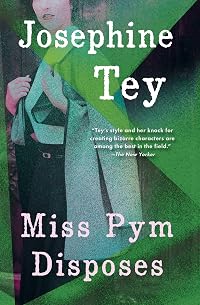
Miss Pym Disposes
by Josephine Tey
On This Page
Description
A unique and absorbing standalone mystery, Miss Pym Disposes is an essential addition to the Josephine Tey collection. Bestselling author Lucy Pym is initially thrilled to be invited to lecture at Leys Physical Training College. The girls are eager to learn about psychology, her pet subject, and she finds herself inspired by their discipline, humour and determination. However, a tragic accident in the gymnasium reveals a darker side to the school, and unexpectedly Miss Pym finds she must show more draw on her psychological expertise to trace who, of all these wholesome girls, has violence on the mind. show lessTags
Recommendations














Member Recommendations

Member Reviews
Former teacher, now celebrated author of a popular book on psychology, Lucy Pym accepts an invitation to lecture at a young women's physical training college run by an old friend she hasn't seen in decades. What was intended to be an overnight visit extends to cover the doings of finals week and the run-up to the year-end demonstration of skills the students have been preparing for all term. As a guest of the college, Miss Pym observes all this with rapidly diminishing objectivity, and finds herself on the horns of one moral dilemma after another. How she rationalizes her own responses to these situations comprises much of the narrative. The reader cannot avoid taking a stand, but will you agree with Miss Pym? I enjoyed this one show more immensely. I did have one quibble with the plot, as I do not believe a school of this sort would allow one of its students to work out alone in the gymnasium, and if they had not, a critical element of the story could not have happened as it did . Nonetheless, a treat, and I recommend it if this is the kind of thing you like. show less
Plotting in the Gymnasium
A review of the Ponomarenko eBook (October 11, 2024) of the Peter Davies hardcover original (1946).
It is 5 stars for the original, but beware of this eBook edition which contains completely inappropriate girlie pulp magazine covers as its so-called "illustrations."
I read all of Josephine Tey's mystery novels featuring Inspector Alan Grant in my pre-GR / pre-review days but had overlooked the non-Grant novel Miss show more Pym Disposes which is somewhat of a roman à clef recalling Tey's own early upbringing in a girl's physical education college.
See cover at https://m.media-amazon.com/images/S/compressed.photo.goodreads.com/books/1628704...
A reprint edition of the 1946 Peter Davies original hardcover edition, adding a cover blurb referencing the later book "The Daughter of Time" (1951). Image sourced from Goodreads.
The Lucy Pym of the title is a former French language teacher who has had a hit with a popular psychology book whereby she is now independently wealthy and tours the lecture circuit. She is asked by her college friend Henrietta Hodge to lecture at Leys College, a physical training academy for girls, where Hodge is the Headmistress.
Lucy interacts with the teaching staff and the senior students who are in preparation for final exams, a public performance for family and their graduations and placements at various teaching institutions, clinics or hospitals. She is induced to stay over until the end of the school term. Lucy gradually becomes aware of the different cliques and rivalries among the girls and eventually a shocking "accident" occurs, about which Lucy holds key information, brings about a moral quandary.
This is a slow burn of a novel where the key event doesn't occur until the 75% point of the book. The suspense builds gradually as you wonder who the victim and perpetrator will be. Along the way Tey delights with her character portrayals ranging from the Four Disciples (a clique of 4 girls with names evoking the 4 Gospel writers), the Nut Tart (the nickname for a Brazilian student of dance), the outsider Barbara Rouse and the elite pair of friends Pamela (Beau) Nash and Mary Innes.
Too much more would be a spoiler, but in the end Miss Pym disposes her decision and certain events take their course, but there is a final twist reveal which causes you to reassess everything that you had previously read and understood. I found this to be a totally captivating read, even though it is quite unlike most novels in the mystery genre. I think you could say it is a precursor for the so-called "psychological suspense" sub-genre of novels.
Trivia and Links
Josephine Tey was one of the pseudonyms of Elizabeth Mackintosh (1896-1952) who also wrote under the penname of Gordon Daviot. Her most popular novel (per GR ratings and reviews) is [book:The Daughter of Time|77661] (Alan Grant #5 - 1951) where the detective is recuperating in hospital and uses the downtime to investigate the case of Richard III and the murder of the Princes in the Tower. In 1990, it was voted Number One in the 100 Greatest Crime Novels of All Time by the British Crime Writers Association. See reference at Wikipedia. show less
A review of the Ponomarenko eBook (October 11, 2024) of the Peter Davies hardcover original (1946).
"Do the obvious right thing, and let God dispose," Rick had said. And it had seemed a sensible ruling. But that was when it had been a hypothetical affair of "causing grievous bodily harm" (that was the phrase, wasn't it?) and now it had ceased to be hypothesis and it wasn't any longer mere bodily harm.
It is 5 stars for the original, but beware of this eBook edition which contains completely inappropriate girlie pulp magazine covers as its so-called "illustrations."
I read all of Josephine Tey's mystery novels featuring Inspector Alan Grant in my pre-GR / pre-review days but had overlooked the non-Grant novel Miss show more Pym Disposes which is somewhat of a roman à clef recalling Tey's own early upbringing in a girl's physical education college.
See cover at https://m.media-amazon.com/images/S/compressed.photo.goodreads.com/books/1628704...
A reprint edition of the 1946 Peter Davies original hardcover edition, adding a cover blurb referencing the later book "The Daughter of Time" (1951). Image sourced from Goodreads.
The Lucy Pym of the title is a former French language teacher who has had a hit with a popular psychology book whereby she is now independently wealthy and tours the lecture circuit. She is asked by her college friend Henrietta Hodge to lecture at Leys College, a physical training academy for girls, where Hodge is the Headmistress.
Lucy interacts with the teaching staff and the senior students who are in preparation for final exams, a public performance for family and their graduations and placements at various teaching institutions, clinics or hospitals. She is induced to stay over until the end of the school term. Lucy gradually becomes aware of the different cliques and rivalries among the girls and eventually a shocking "accident" occurs, about which Lucy holds key information, brings about a moral quandary.
This is a slow burn of a novel where the key event doesn't occur until the 75% point of the book. The suspense builds gradually as you wonder who the victim and perpetrator will be. Along the way Tey delights with her character portrayals ranging from the Four Disciples (a clique of 4 girls with names evoking the 4 Gospel writers), the Nut Tart (the nickname for a Brazilian student of dance), the outsider Barbara Rouse and the elite pair of friends Pamela (Beau) Nash and Mary Innes.
Too much more would be a spoiler, but in the end Miss Pym disposes her decision and certain events take their course, but there is a final twist reveal which causes you to reassess everything that you had previously read and understood. I found this to be a totally captivating read, even though it is quite unlike most novels in the mystery genre. I think you could say it is a precursor for the so-called "psychological suspense" sub-genre of novels.
Trivia and Links
Josephine Tey was one of the pseudonyms of Elizabeth Mackintosh (1896-1952) who also wrote under the penname of Gordon Daviot. Her most popular novel (per GR ratings and reviews) is [book:The Daughter of Time|77661] (Alan Grant #5 - 1951) where the detective is recuperating in hospital and uses the downtime to investigate the case of Richard III and the murder of the Princes in the Tower. In 1990, it was voted Number One in the 100 Greatest Crime Novels of All Time by the British Crime Writers Association. See reference at Wikipedia. show less
By this point in my reread of Josephine Tey it's more than clear that she did not write ordinary books. The cover blurb clearly gives out that Disposes is a murder mystery, but the story is in no rush to do anyone in. And that is brilliant, and cruel. We are introduced to Miss Pym, and become friends. It didn't take long at all to come to care about her – still surprised and honestly delighted at her completely unanticipated fame and relative fortune, at her still-new ability to go wherever and do whatever she pleased. There are times and circumstances in which it is almost as nice (almost) to see good things happen to good people as to have them to oneself; it's lovely to watch Miss Pym as written by Josephine Tey exploring the sort show more of freedom I'd wish for my own life – and which, come to think of it, may have been a glimpse into Miss Tey's own feelings; there is, apparently, much of Josephine Tey (pseudonym of Elizabeth Mackintosh) in Miss Pym and the girls and ladies of the school: Elizabeth Mackintosh was, according to the Times obituary (via http://www.r3.org/fiction/mysteries/tey_butler.html) "born and brought up at Inverness and was trained as a physical training instructress at the Anstey Physical Training College, Birmingham".
Along with Miss Pym we meet the inmates of the Leys school for young women, and seeing through her eyes there are perhaps two students who are less than lovely, and one instructor; everyone else is charming, and indispensable. Which is when the memory that this is a murder mystery begins to niggle … Which of these will be the victim? Worse – which will be the killer? For once there is no hint in the blurb (at least in my edition); the hideous cover of my copy makes it look like a student, but covers are notoriously unreliable. It's a different sort of suspense than is often found in the genre – rather than being kept waiting to find out whodunnit or whether this one will escape the murderer or that one escape the law, here it is a wait to see which of these people I've quickly come to like will a) die and b) be responsible. Neither is a more appealing prospect than the other; it didn't take long before I really didn't want any of them dead, nor did I want any of them to be capable of killing anyone. It is sadly rare to read a book in which the characters are so well-made that their plotline becomes genuinely distressing.
Not a negligible accomplishment for less than a hundred pages. Tey rules. show less
Along with Miss Pym we meet the inmates of the Leys school for young women, and seeing through her eyes there are perhaps two students who are less than lovely, and one instructor; everyone else is charming, and indispensable. Which is when the memory that this is a murder mystery begins to niggle … Which of these will be the victim? Worse – which will be the killer? For once there is no hint in the blurb (at least in my edition); the hideous cover of my copy makes it look like a student, but covers are notoriously unreliable. It's a different sort of suspense than is often found in the genre – rather than being kept waiting to find out whodunnit or whether this one will escape the murderer or that one escape the law, here it is a wait to see which of these people I've quickly come to like will a) die and b) be responsible. Neither is a more appealing prospect than the other; it didn't take long before I really didn't want any of them dead, nor did I want any of them to be capable of killing anyone. It is sadly rare to read a book in which the characters are so well-made that their plotline becomes genuinely distressing.
Not a negligible accomplishment for less than a hundred pages. Tey rules. show less
When Lucy Pym, popular psychologist, accepts an invitation to give a lecture at a women's college run by an old school friend, she expects to be there for a few days at most. As she finds herself drawn to the students and the life of the school, she is convinced to stay the last couple weeks of the term (despite the early morning bells and disgusting cafeteria food). She gets to know the senior girls very well, and finds herself interested in their plans for the immediate future. But when a disaster occurs, Miss Pym is the only one who can prove that what seems like a tragic accident might, in fact, be murder.
Tey writes setting and character beautifully. I can see how the first part of the book might feel a little slow, though I was show more just enjoying getting to know the school, staff, and students. This book was published in the 1940s, and shows its age in certain attitudes and dialogue. In addition, a major part of the plot involves a certain piece of gymnastics equipment called the "boom," which I cannot clearly picture, nor can I find an online image that helps me understand its function. I'm also still a little hazy on the purview of a women's physical training college, which seems to train students who want to become gym teachers, or something like physical therapists, or...? Wikipedia tells me that Tey taught at such a college, so I'm sure all of the details are accurate to the time, but to a modern reader, it's a bit obscure.
All that aside, this is an interesting handling of the mystery element of the book. As you might expect from a main character with an interest in psychology, the ramifications of the crime and of exposing the crime are explored in detail. I figured out "whodunit" almost immediately, and was not distracted by red herrings, but I didn't find the ending entirely satisfying. I did enjoy reading a golden age mystery with an almost entirely female cast (there are a few men, but they play minor roles), and I can see that aspect of the book having some appeal for modern readers. I might read more of Tey if I come across other books by her; I was a little surprised that Miss Pym Disposes is a stand-alone work. show less
Tey writes setting and character beautifully. I can see how the first part of the book might feel a little slow, though I was show more just enjoying getting to know the school, staff, and students. This book was published in the 1940s, and shows its age in certain attitudes and dialogue. In addition, a major part of the plot involves a certain piece of gymnastics equipment called the "boom," which I cannot clearly picture, nor can I find an online image that helps me understand its function. I'm also still a little hazy on the purview of a women's physical training college, which seems to train students who want to become gym teachers, or something like physical therapists, or...? Wikipedia tells me that Tey taught at such a college, so I'm sure all of the details are accurate to the time, but to a modern reader, it's a bit obscure.
All that aside, this is an interesting handling of the mystery element of the book. As you might expect from a main character with an interest in psychology, the ramifications of the crime and of exposing the crime are explored in detail. I figured out "whodunit" almost immediately, and was not distracted by red herrings, but I didn't find the ending entirely satisfying. I did enjoy reading a golden age mystery with an almost entirely female cast (there are a few men, but they play minor roles), and I can see that aspect of the book having some appeal for modern readers. I might read more of Tey if I come across other books by her; I was a little surprised that Miss Pym Disposes is a stand-alone work. show less
"Miss Pym Disposes" was a Leap Day Buddy Read on BookLikes. I spent a couple of days cheerfully reading this book, updating as I went and reading updates from others. I've included the updates here as well as my overall impression of the book.
Overall Impression
I really enjoyed this novel.
Although it's seventy-four years old, it felt fresh and innovative and relevant. It never took the traditional path for a mystery novel and yet it managed to be tense and intriguing. It was filled with humour and with the honest human reactions rather than crime detection tropes.
I strongly recommend it.
I've read 14%. -well this is surprising
I woke to one of those gloomy, rain-sodden, spirit-sapping mornings that England seems to be specialising in at show more the moment and decided that breakfast could wait until after I'd made a start on "Miss Pym Disposes", which, happily, turned out to be not at all what I was expecting.
It seems my subconscious had, on the basis of the title alone, classified Miss Pym as an older single-woman spending her time sharpening the cutting edge of her insight on the strop of other people's weaknesses à la Miss Marple. Instead, I found myself in the company of a woman who is described as "Little Miss Pym" and who, like me, was avoiding getting out of bed.
She's been woken at 05.30 by a clamorous bell that she's doing her best to ignore. The bell is part of the regimen of the girl's school she has stayed overnight at after being the guest external speaker on Friday evening. She regards the bell as excessive and is glad that its summons does not apply to her anymore.
"Once upon a time she too had lived a life regulated by bells, but that was long ago. Nearly twenty years ago. When a bell rang in Miss Pym’s life now it was because she had put a delicately varnished finger-tip on the bell-push."
What follows is a lightly-written, fast-paced, humour-filled set of encounters between Miss Pym and a variety of students that build Miss Pym's character, starts to sketch the very large number of students and staff the story is going to involve and establishes the over-amplified, so-constantly-stressed-no-one-notices-anymore atmosphere of an all-girls Physical Training College.
Miss Pym is not at all the kind of person I'd expect to be at the centre of a 1940's detective story. She not very confident, She describes herself as having been "the little fourth-form rabbit" at school. She is engaged in "a constant and bitter war" with her weaker self, who seems to want to do as little as possible and her other self who doesn't want to make a bad impression. She's also still adjusting to having been propelled into prominence by having her pop psychology book become a best seller. The book was written as a rebuttal to the thirty-something psychology books Miss Pym read when she took an interest in the subject. It's not an academic critique but rather an account of her amazement at the inability of psychologists to read people.
So far, much of the humour of the book comes from Miss Pym's obsessive people watching and her compulsive attempts to use physical appearance to devine character.
So, this is off to a much more cheerful start than my morning is. I'm going to leave Miss Pym socialising with students on the lawn while I get myself some breakfast.
I've read 23%. - wonderful prose, the first hint of spook and a book recommendation
t seems to me that the skill of writing a light book often gets ignored. Serious books wear their purple prose like hard-won bruises and hammer home their demand to be taken seriously. Light books carry you along swiftly with smiles and wit, distracting you from the prose that gives the book its strength and hiding its serious intent from anyone who doesn't have the inclination to look for it.
This book is very skillfully written to deliver introspection without ever appearing to step too deeply into psychology. Take this passage, where Miss Pym reflects on why she is inclined to stay for a while at this college she had previously been determined to leave after only one night:
"There was no good in trying to diddle herself about why she wanted to stay a little longer; why she was seriously prepared to forgo the delights of civilisation that had seemed so desirable—so imperatively desirable—only yesterday morning. It was nice to be liked. In the last few years she had been ignored, envied, admired, kowtowed to, and cultivated; but warm, personal liking was something she had not had since the Lower Fourth said good-bye to her, with a home-made pen-wiper and a speech by Gladys Someone-or-other, shortly after her legacy. To stay in this atmosphere of youth, of liking, of warmth, she was willing to overlook for a space the bells, the beans, and the bathrooms."
I love the easy intimacy of this: with the complex sentence structure to suggest careful reflection and the soft alliteration to sustain the feeling of humorous insight. Yet the serious points are all there and lose none of their weight in the telling.
Then, as we get to the end of Chapter Five when Miss Pym is going to bed having just agreed to stay for a few days, we get the first indication of spookiness in the whispered reactions of the girls in the rooms facing the same courtyard as Miss Pym's:
"A great stillness had settled on Leys. The chatter, the bells, the laughter, the wild protests, the drumming of feet, the rush of bath water, the coming and going, had crystallised into this great silent bulk, a deeper darkness in the quiet dark. ‘Miss Pym.’ The whisper came from one of the windows opposite. Could they see her, then? No, of course not. Someone had heard the small noise of her curtains being drawn back. ‘Miss Pym, we are so glad you are staying.’ So much for the college grape-vine! Not fifteen minutes since Nash said good-night, but already the news was in the opposite wing. Before she could answer, a chorus of whispers came from the unseen windows round the little quadrangle. Yes, Miss Pym. We are glad. Glad. Miss Pym. Yes. Yes. Glad, Miss Pym. ‘Good-night, everyone,’ Lucy said. Good-night, they said. Good-night. So glad. Good-night."
That set off my spook alarm. There's no obvious threat yet suddenly the school feels like a prison or a zoo. In which case, what does that make Miss Pym?
My reading also offered me a book recommendation. Miss Pym borrows a book called "The Young Visiters" that was apparently well-known in 1946 as a book that would make everyone smile.
The publisher's summary says:
A short “society novel” written by Miss Daisy Ashford at the age of nine. The notebook containing the novel was rediscovered by her in adult life and sent by a friend to Frank Swinnerton, the English novelist, critic, editor and essayist. Published in 1919 by Chatto and Windus, with its original misspellings and an arch introduction by “Peter Pan” author J. M. Barrie, it was an immediate bestseller. Its child's view of high society (dukes and earls having ‘levies’ and residing in the ‘Crystall Pallace’) and its heavily romantic plot make it an engaging and enduring popular work. So I added it to my TBR pile. .
I've read 33%. - two quotes - one made me smile, the other made me think of Barbara Pym
I was surprised to find that Lucy Pym and I have something in common - even if it is only our reaction to fresh cakes in good tearooms.
"Miss Nevill came in with the coffee and a large plate of spiced cakes shining with newness and crisp at the edges. Lucy decided to forget her weight just this once and enjoy herself. This was a decision she made with deplorable frequency."
Yet it turns out we are not in the tearooms to share Lucy Pym's delight in coffee and cakes, but to meet the parents of one of the more serious students at the school. Lucy Pym's thoughts on seeing this respectable but slightly down-at-heel couple reminded me of the way Barbara Pym sees people. It also shows some of the seriousness underlying the wit in the book:
"They were Mary Innes’s parents. And in some odd way they explained Mary Innes. Her gravity; her air of belonging to a century other than this one; her not finding life very amusing. To have standards to live up to, but to have little money to live up to them with, was not a happy combination for a girl burdened with the need to make a success of her training."
I've read 56%.- suddenly this isn’t light-hearted any more
Now that I’m far enough along to have opinions about the students and the school and the pressures the school brings to bear on the students, events occur that make me revisit and reconsider what I thought I knew.
I'm fascinated to see how Tey, having cultivated and shaped my preferences and prejudices against the students then uses them against me by asking for judgement with incomplete data and dire consequences. Suddenly, nothing is so light-hearted any more and no one has even died yet.
it’s wonderfully done.
I've read 73%. - amazing how much tension can be produced by controlling the pace of the narrative
Many of the modern crime stories that I read rush to make The Bad Thing happen. Some even write a Prologue to share The Bad Thing out of sequence and then tell the rest of the story leading up to it. It often feels as if the writer (or, perhaps, the publisher) is concerned that the reader will abandon the book unless the scent of blood is in the water from the beginning.
The price paid for this is a lack of context. We don't know the people and have no reason, beyond general humanity, to care what happens to them. We don't know the social setting or it's history so we have no scale to measure the impact of The Bad Thing against. The best books remedy these deficiencies in the chapters after the Prologue but The Bad Thing displayed at the beginning cannot be unknown, nor can it be seen, once more is learned, with the same impact as if it were being seen for the first time.
"Miss Pym Disposes" takes the opposite route. I'm three-quarters of the way through and The Bad Thing is yet to happen. It will happen soon and the tension of knowing that but not being sure what The Bad Thing is, is quite delicious,
It also makes me aware that, in once sense, The Bad Thing, has already been done. The vase has already been dropped. It just hasn't shattered yet. Or perhaps it's better to think that the well has already been poisoned but no one has yet drunk from it.
I admire Josephine Tey's control of the pace of the narrative. She allows that tension to grow not by force-feeding foreboding but by letting the enormity of the dropping of the vase or the poisoning of the well to sink in before the consequences are known. She allows normal life to continue, which is a way of showing us that it's no longer normal after all. That something has already been lost that can't be regained.
I also admire the way Miss Pym is growing up as the story progresses. She's become enough a part of the school to share its intensity. She's more connected to everyday life than she has been for some time and that connection is making her question how well she really understands people. At one point, as she re-evaluates her assessment of teachers, she thinks:
"She had been all wrong about Miss Lux. As a psychologist she began to suspect she was a very good teacher of French."
She's also rediscovering her empathy by linking her experiences to those of the students. I loved this description of what injustice feels like:
"It was Lucy’s private opinion that injustice was harder to bear than almost any other inflicted ill. She could remember yet the surprised hurt, the helpless rage, the despair that used to consume her when she was young and the victim of an injustice. It was the helpless rage that was worst; it consumed one like a slow fire. There was no outlet, because there was nothing one could do about it. A very destructive emotion indeed."
I've read 100%. - what a splendid finish
I wanted to stand up and applaud at the end of this book.
I wasn't entirely surprised but I was deeply satisfied.
I liked the fact that Miss Pym was weighed down by the decision she felt she had to make. The description of her internal struggle over what to do seemed very real to me. I share her sentiment that following the rules may not be doing the right thing and even if it is, it doesn't absolve you of the consequences.
I also enjoyed the twist the ending took, leading me down both the paths I'd seen as possible rather than choosing between them. Both paths were valid and the outcomes and reactions seemed to me to be entirely credible.
One of the abiding things I'll take away from this story is how careful we have to be about the challenges we set the young, especially the young, talented and driven. In a way, the whole tragedy that unfolds here is a product of trying to instil in young people who are searching for identity, community, recognition and affection, the strong to desire to PROVE themselves worthy.
There's a description of the Seniors, just before they are about to perform in the Demonstration, an event they've been practising for all year and which will validate thm and their achievements in the eyes of the great, the good and of their parents, that demonstrates this. They are nervous because events have forced last-minute changes that their teacher, Miss Fröken, is walking them through,
"Lucy had a seat at the end of the front row. From there she looked down with affection on the grave young faces waiting, with such tense resolution, Fröken’s word of command. ‘Don’t worry,’ she had heard a Senior say, ‘Fröken will see us through,’ and one could see the faith in their eyes. This was their ordeal, and they came to it shaken, but Fröken would see them through."
This faith and this focus carry an enormous responsibility with it. Young people can do anything. We need to be careful about what we ask them to do. show less
With a cast of quippy, melodramatic characters and the crime occurring only near the end, it is all too easy to overlook the subtle and intricate set up of clues and events which lead inevitably to the final bloodshed. The characters are firmly in two camps of Utter Sensibility or Vivid Imagination but instead of appearing one-dimensional, they complement each other and completely suit the overall tone. For a seemingly light read, it poses some serious moral quandaries and interesting questions - I really enjoyed the justification of who got the post of the top school, just because someone is the best in exams, it doesn't mean they have the aptitude for real-world applications - , all of which wraps up in a very satisfying ending. It's show more also soothing to have a female-majority cast - Desterro is the best - , even if it was slightly dampened by some casual references to the n-word - one was used to describe the colour of a dress! - and victim-blaming sentiments of rape. Recommended for one in need of a light-hearted, but still solid in its psychological groundwork, crime read. show less
While [a:Josephine Tey|44023|Josephine Tey|http://d202m5krfqbpi5.cloudfront.net/authors/1193918690p2/44023.jpg]’s most well-known detective, Inspector Alan Grant, features in six of her eight mystery novels, Miss Pym Disposes is not one of them.
This book features the eponymous Miss Lucy Pym, a quiet, non-assertive, intelligent woman who has written a best-selling psychology book (shades of Chicken Soup for the Soul). She is invited to a girls’ school by its headmistress, a former schoolmate, for as a guest lecturer.
Thinking this was another of Tey’s Inspector Grant book, I kept waiting for the requisite murder and his arrival. I was three-quarters through the book when I surfaced and checked the internet, since I was enjoying the show more novel that much. Once confirming what I now suspected (that this is not an Inspector Grant novel at all), I dove back in and read to the finish in one sitting.
This book is unlike Tey’s previous two mysteries, not only in the absence of Inspector Grant but also in that the “murder event” does not occur until nearly the end of the book. Instead of being the driving force of the book and central reason the characters come together, in Miss Pym Disposes it exists to cause an existential discussion on the meanings of justice and the law. Though shocking, it becomes a life-changing event for very few of the characters.
Mostly this is an observational book from the point of view of Miss Pym as she adjusts to her new status as Celebrity and reevaluates her relationship with people based on the feedback she gets from the various students and teachers at the College. She self-identifies as “a bit of a rabbit”, yet the Senior students to whom she lectures take to her immediately. Miss Pym, through her “psychological lens”, gives us an outsider view of the close-knit community of the College. Presumably, we are expected to use this intimate knowledge of the participants to come to a decision regarding the causes that lead to the nasty accident.
As with Tey’s other books, there are several colloquial words and references that date the book, reflecting the specific time and culture at a private English school. And as with her other books, Miss Pym Disposes is no less enjoyable for that. At a minimum, I got a few great Scrabble words out of it!
Very good. show less
This book features the eponymous Miss Lucy Pym, a quiet, non-assertive, intelligent woman who has written a best-selling psychology book (shades of Chicken Soup for the Soul). She is invited to a girls’ school by its headmistress, a former schoolmate, for as a guest lecturer.
Thinking this was another of Tey’s Inspector Grant book, I kept waiting for the requisite murder and his arrival. I was three-quarters through the book when I surfaced and checked the internet, since I was enjoying the show more novel that much. Once confirming what I now suspected (that this is not an Inspector Grant novel at all), I dove back in and read to the finish in one sitting.
This book is unlike Tey’s previous two mysteries, not only in the absence of Inspector Grant but also in that the “murder event” does not occur until nearly the end of the book. Instead of being the driving force of the book and central reason the characters come together, in Miss Pym Disposes it exists to cause an existential discussion on the meanings of justice and the law. Though shocking, it becomes a life-changing event for very few of the characters.
Mostly this is an observational book from the point of view of Miss Pym as she adjusts to her new status as Celebrity and reevaluates her relationship with people based on the feedback she gets from the various students and teachers at the College. She self-identifies as “a bit of a rabbit”, yet the Senior students to whom she lectures take to her immediately. Miss Pym, through her “psychological lens”, gives us an outsider view of the close-knit community of the College. Presumably, we are expected to use this intimate knowledge of the participants to come to a decision regarding the causes that lead to the nasty accident.
As with Tey’s other books, there are several colloquial words and references that date the book, reflecting the specific time and culture at a private English school. And as with her other books, Miss Pym Disposes is no less enjoyable for that. At a minimum, I got a few great Scrabble words out of it!
Very good. show less
Members
- Recently Added By
Lists

Cerebral Mysteries
34 works; 23 members

Books With a Twist
69 works; 46 members

Best Campus Novels
99 works; 18 members

Crime and Mysteries to Read
746 works; 31 members

British Mystery
469 works; 14 members

Books Set in Great Britain
191 works; 13 members
all aboard for malory towers (grownups)
28 works; 5 members

Female Protagonist
1,056 works; 57 members

Best Books Set in Boarding Schools
160 works; 57 members

Academia in Fiction
158 works; 23 members

Female Friendship
54 works; 12 members

Books With Complete Sentence Titles
501 works; 17 members

Books Read in 2010
631 works; 11 members

Literature About Women and Girls
394 works; 39 members

#JustTheFacts2020Gold
48 works; 1 member

Books Read in 2024
4,727 works; 128 members

Top Five Books of 2024
795 works; 264 members
Author Information

52+ Works 20,138 Members
Josephine Tey is a pseudonym used by Elizabeth Mackintosh. She was born in 1896 in Inverness and died in 1952. She is a Scottish author best known for her mystery novels. She attended Inverness Royal Academy and then Anstey Physical Training College in Erdington, a suburb of Birmingham. She taught physical training at various schools in England show more and Scotland, but in 1926 she had to return to Inverness to care for her invalid father. There she began her career as a writer. In five of the mystery novels, the hero is Scotland Yard Inspector Alan Grant. The most famous of these is The Daughter of Time, in which Grant, laid up in hospital, has friends research reference books and contemporary documents so that he can puzzle out the mystery of whether King Richard III of England murdered his nephews, the Princes in the Tower. Grant comes to the firm conclusion that King Richard was totally innocent of the death of the Princes. In 1990, The Daughter of Time was selected by the British Crime Writers' Association as the greatest mystery novel of all time; The Franchise Affair was 11th on the same list of 100 books. (Bowker Author Biography) show less
Some Editions
Work Relationships
Common Knowledge
- Canonical title
- Miss Pym Disposes
- Original title
- Miss Pym disposes
- Original publication date
- 1946
- People/Characters
- Lucy Pym; Henrietta Hodge; Catherine Lux; Beau Nash; Mary Innes; Barbara Rouse (show all 10); Teresa Desterro; Rick Gillespie; Edward Adrian; Fröken
- Important places
- Leys Physical Training College, England, UK
- First words
- A bell clanged. Brazen, insistent, maddening.
- Quotations
- "If you knew that by saving a person from the top of a snow slide,you would start an avalanche that would destroy a village, would you do it? That sort of thing." "Of course I would do it." "You would?" "The avalanche mig... (show all)ht bury a village without killing a cat, so you would be one life to the good." "You would always do the right thing, and let the consequences take care of themselves?" "That's about it." "It is certainly the simplest. In fact I think it's too simple." "Unless you plan to play God, one has to take the simple way."
- Last words
- (Click to show. Warning: May contain spoilers.)Face-reading was not well-seen among the intelligentsia.
Classifications
Statistics
- Members
- 1,569
- Popularity
- 14,607
- Reviews
- 64
- Rating
- (3.81)
- Languages
- 8 — Dutch, English, French, German, Italian, Polish, Russian, Spanish
- Media
- Paper, Audiobook, Ebook
- ISBNs
- 33
- ASINs
- 37