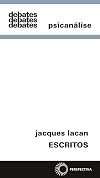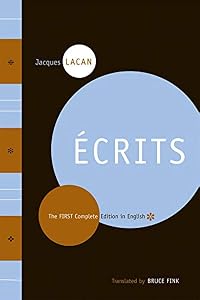
Écrits
by Jacques Lacan
On This Page
Description
"Fink's precise new translation makes this pivotal period in Lacan's thought more accessible to English speakers."--Publishers Weekly, starred review Brilliant and innovative, Jacques Lacan's work lies at the epicenter of modern thought about otherness, subjectivity, sexual difference, the drives, the law, and enjoyment. This new translation of his complete works offers welcome, readable access to Lacan's seminal thinking on diverse subjects touched upon over the course of his inimitable show more intellectual career. show lessTags
Recommendations














Member Recommendations

Member Reviews
Gli Scritti del grande psicoanalista francese, riproposti a vent'anni di distanza dalla loro prima apparizione in Italia (1974), vedono immutati la forza teorica di Lacan, l'impatto del suo «luogo» analitico e della sua «riforma epistemologica». Tessendo la giunzione tra psicoanalisi e linguistica, Lacan fa del linguaggio una struttura e dell'inconscio un ordine logico. La fondazione materialistica della critica lacaniana, in chiave anti-idealistica e anti-soggettivistica, se da una parte si situa nel solco della piú sofisticata tradizione epistemologica, dall'altro si configura come «ritorno a Freud», non in termini riduttivamente interdisciplinari, ma come ricostituzione del tessuto interno del discorso psicoanalitico. Lacan show more riporta la scienza al problema della verità, ridefinendo il fondamento del soggetto e dell'accesso al simbolico.
Volutamente non sistematici, questi appunti, interventi, recensioni di varia natura testimoniano la «rivoluzione epistemologica» del grande psicoanalista francese, artefice di un ritorno a Freud attraverso l'analisi del linguaggio. Lacan respinge decisamente la riduzione della lingua a mero strumento per la trasmissione di un senso dato: nella sua celebre formulazione, «il linguaggio umano costituisce una comunicazione in cui l'emittente riceve dal ricevente il proprio messaggio in forma invertita». È la scoperta del primato del significante, che non coinvolge solo il significato, ma anche i fondamenti del soggetto, del senso e - in ultima analisi - della realtà. show less
Volutamente non sistematici, questi appunti, interventi, recensioni di varia natura testimoniano la «rivoluzione epistemologica» del grande psicoanalista francese, artefice di un ritorno a Freud attraverso l'analisi del linguaggio. Lacan respinge decisamente la riduzione della lingua a mero strumento per la trasmissione di un senso dato: nella sua celebre formulazione, «il linguaggio umano costituisce una comunicazione in cui l'emittente riceve dal ricevente il proprio messaggio in forma invertita». È la scoperta del primato del significante, che non coinvolge solo il significato, ma anche i fondamenti del soggetto, del senso e - in ultima analisi - della realtà. show less
Tough-going for initiates, but a good place to begin to understand avant-garde French philosophy; Zizek's introductions to Lacan help clear away some of the mist.
I know from reading Bruce Fink (and har har Paul Ricœur's book on Freud) that Lacan's philosophy has a ton of potential (not to mention his actual influence on a couple writers I adore: Deleuze and Laruelle). However, Lacan himself is a horrible writer. Reading him is a very unenjoyable experience.
He very often feels the need to unexpectedly jump from one topic to another with little logical connecting tissue. He comes off as completely petty and overly self-important in the takedowns of his colleagues he performs with some regularity (especially because he barely takes the time to explain why he is so obviously correct). And despite the impressive web of concepts and literary references he weilds to back up his points, he barely ever show more ends up making points. There are really great passages here and there in the papers in Écrits, but to get to them, the reader has to slog through pages and pages of nebulous piles of psychoanalytic jargon, arguments which are interrupted half-way, obtuse irrelevant wordplay, and vague allusions to whatever books Lacan happened to be skimming at the time.
In short, this book sucks. Which itself sucks, because from what I've gotten from secondary sources, Lacanian philosophy is really interesting, just not when written by Lacan! blech show less
He very often feels the need to unexpectedly jump from one topic to another with little logical connecting tissue. He comes off as completely petty and overly self-important in the takedowns of his colleagues he performs with some regularity (especially because he barely takes the time to explain why he is so obviously correct). And despite the impressive web of concepts and literary references he weilds to back up his points, he barely ever show more ends up making points. There are really great passages here and there in the papers in Écrits, but to get to them, the reader has to slog through pages and pages of nebulous piles of psychoanalytic jargon, arguments which are interrupted half-way, obtuse irrelevant wordplay, and vague allusions to whatever books Lacan happened to be skimming at the time.
In short, this book sucks. Which itself sucks, because from what I've gotten from secondary sources, Lacanian philosophy is really interesting, just not when written by Lacan! blech show less
150 LAC 1
150 LAC 2
Ratings
Members
- Recently Added By
Lists

Filosofía - Clásicos
217 works; 1 member

Works cited in Palimpsest: A History of the Written Word by Matthew Battles
79 works; 2 members
Author Information

205+ Works 6,070 Members
Jacques Lacan was born into an upper-middle-class Parisian family. He received psychiatric and psychoanalytic training, and his clinical training began in 1927. His doctoral thesis, "On Paranoia and Its Relation to Personality," already indicated an original thinker; in it he tried to show that no physiological phenomenon could be adequately show more understood without taking into account the entire personality, including its engagement with a social milieu. Practicing in France, Lacan led a "back to Freud" movement in the most literal sense, at a time when others were trying to interpret Sigmund Freud (see also Vol. 3) broadly. He emphasized the role of the image and the role of milieu in personality organization. Seeking to reinterpret Freud's theories in terms of structural linguistics, Lacan believed that Freud's greatest insight was his understanding of the "talking cure" as revelatory of the unconscious. By taking Freud literally, Lacan led a psychoanalytic movement that evolved into a very specific school of interpretation. Often embroiled in controversy, in the 1950s he opposed the standardization of training techniques, the classification of psychoanalysis as a medical treatment, and the then emerging school of ego psychology. Although general readers may find Lacan difficult to read, his works are provocative and rewarding. (Bowker Author Biography) show less
Some Editions
Awards and Honors
Series
Belongs to Publisher Series
Paperbacks [Einaudi] (52)
Work Relationships
Has as a reference guide/companion
Common Knowledge
- Canonical title
- Écrits
- Original publication date
- 1966 (Écrits ∙ Éditions du Seuil ∙ París) (Écrits ∙ Éditions du Seuil ∙ París); 1971 (Español) (Español)
Classifications
- Genres
- Nonfiction, Philosophy, General Nonfiction, Literature Studies and Criticism
- DDC/MDS
- 150.195 — Philosophy & psychology Psychology Emotions, Relationships, & Family Theory And Instruction Systems, schools, viewpoints Psychoanalytic systems
- LCC
- BF173 .L14213 — Philosophy, Psychology and Religion Psychology Psychology Psychoanalysis
- BISAC
Statistics
- Members
- 804
- Popularity
- 34,463
- Reviews
- 5
- Rating
- (3.89)
- Languages
- 5 — English, French, Italian, Portuguese, Spanish
- Media
- Paper
- ISBNs
- 11