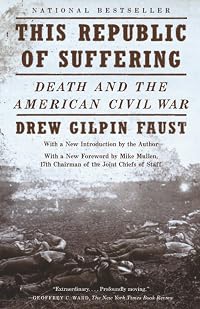
This Republic of Suffering: Death and the American Civil War
by Drew Gilpin Faust
On This Page
Description
An illuminating study of the American struggle to comprehend the meaning and practicalities of death in the face of the unprecedented carnage of the Civil War. During the war, approximately 620,000 soldiers lost their lives. An equivalent proportion of today's population would be six million. This book explores the impact of this enormous death toll from every angle: material, political, intellectual, and spiritual. Historian Faust delineates the ways death changed not only individual lives show more but the life of the nation and its understanding of the rights and responsibilities of citizenship. She describes how survivors mourned and how a deeply religious culture struggled to reconcile the slaughter with its belief in a benevolent God, and reconceived its understanding of life after death.--From publisher description. show lessTags
Recommendations
























Member Recommendations
by anonymous user
Member Reviews
An extremely grim, if absorbing, book. Faust takes a look at how both sides in the American Civil War treated the issue of their dead; he focuses mostly, though not exclusively, on the dead soldiers. The book marches through a logical progression, to wit: Dying, Killing, Burying, Naming, Realizing, Believing and Doubting, Accounting, and Numbering. One of the strongest things I got out of the book is how the war changed the way the United States dealt with its war dead; granted, the other wars previous to this (and subsequent to it) did not have the ferocious levels of dead that the Civil War did, it still strikes one that it was not just societal changes that made the treatment of the dead different. Technology, both in the killing and show more the recovery of the dead, had changed much. (After all, the railroads could send the boys to war, and bring their remains back.) The selection of illustrations is well-chosen. For the most part, Faust avoids trendy buzzwords in historiography (though gender stuff crops up a few times). Another thing, while I think of it, that crops up is how well Walt Whitman comes off in the book. The level of care he gave to wounded and dying soldiers says much about the man's basic decency; and of course, it enriched his own understanding and writing. A number of other reviews comment on how grim the book is. Undeniable, given the subject matter. If you can stick it, though, it's a good read. Recommended. show less
By focusing on the shared experience of death and loss Gilpin Faust frames the Civil War as a national experience rather than one of just North vs South. The author shows how the unprecedented carnage of modern warfare necessitated a shift in American understanding of death and dying that has pervaded the culture since. I can't help but read this account of crisis shaping culture in light of the current pandemic, especially the numbing effect of numbers.
Quote: "Americans had not just lost the dead; they had lost their own lives as they had understood them before the war."
Quote: "Americans had not just lost the dead; they had lost their own lives as they had understood them before the war."
Despite recommendations from those in tune with my interests, I went out of my way to avoid reading This Republic of Suffering: Death and the American Civil War, by Drew Gilpin Faust. Not only did the topic strike me as too gloomy and depressing, but I questioned the value of a book-length treatment of it. Then fate intervened and a copy came to me from an anonymous yet perspicacious “Secret Santa” via the annual holiday “Santathing” event sponsored by LibraryThing, the splendid online community especially fashioned for book nerds like me. Now I felt obligated.
As it turned out, This Republic of Suffering proved to be the perfect punctuation mark to my self-assigned intensive study of the Civil War during the sesquicentennial show more years. Over that time, I read some two dozen books on the conflict and its related themes, listened to countless hours of audio lectures in the car, watched film documentaries, visited battlefields – even digitized a rediscovered trove of Civil War correspondence and memoirs for a local museum, and spent a weekend seminar with legendary National Parks historian Ed Bearss that included tours of Antietam and Gettysburg. What could be missing?
As eminent historian and Harvard University president Drew Gilpin Faust brilliantly reminds us in this consequential study, what we have carelessly overlooked are the main characters: the sea of dead on both sides that totaled somewhere around 620,000 – about two percent of the nation’s population at the time, and a number equal to all dead in all other American wars through the Korean War! And these deaths did not simply epitomize a national tragedy, but they each represented a series of widespread individual tragedies for grieving mothers, fathers, wives, children and other members of extended families who were themselves victims of the Civil War even if they spent the war years hundreds or thousands of miles from the scenes of carnage that manifested these dead relations. This was a tangible and painful reality for millions of Americans touched by the war from a distance, but one that somehow had become lost to history until Faust neatly resurrected it here. It has been estimated that there have been in excess of fifty thousand books written on the Civil War since 1861, so it is somewhat astonishing when one is published that brings an entirely new perspective to what has been such an exhaustive study, but such is Faust’s triumph with This Republic of Suffering.
When we look back on mid-nineteenth century America from our twenty-first century standpoint, we cannot help but observe the prevalence of death for our relatively recent ancestors, in the explosive rates of infant mortality, in the numbers of women who perished in childbirth, in the much shorter average lifespans for those who lived in a time before modern medicine. But the inhabitants of that time could not see into the future. These grim realities were typical for their world. What was not typical, however, was the sudden loss of hundreds of thousands of men, most in their prime of life, over a brief four-year period. Two-thirds of these casualties may have succumbed to disease rather than bullets, but dead was dead, and these dead represented a significant segment of an entire generation that would be conspicuous in their absence for many decades after Appomattox. Faust deftly explores how this impacted both individual families and the nation at large, and how the survivors coped with such massive losses in practical, emotional and spiritual terms. Until This Republic of Suffering, this critical chunk of American history has been largely forgotten.
In the antebellum era, most Americans died at home rather than in today’s more commonly antiseptic hospital setting. Faust notes that there was a strong notion of an ars moriendi, a “Good Death,” that saw the end of life as a righteous path to heaven. The dead were tended to by their families; there were religious services and there was burial. The war changed all that. As Faust reveals, in the days before dog tags and databases, huge numbers of victims of munitions or measles went unidentified, leaving questions marks and a profound lack of closure for thousands upon thousands of families whose soldier boys never returned home. The task of seeking such closure was a significant priority after the war’s end, but so was the recovery of the remains, known and unknown, for proper reburial. For the victorious north, whose Union dead typically fell so far from home, this became both a private and a coordinated federal campaign. Embalming, then in its infancy, and sealed coffins capable of long distance shipment, all came into their own. So did the concept of great cemeteries to house the dead and memorialize them. And while charlatans who claimed to communicate with the other side preyed on many pitiful, grieving families, the more benign comforts of traditional religion and spirituality were also challenged and had to be refashioned for a different age that presided over losses of such magnitude in this cataclysmic war.
The Civil War still resonates to this day, which perhaps accounts for its ongoing fascination for us. Every great book about that war speaks to us for our own time, and this is true of This Republic of Suffering, as well, which contains a telling side note that seems to reinforce the notion that while the north won the war, it was indeed the south that won the peace. While I was reading this book, controversy was raging over the removal of Confederate monuments in southern cities. Those who sought to retain these often awkward shrines claimed that to remove them would be to dishonor Confederate dead. Yet ironically, as Faust reveals in her narrative, at least some of the north’s sense of urgency for recovering and relocating the bodies of the fallen was based upon the widespread reports of the deliberate defilement of Union remains in the states of the former Confederacy. Edmund B. Whitman, charged by the United States with heading up the effort to locate federals for reburial, noted that “he had witnessed the ‘total neglect’ or ‘wanton desecration’ of Union graves by a southern population whose ‘hatred of the dead’ seemed to exceed their earlier ‘abhorrence of the living.’” [p228]
This unpleasantness was to be set aside, along with much else, in the great reconciliation that marked the end of the nineteenth century, reestablishing legitimacy for the unfortunately “redeemed” south while trampling upon the rights of the formerly enslaved African-American population. In 1898, President McKinley made a speech heralding a new national policy to share in the care for Confederate graves. Frederick Douglass was gone by then, but had he overheard he likely would have chafed at the sentiment, an extension of honoring the dead of both sides which had gained currency some years before. “Death has no power to change moral qualities,” Douglass once lamented. “Whatever else I may forget,” he said, “I shall never forget the difference between those who fought for liberty and those who fought for slavery.” [p269]
I am very grateful that I read this work; my initial reluctance was well trumped by its quality content. While there are parts of this book that go on for too long, and certain details that perhaps clutter up the narrative which might better have been left to footnotes, the writing is generally crisp and compelling. Moreover, This Republic of Suffering stands as a remarkable achievement for Civil War scholarship, and Drew Gilpin Faust deserves high accolades for her efforts. I would pronounce this as nothing less than a must-read for students of the Civil War era and its aftermath.
[Note: A great web link sponsored by the Civil War Trust that explores Civil War casualties in some detail can be found here: http://www.civilwar.org/education/civil-war-casualties.html ]
My review of: "This Republic of Suffering: Death and the American Civil War," by Drew Gilpin Faust, on my book blog http://wp.me/p5Hb6f-62 show less
As it turned out, This Republic of Suffering proved to be the perfect punctuation mark to my self-assigned intensive study of the Civil War during the sesquicentennial show more years. Over that time, I read some two dozen books on the conflict and its related themes, listened to countless hours of audio lectures in the car, watched film documentaries, visited battlefields – even digitized a rediscovered trove of Civil War correspondence and memoirs for a local museum, and spent a weekend seminar with legendary National Parks historian Ed Bearss that included tours of Antietam and Gettysburg. What could be missing?
As eminent historian and Harvard University president Drew Gilpin Faust brilliantly reminds us in this consequential study, what we have carelessly overlooked are the main characters: the sea of dead on both sides that totaled somewhere around 620,000 – about two percent of the nation’s population at the time, and a number equal to all dead in all other American wars through the Korean War! And these deaths did not simply epitomize a national tragedy, but they each represented a series of widespread individual tragedies for grieving mothers, fathers, wives, children and other members of extended families who were themselves victims of the Civil War even if they spent the war years hundreds or thousands of miles from the scenes of carnage that manifested these dead relations. This was a tangible and painful reality for millions of Americans touched by the war from a distance, but one that somehow had become lost to history until Faust neatly resurrected it here. It has been estimated that there have been in excess of fifty thousand books written on the Civil War since 1861, so it is somewhat astonishing when one is published that brings an entirely new perspective to what has been such an exhaustive study, but such is Faust’s triumph with This Republic of Suffering.
When we look back on mid-nineteenth century America from our twenty-first century standpoint, we cannot help but observe the prevalence of death for our relatively recent ancestors, in the explosive rates of infant mortality, in the numbers of women who perished in childbirth, in the much shorter average lifespans for those who lived in a time before modern medicine. But the inhabitants of that time could not see into the future. These grim realities were typical for their world. What was not typical, however, was the sudden loss of hundreds of thousands of men, most in their prime of life, over a brief four-year period. Two-thirds of these casualties may have succumbed to disease rather than bullets, but dead was dead, and these dead represented a significant segment of an entire generation that would be conspicuous in their absence for many decades after Appomattox. Faust deftly explores how this impacted both individual families and the nation at large, and how the survivors coped with such massive losses in practical, emotional and spiritual terms. Until This Republic of Suffering, this critical chunk of American history has been largely forgotten.
In the antebellum era, most Americans died at home rather than in today’s more commonly antiseptic hospital setting. Faust notes that there was a strong notion of an ars moriendi, a “Good Death,” that saw the end of life as a righteous path to heaven. The dead were tended to by their families; there were religious services and there was burial. The war changed all that. As Faust reveals, in the days before dog tags and databases, huge numbers of victims of munitions or measles went unidentified, leaving questions marks and a profound lack of closure for thousands upon thousands of families whose soldier boys never returned home. The task of seeking such closure was a significant priority after the war’s end, but so was the recovery of the remains, known and unknown, for proper reburial. For the victorious north, whose Union dead typically fell so far from home, this became both a private and a coordinated federal campaign. Embalming, then in its infancy, and sealed coffins capable of long distance shipment, all came into their own. So did the concept of great cemeteries to house the dead and memorialize them. And while charlatans who claimed to communicate with the other side preyed on many pitiful, grieving families, the more benign comforts of traditional religion and spirituality were also challenged and had to be refashioned for a different age that presided over losses of such magnitude in this cataclysmic war.
The Civil War still resonates to this day, which perhaps accounts for its ongoing fascination for us. Every great book about that war speaks to us for our own time, and this is true of This Republic of Suffering, as well, which contains a telling side note that seems to reinforce the notion that while the north won the war, it was indeed the south that won the peace. While I was reading this book, controversy was raging over the removal of Confederate monuments in southern cities. Those who sought to retain these often awkward shrines claimed that to remove them would be to dishonor Confederate dead. Yet ironically, as Faust reveals in her narrative, at least some of the north’s sense of urgency for recovering and relocating the bodies of the fallen was based upon the widespread reports of the deliberate defilement of Union remains in the states of the former Confederacy. Edmund B. Whitman, charged by the United States with heading up the effort to locate federals for reburial, noted that “he had witnessed the ‘total neglect’ or ‘wanton desecration’ of Union graves by a southern population whose ‘hatred of the dead’ seemed to exceed their earlier ‘abhorrence of the living.’” [p228]
This unpleasantness was to be set aside, along with much else, in the great reconciliation that marked the end of the nineteenth century, reestablishing legitimacy for the unfortunately “redeemed” south while trampling upon the rights of the formerly enslaved African-American population. In 1898, President McKinley made a speech heralding a new national policy to share in the care for Confederate graves. Frederick Douglass was gone by then, but had he overheard he likely would have chafed at the sentiment, an extension of honoring the dead of both sides which had gained currency some years before. “Death has no power to change moral qualities,” Douglass once lamented. “Whatever else I may forget,” he said, “I shall never forget the difference between those who fought for liberty and those who fought for slavery.” [p269]
I am very grateful that I read this work; my initial reluctance was well trumped by its quality content. While there are parts of this book that go on for too long, and certain details that perhaps clutter up the narrative which might better have been left to footnotes, the writing is generally crisp and compelling. Moreover, This Republic of Suffering stands as a remarkable achievement for Civil War scholarship, and Drew Gilpin Faust deserves high accolades for her efforts. I would pronounce this as nothing less than a must-read for students of the Civil War era and its aftermath.
[Note: A great web link sponsored by the Civil War Trust that explores Civil War casualties in some detail can be found here: http://www.civilwar.org/education/civil-war-casualties.html ]
My review of: "This Republic of Suffering: Death and the American Civil War," by Drew Gilpin Faust, on my book blog http://wp.me/p5Hb6f-62 show less
One might say "another book about the Civil War, why?" but this is a remarkable effort. Gilpin looks at death in mid19th Century America with the focus on the Civil War and how the country handled the 600,000 plus deaths that came about because of the war. She organized the volume in chapters that focused on the idea of dying, the rules of burial, how to mark graves when you do not know the name of the soldier you are burying, the impact of all these deaths on the civilian population, what did the country owe to all these dead men in terms of recognition of where their final resting place was and the cost to the country and its people by the loss of all these men.
I approached this volume anticipating reading a scholarly tome but while show more she conducted great amounts of research and the notes and bibliography are immense, this turned out to be a page turner for me. Gilpin fills the pages with anecdotes from diaries, newspapers and memoires to illustrate her points. show less
I approached this volume anticipating reading a scholarly tome but while show more she conducted great amounts of research and the notes and bibliography are immense, this turned out to be a page turner for me. Gilpin fills the pages with anecdotes from diaries, newspapers and memoires to illustrate her points. show less
About America's national PTSD in the wake of the Civil War. More than 600,000 soldiers died - an equivalent proportion of today's population would be six million. That doesn't include the wounded, and civilian casualties. Americans had to realize the enormity of what had happened to their country, to every family, to do the work of burying, naming, accounting, and numbering.
Both sides assumed the conflict would last a couple of months. Neither planned for care of the wounded, housing prisoners, identification of the missing and the dead. The military had no formal muster rolls, no organized way of identifying the dead and wounded.
To find what had happened, family members traveled to battle sites to try to find missing soldiers. Can you show more imagine knowing your son or father had fought in a battle you read about in the paper, and then no word from him? For months? Sometimes the missing one turned up in a hospital or prison camp; sometimes a letter describing his death and burial would come from a commander or fellow soldier; sometimes they never knew. Families wanted to know if their dear one had had a "good death". Was he a believer, was he willing to die? Letters sent from the front have descriptions like "the calm repose of his countenance indicated the departure of one at peace with God."
The numbers were staggering, unimaginable. At the same time, a story lay behind every death. Every individual's loss was a heartbreak. Both sides realized they must name and count the dead and wounded, find every body and identify and bring home as many as possible. Vast cemeteries must be created. By the last year of the war the Army sent special units to search for and retrieve the bodies of Union soldiers, which were being desecrated in the South. African-American Southerners helped protect and identify some of these graves. Confederate women formed their own burial associations to care for their dead.
Before the war most Americans weren't embalmed. Why would they be? They died and were buried close to home. Before the war, Americans pictured Heaven and the afterlife as a place where disembodied souls spent eternity in the presence of God. In the wake of the war came books that pictured lost sons and fathers in a Heaven like their earthly homes, where bodies were made whole again, amputated limbs restored. Some believers looked forward to being reunited with their lost ones after death; others lost their faith. What kind of God could allow such suffering? Spiritualism, table tapping, communing with the dead all became popular, as they do in the wake of every war.
This is a terrific, detailed, moving book. show less
Both sides assumed the conflict would last a couple of months. Neither planned for care of the wounded, housing prisoners, identification of the missing and the dead. The military had no formal muster rolls, no organized way of identifying the dead and wounded.
To find what had happened, family members traveled to battle sites to try to find missing soldiers. Can you show more imagine knowing your son or father had fought in a battle you read about in the paper, and then no word from him? For months? Sometimes the missing one turned up in a hospital or prison camp; sometimes a letter describing his death and burial would come from a commander or fellow soldier; sometimes they never knew. Families wanted to know if their dear one had had a "good death". Was he a believer, was he willing to die? Letters sent from the front have descriptions like "the calm repose of his countenance indicated the departure of one at peace with God."
The numbers were staggering, unimaginable. At the same time, a story lay behind every death. Every individual's loss was a heartbreak. Both sides realized they must name and count the dead and wounded, find every body and identify and bring home as many as possible. Vast cemeteries must be created. By the last year of the war the Army sent special units to search for and retrieve the bodies of Union soldiers, which were being desecrated in the South. African-American Southerners helped protect and identify some of these graves. Confederate women formed their own burial associations to care for their dead.
Before the war most Americans weren't embalmed. Why would they be? They died and were buried close to home. Before the war, Americans pictured Heaven and the afterlife as a place where disembodied souls spent eternity in the presence of God. In the wake of the war came books that pictured lost sons and fathers in a Heaven like their earthly homes, where bodies were made whole again, amputated limbs restored. Some believers looked forward to being reunited with their lost ones after death; others lost their faith. What kind of God could allow such suffering? Spiritualism, table tapping, communing with the dead all became popular, as they do in the wake of every war.
This is a terrific, detailed, moving book. show less
Death, dying, and killing in the Civil War. Faust argues that the scale of the Civil War transformed the meanings and modes of death, both for fighting men and for the civilians left behind—often left for months in ignorance of whether the soliders they cared about had survived or perished. Her accounts of how soldiers performed, or attempted to perform, “a good death” showed just how much social meaning shapes us, even in extremis. Race of course played a big role, both in how willing Southern whites were to kill Northern soldiers and in how living and dead black soldiers were treated. Before the Civil War, no one kept track of soldiers’ deaths in a systematic way; after, there was a massive effort both to identify the dead and show more change recordkeeping so people wouldn’t lose track of so many bodies and gravesites. Really interesting read. show less
Written with a studied calm, This Republic of Suffering carefully teases out bits of meaning in the rubble created by the American Civil War. Unlike many war chronicles, there is little here to gratify base interest in the macabre – although it is a book whose central subject is the lineaments of corporeal mayhem.
In addition to Ms. Faust's laudable ability to write cogently and engagingly, she has also structured her book in an immensely gratifying manner. The first few chapters read like a conventional history of a neglected aspect of the Civil War, but by the end of the book the repercussions of what she has described become clear. Consequently, the reader comes not only to understand some fresh aspect of our contemporary attitudes show more about death and warfare, but also that those selfsame attitudes are protean, impermanent, and trace their pedigree to very specific individuals and actions. Things we take for granted or chalk up as simple commonsense ideas (i.e., the rightness of recovering and honoring fallen soldiers) turn out to be shockingly modern. This knowledge casts new light on how our current behavior might affect the attitudes and behaviors of future generations; particularly since so much of the post-mortem activity that followed the Civil War was largely undocumented (even ignored) and yet decidedly precedent-setting.
This is a meditation on death as well as our attitudes about sacrifice and community. As such, it is a great deal more rewarding than a typical historical account. show less
In addition to Ms. Faust's laudable ability to write cogently and engagingly, she has also structured her book in an immensely gratifying manner. The first few chapters read like a conventional history of a neglected aspect of the Civil War, but by the end of the book the repercussions of what she has described become clear. Consequently, the reader comes not only to understand some fresh aspect of our contemporary attitudes show more about death and warfare, but also that those selfsame attitudes are protean, impermanent, and trace their pedigree to very specific individuals and actions. Things we take for granted or chalk up as simple commonsense ideas (i.e., the rightness of recovering and honoring fallen soldiers) turn out to be shockingly modern. This knowledge casts new light on how our current behavior might affect the attitudes and behaviors of future generations; particularly since so much of the post-mortem activity that followed the Civil War was largely undocumented (even ignored) and yet decidedly precedent-setting.
This is a meditation on death as well as our attitudes about sacrifice and community. As such, it is a great deal more rewarding than a typical historical account. show less
Members
- Recently Added By
Published Reviews
ThingScore 75
A moving work of social history, detailing how the Civil War changed perceptions and behaviors about death.
added by Richardrobert
Battle is the dramatic centerpiece of Civil War history; this penetrating study looks instead at the somber aftermath. Historian Faust (Mothers of Invention ) notes that the Civil War introduced America to death on an unprecedented scale and of an unnatural kind—grisly, random and often ending in an unmarked grave far from home.
added by Richardrobert
Lists

2008-2012 Notable Books for Adults
127 works; 10 members

Deathreads
78 works; 2 members

Books Read in College
80 works; 5 members

THE WAR ROOM
813 works; 24 members

Books recommended in the history category on FiveBooks.com
329 works; 4 members

Books Cited in Digging Up the Dead by Michael Kammen
183 works; 1 member
Author Information

9+ Works 3,136 Members
Some Editions
Awards and Honors
Awards
Distinctions
Common Knowledge
- Original title
- This Republic of Suffering: Death and the American Civil War
- Original publication date
- 2008
- Important places
- USA
- Important events
- American Civil War (1861 | 1865); Battle of Shiloh (1862-04-06 | 1862-04-07)
- Related movies
- Death and the Civil War (2012 | IMDb)
- Dedication
- In Memory
of
McGhee Tyson Gilpin
1919-2000
Captain, U.S. Army
Commanding Officer
Military Intelligence Interpreter Team #436
6th Armored Division
Wounded August 6, 1944
Plouviens, France<... (show all)br>
Silver Star
Purple Heart
Croix de Guerre - First words
- Mortality defines the human condition.
- Last words
- (Click to show. Warning: May contain spoilers.)We still work to live with the riddle that they -- the Civil War dead and their survivors alike -- had to solve so long ago.
- Blurbers
- McPherson, James M.; Horowitz, Tony; Gallagher, Gary W.; Blight, David W.
Classifications
Statistics
- Members
- 2,104
- Popularity
- 9,813
- Reviews
- 54
- Rating
- (3.99)
- Languages
- English
- Media
- Paper, Audiobook, Ebook
- ISBNs
- 12
- ASINs
- 12