On This Page
Description
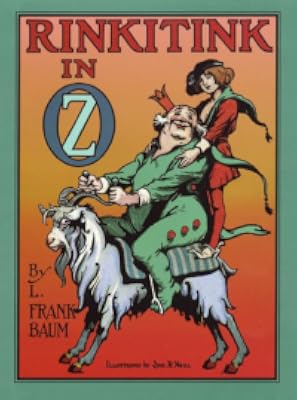
Like many of author L. Frank Baum's Oz and non-Oz novels, Rinkitink in Oz is a quest story that follows King Rinkitink and his traveling companion Princess Inga on a long and perilous journey through the land of the Nomes, and finally, to Oz itself. Although most of the action in the novel is only tangentially related to the primary cast of well-known Oz characters, Baum's rich imagination shines through, making this an engaging read for fans of the fantasy fiction genre..
Tags
Recommendations













Member Reviews
I feel sorry for L. Frank Baum. Dorothy was so popular that his audience clamored for more of her, but this book proves that she really is not needed. A very entertaining story in which Baum brings in Dorothy at the end simply to make his readers happy. The story could easily have been written without her and would probably have been even better. I enjoyed Rinkitink and Bilbil very much. And Prince Inga was a strong serious heroic character who shouldn't have needed any help from Oz. I wish he'd been able to write what he wanted and not what his audience demanded because his imagination really knew no bounds.
To my surprise, this 10th book in the Oz series is actually one of the best. Rather than just being about a bunch of random characters wandering from A to B meeting wacky characters and imaginative lands and facing no peril, here we have an actual structured plot, a hero with goals and loads of peril to overcome. Yet again however it is not an Oz story. We know that the land of Oz is surrounded by the deadly desert and that on one side of this is the land of Ev and the Nome King's kingdom. Apparently on the other side of THIS, is the country of Rinkitink, and in the ocean nearby is the island nation of Pingaree, and further out are the twin islands of Regos and Coregos. This story is about a war between Pingaree and Regos. The warriors show more of Regos abduct all the people of Pingaree and pillage their island, so the young Prince of Pingaree must travel to the twin islands to free his people. Also the King of Rinkitink is with him, though I don't know why the book is named after him and he is in no way affiliated with Oz so the title is just a lie. The story is set in lands near Oz, but unlike other stories in the series that did similar things, it isn't about any characters who have any connection to Oz. In fact, there is a conversation with the Nome King making it quite clear that these characters have nothing to do with Oz (he doesn't want any beef with Oz). NOT AN OZ BOOK. But then on page 169 of this 194 page novel, it suddenly, rudely becomes part of Oz canon and all agency is taken away from our hero who has been doing exceptionally well until now. So it is rather a let down. I think Baum just had a good story but no clear way to link it into his most profitable series.
NB the book I own is clearly called Rinkitink OF Oz, this title is repeated on the copyright page as well, but Goodreads (and Wikipedia) lists it as Rinkitink IN Oz, which I guess is slightly more accurate though still not at all representative of the story as he only spends one chapter in Oz. show less
NB the book I own is clearly called Rinkitink OF Oz, this title is repeated on the copyright page as well, but Goodreads (and Wikipedia) lists it as Rinkitink IN Oz, which I guess is slightly more accurate though still not at all representative of the story as he only spends one chapter in Oz. show less
Rinkitink in Oz, like The Scarecrow of Oz opens outside of Oz and mostly takes place there, too. The protagonist is Prince Inga of Pingaree; his peaceful island nation is sacked by raiders from the islands of Regos and Coregos, and his parents kidnapped. Along with King Rinkitink of Rinkitink and the king's talking goat Bilbil, Inga has to travel to Regos and Coregos to liberate his people, and then go to the Nome Kingdom to find his parents. Near the end, though, Dorothy and the Wizard come to help him, and the character briefly visit Oz.
I didn't know the circumstances of this book's creation when I was a child. Baum wrote what was initially called King Rinkitink around 1905, after he had written just two Oz books, and a few non-Oz show more fantasies, including The Life and Adventures of Santa Claus. He never published King Rinkitink, though, and thus when he didn't have time to write a new Oz book in 1916, he pulled King Rinkitink out of a drawer, edited some of the continuity to make it fit what had happened in the Oz books (particularly the deposition of the Nome King in Tik-Tok of Oz), and totally replaced the ending so that Dorothy showed up to save the day. (He must have been thinking of somehow incorporating Rinkitink into the Oz mythos for some time, though, since the countries from it all appear on the map in the Tik-Tok endpapers, published in 1914.)
Something I never noticed until reading it aloud to a three-year-old is that it's very different tonally from most other Oz books. The dangers in Oz books are often very abstract, things that it's hard to be scared of. But in Rinkitink, the raiders from Regos and Coregos go around destroying buildings and whole societies; Inga's parents are constantly being threatened with destruction. It's more of a boy's adventure story than the gentle fantasies of most Oz novels. My son reacted very strongly to this, often crying out "no!" and hiding under the sheets as I read and telling me it was very scary. Though when I asked if I should stop reading it, he said, "No, I like being scared." But still he continued to react strongly, and it was enough that my wife suggested that maybe I shouldn't be reading him the Oz books until he is older. But my memory is that Rinkitink is very much an outlier in this way, and if we got through it, things ought to return to normal.
I asked my son what he thought of it when we were done, and he said, "I liked the good parts and didn't like the bad parts." Well, fair enough. The "bad parts," on probing, were any time anything was destroyed, or anyone was threatened with destruction. The good parts were all the rest of it.
I don't really remember what I thought of the book as a kid, but I enjoyed it as an adult. Baum has a tendency to undercut his protagonists, but here, even though Inga is aided by some Magic Pearls (given to his ancestors by a mermaid queen, presumably the same one we met in The Sea Fairies), he shows himself to be brave, resourceful, and clever, reasoning his own way out of many of the tricky situations he ends up in. Dorothy saving him in the ending is a little frustrating, but before that, Inga has managed to escape death at the hands of the Nome King many times, and I didn't find it too bad. What did bother me is that the King of Regos and Queen of Coregos die off-page through the total happenstance of their boat hitting a storm! No comeuppance for Inga there.
Unfortunately, the original manuscript to King Rinkitink no longer exists, so we don't know how Inga would have saved his parents without Dorothy's intervention. The International Wizard of Oz Club ran a competition in 2017 for fans to come up with an alternative ending without Oz elements, and published the winner as a new edition called King Rinkitink; I'll have to check it out at some point.
If King Rinkitink had been published when originally intended, it would have been the first appearance of the Nome King (aside from a minor cameo in Life and Adventures of Santa Claus), but by the time Rinkitink in Oz came out, the Nomes had been the antagonists in three Oz novels: Ozma, Emerald City, and Tik-Tok. In Tik-Tok, the original Nome King, Ruggedo né Roquat, is deposed, and he is replaced by his own chief steward, Kaliko. As a result, Baum seemingly just went through the Rinkitink manuscript and replaced the name. Some people argue that this results in a discontinuity: Kaliko is a nicer ruler in Tik-Tok than Ruggedo had been, but in Rinkitink, he enchants Inga's parents and will not let them go. I think people who argue this, though, are overlooking that Kaliko is not "nicer" in the sense that he is a "good person" overall. Rather, Kaliko is "nicer" in two ways: one, he is less cruel toward the Nomes themselves and thus a more popular ruler, and two, he is more deferential to people from Oz because they have more power than the Nomes and have defeated them on many occasions. Kaliko has no reason to be nice to Inga, and indeed, being nice to Inga would require him to break his word to Regos and Coregos, and we know from Ozma of Oz the extent to which Nomes will go to keep their deals. But as soon as Dorothy and the Wizard show up, Kaliko is highly deferential. It's all politics! As always, I enjoyed getting to use my very snobby-but-deferential Kaliko voice, especially with Kaliko being king. I had him always saying quite terrible things to Inga and Rinkitink, but sounding very apologetic in doing so.
Note that the Wizard considers Bilbil very unusual because he's a talking animal even though he's never been to Oz... but he meets Bilbil in the Nome Kingdom, which lies underneath the Land of Ev, and in Ozma of Oz the ordinary American chicken Billina becomes capable of speech when she arrives in Ev.
The other thing that occurred to me on this read is that people from Pingaree age normally. This would be quite sad if you think about it: Inga may be good friends with Dorothy now because they are seemingly the same age, but in another couple decades, Dorothy will still be about ten while Inga will be an adult, and by the present day, Dorothy will still be about ten... but Inga will be dead! Dorothy may live forever, but she can never be friends with someone from outside Oz. I am given to understand, though, that Inga does return in Sherwood Smith's Trouble under Oz (2006), so I am curious to see how she handles this issue. Only forty-two more books until we find out! show less
I didn't know the circumstances of this book's creation when I was a child. Baum wrote what was initially called King Rinkitink around 1905, after he had written just two Oz books, and a few non-Oz show more fantasies, including The Life and Adventures of Santa Claus. He never published King Rinkitink, though, and thus when he didn't have time to write a new Oz book in 1916, he pulled King Rinkitink out of a drawer, edited some of the continuity to make it fit what had happened in the Oz books (particularly the deposition of the Nome King in Tik-Tok of Oz), and totally replaced the ending so that Dorothy showed up to save the day. (He must have been thinking of somehow incorporating Rinkitink into the Oz mythos for some time, though, since the countries from it all appear on the map in the Tik-Tok endpapers, published in 1914.)
Something I never noticed until reading it aloud to a three-year-old is that it's very different tonally from most other Oz books. The dangers in Oz books are often very abstract, things that it's hard to be scared of. But in Rinkitink, the raiders from Regos and Coregos go around destroying buildings and whole societies; Inga's parents are constantly being threatened with destruction. It's more of a boy's adventure story than the gentle fantasies of most Oz novels. My son reacted very strongly to this, often crying out "no!" and hiding under the sheets as I read and telling me it was very scary. Though when I asked if I should stop reading it, he said, "No, I like being scared." But still he continued to react strongly, and it was enough that my wife suggested that maybe I shouldn't be reading him the Oz books until he is older. But my memory is that Rinkitink is very much an outlier in this way, and if we got through it, things ought to return to normal.
I asked my son what he thought of it when we were done, and he said, "I liked the good parts and didn't like the bad parts." Well, fair enough. The "bad parts," on probing, were any time anything was destroyed, or anyone was threatened with destruction. The good parts were all the rest of it.
I don't really remember what I thought of the book as a kid, but I enjoyed it as an adult. Baum has a tendency to undercut his protagonists, but here, even though Inga is aided by some Magic Pearls (given to his ancestors by a mermaid queen, presumably the same one we met in The Sea Fairies), he shows himself to be brave, resourceful, and clever, reasoning his own way out of many of the tricky situations he ends up in. Dorothy saving him in the ending is a little frustrating, but before that, Inga has managed to escape death at the hands of the Nome King many times, and I didn't find it too bad. What did bother me is that the King of Regos and Queen of Coregos die off-page through the total happenstance of their boat hitting a storm! No comeuppance for Inga there.
Unfortunately, the original manuscript to King Rinkitink no longer exists, so we don't know how Inga would have saved his parents without Dorothy's intervention. The International Wizard of Oz Club ran a competition in 2017 for fans to come up with an alternative ending without Oz elements, and published the winner as a new edition called King Rinkitink; I'll have to check it out at some point.
If King Rinkitink had been published when originally intended, it would have been the first appearance of the Nome King (aside from a minor cameo in Life and Adventures of Santa Claus), but by the time Rinkitink in Oz came out, the Nomes had been the antagonists in three Oz novels: Ozma, Emerald City, and Tik-Tok. In Tik-Tok, the original Nome King, Ruggedo né Roquat, is deposed, and he is replaced by his own chief steward, Kaliko. As a result, Baum seemingly just went through the Rinkitink manuscript and replaced the name. Some people argue that this results in a discontinuity: Kaliko is a nicer ruler in Tik-Tok than Ruggedo had been, but in Rinkitink, he enchants Inga's parents and will not let them go. I think people who argue this, though, are overlooking that Kaliko is not "nicer" in the sense that he is a "good person" overall. Rather, Kaliko is "nicer" in two ways: one, he is less cruel toward the Nomes themselves and thus a more popular ruler, and two, he is more deferential to people from Oz because they have more power than the Nomes and have defeated them on many occasions. Kaliko has no reason to be nice to Inga, and indeed, being nice to Inga would require him to break his word to Regos and Coregos, and we know from Ozma of Oz the extent to which Nomes will go to keep their deals. But as soon as Dorothy and the Wizard show up, Kaliko is highly deferential. It's all politics! As always, I enjoyed getting to use my very snobby-but-deferential Kaliko voice, especially with Kaliko being king. I had him always saying quite terrible things to Inga and Rinkitink, but sounding very apologetic in doing so.
Note that the Wizard considers Bilbil very unusual because he's a talking animal even though he's never been to Oz... but he meets Bilbil in the Nome Kingdom, which lies underneath the Land of Ev, and in Ozma of Oz the ordinary American chicken Billina becomes capable of speech when she arrives in Ev.
The other thing that occurred to me on this read is that people from Pingaree age normally. This would be quite sad if you think about it: Inga may be good friends with Dorothy now because they are seemingly the same age, but in another couple decades, Dorothy will still be about ten while Inga will be an adult, and by the present day, Dorothy will still be about ten... but Inga will be dead! Dorothy may live forever, but she can never be friends with someone from outside Oz. I am given to understand, though, that Inga does return in Sherwood Smith's Trouble under Oz (2006), so I am curious to see how she handles this issue. Only forty-two more books until we find out! show less
This was such a fun story. I loved the characters, although Rinkitink was annoying at times with his constant laughing and references to not being able to do things because he was too fat. Oz doesn’t feature much in the story, and it carries on fine as a stand alone tale without it. But I guess as a publishing venture, it was best to keep it in the Oz franchise.
If Baum had just had the courage of his convictions - or not been looking to make a quick buck - we might laud King Rinkitink as the best of his non-Oz fantasies today. As it is, we don't know why he abandoned the book originally, but he chose to revive it as an Oz story by slapping a brand new ending on that functioned as a deus ex machina, reintroducing favorite old characters and dragging everyone to the Emerald City. Effectively, it ruins what has up to that point been a superlative fantasy-adventure novel. I didn't like the book much as a child because there wasn't a lot of Oz in it, but today, I can see it for what it is. I wish I could read Baum's original version because I'm sure that was even better.
Meet Rinkitink--a kindhearted king who's as fat and jolly as old Saint Nick himself! When the jovial monarch sails for a visit to the island kingdom of Pingaree, he and his talking goat, Bilbil, are welcomed with open arms. Before long, Rinkitink's lighthearted ways and merry songs endear him to the king and queen of Pingaree, as well as to their son, Prince Inga.
But when the peaceful isle is invaded by fierce warriors, everyone from the rulers to the smallest child is taken off in chains. Only Prince Inga, Rinkitink, and Bilbil escape the conquerors. And so the three friends set out--aided by the magical Pearls of Pingaree--to rescue the prince's people.
Their perilous quest takes them across the vast Nonestic Ocean to the terrible show more islands of Regos and Coregos to the dark underground domains of the Nome King. Victories are followed by setbacks, which are in turn followed by strokes of good fortune. Just when it seems our friends have met their match in the clever Nome King, Dorothy and the Wizard of Oz arrive to lend a hand. show less
But when the peaceful isle is invaded by fierce warriors, everyone from the rulers to the smallest child is taken off in chains. Only Prince Inga, Rinkitink, and Bilbil escape the conquerors. And so the three friends set out--aided by the magical Pearls of Pingaree--to rescue the prince's people.
Their perilous quest takes them across the vast Nonestic Ocean to the terrible show more islands of Regos and Coregos to the dark underground domains of the Nome King. Victories are followed by setbacks, which are in turn followed by strokes of good fortune. Just when it seems our friends have met their match in the clever Nome King, Dorothy and the Wizard of Oz arrive to lend a hand. show less
I love the Oz books. Rinkitink is a jolly king with a talking goat who has to go on a dangerous journey with young Prince Inga. As a matter of fact, they’re not in Oz but in a nearby fantastical land. Prince Inga has three magical pearls that guide him, and he tries to hide two of them in the pointy toes of his shoes. But the shoes get thrown away and then they’re really in trouble. You think you won’t see Dorothy but at the last minute she and the Wizard and Ozma show up to save the day.
Usually you can count on the Oz books to leave out the racist garbage that is so prevalent in the books of this time period, but there was a horrible bit at the end of this one that I had forgotten which involves transforming the talking goat show more back into Prince Bobo of Boboland, and there’s even an illustration. If I were reading this book out loud to a young child I would skip over that part.
Unfortunately there aren’t that many Oz books left as L. Frank Baum is due to die in 1919. Do you think I should keep on reading the sequels by Ruth Plumly Thompson, who took over the series after Baum’s death? I have a couple years to make up my mind. show less
Usually you can count on the Oz books to leave out the racist garbage that is so prevalent in the books of this time period, but there was a horrible bit at the end of this one that I had forgotten which involves transforming the talking goat show more back into Prince Bobo of Boboland, and there’s even an illustration. If I were reading this book out loud to a young child I would skip over that part.
Unfortunately there aren’t that many Oz books left as L. Frank Baum is due to die in 1919. Do you think I should keep on reading the sequels by Ruth Plumly Thompson, who took over the series after Baum’s death? I have a couple years to make up my mind. show less
Members
- Recently Added By
Lists

Favorite Childhood Books
1,651 works; 519 members
NPRs Ultimate Backseat Bookshelf: 100 Must-Reads for kids 9-14
222 works; 30 members

Carole's List
445 works; 13 members

Geek Dad Read to Your Kids Additions List
66 works; 4 members

All Things Oz
32 works; 2 members

First published in 1916
68 works; 4 members

Books Read in 2020
4,379 works; 124 members

1910s
90 works; 16 members

Books Read in 2014
2,344 works; 89 members

Children's Literature 1900 - 1950 in order
413 works; 8 members

Books Read in 2025
4,128 works; 98 members
Author Information

606+ Works 72,904 Members
Best known as the author of the Wizard of Oz series, Lyman Frank Baum was born on May 15, 1856, in New York. When Baum was a young man, his father, who had made a fortune in oil, gave him several theaters in New York and Pennsylvania to manage. Eventually, Baum had his first taste of success as a writer when he staged The Maid of Arran, a show more melodrama he had written and scored. Married in 1882 to Maud Gage, whose mother was an influential suffragette, the two had four sons. Baum often entertained his children with nursery rhymes and in 1897 published a compilation titled Mother Goose in Prose, which was illustrated by Maxfield Parrish. The project was followed by three other picture books of rhymes, illustrated by William Wallace Denslow. The success of the nursery rhymes persuaded Baum to craft a novel out of one of the stories, which he titled The Wonderful Wizard of Oz. Some critics have suggested that Baum modeled the character of the Wizard on himself. Other books for children followed the original Oz book, and Baum continued to produce the popular Oz books until his death in 1919. The series was so popular that after Baum's death and by special arrangement, Oz books continued to be written for the series by other authors. Glinda of Oz, the last Oz book that Baum wrote, was published in 1920. (Bowker Author Biography) show less
Some Editions
Series


Belongs to Publisher Series
Work Relationships
Is contained in
Is retold in
Has the adaptation
Is abridged in
Common Knowledge
- Canonical title
- Rinkitink in Oz
- Original title
- Rinkitink in Oz
- Original publication date
- 1916
- People/Characters
- Inga; Rinkitink; Bilbil; Kaliko; Nome King
- Important places
- Oz; Pingaree
- Dedication
- To My New Grandson - Robert Alison Baum
- First words
- If you have a map of the land of Oz handy, you will find that the great Nonestic Ocean washes the shores of the Kingdom of Rinkitink, between which and the land of Oz lies a strip of the country of the Nome King and a Sandy D... (show all)esert.
- Last words
- (Click to show. Warning: May contain spoilers.)"Like all your songs, dear Rinkitink, the sentiment far exceeds the poetry."
- Original language
- English
Classifications
- Genres
- Fiction and Literature, Kids, Fantasy
- DDC/MDS
- 813.52 — Literature & rhetoric American literature in English American fiction in English 1900-1999 1900-1945
- LCC
- PZ7 .B327 .R — Language and Literature Fiction and juvenile belles lettres Fiction and juvenile belles lettres Juvenile belles lettres
- BISAC
Statistics
- Members
- 1,404
- Popularity
- 16,935
- Reviews
- 22
- Rating
- (3.84)
- Languages
- English, Italian, Swedish, Ukrainian
- Media
- Paper, Audiobook, Ebook
- ISBNs
- 128
- UPCs
- 3
- ASINs
- 43