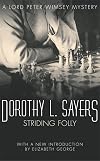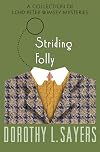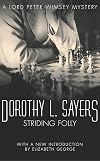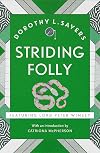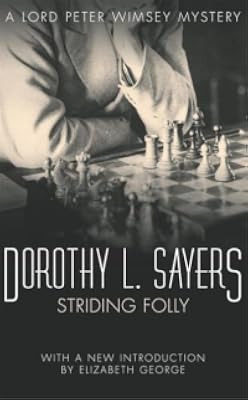
Striding Folly: Three Lord Peter Wimsey Mysteries
by Dorothy L. Sayers
Peter Wimsey & Harriet Vane (4.5), Lord Peter Wimsey (15, short stories)
On This Page
Description
In his final 3 stories, Lord Peter confronts the greatest mystery of all: fatherhood. For decades, Lord Peter Wimsey has made life tough for England's criminal class. In town and country he solved some of the most baffling mysteries of the Jazz Age, facing down killers armed only with wit, charm, and a keen nose for deception. His work brought him 1 great reward: the love of beautiful mystery novelist Harriet Vane. After years of pleading, he has finally convinced her to marry him. Now the show more real adventure begins. In the final 3 Wimsey stories, Lord Peter confronts land barons, killers, and the terror that comes from raising 3 young sons. Through it all, his clear thinking never fails him, and he solves these last puzzles as successfully as he did his 1st. He may be a family man now, but like good wine, a great detective only gets better with age. Striding Folly is the 15th book in the Lord Peter Wimsey Mysteries, but you may enjoy the series by reading the books in any order. This ebook features an illustrated biography of Dorothy L. Sayers including rare images from the Marion E. Wade Center at Wheaton College. show lessTags
Recommendations















Member Reviews
As a teen I loved the Lord Peter Wimsey mysteries, and read them all after seeing a couple of the BBC productions starring Ian Carmichael. So when I found a book by the same author, and about Lord Peter Wimsey, I expected a winner. Unfortunately, I was underwhelmed. This volume includes an incredibly long introduction (31 pages!) and three short stories/novellas.
Problems? There wasn't much mystery or suspense. Or maybe Wimsey just doesn't work as well in a shorter format, at least not for me. Or maybe my tastes have changed four decades later. I have no plans for a reread of what I considered to be pablum.
Problems? There wasn't much mystery or suspense. Or maybe Wimsey just doesn't work as well in a shorter format, at least not for me. Or maybe my tastes have changed four decades later. I have no plans for a reread of what I considered to be pablum.
This is a small book, containing only three stories, prefaced by a passionate verbal portrait of Sayers herself, written by Janet Hitchman. Having read the preface, I initially found the first story a let down, but as I progressed through the collection I was more and more fascinated.
The title story, while interesting, was possibly the weakest of the stories across the two collections, with surreal dream sequences, and tortuous plot logic. The other two stories, which as asides show us Wimsey as family man, were more interesting. Having said that, some of the same surreal quality is seen in the second story ("The Haunted Policeman"), told through two viewpoints - that of Wimsey, who has stayed up late while his wife is giving birth, show more and a local copper (P C Burt) who Wimsey has lured in to tell of the odd events of the night. But here the surreal quality feels more justified - the reality of the copper's experience really was peculiar, and across the telling of the story both Wimsey and Burt become more and more drunk on Wimsey's celebratory champagne, leading to believably vague characterisation.
The final story reads as allegory about the role of society and the family in the rearing of children, with interferring society embodied in the visiting Miss Quirk, who neither Wimsey nor his wife Harriet seem to have any real connection with, but who has been foisted upon them. Woven in amongst the mystery of who, exactly, has stolen which of a neighours peaches, is a pointed commentary on discipline of children and the long-term effects thereof. I'm not convinced that the arguments necessarily held up at the time of writing, and they are very much contrary to what I consider to be current child-rearing wisdom, but as extremes of view and arguments either way, there is an interesting juxtaposition. show less
The title story, while interesting, was possibly the weakest of the stories across the two collections, with surreal dream sequences, and tortuous plot logic. The other two stories, which as asides show us Wimsey as family man, were more interesting. Having said that, some of the same surreal quality is seen in the second story ("The Haunted Policeman"), told through two viewpoints - that of Wimsey, who has stayed up late while his wife is giving birth, show more and a local copper (P C Burt) who Wimsey has lured in to tell of the odd events of the night. But here the surreal quality feels more justified - the reality of the copper's experience really was peculiar, and across the telling of the story both Wimsey and Burt become more and more drunk on Wimsey's celebratory champagne, leading to believably vague characterisation.
The final story reads as allegory about the role of society and the family in the rearing of children, with interferring society embodied in the visiting Miss Quirk, who neither Wimsey nor his wife Harriet seem to have any real connection with, but who has been foisted upon them. Woven in amongst the mystery of who, exactly, has stolen which of a neighours peaches, is a pointed commentary on discipline of children and the long-term effects thereof. I'm not convinced that the arguments necessarily held up at the time of writing, and they are very much contrary to what I consider to be current child-rearing wisdom, but as extremes of view and arguments either way, there is an interesting juxtaposition. show less
Only one of the three short stories in this collection is a murder mystery, and Lord Peter Wimsey appears only briefly in the one with the murder. The title story, “Striding Folly,” has an air of the supernatural about it, as the central figure escapes a murder charge only because of a dream he had the night before. Had he not acted in accordance with the dream, Wimsey would have had little to detect.
“The Haunted Policeman” takes place immediately following the birth of Lord Peter and Harriet’s first son. A shaken Lord Peter steps outside for a smoke and encounters a policeman new to the beat. The policeman is rattled about something he has just witnessed, and Lord Peter loosens his tongue with celebratory champagne. An easily show more solved puzzle is just what Lord Peter needs to relieve the stress that built up during his anxiety for Harriet’s well-being during her hours of labor and childbirth.
“Talboys” is my favorite of the three stories. Seven years after their honeymoon at Talboys, Lord Peter and Harriet are on holiday there with their three young sons. The eldest, Bredon, gets into mischief with a neighbor’s peaches. No harm is done and all is forgiven. However, the very next night all of the peaches on the tree disappear. Lord Peter and Harriet’s unwanted house guest, Miss Quirk, insists that she can prove that Bredon is guilty this time, too. Lord Peter must find out what really happened to the peaches in order to prove Bredon’s innocence. Father and son get into some shared mischief in the process. Lord Peter is at his best when he converses with children, and it’s satisfying to me that the Wimsey canon closes with this glimpse of Peter as a father. show less
“The Haunted Policeman” takes place immediately following the birth of Lord Peter and Harriet’s first son. A shaken Lord Peter steps outside for a smoke and encounters a policeman new to the beat. The policeman is rattled about something he has just witnessed, and Lord Peter loosens his tongue with celebratory champagne. An easily show more solved puzzle is just what Lord Peter needs to relieve the stress that built up during his anxiety for Harriet’s well-being during her hours of labor and childbirth.
“Talboys” is my favorite of the three stories. Seven years after their honeymoon at Talboys, Lord Peter and Harriet are on holiday there with their three young sons. The eldest, Bredon, gets into mischief with a neighbor’s peaches. No harm is done and all is forgiven. However, the very next night all of the peaches on the tree disappear. Lord Peter and Harriet’s unwanted house guest, Miss Quirk, insists that she can prove that Bredon is guilty this time, too. Lord Peter must find out what really happened to the peaches in order to prove Bredon’s innocence. Father and son get into some shared mischief in the process. Lord Peter is at his best when he converses with children, and it’s satisfying to me that the Wimsey canon closes with this glimpse of Peter as a father. show less
Three Wimsey short stories, one of which doesn't really feature him at all. The other two show him as a family man, first on the night of the birth of his first child, then as the father of three children. Beautifully one as family study (neither he nor Harriet have really changed, with hilarious results). Weird to see such a well-written and snarky defense of spanking (some) children at the detriment of a nosy and stupid woman with derided modern views.
This short work contains the last three Lord Peter Wimsey mysteries. "Striding Folly" barely mentions Lord Peter at all, and the plot disappointed. "The Haunted Policeman" concerns a young constable who encounters Wimsey the night Harriet gave birth to their first son. Lord Peter loosens the officer's tongue with champagne. The third, "Talboys,"features Lord Peter's son Bredon in trouble for stealing a couple of peaches. Then all the neighbors' peaches disappear overnight. Many modern readers probably agree with Miss Quirk's dislike of the means Lord Peter chose of punishing the boy. However, I don't like what the boy (and his father) did to the woman later. All three were mediocre reads although it was nice to see Lord Peter and show more Harriet settling in as a family. show less
In this collection of three short stories, Dorothy Sayers continues the adventures — both familial and criminal — of Lord Peter and his growing family. Striding Folly, published in 1972, is the last canonical Lord Peter book (and by that I mean written by Sayers). Two of the stories, "Striding Folly" and "The Haunted Policeman," had been previously published, unlike the third, "Talboys."
I wasn't overly impressed with the mysteries, but they're a wonderful excuse for the scenes describing Peter's and Harriet's marriage. What is it about the relationship between these two characters that is so riveting? It's humorous and secure and intelligent, and just so much fun. Peter's reaction to his wife's labor and the subsequent production show more of an heir is especially priceless. There is also some highly amusing snark directed at modern attempts to reinvent traditional child-rearing.
I can't comment on Janet Hitchman's introduction to this volume, as I skipped it on principle when I read the stories. I'm sure it's quite illuminating, but the book has gone mysteriously missing since I read it, so my good intentions of returning to the introduction are all in vain. Alas, I'm left to my own analysis, and so I say: this is not the best of the Lord Peter books, not by a long shot. But it's a a quick and entertaining read that Sayers fans will enjoy. show less
I wasn't overly impressed with the mysteries, but they're a wonderful excuse for the scenes describing Peter's and Harriet's marriage. What is it about the relationship between these two characters that is so riveting? It's humorous and secure and intelligent, and just so much fun. Peter's reaction to his wife's labor and the subsequent production show more of an heir is especially priceless. There is also some highly amusing snark directed at modern attempts to reinvent traditional child-rearing.
I can't comment on Janet Hitchman's introduction to this volume, as I skipped it on principle when I read the stories. I'm sure it's quite illuminating, but the book has gone mysteriously missing since I read it, so my good intentions of returning to the introduction are all in vain. Alas, I'm left to my own analysis, and so I say: this is not the best of the Lord Peter books, not by a long shot. But it's a a quick and entertaining read that Sayers fans will enjoy. show less
I listened to the audio version of this collection of three Lord Peter Wimsey stories. The second story, "The Haunted Policeman", takes place on the night that Wimsey's first son is born. The third story, "Tallboys", finds the oldest Wimsey son, Bredon, following in his father's footsteps. After Bredon confesses to stealing a couple of peaches from a neighbor's tree, the neighbor soon discovers all of his prize-winning peaches missing. In order to clear his son's name, Lord Peter takes up the investigation into the missing peaches with the same attention to detail with which he investigates murders. Father and son also get up to a bit of mischief involving a disagreeable house guest. Unfortunately, I have a defective CD, so I missed the show more resolution of the first story because I couldn't get that track to play. Lord Peter had a small role in that story, though, so I didn't find it as interesting as the other two stories.
These stories aren't the best of Sayers work. However, I enjoyed them particularly for their portrayal of Wimsey's family life. This wouldn't be the place to start the Wimsey books, but most Sayers fans will want this in their collections. I found Ian Carmichael's narration difficult to follow in the car. His voice is low-pitched and breathy, and road noise often made it hard to distinguish some of the words. I'll be looking for a print copy to read the parts that I missed on the audio version. show less
These stories aren't the best of Sayers work. However, I enjoyed them particularly for their portrayal of Wimsey's family life. This wouldn't be the place to start the Wimsey books, but most Sayers fans will want this in their collections. I found Ian Carmichael's narration difficult to follow in the car. His voice is low-pitched and breathy, and road noise often made it hard to distinguish some of the words. I'll be looking for a print copy to read the parts that I missed on the audio version. show less
Members
- Recently Added By
Lists

Books Read in 2013
1,630 works; 51 members

Books Read in 2019
4,052 works; 110 members

Books Read in 2018
4,360 works; 110 members
Author Information

277+ Works 70,816 Members
Dorothy Sayers's impressive reputation as a contemporary master of the classic detective story is eclipsed only by Agatha Christie's. Sayers was born in Oxford and attended Somerville College, where she received a B.A. in 1915 and an M.A. in 1920. During that period, Sayers worked as an instructor of modern languages at Hull High School for Girls show more in Yorkshire and as a reader for a publisher in Oxford. Her early literary work was in poetry; she published several volumes and served as an editor for the journal Oxford Poetry from 1917 to 1919. Sayers also worked as a copywriter for a major advertising firm in London. She was president of the Modern Language Association from 1939 to 1945 and of the Detection Club in the 1950s. Around 1920 Sayers developed the idea for her detective hero Lord Peter Wimsey, and she soon published her first mystery, Whose Body? (1923), in which Lord Peter is introduced. For the next dozen or so years, Sayers wrote prolifically about Wimsey, creating in the process what many critics of the genre consider to be the finest detective novels in the English language. Perhaps her most famous Wimsey mystery was The Nine Tailors (1934). Although Sayers essentially followed the classic form in her detective fiction---a formula in which the plot assumes a greater importance than do the characters---Sayers maintained that a detective hero's greatness depended on how effectively the character was portrayed. All but one of Sayers's mysteries feature Lord Peter Wimsey. By the late 1930s, Sayers had apparently tired of writing detective fiction. She stated in 1947 that she would write no more mysteries, that she wrote detective fiction only when she was young and in need of money. Thus saying, Sayers turned her attention to her early loves, medieval and religious literature, spending her remaining years lecturing on and translating Dante (see Vol. 2). (Bowker Author Biography) show less
Some Editions
Series


Belongs to Publisher Series
Work Relationships
Is contained in
Common Knowledge
- Canonical title
- Striding Folly: A Collection of Mysteries; Striding Folly: Three Lord Peter Wimsey Mysteries
- Original title
- Striding Folly
- Original publication date
- 1972 (collection) (collection)
- People/Characters
- Peter Death Bredon Wimsey (Lord Peter Wimsey); Harriet Deborah Vane
- Important places
- London, England, UK
- First words
- ["Striding Folly']
"Shall I expect you next Wednesday for our game as usual?" asked Mr. Mellilow. - Last words
- (Click to show. Warning: May contain spoilers.)["Talboys"]
"It answers to the name of Cuthbert." - Disambiguation notice
- This short story collection contains the short stories "Striding Folly", "The Haunted Policeman", and "Talboys". Please do not combine it with the short story of the same name.
Classifications
Statistics
- Members
- 860
- Popularity
- 31,649
- Reviews
- 22
- Rating
- (3.66)
- Languages
- Danish, English
- Media
- Paper, Audiobook, Ebook
- ISBNs
- 22
- UPCs
- 1
- ASINs
- 20