A Fine of Two Hundred Francs
by Elsa Triolet
On This Page
Description
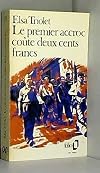
'You or I would walk barefoot in the snow to save an unknown comrade from death. We have learned to kill...the traitors'It is the winter of 1942. Juliette No?l moves silently through Occupied France, trudging across the snowy countryside, working for the Resistance, always just one move ahead of the Gestapo. The painter Alexis Slavsky must conceal his Jewish blood. As he drifts-from Montparnasse to Lyons to the Alps-the precariousness of his Bohemian life becomes intensified by the show more exigencies of war. Russian-born Louise has survived Nazi interrogation and escaped from a concentration camp. Now she lies low in a 'safe' house, waiting to rejoin the maquis. First published illegally by Underground presses, these extraordinary stories of the French Resistance are a moving and shocking testament to the courage of those caught up by the nightmare of war. show lessTags
Recommendations














Member Reviews
This volume telling the stories of lives lived during the second world war in France was the winner of the Prix Goncourt in 1945. It is a book brimming over with history yet with real life characters in whose lives I became completely immersed. Beyond the book the very facts of the writing, publishing and the life of the author are fascinating and riveting in themselves. What an amazing lady was Russian born Elsa Triolet. Not only was she an essayist, author of twenty seven books, a translator of Russian prose and poetry, Chekov and Gagol but she was also decorated for her heroic role in the French resistance. The story of the life of underground resistance worker, Juliette was first published illegally by underground presses in 1943 show more and was dedicated to other resistance workers one of whom, Daniele Casanova was later to lose her life in Auschwitz. In the second story she relates the life of artist Alexis Slavky and his attempt to live under extreme conditions of war time. Apparently Alexis was partly modelled upon Henri Matisse – who complained bitterly as the war was interrupting his work. The final story, linked to the second is the most autobiographical and tells of how Louise, a resistance worker passes her time hiding from the gestapo by writing of her early life, reflections and of how the work, like that of Elsa’s was buried under a tree.
The final part or epilogue was of special interest to me as it relates an event in which a parachute drop onto a small village on the Vercors plateau resulted in the most severe German reprisals against the villagers. It is the only ‘atrocity’ one encounters in the book. Through the travels of my mother I know that this event was commemorated and the loss of lives honoured by the erecting of the stations of the cross up the track, now road, that leads to the plateau. I long to visit the simple yet deeply moving memorial and this book has renewed that desire.
At times this was a hard book yet at others I could barely put it down. As it was written at the time of war there was much ‘reading between the lines’ needed in part as the audience of the period would have done. For example, the title itself was the secret code to signal the Allied landings in Normandy and for the readers of 1945 that meaning was clear. This is a book asking to be re read and to me the details of the author’s life are almost as interesting and as fascinating as the book itself. show less
The final part or epilogue was of special interest to me as it relates an event in which a parachute drop onto a small village on the Vercors plateau resulted in the most severe German reprisals against the villagers. It is the only ‘atrocity’ one encounters in the book. Through the travels of my mother I know that this event was commemorated and the loss of lives honoured by the erecting of the stations of the cross up the track, now road, that leads to the plateau. I long to visit the simple yet deeply moving memorial and this book has renewed that desire.
At times this was a hard book yet at others I could barely put it down. As it was written at the time of war there was much ‘reading between the lines’ needed in part as the audience of the period would have done. For example, the title itself was the secret code to signal the Allied landings in Normandy and for the readers of 1945 that meaning was clear. This is a book asking to be re read and to me the details of the author’s life are almost as interesting and as fascinating as the book itself. show less
This is a series of stories about the men and women of the French resistance. Triolet secretly published this book during the war, and thus is not merely a chronicle of, but also part of the actual fight against Nazi occupation. Triolet tells stories of men and women who found themselves, either by choice or necessity, engaged with the resistance movement. Given the subject matter, it likely comes as no surprise that these are haunting stories. They are extremely atmospheric: cold, hunger, uncertainty, all are omnipresent in these tales, and are vividly presented to the reader. While these sensory experiences are so vivid, other things have been normalized. Some privations have been so normalized that they pass with minimal comment. show more Because this was published during wartime by the underground press there are elements of wartime culture Triolet never fully explains. While these must have been self-evident in 1944, they are not necessarily so in 2009. That said, this was a very interesting look at the day-to-day operations of the resistance movement. show less
Ratings
Members
- Recently Added By
Lists

Favourite Virago Modern Classics
183 works; 38 members

Women in War
148 works; 30 members

1940s
221 works; 25 members

Books About World War II
102 works; 29 members

Books translated from Romance Languages into English
102 works; 7 members

Translingualism
191 works; 4 members
Author Information

38+ Works 418 Members
Some Editions
Awards and Honors
Awards
Series
Belongs to Publisher Series
Virago Modern Classics (207)
Gallimard, Folio (371)
Common Knowledge
- Canonical title
- A Fine of Two Hundred Francs
- Original title
- Le premier accroc coûte deux cents francs
- Original publication date
- 1944
- Important places
- France
- Important events
- World War II (1939 | 1945); World War II, German Occupation of France (1940 | 1944)
- First words
- I've always been fond of Juliette Noel. (The Lovers of Avignon)
I would like to tell about the rose and the nightingale, about lovely night, about a fair day and a beautiful life, happiness, and fragile, floating, vaporous dramas. (The Private Life of Alexis Slavsky, Painter)
It has been going on for four years now. (Notebooks Buried Under a Peach Tree)
Elsa Triolet was a major literary and political figure on the left in Europe. (Introduction)
Everything's in a terrible mess: railways, the minds of men, and food supplies... (Epilogue) - Last words
- (Click to show. Warning: May contain spoilers.)And dreams were Juliette's familiar companions. (The Lovers of Avignon)
(Click to show. Warning: May contain spoilers.)He thought he had done well. (The Private Life of Alexis Slavsky, Painter)
(Click to show. Warning: May contain spoilers.)It was the manufacturer who filled up the hole and sealed Louise's grave. (Notebooks Buried Under a Peach Tree)
(Click to show. Warning: May contain spoilers.)This bleak meditation on loneliness, old age and death was published just weeks before Triolet's own death from heart disease. (Introduction)
(Click to show. Warning: May contain spoilers.)In our impatience we had all begun tearing it apart. (Epilogue) - Original language
- French
Classifications
Statistics
- Members
- 152
- Popularity
- 216,340
- Reviews
- 2
- Rating
- (3.73)
- Languages
- English, French, German, Spanish
- Media
- Paper, Ebook
- ISBNs
- 6
- ASINs
- 9