On This Page
Description
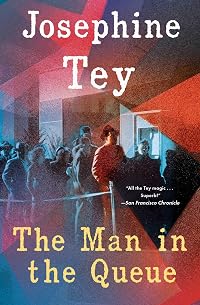
The first of Josephine Tey's Inspector Grant mysteries concerns the murder of a man, standing in a ticket queue for a London musical comedy. With his customary tenacity, Grant pursues his suspects through the length of Britain and the labyrinth of the city.Tags
Recommendations












Member Reviews
Not my favorite Tey, but interesting. In reading the reviews, it seems that some editions of the novel use the word 'dago' in referring to the main suspect, and this racist term turned people off. Mine used the word 'Levantine' which is an indication of geographic origin (the Levant, which I think we would now consider the 'near East'). I don't know which term was used in the original British edition. Regardless, there's certainly an element of cultural smugness in the attitude of Inspector Grant (which I think is probably an accurate depiction of your average Englishman back when this book was written), and he makes a lot of assumptions based on the perceived origins of the victim and the suspects. Grant has nothing else to go on but show more cultural and class stereotypes, since initially there are no clues. So he falls into some pitfalls due to his own biases, and ultimately all his assumptions are proven to be wrong. There's a recurring theme of disguise and deception throughout the novel, including the police methodology. No one is who they seem, people are more complicated than their surface presentation, and even though the solution to the crime seems to come out of the blue, there were actually subtle clues planted in the narrative which were ignored by Grant because they didn't fit with his worldview. In fact, Grant couldn't have solved the crime because he was so caught up in his preconceived notions and ideas about motive. In the end, the motive of the murder was unguessable, because it was so personal to the killer.
There's a lot of irony here. Tey wrote a number of stories with Grant as the protagonist, and it's hard to know what her intentions were, if the dramatic irony was purposeful and she was making a deliberate statement about social attitudes or if that's an artifact that appears due to modern sensibilities. In any case, although the narrative is flawed, it's a different type of story than your typical 'murder in a country house' and so I found it interesting. show less
There's a lot of irony here. Tey wrote a number of stories with Grant as the protagonist, and it's hard to know what her intentions were, if the dramatic irony was purposeful and she was making a deliberate statement about social attitudes or if that's an artifact that appears due to modern sensibilities. In any case, although the narrative is flawed, it's a different type of story than your typical 'murder in a country house' and so I found it interesting. show less
After a long absence, Alan Grant returns to my life. (Which is a different way of saying "I haven't read this in a long time".) It's obvious that Josephine Tey didn't originally intend to write mystery novels: not to in any way belittle mystery novels, which I love, but there is an intelligent uniqueness to her story and her writing that is a pure joy, an approach to the task which is fresh and unique.
Alan Grant (whom I cannot call by his last name, and therefore with whom I will probably become a bit familiar as I talk about these books; hopefully he wouldn't mind me calling him Alan) is … lovely.
A friend noted in her recent review of a different edition that she was made a bit uneasy by the oft-repeated word "dago". I decided to show more read this on the spur of the moment, and a little ways in remembered that part of the discussion that followed her review, and was a little surprised that I had not encountered the epithet. Before long, Alan Grant dubs the mysterious suspect "the Levantine" – and a minute later I started wondering if that was where "dago" used to be; I questioned it because it didn't seem to mean the same thing. By the time I finished the book and realized that "dago" had never appeared, it was clear that at some point a more politically correct edit had taken place. Unfortunately the edit was more politically than typographically correct – there were a number of spelling errors. It also wasn't terribly correct topographically, as the Levant consists of "The countries bordering on the eastern Mediterranean Sea from Turkey to Egypt", which I think would be a much different sort of complexion than the descriptions of our lad imply.
It's a lovely, gorgeously written story, this, and I'm glad that the casual racism of another time has been erased (though I'm interested in the mechanics of that). It isn't so much a Whodunnit, in which the reader can follow along and figure out who the killer is – I'm fairly sure that's impossible, as the story is written. But it is a terrific Howdunnit, as well as a terrific Howsolvdit – a portrait of a very good and unique detective doggedly following up any thread to find answers to who had the opportunity (and means, and motive) to stab The Man in the Queue. It's a psychological study, in a way – how people (or at least 1920's Londoners) can be standing in line in front of or behind or nearby someone who is murdered, and never see a thing; the mindset of a very intelligent detective relentlessly hunting his suspect, and how that changes when the suspect become a man to him; the mindset of the hunted man, whose friend is dead, whether he was the one who killed him or not.
I can't think of another detective – perhaps not even another fictional character – quite like Alan Grant. He is thoughtful, insightful, brilliant, and could have been anything – and has chosen to take his "flair" into the field of homicide investigation. It's not quite fair to the poor killers (which is as it should be). His thought processes are clearly illustrated, and it's a pleasure to follow them. It's also a pleasure that, while he's clearly more intelligent than his colleagues, they aren't idiots – the police are uniformly (pardon the pun) depicted as sharp and hard-working. Nice for a change.
(Reading "Ray Marcable" did not make an impact for a chapter or so, and then I let it sound in my head – and groaned. She wouldn't … Oh. She would. But surely the British Theatah wouldn't / didn't…? I mean, that's just awful.) show less
Alan Grant (whom I cannot call by his last name, and therefore with whom I will probably become a bit familiar as I talk about these books; hopefully he wouldn't mind me calling him Alan) is … lovely.
A friend noted in her recent review of a different edition that she was made a bit uneasy by the oft-repeated word "dago". I decided to show more read this on the spur of the moment, and a little ways in remembered that part of the discussion that followed her review, and was a little surprised that I had not encountered the epithet. Before long, Alan Grant dubs the mysterious suspect "the Levantine" – and a minute later I started wondering if that was where "dago" used to be; I questioned it because it didn't seem to mean the same thing. By the time I finished the book and realized that "dago" had never appeared, it was clear that at some point a more politically correct edit had taken place. Unfortunately the edit was more politically than typographically correct – there were a number of spelling errors. It also wasn't terribly correct topographically, as the Levant consists of "The countries bordering on the eastern Mediterranean Sea from Turkey to Egypt", which I think would be a much different sort of complexion than the descriptions of our lad imply.
It's a lovely, gorgeously written story, this, and I'm glad that the casual racism of another time has been erased (though I'm interested in the mechanics of that). It isn't so much a Whodunnit, in which the reader can follow along and figure out who the killer is – I'm fairly sure that's impossible, as the story is written. But it is a terrific Howdunnit, as well as a terrific Howsolvdit – a portrait of a very good and unique detective doggedly following up any thread to find answers to who had the opportunity (and means, and motive) to stab The Man in the Queue. It's a psychological study, in a way – how people (or at least 1920's Londoners) can be standing in line in front of or behind or nearby someone who is murdered, and never see a thing; the mindset of a very intelligent detective relentlessly hunting his suspect, and how that changes when the suspect become a man to him; the mindset of the hunted man, whose friend is dead, whether he was the one who killed him or not.
I can't think of another detective – perhaps not even another fictional character – quite like Alan Grant. He is thoughtful, insightful, brilliant, and could have been anything – and has chosen to take his "flair" into the field of homicide investigation. It's not quite fair to the poor killers (which is as it should be). His thought processes are clearly illustrated, and it's a pleasure to follow them. It's also a pleasure that, while he's clearly more intelligent than his colleagues, they aren't idiots – the police are uniformly (pardon the pun) depicted as sharp and hard-working. Nice for a change.
(Reading "Ray Marcable" did not make an impact for a chapter or so, and then I let it sound in my head – and groaned. She wouldn't … Oh. She would. But surely the British Theatah wouldn't / didn't…? I mean, that's just awful.) show less
That this was a debut mystery shows through a little in some less-than-perfect pacing and a slightly odd storytelling viewpoint. but that is more than made up for by the vivid descriptions of 1920's London, especially its theatreland and by the introduction of a strongly-drawn main character, Inspector Alan Grant. The plot is a little improbable and the solution is clumsy by the people and places feel real,
The book gets off to a slightly sluggish start, ameliorated by atmospheric descriptions of the rituals and entertainments associated with the process of patiently queuing in the rain in hope of gaining a theatre seat.
The scenes in the theatre, both when Grant meets the star of the show in her dressing room and then sees beyond her show more glamour in her final performance hum with life and lift the book.
The premise, an unknown man stabbed in a theatre queue by an unknown assailant, gives Grant the double challenge of identifying both parties. The manhunt that follows is methodical and sometimes ingenious but I didn't find it engaging. Almost halfway through, something happened that twisted my understanding of what was going on and the story moved from relentless manhunt to something more complicated and whole new set of possibilities opened up.
The ending, although plausible, was clumsily handled by comparison to the rest of the plot and left me dissatisfied.
The main thing I took away from the book was Tey's ability to bring people and places alive. Her main focus was Inspector Alan Grant, who appeared in six of her mystery books. I found that, the longer the book went on, the more I understood him and the less I liked him.
Grant is a charming but emotionally distant introvert who assess the world from behind an extrovert's smile. He has the easy social grace of a man who went to the right schools, served as an officer in World War I and survived and who is financially independent. He lives alone. He appears to have no close friends and no lovers. He seems comfortable in his isolation, which he appears to experience as freedom.
Grant is seen by his colleagues and superiors at Scotland Yard as having 'flair'. This is something closely associated with imagination and therefore suspect if used too often but Grant's charming, self-deprecating style convinces people to trust him. This surprised me as Grant's first instinct, in most cases, is to lie to get what he wants. He's almost pathologically incapable of a straightforward approach Even when he sets out to arrest a man and has a warrant in his pocket, he relies on subterfuge rather than just serving the warrant and making the arrest. He picks subordinates who share his talent for trickery and lies and he and they default to covert methods of investigation. Yet Grant's public face is one of firm-but-fair open-minded rectitude.
It seems to me that the real Grant is what he refers to as 'his watcher' who always sit back and assesses people and situations dispassionately. This 'watcher' is not passive. Grant is an ambush predator. His watcher is always scenting for prey and looking for ambush points.
I had the same experience watching Grant that he had when watching the charismatic actress' final performance. I saw past the glamour to the clever predator hiding in the shadows.
I was perhaps helped in this by the fact that Grant is a man of times and class. His judgements are based on crude stereotypes about race and class that mean the world he sees is not really what's in front of him. He suspects the foreigner and constantly refers to the suspect, even after he knows his name, as 'the Dago'. He under-estimates women and is completely unconscious of his own privilege.
Of course, Grant as privileged English predator may have been exactly what Tey intended me to see. My dislike of Grant is a sign of how strongly drawn he is. I'll read the next book in the series just to see what happens to him. show less
‘Yes,’ she said; ‘that’s all very well, but look at the long night there’ll be. You never know the minute you’ll waken up hungry and be glad of the sandwiches even if it’s only to pass the time. They’re chicken, and you don’t know when you’ll have chicken again. It’s a terribly poor country, Scotland. Goodness only knows what you’ll get to eat!’
Grant said that Scotland nowadays was very like the rest of Britain, only more beautiful.
‘I don’t know anything about beauty,’ said Mrs Field, putting the sandwiches resolutely away in the rug-strap, ‘but I do know that a cousin of mine was in service there once – she went for the season with her people from London – and there wasn’t a house to be seen in show more the whole countryside but their own, and not a tree. And the natives had never heard of teacakes, and called scones “skons.”’
‘How barbaric!’ said Grant, folding his most ancient tweed lovingly away in his case.
The Man in the Queue is Tey's first book in the Inspector Grant series and deals with the mystery of a murder that occurs in plain sight but has no witnesses. This is not a spoiler as such as this literally happens within the first few pages.
From there on we are introduced to Scotland Yard's Alan Grant, who is the Inspector investigating the case. Grant is a great character - he is funny, contemplative, but also does not shirk away from action.
Some of the funniest parts of this story are build around the dialogue that Grant has with various other characters. And the best part is that they are meant to be funny. They are not just funny because they are quaint - there is some freshness to the dialogues.
‘No time is wasted that earns such a wealth of gratitude as I feel for you,’ said Struwwelpeter. ‘I was in the depths when you arrived. I can never paint on Monday mornings. There should be no such thing. Monday mornings should be burnt out of the calendar with prussic acid. And you have made a Monday morning actually memorable! It is a great achievement. Sometime when you are not too busy breaking the law come back and I’ll paint your portrait. You have a charming head.’
Of course, this should not come as a surprise when we know that before writing this book, Tey had already become a successful writer of plays and other stories under her pseudonym of Gordon Daviot. But it was a bit of a surprise to me, because quite a few reviews of The Man in the Queue did mention that the book had not aged well, a criticism which also seems to be linked with the use of the slur "Dago" throughout the book.
I can of course understand that criticism. However, having read two of her other novels in this series also, I am beginning to wonder whether Tey's use of satire and irony may have been at play here, too. She uses the term "Dago" so abundantly to refer to main suspect that I began to wonder whether this over-use was intended to show the assumptions that Tey may have suspected her readers at the time to make as being blinded by stereotype rather than the analysis of the facts.
There are some other parts in the book that lead me to believe that Tey may actually have tried to dispel some of the stereotypes found in the pulp fiction of her time. (And of course, in her most famous work A Daughter of Time, we get to question again whether appearances really tell us anything about facts at all!)
Notably, Tey includes a dinner conversation in which she shows up a character who is a racist as an ignorant bigot:
"His race was a fetish with him, and he compared it at length with most of the other nations in Western Europe, to their extreme detriment. It was only towards the end of tea that Grant found, to his intense amusement, that Mr Logan had never been out of Scotland in his life. The despised Lowlanders he had met only during his training for the ministry some thirty years ago, and the other nations he had never known at all."
I have no biographical proof for this notion of mine. Tey was a private person. Even Josephine Tey is a nom de plume. However, I am looking forward to finding out more about Tey and see whether I can put some meat on this bone in the course of reading more by and about her.
As for The Man in the Queue, it is not a great mystery - which is another reason I am inclined to believe that Tey's interest lay more with the creation of ambiguity than with a plot that would thrill lovers of puzzles. There are no clues that would lead the reader to the ultimate solution of the murder. In fact, the ending and solution comes quite out of the blue. In that sense, I would even say that it might work as a mockery of the detective genre. (Maybe that is the reason why it took another 7 years for the next book in the series? I have no answers.)
Still I found it very much worth reading.
"Well, he would find out from the Yard if there was anything new, and if not, he would fortify himself with tea. He needed it. And the slow sipping of tea conduced to thought. Not the painful tabulations of Barker, that prince of superintendents, but the speculative revolving of things which he, Grant, found more productive. He numbered among his acquaintances a poet and essayist, who sipped tea in a steady monotonous rhythm, the while he brought to birth his masterpieces. His digestive system was in a shocking condition, but he had a very fine reputation among the more precious of the modern littérateurs." show less
Grant said that Scotland nowadays was very like the rest of Britain, only more beautiful.
‘I don’t know anything about beauty,’ said Mrs Field, putting the sandwiches resolutely away in the rug-strap, ‘but I do know that a cousin of mine was in service there once – she went for the season with her people from London – and there wasn’t a house to be seen in show more the whole countryside but their own, and not a tree. And the natives had never heard of teacakes, and called scones “skons.”’
‘How barbaric!’ said Grant, folding his most ancient tweed lovingly away in his case.
The Man in the Queue is Tey's first book in the Inspector Grant series and deals with the mystery of a murder that occurs in plain sight but has no witnesses. This is not a spoiler as such as this literally happens within the first few pages.
From there on we are introduced to Scotland Yard's Alan Grant, who is the Inspector investigating the case. Grant is a great character - he is funny, contemplative, but also does not shirk away from action.
Some of the funniest parts of this story are build around the dialogue that Grant has with various other characters. And the best part is that they are meant to be funny. They are not just funny because they are quaint - there is some freshness to the dialogues.
‘No time is wasted that earns such a wealth of gratitude as I feel for you,’ said Struwwelpeter. ‘I was in the depths when you arrived. I can never paint on Monday mornings. There should be no such thing. Monday mornings should be burnt out of the calendar with prussic acid. And you have made a Monday morning actually memorable! It is a great achievement. Sometime when you are not too busy breaking the law come back and I’ll paint your portrait. You have a charming head.’
Of course, this should not come as a surprise when we know that before writing this book, Tey had already become a successful writer of plays and other stories under her pseudonym of Gordon Daviot. But it was a bit of a surprise to me, because quite a few reviews of The Man in the Queue did mention that the book had not aged well, a criticism which also seems to be linked with the use of the slur "Dago" throughout the book.
I can of course understand that criticism. However, having read two of her other novels in this series also, I am beginning to wonder whether Tey's use of satire and irony may have been at play here, too. She uses the term "Dago" so abundantly to refer to main suspect that I began to wonder whether this over-use was intended to show the assumptions that Tey may have suspected her readers at the time to make as being blinded by stereotype rather than the analysis of the facts.
There are some other parts in the book that lead me to believe that Tey may actually have tried to dispel some of the stereotypes found in the pulp fiction of her time. (And of course, in her most famous work A Daughter of Time, we get to question again whether appearances really tell us anything about facts at all!)
Notably, Tey includes a dinner conversation in which she shows up a character who is a racist as an ignorant bigot:
"His race was a fetish with him, and he compared it at length with most of the other nations in Western Europe, to their extreme detriment. It was only towards the end of tea that Grant found, to his intense amusement, that Mr Logan had never been out of Scotland in his life. The despised Lowlanders he had met only during his training for the ministry some thirty years ago, and the other nations he had never known at all."
I have no biographical proof for this notion of mine. Tey was a private person. Even Josephine Tey is a nom de plume. However, I am looking forward to finding out more about Tey and see whether I can put some meat on this bone in the course of reading more by and about her.
As for The Man in the Queue, it is not a great mystery - which is another reason I am inclined to believe that Tey's interest lay more with the creation of ambiguity than with a plot that would thrill lovers of puzzles. There are no clues that would lead the reader to the ultimate solution of the murder. In fact, the ending and solution comes quite out of the blue. In that sense, I would even say that it might work as a mockery of the detective genre. (Maybe that is the reason why it took another 7 years for the next book in the series? I have no answers.)
Still I found it very much worth reading.
"Well, he would find out from the Yard if there was anything new, and if not, he would fortify himself with tea. He needed it. And the slow sipping of tea conduced to thought. Not the painful tabulations of Barker, that prince of superintendents, but the speculative revolving of things which he, Grant, found more productive. He numbered among his acquaintances a poet and essayist, who sipped tea in a steady monotonous rhythm, the while he brought to birth his masterpieces. His digestive system was in a shocking condition, but he had a very fine reputation among the more precious of the modern littérateurs." show less
Tey was a fantastic writer, and her mystery novels are peppered with beautiful set-pieces, elegant descriptions and minor characters sketched with scythe-like precision. Her concept of the investigator who often makes mistakes and has to recalibrate is also fantastic, and the novel inadvertently has become a piece of historical writing: it's thoroughly enjoyable to keep reminding oneself that Grant can't just use a mobile phone, or look up a suspect's address in "the system". Very engaging.
I will say the ending is rather abrupt, in contradistinction to the sometimes languid, well-paced rest of the novel. And, to be frank, Tey doesn't do a good job of hiding a major clue which - annoyingly - Grant doesn't seem to pick up! The clue show more doesn't reveal the killer, but it certainly points an arrow in a general direction. I hope that Tey meant for us to pick up on things that Grant doesn't, but I'm not so sure in this particular interest.
But anyhow, she's great, and all of her books are worth reading on their own merits. show less
I will say the ending is rather abrupt, in contradistinction to the sometimes languid, well-paced rest of the novel. And, to be frank, Tey doesn't do a good job of hiding a major clue which - annoyingly - Grant doesn't seem to pick up! The clue show more doesn't reveal the killer, but it certainly points an arrow in a general direction. I hope that Tey meant for us to pick up on things that Grant doesn't, but I'm not so sure in this particular interest.
But anyhow, she's great, and all of her books are worth reading on their own merits. show less
On the plus side, the writing is descriptive and sometimes lovely, both of which are surprising in a detective story. For instance, Inspector Grant sees laundry hanging to dry in a poor neighborhood: “Here and there a line of gay, motley child’s clothes danced and ballooned with the breeze in a necklace of coloured laughter.”
On the minus side, it’s rather dated in its social attitudes. Just by seeing the murder weapon, Inspector Grant draws this conclusion: “This was a crime that had been planned with an ingenuity and executed with a subtlety that was foreign to an Englishman’s habit of thought. The very femininity of it proclaimed the Levant, or at the very least one used to Levantine habits of life.”
On the plus side show more again, it’s a clever and engaging story, if one makes allowances for the ways it’s dated, and it is a colorful depiction of a time and place. Looking up some of the obsolete colloquialisms was part of the fun. show less
On the minus side, it’s rather dated in its social attitudes. Just by seeing the murder weapon, Inspector Grant draws this conclusion: “This was a crime that had been planned with an ingenuity and executed with a subtlety that was foreign to an Englishman’s habit of thought. The very femininity of it proclaimed the Levant, or at the very least one used to Levantine habits of life.”
On the plus side show more again, it’s a clever and engaging story, if one makes allowances for the ways it’s dated, and it is a colorful depiction of a time and place. Looking up some of the obsolete colloquialisms was part of the fun. show less
I am a particular fan of strong, female protagonists. This has usually led me to female authors. However, one of the early female mystery writers, [a:Josephine Tey|44023|Josephine Tey|http://d202m5krfqbpi5.cloudfront.net/authors/1193918690p2/44023.jpg], only came to my attention recently when I picked up a pile of The Saint Magazines dating from the 1950s. This monthly pulp magazine, edited by [a:Leslie Charteris|36260|Leslie Charteris|http://d202m5krfqbpi5.cloudfront.net/authors/1328997893p2/36260.jpg], featured short stories written by some of the upcoming and leading lights of the mystery genre. There were many authors I had never heard of and, based on the strength of their short story, I decided to hunt down their other writings. show more This led me to [a:Craig Rice|263980|Craig Rice|http://d202m5krfqbpi5.cloudfront.net/authors/1301407676p2/263980.jpg] and, subsequently, Tey.
Josephine Tey is a well-loved Scottish author who wrote two stand-alone mysteries, six mystery novels featuring Inspector Alan Grant, and three other novels. Grant’s most distinguishing feature is that he does not “look like a detective”. This affords him plenty of opportunities to observe people and engage them in frank and revealing conversations, all without putting them on their guard: A very useful trait in his trade. It also provides the author an opportunity to make shrewd and, at times, critical observations about people, and the English society of the day.
The Man in the Queue is the first of the Inspector Alan Grant series. This is worth noting in that, at several places in the book, the main character reflects back on previous cases with specific details in such a way as to make me think, “Is there a novel before this one that I missed?” It turns out that Tey does this regularly in her books, giving Grant a depth and breadth by relating aspects of his life we are not made privilege to in any other novel.
The book starts with the murder of a man who is standing in a queue for a very popular theatre show. Despite the crushing crowd, no one saw anything and the clues (including anything to identify the victim) are non-existent. Grant is thus hampered in his investigations. How he begins to weave together what happened from mere wisps of thread is a real treat. Because it is told in the third-person from Grant’s point of view, we learn facts as he learns them and share in his frustrations and decision-making process as to what clues to pursue next.
Set mostly in London in the 1920s, the book is short on drawn-out descriptive details of The City, but takes more time in describing the beautiful country-sides through which Grant travels by train. The latter will resonate pleasantly with those, like me, who have traveled through England by train. A part of the novel is set in a remote area of Scotland and there too, Tey does a great job of describing the area and the people with careful attention to detail but without undue sentiment.
Tey intersperses her writing with colloquialisms and local idioms suitable to the time, in some cases referring to well-known popular culture icons. These turns of phrase may baffle some readers, but these occasional references do not detract in any way from the story or plot and character development.
I enjoyed this book very much. The writing was tight and moved at a fast enough clip so that the detailed exposition of the case did not weigh the reader down. The excellent plot, while appearing complex, had a clean, solid resolution with no cheats. The characters were well-drawn and behaved in a realistic manner.
Sidenote: Josephine Tey’s most well-known book is [b:The Daughter of Time|77661|The Daughter of Time|Josephine Tey|http://d202m5krfqbpi5.cloudfront.net/books/1307325271s/77661.jpg|3222080], which has Inspector Grant conduct, and solve, a mystery from his hospital bed. show less
Josephine Tey is a well-loved Scottish author who wrote two stand-alone mysteries, six mystery novels featuring Inspector Alan Grant, and three other novels. Grant’s most distinguishing feature is that he does not “look like a detective”. This affords him plenty of opportunities to observe people and engage them in frank and revealing conversations, all without putting them on their guard: A very useful trait in his trade. It also provides the author an opportunity to make shrewd and, at times, critical observations about people, and the English society of the day.
The Man in the Queue is the first of the Inspector Alan Grant series. This is worth noting in that, at several places in the book, the main character reflects back on previous cases with specific details in such a way as to make me think, “Is there a novel before this one that I missed?” It turns out that Tey does this regularly in her books, giving Grant a depth and breadth by relating aspects of his life we are not made privilege to in any other novel.
The book starts with the murder of a man who is standing in a queue for a very popular theatre show. Despite the crushing crowd, no one saw anything and the clues (including anything to identify the victim) are non-existent. Grant is thus hampered in his investigations. How he begins to weave together what happened from mere wisps of thread is a real treat. Because it is told in the third-person from Grant’s point of view, we learn facts as he learns them and share in his frustrations and decision-making process as to what clues to pursue next.
Set mostly in London in the 1920s, the book is short on drawn-out descriptive details of The City, but takes more time in describing the beautiful country-sides through which Grant travels by train. The latter will resonate pleasantly with those, like me, who have traveled through England by train. A part of the novel is set in a remote area of Scotland and there too, Tey does a great job of describing the area and the people with careful attention to detail but without undue sentiment.
Tey intersperses her writing with colloquialisms and local idioms suitable to the time, in some cases referring to well-known popular culture icons. These turns of phrase may baffle some readers, but these occasional references do not detract in any way from the story or plot and character development.
I enjoyed this book very much. The writing was tight and moved at a fast enough clip so that the detailed exposition of the case did not weigh the reader down. The excellent plot, while appearing complex, had a clean, solid resolution with no cheats. The characters were well-drawn and behaved in a realistic manner.
Sidenote: Josephine Tey’s most well-known book is [b:The Daughter of Time|77661|The Daughter of Time|Josephine Tey|http://d202m5krfqbpi5.cloudfront.net/books/1307325271s/77661.jpg|3222080], which has Inspector Grant conduct, and solve, a mystery from his hospital bed. show less
Members
- Recently Added By
Lists

Top Cops (Detectives in Fiction)
86 works; 24 members

Crime and Mysteries to Read
746 works; 31 members

British Mystery
469 works; 14 members

Books About Murder
313 works; 7 members

Detective Stories
343 works; 5 members

Books mentioned in Julian Symons’ Bloody Murder
438 works; 6 members

In and About the 1920s
181 works; 31 members

Books Read in 2014
2,344 works; 89 members

Books Set in London
49 works; 3 members

Thrillers to read
21 works; 2 members

Books Read in 2020
4,379 works; 124 members

Books Read in 2022
5,226 works; 115 members

Books Read in 2023
5,638 works; 147 members
Author Information

52+ Works 20,163 Members
Josephine Tey is a pseudonym used by Elizabeth Mackintosh. She was born in 1896 in Inverness and died in 1952. She is a Scottish author best known for her mystery novels. She attended Inverness Royal Academy and then Anstey Physical Training College in Erdington, a suburb of Birmingham. She taught physical training at various schools in England show more and Scotland, but in 1926 she had to return to Inverness to care for her invalid father. There she began her career as a writer. In five of the mystery novels, the hero is Scotland Yard Inspector Alan Grant. The most famous of these is The Daughter of Time, in which Grant, laid up in hospital, has friends research reference books and contemporary documents so that he can puzzle out the mystery of whether King Richard III of England murdered his nephews, the Princes in the Tower. Grant comes to the firm conclusion that King Richard was totally innocent of the death of the Princes. In 1990, The Daughter of Time was selected by the British Crime Writers' Association as the greatest mystery novel of all time; The Franchise Affair was 11th on the same list of 100 books. (Bowker Author Biography) show less
Some Editions
Series

Belongs to Publisher Series
Work Relationships
Common Knowledge
- Canonical title
- The Man in the Queue
- Original title
- The Man in the Queue
- Alternate titles
- Killer in the Crowd
- Original publication date
- 1929
- People/Characters
- Alan Grant (Inspector); Ray Markable; Raoul Legarde; Mrs Ratcliffe; Danny Miller; Mrs Everett (show all 9); Gerald Lamont; Dandie Dinmont; Rosie Markham
- Important places
- London, England, UK; Scotland, UK
- Dedication
- To Brisena who actually wrote it
- First words
- It was between seven and eight o'clock on a March evening, and all over London the bars were being drawn back from pit and gallery doors.
- Last words
- (Click to show. Warning: May contain spoilers.)Well, is there?
- Original language
- English UK
Classifications
Statistics
- Members
- 1,905
- Popularity
- 11,288
- Reviews
- 73
- Rating
- (3.56)
- Languages
- 12 — Dutch, English, Finnish, French, German, Italian, Japanese, Polish, Russian, Spanish, Swedish, Chinese, traditional
- Media
- Paper, Audiobook, Ebook
- ISBNs
- 58
- UPCs
- 1
- ASINs
- 48