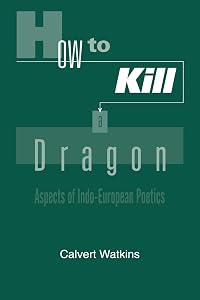
How to Kill a Dragon: Aspects of Indo-European Poetics
by Calvert Watkins
On This Page
Description
A demonstration of the continuity of poetic formulae in Indo-European languages from Old Hittite to medieval Irish. Using the comparative method, the traditional poetic formulae can be reconstructed back to the original common languages, thus revealing the tenacity of the poetic tradition.Tags
Recommendations













Member Recommendations
Member Reviews
This is what I would have liked to do with my life if I were smarter and grew up speaking four languages. Indo-European poetics--speculatively reconstructing on the basis of the common poetic devices, themes, and stories of the ancient peoples of Europe, Iran, and South Asia--speakers of Greek, Indic, Iranic, Celtic, Italic, Anatolian, Germanic, and Slavic--the poetic art of the speakers of their ancestor-tongue, and (even more speculatively) their narrative art and common culture as well. The early verse-prose of the lay, held together not so much by rhyme or meter as by grammatical and sound parallelism, strophe after strophe, that gives the words such heft. The poet as weaver of word-magic, professional shaper of reality, really all show more the professions in one.
But really most of all the hero-story: Hercules. Indra. Cuchulainn. Thor. Rostam. So deeply rooted in our collective (un)consciousness that we have to stop and actually appreciate how different are their closest analogues in the non-IE traditions: David, Quetzalcoatl, Liu Bei, these are hero-kings and hero-magisters, perhaps, but not the pure hero we know so well, the one anointed such by the special word we use when he does his deeds: not KILL, but SLAY (proto-IE guhen--in either the formula HERO SLAY SERPENT or HERO SLAY HERO, with the variant SLAIN IS HERO. (Tho after he SLAYs, the other thing the hero does that distinguishes him is that he OVERCOMEs--archetypally, in this case, not the serpent, but DEATH itself). The intertextual variations of this basic framework are followed out across the epics in a work of incredible perceptiveness and depth.
How our prehistoric cultural progenitors may have seen the world, reconstructed from how we do, or at least how our earliest historical forebears did. It's as amazing that we can do this as it is that we can go to the moon. show less
But really most of all the hero-story: Hercules. Indra. Cuchulainn. Thor. Rostam. So deeply rooted in our collective (un)consciousness that we have to stop and actually appreciate how different are their closest analogues in the non-IE traditions: David, Quetzalcoatl, Liu Bei, these are hero-kings and hero-magisters, perhaps, but not the pure hero we know so well, the one anointed such by the special word we use when he does his deeds: not KILL, but SLAY (proto-IE guhen--in either the formula HERO SLAY SERPENT or HERO SLAY HERO, with the variant SLAIN IS HERO. (Tho after he SLAYs, the other thing the hero does that distinguishes him is that he OVERCOMEs--archetypally, in this case, not the serpent, but DEATH itself). The intertextual variations of this basic framework are followed out across the epics in a work of incredible perceptiveness and depth.
How our prehistoric cultural progenitors may have seen the world, reconstructed from how we do, or at least how our earliest historical forebears did. It's as amazing that we can do this as it is that we can go to the moon. show less
A careful , painstaking and thoroughgoing look at reconstructed Indo-European poetics (and, to some degree, culture) based on the formulaic level rather than the simple word level. Watkins deals with poetic technique as well as themes, but his primary focus is on one major theme: that of the hero / god who slays a serpent (where the core of the formula is the reconstructed PIE root *gyhen). Along the way he makes a strong argument for a particular role of the poet in PIE society: part-bard, part-magician, certainly more than a tale-teller. Well worth reading, but especially rewarding if one has enough Greek background to dive into the texts he cites (anyone who has a grasp of Sanskrit, Avestan, Hittite, and Celtic, will have an even show more more rewarding time, but this is less likely; he also deals with Germanic examples, principally Anglo-Saxon and Old Norse, but they are less prominent). show less
Well, I probably couldn't kill a dragon after reading, but I probably could write a poem about killing a dragon in the correct form. A dense book - I'm sure it would've helped if my knowledge of Indo-European languages were broader, but with only three (English, Old Norse and Latin) under my belt I feel like I must've missed a lot. Greek would've helped. Not a book for the linguistically faint of heart.
Ratings
Members
- Recently Added By
Lists

Indo-European Studies
55 works; 5 members

Books Read in 2019
4,052 works; 110 members

Top Five Books of 2019
387 works; 111 members

Books Read in 2026
1,913 works; 66 members
Author Information

8+ Works 692 Members
Awards and Honors
Common Knowledge
- Original publication date
- 1995
Classifications
- Genres
- Fiction and Literature, Literature Studies and Criticism
- DDC/MDS
- 809 — Literature & rhetoric Literature, rhetoric & criticism History, description, critical appraisal of more than two literatures
- LCC
- P569 .W38 — Language and Literature Philology. Linguistics Indo-European (Indo-Germanic) philology
- BISAC
Statistics
- Members
- 251
- Popularity
- 129,187
- Reviews
- 3
- Rating
- (4.35)
- Languages
- English
- Media
- Paper, Ebook
- ISBNs
- 6