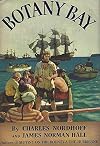
Botany Bay
by Charles Nordhoff, James Norman Hall
On This Page
Tags
Recommendations
























Member Reviews
One of Nordhoff/Hall's less recognized novels, Botany Bay deserves better attention. It seems almost of the time (1831) from which it looks back over the events of the life of Hugh Tallant, an American caught up in poverty in England and sentenced to transportation to Australia (New South Wales). Its atmosphere in London is almost Dickensian. And the time detailing the founding of Sydney reads like an adventure story akin to James Finemore Cooper's.
Clearly, the research Nordhoff/Hall conducted into the preparation of their famous Bounty Trilogy paid off with a sort of twofer. It enabled them a head start on their research of London and England in the late 18th century as well as giving some prior insights into the settlement of show more Australia, which was to be governed in the very early years of the 19th century by William Bligh, who was made notorious through his depiction in the Trilogy.
The story of the novel itself is epic in scope, while also focusing on the intimacies of poverty and injustice in England and the dangers and thrills of settling a new continent. For good measure, Nordhoff/Hall throw in yet another long sea voyage in a small launch that, while it does not rival that of Men Against the Sea, nonetheless makes for eager turning of the pages. show less
Clearly, the research Nordhoff/Hall conducted into the preparation of their famous Bounty Trilogy paid off with a sort of twofer. It enabled them a head start on their research of London and England in the late 18th century as well as giving some prior insights into the settlement of show more Australia, which was to be governed in the very early years of the 19th century by William Bligh, who was made notorious through his depiction in the Trilogy.
The story of the novel itself is epic in scope, while also focusing on the intimacies of poverty and injustice in England and the dangers and thrills of settling a new continent. For good measure, Nordhoff/Hall throw in yet another long sea voyage in a small launch that, while it does not rival that of Men Against the Sea, nonetheless makes for eager turning of the pages. show less
Interesting story about something I had never considered. After the Revolution, what happened to the people fought against the Americans for King George? The story starts with leaving New York & eventually going to England. Took a while to read, but it was worth it!
The third in the "Mutiny on the Bounty" series. Depicts the discovery of Pitcairn Island and what happened to the mutineers of the HMS Bounty.
Ratings
Members
- Recently Added By
Author Information

19+ Works 3,883 Members

47+ Works 4,297 Members
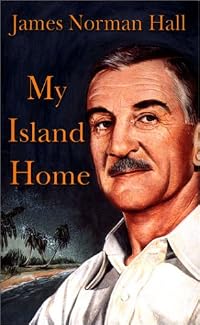
James Norman Hall, 1887 - 1951 James Norman Hall was born at Colfax, Iowa. He attended public schools in Colfax, and entered Grinnell College, Iowa, graduating in 1910. From 1910 to 1914 he was a social worker in Boston, working for Society for the Prevention of Cruelty to Children. At the outbreak of World War I, Hall joined the British Army. He show more served in the 9th Battalion Royal Fusiliers, taking part in the Battle of Loos. His war memoirs were published in 1916 under the title Kitcher's Mob and High Adventure. Hall re-enlisted in 1916 as a member of the Lafayette Flying Corps. During those years, he met Charles Nordhoff, a pilot serving in the same corps. When Hall and Nordhoff received an advance from Harper's to write travel articles, they moved to Tahiti. In 1921 their travel book Faery Lands of the South Seas was published. Eventually they parted ways, with Hall continuing with travel books and Nordhoff publishing novels. In 1929 Nordhoff's and Hall's jointly written book about flying, Falcons of France was published. Hall suggested the team start to write Mutiny on the Bounty in 1932, and ended up a trilogy that included Men against the Sea in 1933 and Pitcairn's Island in 1934. Nordhoff and Hall published six more coauthored novels, although the last three were largely composed by Hall. Several of these books were filmed. In his later years, Hall wrote children stories about Dr. Dogbody, a peg-legged old sailor, travel essays, narrative poems, and an collection of short stories. In 1950, Hall returned to the United States to accept an honorary doctorate from Grinnell University. He died the next year in Tahiti in 1951. His posthumously published memoirs, My Island Home, appeared in 1952. (Bowker Author Biography) show less
Some Editions
Series
Belongs to Publisher Series
Bonniers folkbibliotek (285)
Zephyr Books (75)
Common Knowledge
- Original title
- Botany Bay
- Important places
- Botany Bay, New South Wales, Australia; Sydney, New South Wales, Australia
- Related movies
- Botany Bay (1953 | IMDb)
Classifications
- Genres
- Fiction and Literature, General Fiction, Historical Fiction
- DDC/MDS
- 839.78 — Literature & rhetoric German & related literatures Other Germanic literatures Swedish literature Swedish miscellany
- LCC
- PZ3 .N764 .B — Language and Literature Fiction and juvenile belles lettres Fiction and juvenile belles lettres Fiction in English
Statistics
- Members
- 81
- Popularity
- 391,199
- Reviews
- 3
- Rating
- (4.00)
- Languages
- 5 — Dutch, English, Estonian, German, Swedish
- Media
- Paper, Ebook
- ISBNs
- 5
- ASINs
- 9