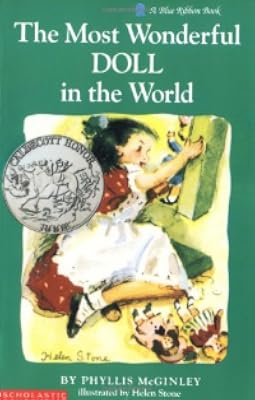
The Most Wonderful Doll in the World
by Phyllis McGinley
On This Page
Description
The memory of the doll Dulcy lost becomes more wonderful and exaggerated each time she talks about it.Tags
Recommendations










Member Reviews
Dulcy is a sweet little girl, with a loving family and plenty of friends.She has one immature flaw, though - she is never satisfied with things the way they are. Dulcy collects dolls, and she has a great assortment, including a ballerina, a set of twins, and a bridal doll. She has favorites, and loves playing with her dolls, but she can't help wishing that each doll was a little better. If only that one had blond hair, or that one a slip that matched her veil. One day, her friend Mrs. Primrose gives her another doll as a gift. Dulcy likes Angela, even if she wishes her hair was a different color. She puts Angela and her box of clothes down when she sees her gardener raking leaves on the lawn, and gets so caught up in the fun of leaf show more burning that she forgets all about Angela.
When Dulcy remembers, later that night, Angela and her box of clothes are nowhere to be found. Her mother and the gardener help her search everywhere, but the doll has disappeared. Dulcy is distraught. Her mother consoles her with the promise of a new doll, but Dulcy claims that no doll could be as wonderful as Angela. Her eyes opened and closed, she had her own wardrobe, and she could speak. Dulcy really thinks she remembers all these features, although a careful reader will know Angela wasn't quite so talented.
Dulcy can't help lamenting her lost doll to everyone. As she describes the wonders of Angela, the list continues to grow and grow. Anytime someone says their doll has something Angela didn't, Dulcy suddenly remembered that Angela had something like it, only better. Her constant complaints mixed with bragging drive others away, and poisons Dulcy against her other dolls, which she locks up in the cupboard. One day, Dulcy is playing with a new girl outside, one who isn't fed up with her Angela stories. Together, they discover two old boxes, containing a doll and wardrobe, very soiled and neglected. Dulcy recognizes Angela, and also realizes that Angela is quite different from her stories. Dulcy runs home in tears. Her mother comforts Dulcy in her disappointment; Dulcy explains to her mom that she really did think Angela was as wonderful as she imagined, and her mom teaches Dulcy that we can hold special dreams that are perfect, as long as we also are happy with the reality that we have.
The story is a quick read, with a charming story and good moral. Dulcy comes away from her experience with more appreciation and satisfaction in life, and is able to repair broken friendships. She also begins to play with all her dolls again. The message is simple and innocent, but I found that refreshing. The book was published in the fifties, when children's fiction was restricted to a more didactic style, but this story manages to be entertaining within those limitations. The illustrations are charming if old-fashioned, and excellently complement the narrative. In fact, this is a Caldecott Honor book. The theme of the book is still valid today, and the story will be a short but fun read for kids. show less
When Dulcy remembers, later that night, Angela and her box of clothes are nowhere to be found. Her mother and the gardener help her search everywhere, but the doll has disappeared. Dulcy is distraught. Her mother consoles her with the promise of a new doll, but Dulcy claims that no doll could be as wonderful as Angela. Her eyes opened and closed, she had her own wardrobe, and she could speak. Dulcy really thinks she remembers all these features, although a careful reader will know Angela wasn't quite so talented.
Dulcy can't help lamenting her lost doll to everyone. As she describes the wonders of Angela, the list continues to grow and grow. Anytime someone says their doll has something Angela didn't, Dulcy suddenly remembered that Angela had something like it, only better. Her constant complaints mixed with bragging drive others away, and poisons Dulcy against her other dolls, which she locks up in the cupboard. One day, Dulcy is playing with a new girl outside, one who isn't fed up with her Angela stories. Together, they discover two old boxes, containing a doll and wardrobe, very soiled and neglected. Dulcy recognizes Angela, and also realizes that Angela is quite different from her stories. Dulcy runs home in tears. Her mother comforts Dulcy in her disappointment; Dulcy explains to her mom that she really did think Angela was as wonderful as she imagined, and her mom teaches Dulcy that we can hold special dreams that are perfect, as long as we also are happy with the reality that we have.
The story is a quick read, with a charming story and good moral. Dulcy comes away from her experience with more appreciation and satisfaction in life, and is able to repair broken friendships. She also begins to play with all her dolls again. The message is simple and innocent, but I found that refreshing. The book was published in the fifties, when children's fiction was restricted to a more didactic style, but this story manages to be entertaining within those limitations. The illustrations are charming if old-fashioned, and excellently complement the narrative. In fact, this is a Caldecott Honor book. The theme of the book is still valid today, and the story will be a short but fun read for kids. show less
Dulcy is a child who is never satisfied, she is always wanting bigger and better and different from what she already has. Dulcy loves each of her dolls dearly, but each of them is not quite right, and she wishes she could change them. One day, Dulcy is given a doll named Angela, but soon after she gets her she looses her! Dulcy is so sad she has misplaced Angela, because she was the best doll in the world. Dulcy begins to idealize Angela, and imagine things that were never true about Angela. None of Dulcy's other dolls can match up to her memory of Angela! Dulcy refuses to play with dolls anymore, until spring when she finds Angela! Recovered from a pile of dirt, Angela is not at all like Dulcy remembered. Dulcy realizes that she had show more imagined many things about Angela, and that imagining is different from what is real. Dulcy learns to separate her dreams from reality. The illustrations are beautiful, and tell the story in a vivid way. This book would be great to read to a child who has a wild imagination. show less
Dulcy is a 6-year -old- girl who has a large doll collection but is never satisfied with what she does have. She does not appreciate the newest doll she gets until it is gone. As time goes by and Dulcy gets a little older, she imagines the doll to have been greater than it ever was and does not recognize it when she finds it. By reading this story, children can learn to appreciate what they have and to find joy in life. They can also learn to distinguish between what is real and what is imaginary. I am giving this book 5 stars because I appreciate the message so beautifully taught and how the author still manages to tell it in such a way that young children can easily grasp its meaning. I also find the artwork to be brilliant and makes show more it seem as if the dolls are coming alive. show less
Read several times, but only as an adult. My rating each time depends on my mood. Today I can't help but think of Dulcy as spoiled. Nor can I decide whether I love the art or not.
The classic tale about imaginative Dulcy and her beloved doll Angela, who Dulcy loses soon after she gets her. When Dulcy finds Angela, she's not at all like the doll Dulcy remembers, but that won't stop Dulcy from hoping to find the doll of her dreams.
The main character, Dulcy, is spoiled when it comes to her dolls. She always wants a better doll than what she has. One day she gets a new doll, Angela, but loses it. Every time someone asks her to describe her doll, she gets more and more extravagant. It seems like the doll that she lost was the most perfect and wonderful doll any little girl could imagine. But when she finally finds Angela she sees that’s exactly what she did. She imagined all of those magnificent details. The doll she lost was quite ordinary. She realizes this, and knows that to grow up properly she needs to stop making up stories and fibbing. I suppose this is a strange coming of age story. With the setting of this story taking place in the fifties, it may be a show more little difficult for modern children to relate.
Details: This book was written to interest children in grades 3-5 and is a 4.6 reading level. show less
Details: This book was written to interest children in grades 3-5 and is a 4.6 reading level. show less
1950 Caldecott Honor Book and part of the series of Blue Ribbon Books.
A story about a little girl that gets a doll from an older woman who is leaving town for a short time and wants her to have this doll to take care. The girl has many dolls but this one is very special, until she gets side tracked and leaves it in a pile of leaves. She begins to invent stories of her adventures with the doll, but will not share that she has lost the doll till one day after a long winter the doll appears right where she left it. The doll is a little worse for the wear.
Here are a couple of interesting quotes from the book that I found interesting from this dated story.
"We learn to be more satisfied with Things As They Are" As grownups, Dreams are like show more fire that can warm hearts. show less
A story about a little girl that gets a doll from an older woman who is leaving town for a short time and wants her to have this doll to take care. The girl has many dolls but this one is very special, until she gets side tracked and leaves it in a pile of leaves. She begins to invent stories of her adventures with the doll, but will not share that she has lost the doll till one day after a long winter the doll appears right where she left it. The doll is a little worse for the wear.
Here are a couple of interesting quotes from the book that I found interesting from this dated story.
"We learn to be more satisfied with Things As They Are" As grownups, Dreams are like show more fire that can warm hearts. show less
Members
- Recently Added By
Lists

Caldecott Honor Books
296 works; 23 members

1950s
340 works; 22 members

Books Read in 2020
4,379 works; 124 members

Books Read in 2023
5,638 works; 147 members
Author Information

42+ Works 2,132 Members
Some Editions
Awards and Honors
Awards
Common Knowledge
- Canonical title
- The Most Wonderful Doll in the World
- Original publication date
- 1950
Classifications
Statistics
- Members
- 586
- Popularity
- 50,279
- Reviews
- 11
- Rating
- (3.29)
- Languages
- English
- Media
- Paper
- ISBNs
- 6
- ASINs
- 5