The Moon
by Robert Louis Stevenson
On This Page
Description
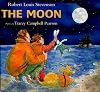
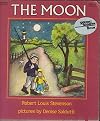
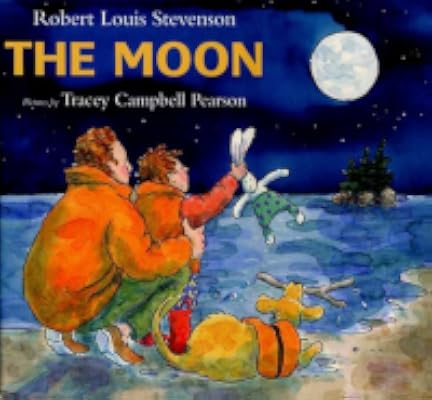
Pictures of a father and child out in the moonlight illustrate Stevenson's poem from A child's garden of verses.Tags
Recommendations

















Member Reviews
This is a lovely poem made into a picture book. Great for a bedtime story or a poetry-themed story time. The poem is about the moon and everything under it, while the watercolor and ink illustrations include scenes of a family settling down for the night.
I liked this book for a couple reasons. The first reason is because of the illustrations. If you just read the text itself without the pictures, it is a poem about the moon. Once you add the illustrations it creates a story about a boy going on a boat ride with his father and seeing all of the nature at dark. The pictures create a story that pairs with the poem and makes this book more of a story than a simple poem.
I also like the language used in this book. It really lets you imagine and picture in your mind what the author is writing about. One of my favorite lines in the book is, "But all of the things that belong to the day cuddle to sleep to be out of her way;"
I think the message of this book is about how things exist outside of show more daytime and are a whole different kind of beautiful. As a child I was scared of the dark and so are many other children and so nighttime was a scary thing for me and I associated it with darkness. While the nighttime is dark the moon gives off a lot of light and there are many beautiful things outside during the night. show less
I also like the language used in this book. It really lets you imagine and picture in your mind what the author is writing about. One of my favorite lines in the book is, "But all of the things that belong to the day cuddle to sleep to be out of her way;"
I think the message of this book is about how things exist outside of show more daytime and are a whole different kind of beautiful. As a child I was scared of the dark and so are many other children and so nighttime was a scary thing for me and I associated it with darkness. While the nighttime is dark the moon gives off a lot of light and there are many beautiful things outside during the night. show less
I liked this book for 2 reasons. It was the classic bedtime story that will put kids to bed. I really liked the illustrations. Most of the book was focused on the illustrations that were extremely detailed and helped readers visualize the setting and environment of the story. For example, the poem’s stanzas did not correlate to the pictures exactly. Instead the illustrations made their own story about a little boy and his father going to look at the moon. The illustrations provided a relevant avenue for readers and something for them to enjoy while listening to the poem. The poem’s lines were each divided up on separate pages and each illustration would hint at one aspect of the line in the poem. Another reason I liked this book was show more because of the language. The poem rhymed. This is a classic element of bedtime stories. As I was reading through the poem, I experienced a relaxed and easy to follow feeling. Children of all ages can listen to this story for its simplicity in nature, but also because there are some words that are unfamiliar to them and can be taught. The main idea of this story is to describe the moon and describe its effects on the people below it. show less
This is an excellent poem, and I love Pearson's illustrations. The problem is that the poem just doesn't make a convenient picture book length. Pearson has really interesting interpretations of the text, but I really think the reader loses the poem as a whole reading it broken up into these bitty chunks. It takes the music out of the whole thing. Ah, well.
Stevenson's classic poem "The moon has a face like the clock in the hall," is here given a beautiful and very child-friendly treatment. Wide double-spreads depict a father and child on a late night adventure that includes a moonlight cruise.
Another beautifully illustrated classic that is important to bring into your classroom. Brings a wonderful poem to life!
Booklist - *Starred Review* Stevenson's famous 12-line poem, which begins "The moon has a face / like the clock in the hall," becomes the text of a picture-book depiction of the nighttime outing of a contemporary father and his child. Leaving Mother and Baby behind, they climb into a truck with the dog, the cat, and some provisions; travel to the dock; and take their boat across a cove and back again while they watch the places and creatures illuminated by the moon. The pictured journey creates a vivid, visual counterpoint to the poetry, which flows as magically as an incantation. Though inspired by the poem, the luminous ink-and-watercolor illustrations reflect Pearson's creative imagination and her sure sense of what is visually show more interesting to young children. Along with the many detailed pictures of the characters' expedition, one double-page spread is a lovely panorama of the water and the surrounding landscape, with the moon floating above it all. Picture-book versions of "Block City," "My Shadow," and other poems drawn from Stevenson's A Child's Garden of Verseshave entranced children over the years. This mesmerizing interpretation shows once again the timeless quality of the poet's verse. Jane Yolen's Owl Moon (1987), Amy Tan's The Moon Lady(1995), and Cynthia Rylant's Long Night Moon (2004) make excellent follow-ups or companions to this lovely book. Carolyn Phelan show less
Members
- Recently Added By
Author Information

2,826+ Works 140,074 Members
Novelist, poet, and essayist Robert Louis Stevenson was born in Edinburgh, Scotland. A sickly child, Stevenson was an invalid for part of his childhood and remained in ill health throughout his life. He began studying engineering at Edinburgh University but soon switched to law. His true inclination, however, was for writing. For several years show more after completing his studies, Stevenson traveled on the Continent, gathering ideas for his writing. His Inland Voyage (1878) and Travels with a Donkey (1878) describe some of his experiences there. A variety of essays and short stories followed, most of which were published in magazines. It was with the publication of Treasure Island in 1883, however, that Stevenson achieved wide recognition and fame. This was followed by his most successful adventure story, Kidnapped, which appeared in 1886. With stories such as Treasure Island and Kidnapped, Stevenson revived Daniel Defoe's novel of romantic adventure, adding to it psychological analysis. While these stories and others, such as David Balfour and The Master of Ballantrae (1889), are stories of adventure, they are at the same time fine studies of character. The Master of Ballantrae, in particular, is a study of evil character, and this study is taken even further in The Strange Case of Dr. Jekyll and Mr. Hyde (1886). In 1887 Stevenson and his wife, Fanny, went to the United States, first to the health spas of Saranac Lake, New York, and then on to the West Coast. From there they set out for the South Seas in 1889. Except for one trip to Sidney, Australia, Stevenson spent the remainder of his life on the island of Samoa with his devoted wife and stepson. While there he wrote The Wrecker (1892), Island Nights Entertainments (1893), and Catriona (1893), a sequel to Kidnapped. He also worked on St. Ives and The Weir of Hermiston, which many consider to be his masterpiece. He died suddenly of apoplexy, leaving both of these works unfinished. Both were published posthumously; St. Ives was completed by Sir Arthur Quiller-Couch, and The Weir of Hermiston was published unfinished. Stevenson was buried on Samoa, an island he had come to love very much. Although Stevenson's novels are perhaps more accomplished, his short stories are also vivid and memorable. All show his power of invention, his command of the macabre and the eerie, and the psychological depth of his characterization. (Bowker Author Biography) show less
Some Editions
Awards and Honors
Series
Belongs to Publisher Series
Classifications
Statistics
- Members
- 177
- Popularity
- 185,731
- Reviews
- 12
- Rating
- (3.84)
- Languages
- English
- Media
- Paper
- ISBNs
- 5
- ASINs
- 2