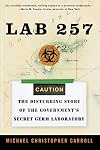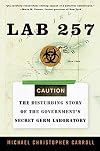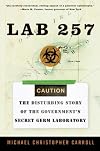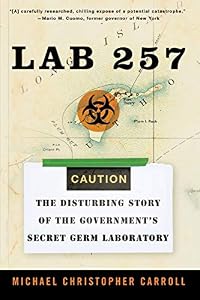
Lab 257: The Disturbing Story of the Government's Secret Germ Laboratory
by Michael C. Carroll
On This Page
Description
Strictly off limits to the public, Plum Island is home to virginal beaches, cliffs, forests, ponds-and the deadliest germs that have ever roamed the planet. Lab 257 blows the lid off the stunning true nature and checkered history of Plum Island. It shows that the seemingly bucolic island in the shadow of New York City is a ticking biological time bomb that none of us can safely ignore. Based on declassified government documents, in-depth interviews, and access to Plum Island itself, this is show more an eye-opening, suspenseful account of a federal government germ laboratory gone terribly wrong. For the first time, Lab 257 takes you deep inside this secret world and presents startling revelations on virus outbreaks, biological meltdowns, infected workers, the periodic flushing of contaminated raw sewage into area waters, and the insidious connections between Plum Island, Lyme disease, and the deadly West Nile virus. The book also probes what's in store for Plum Island's new owner, the Department of Homeland Security, in this age of bioterrorism. Lab 257 is a call to action for those concerned with protecting present and future generations from preventable biological catastrophes. show lessTags
Recommendations























Member Reviews
This is terrible. Really, really terrible. Michael C. Carroll has written a book about Plum Island, an island just off the coast of Massachusetts. It harbors an animal disease research facility and it has a long history of polluting the surrounding waters and releasing toxic chemicals and potentially harmful biological diseases into the surrounding area.
This sounds like it would make a great book, wouldn't it? Unfortunately, the author doesn't have a clue what he's talking about, and this is evident to even the most unenlightened person of the microbiological field. Here, let me give you a couple of examples.
In part one, Mr. Carroll accuses Plum Island for causing an outbreak of Lyme disease, and he quotes Jerry Callis as he comments show more on the experiments done on ticks in the laboratory.
Dr. Callis gave a surprising answer ... "We had a tick colony, where you take them and feed them on virus, and breed the ticks to see how many generations it would last, on and on, until it's diluted. Recently, they reinstated the tick colony."
Tick colony.
Note how he emphasizes the word colony. Ohhhh! A colony. CREEPY. It's like, you know, something straight out of ALIEN. A tick COLONY. Ugh, yes Mr. Michael Christopher Carroll, it's called a colony. Would you prefer it be called a flock of ticks? A troop? A gaggle of ticks?
Please...
Another good example of Carroll's stupidity is in the picture section. There is a picture of a scientist examining a cow. The scientist is leaning in front of the cow and shining a flashlight in it's snout, looking for symptoms of disease. The caption reads as follows:
An examination into exotic animal germs by a Plum Island scientist wielding, of all things, a flashlight
Oh, yes Mr. Carroll. When scientists need to see into dark places, they use flashlights. They don't have some super-ultra-secret mega-powerful technology that banishes all darkness within a 1-mile radius (and if they did, you'd probably think it gave everyone cancer and various tropical diseases.) No, they use flashlights like the rest of us...
Ugh, what a moron. This could have been a good book. If the author could have stuck with the facts, he would have been much better off. The hard facts a really are quite concerning. There is certainly enough evidence to raise suspicion about what is really happening on Plum Island. There is definitely shady business and the island is without a doubt a health risk to any humans and animals living within the area. There was really no reason for the author to do more than present the facts, they are terrifying enough already. Unfortunately, his excessive speculation and blind accusations are far too prominent, and his dim-witted commentary is nothing more than annoying.
The subject is definitely one worth looking into, as there is definitely some intriguing and frightening aspects of this mysterious Plum Island research facility, but this book just feels like a sad attempt to cultivate fear and raise alarm amongst those who are susceptible to conspiracy theories, and not much else.
The book does get a little bit better after the first part is over, but at this point the author lost all credibility for me, so I couldn't even enjoy it when he covered the confirmed history of the facility...
I would definitely recommend readers interested in the topic to look into what is really happening on Plum Island, but I would recommend finding a book written by a more competent author.
1 star. show less
This sounds like it would make a great book, wouldn't it? Unfortunately, the author doesn't have a clue what he's talking about, and this is evident to even the most unenlightened person of the microbiological field. Here, let me give you a couple of examples.
In part one, Mr. Carroll accuses Plum Island for causing an outbreak of Lyme disease, and he quotes Jerry Callis as he comments show more on the experiments done on ticks in the laboratory.
Dr. Callis gave a surprising answer ... "We had a tick colony, where you take them and feed them on virus, and breed the ticks to see how many generations it would last, on and on, until it's diluted. Recently, they reinstated the tick colony."
Tick colony.
Note how he emphasizes the word colony. Ohhhh! A colony. CREEPY. It's like, you know, something straight out of ALIEN. A tick COLONY. Ugh, yes Mr. Michael Christopher Carroll, it's called a colony. Would you prefer it be called a flock of ticks? A troop? A gaggle of ticks?
Please...
Another good example of Carroll's stupidity is in the picture section. There is a picture of a scientist examining a cow. The scientist is leaning in front of the cow and shining a flashlight in it's snout, looking for symptoms of disease. The caption reads as follows:
An examination into exotic animal germs by a Plum Island scientist wielding, of all things, a flashlight
Oh, yes Mr. Carroll. When scientists need to see into dark places, they use flashlights. They don't have some super-ultra-secret mega-powerful technology that banishes all darkness within a 1-mile radius (and if they did, you'd probably think it gave everyone cancer and various tropical diseases.) No, they use flashlights like the rest of us...
Ugh, what a moron. This could have been a good book. If the author could have stuck with the facts, he would have been much better off. The hard facts a really are quite concerning. There is certainly enough evidence to raise suspicion about what is really happening on Plum Island. There is definitely shady business and the island is without a doubt a health risk to any humans and animals living within the area. There was really no reason for the author to do more than present the facts, they are terrifying enough already. Unfortunately, his excessive speculation and blind accusations are far too prominent, and his dim-witted commentary is nothing more than annoying.
The subject is definitely one worth looking into, as there is definitely some intriguing and frightening aspects of this mysterious Plum Island research facility, but this book just feels like a sad attempt to cultivate fear and raise alarm amongst those who are susceptible to conspiracy theories, and not much else.
The book does get a little bit better after the first part is over, but at this point the author lost all credibility for me, so I couldn't even enjoy it when he covered the confirmed history of the facility...
I would definitely recommend readers interested in the topic to look into what is really happening on Plum Island, but I would recommend finding a book written by a more competent author.
1 star. show less
Interesting in lots of ways. The origin of Lyme Disease from chemical warfare? All that and more!
The history of the research centre on Plum Island just off Long Island. Years of denials about its true purpose but it figures high on Russia’s list of places to be curious about.
A well documented account of the Foot & Mouth outbreak in 1976 which flies in the face of the US claim that the last outbreak was 1929.
Also a reflection of the changes since its inception in the halcyon days of scientific research in the 50s. Originally protected by a resident force of 34 highly armed guards reduced to one unarmed security man after privatisation. Likewise a permanent fire brigade of 12 staff highly trained in what can happen at a secret show more viral/bacterial facility, reduced to one untrained person
Having one of the most toxic stores of bacterial and viral agents with no antidote or vaccine in the US and also having a disturbingly bad record of working with this stuff in safety.
A disturbingly good read show less
The history of the research centre on Plum Island just off Long Island. Years of denials about its true purpose but it figures high on Russia’s list of places to be curious about.
A well documented account of the Foot & Mouth outbreak in 1976 which flies in the face of the US claim that the last outbreak was 1929.
Also a reflection of the changes since its inception in the halcyon days of scientific research in the 50s. Originally protected by a resident force of 34 highly armed guards reduced to one unarmed security man after privatisation. Likewise a permanent fire brigade of 12 staff highly trained in what can happen at a secret show more viral/bacterial facility, reduced to one untrained person
Having one of the most toxic stores of bacterial and viral agents with no antidote or vaccine in the US and also having a disturbingly bad record of working with this stuff in safety.
A disturbingly good read show less
The start of this book is ready easy to summarize: "The government lied to us." Or more completely: The government lied to us about this deadly disease laboratory, and several especially virulent diseases now found in the US spread from there. And they did it for decades. As I began reading, the details seemed a bit tedious, but I suppose that's what happens when you research something that is being hidden - you have to present whatever information you can find. As the book went on that feeling left me and I was more interested in seeing the drama unfold. Early in the book we are introduced to a host of incurable diseases: Lyme disease, Elboa, Rift Valley, Hoof and Mouth, and others. There we have a concentrated supply of them less than show more 2 miles from a major US population center, and right in a hurricane path.
There is lots of tragedy in here - of people's lives damaged as a new administration ignores basic safety.
"After the meltdown, with no help from Plum Island and no diagnosis from his doctor, Shine turned to the one person who could help him recover - his wife, Fran. 'My best doctor was my wife. She took all these books out of the local library, and threw away my meds.' Fran put him on a strict regimen of exercise, good food, and positive thinking, and he slowly regained himself. To this very day he has no idea what his illness was. A possibility is one of the feared 'slow' viruses, so named not for the tempo of virus growth, but for the protracted time of the disease's course, which can be months or years." (Page 211)
The Soviets knew what was going on. (Chapter 14)
Speaking of the Russians: "In 1976, the average U.S. farm worker fed 52 mouths, while the Russian worker fed only seven; livestock production per animal was up 130 percent from the previous fifty years. ... The USDA has accomplished this growth through proselytizing the new religion of science with an uncanny blind faith, ignoring any fallout over the last half century. It claimed that DDT would not contaminate the wildlife and marine ecosystem. Thanks in large part to Rachel Carson, the USDA now admits that it does. The USDA championed chemical pesticides ... But now, it grudgingly admits the chemicals are infused into the food products people eat, and wreak havoc upon wildlife. ... said that fertilizer nitrates ... would never reach groundwater aquifers. Today, the USDA admits that nitrates have seeped into and blighted potable water supplies in dangerous concentrations. ... The USDA promoted dieldrin ... to eliminate the Argentinean fire ant. ... 'The lost war against the fire ants should have been a cautionary, ... instead it typified a mind-set that substituted faith in science and bureaucratic expertise for common sense.' " (Page 232)
The author is not a professional author nor investigative journalist. This is something he cared deeply enough about to spend 7 years putting it together. And that is what makes the book interesting. (page 288) show less
There is lots of tragedy in here - of people's lives damaged as a new administration ignores basic safety.
"After the meltdown, with no help from Plum Island and no diagnosis from his doctor, Shine turned to the one person who could help him recover - his wife, Fran. 'My best doctor was my wife. She took all these books out of the local library, and threw away my meds.' Fran put him on a strict regimen of exercise, good food, and positive thinking, and he slowly regained himself. To this very day he has no idea what his illness was. A possibility is one of the feared 'slow' viruses, so named not for the tempo of virus growth, but for the protracted time of the disease's course, which can be months or years." (Page 211)
The Soviets knew what was going on. (Chapter 14)
Speaking of the Russians: "In 1976, the average U.S. farm worker fed 52 mouths, while the Russian worker fed only seven; livestock production per animal was up 130 percent from the previous fifty years. ... The USDA has accomplished this growth through proselytizing the new religion of science with an uncanny blind faith, ignoring any fallout over the last half century. It claimed that DDT would not contaminate the wildlife and marine ecosystem. Thanks in large part to Rachel Carson, the USDA now admits that it does. The USDA championed chemical pesticides ... But now, it grudgingly admits the chemicals are infused into the food products people eat, and wreak havoc upon wildlife. ... said that fertilizer nitrates ... would never reach groundwater aquifers. Today, the USDA admits that nitrates have seeped into and blighted potable water supplies in dangerous concentrations. ... The USDA promoted dieldrin ... to eliminate the Argentinean fire ant. ... 'The lost war against the fire ants should have been a cautionary, ... instead it typified a mind-set that substituted faith in science and bureaucratic expertise for common sense.' " (Page 232)
The author is not a professional author nor investigative journalist. This is something he cared deeply enough about to spend 7 years putting it together. And that is what makes the book interesting. (page 288) show less
There's a bio-warfare laboratory within 100 miles of 20 million people on the eastern seaboard of the US. Extremely well documented and sourced, and the author proves convincingly of sever safety lapses creating potentially extremely high-risk situations. there's no smoking gin on the lab sourcing Lyme Disease or West Nile Virus, but the coincidental / circumstantial evidence is telling. what would be refreshing is for a former lab director to come clean.
Ever wonder about the origins of Lyme Disease and West Nile Virus? Lab 257 begins by presenting an interesting circumstantial case that the outbreak of these strange maladies in the U.S. may be traced to the secret government facility at Plum Island. The author then proceeds to explain how, thanks to inadequate funding, managerial complacency, and insufficient governmental oversight, this once state-of-the-art animal disease laboratory has degenerated into an environmental hazard of startling proportions, making future outbreaks of other frightening biological agents all too possible. The book concludes with some useful suggestions regarding alternatives to the current situation at Plum Island, acknowledging the heightened importance of show more its charter in the post-9/11 world. While some may find the details a bit dense in parts, it's a fine piece of investigative journalism that cries out for concerned citizens and politicians to take notice.
-Kevin Joseph, author of "The Champion Maker" show less
-Kevin Joseph, author of "The Champion Maker" show less
This frightening book explores one of the countries biggest biological research laboratories from opening to current day. It explores the dangerous diseases, security issues, and funding issues surrounding the facilities. Weather, outbreaks, and politics surrounding this scientific research are explored.
a description of the the peters principal it practices of a spreading responsibly such that no one is at fault. As said no one wants their cheese moved and when it is no is responsible for the results.
currently keep Trump in mind.
currently keep Trump in mind.
Members
- Recently Added By
Author Information
1 Work 380 Members
Michael Christopher Carroll spent seven years researching and writing Lab 257. A native of Long Island and an avid outdoorsman, Carroll is now general counsel of a New York-based finance company. He lives on Long Island and in New York City
Common Knowledge
- Original publication date
- 2004
- Important places
- Plum Island
- Epigraph
- For a quiet outing where the air is a real tonic to a run-down man or woman; where you could have your bluefish and blackfish, sea bass, and lobsters fresh out of the water, cooked to a turn; milk, eggs, and chicken in abu... (show all)ndance, Plum Island was the ideal place. What more could one ask?
-Plum Island Adventurer (1909)
Plum Island is a biological Three Mile Island
-Plum Island Employee (2003) - Dedication
- To my mother,
Audrey Joan Carroll
-M.C.C. - First words
- Protecting a nuclear power plant is no small task.
- Blurbers
- DeMille, Nelson; Cuomo, Mario M.; Weicker, Lowell P., Jr.
Classifications
- Genres
- Nonfiction, Science & Nature, General Nonfiction, History, Politics and Government
- DDC/MDS
- 614.5 — Applied science & technology Medicine & health Epidemics, Poisons, Alternative Medicine Incidence of and public measures to prevent specific diseases and kinds of diseases
- LCC
- QR359.5 .U6 .C37 — Science Microbiology Microbiology Virology
- BISAC
Statistics
- Members
- 380
- Popularity
- 82,126
- Reviews
- 8
- Rating
- (3.55)
- Languages
- English
- Media
- Paper, Audiobook, Ebook
- ISBNs
- 6
- ASINs
- 3