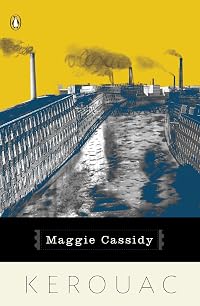
Maggie Cassidy
by Jack Kerouac 
On This Page
Description
"When someone asks 'Where does [Kerouac] get that stuff?' say: 'From you!' He lay awake all night listening with eyes and ears. A night of a thousand years. Heard it in the womb, heard it in the cradle, heard it in school , heard it on the floor of life's stock exchange where dreams are traded for gold." --Henry Miller One of the dozen books written by Jack Kerouac in the early and mid-1950s, Maggie Cassidy was not published until 1959, after the appearance of On the Road had made its author show more famous overnight, Long out of print, this touching novel of adolescent love in a New England mill town, with its straight-forward narrative structure, is one of Kerouac's most accesible works. It is a remarkable , bittersweet evocation of the awkwardness and the joy of growing up in America. show lessTags
Recommendations












Member Reviews
As with much of Kerouac, I start out trying to piece the images together into a single focus and quickly shift into just letting the prose flow. There are some gems within that flow. And some troubling pieces (fantasies of violence against women, and the trivialization of being a "raper.") Kerouac captures that confusion between being in love with another person and being in love with love or being in love with the idea of being in love with another person. And while I was expecting it to be a purely romantic vision, I should have known better. Kerouac reaches for something deeper, truer, more difficult, and the novel ends with a scene that captures that (for me).
I'm still not enjoying these early days of Jack Kerouac books as much as I did his life from "On the Road" on. But this one was a little better than the previous ones. It is about Jack's high school life, and his first 'true' love, Maggie. (well, another girl named Pauline might have been 'first', but her name's not on the cover, now is it?) Kerouac really captures the mania of a first love very well, with all of it's quirks, uneasiness, and intense feelings. The other parts of his life in this book, particularly the pieces when he is hanging out with his friends, are not as interesting. Heck, I hardly understood their dialogues at all! (did people really talk like that back then?) I also wasn't interested in all of the minute details show more of life in Lowell, and those details take up a lot of room in this book! I think if I was from Lowell, or really interested in what life was like pre-WWII in the Massachusetts area, this story would have won me over. But I wasn't, so it didn't. And that ending is quite a stinker. Jack should have stopped at 45 chapters. show less
In the beginning part of this book, I thought it was heading for a 2.5 star rating, as some of the sloppy grammar and lack of editing was poor even by Kerouac’s standards. If you do read it, all I can say is bear with it, it gets better.
Written in 1953 but not published until 1959 after the success of ‘On the Road’, ‘Maggie Cassidy’ has 16-17-year-old Kerouac (in the form of Jacky Duluoz) in high school, hangin’ out with the fellas, running at track events, playing baseball, and falling for Maggie Cassidy (real life, Mary Carney). As an aside, he’s also reading ‘Lust for Life’, the fictional biography of Van Gogh, as well as Whitman and later Dostoevsky, which I found fitting.
Kerouac is on a trajectory to say goodbye show more to everyone around him and to live the life of a vagabond, and there are glimpses of that in his narrative which make it poignant. The book has a perfect ending, albeit bitter, with Jacky going back home after a few years and looking Maggie up. Throughout the book the writing is honest, and the overall effect of his writing is one that I would liken to a rough, post-impressionist painter. It’s an art form of its own, and if you’re looking for classical form or pristine, lyrical structure, this isn’t the book (or author) for you. If you are a Kerouac fan, it’s certainly worth reading, as one of the early pieces of the “Jack Duluoz legend”.
Quotes:
On confusion in love:
“One night by the radiator in March she’d starting huffing and puffing against me unmistakably, it was my turn to be a man – and I didnt know what to do, no idea in my dull crowded-up-with-worlds brain that she wanted me that night; no idea of what that is.”
On goodbye, these words from Maggie foretelling the nature of Kerouac’s real life:
“You’ll let me die – you wont come save me – I dont even know where your grave is – remember what you were like, where your house, what your life – you’ll die without knowing what happened to my face – my love – my youth – You’ll burn yourself out like a moth jumping in a locomotive boiler looking for light – Jacky – and you’ll be dead – and sink – and you’ll be dead – and lose yourself from yourself – and forget – and sink – and me too - …”
On love:
“Ah I loved my Maggie, I wanted to eat her, bring her home, hide her in the heart of my life the rest of my days.”
On passion, the wording is awkward and wrong but I love the nuggets “ambrosial brew” and “profound struggle” and the feeling he recreates:
“There were tears of joy in her eyes, on her cheeks; her warm body smelled ambrosial brew in the profound struggle we waged sinking in pillows, bliss, madness, night – hours on end -...”
On walking in the night; this is another example of the roughness of his grammar, but the net impressionist painting he creates reminds me of feelings I had when I was young and in similar circumstances:
“I walked home in the dead of Lowell night – three miles, no buses – the dark ground, roads, cemeteries, streets, construction ditches, millyards – The billion winter stars hugeing overhead like frozen beads frozen suns all packed inter-allied in one rich united universe of showery light, beating, beating, like great hearts in the non-understandable bowl void black.
To which nevertheless I offered up all my songs and longwalk sighs and sayings, as if they could hear me, know, care.” show less
Written in 1953 but not published until 1959 after the success of ‘On the Road’, ‘Maggie Cassidy’ has 16-17-year-old Kerouac (in the form of Jacky Duluoz) in high school, hangin’ out with the fellas, running at track events, playing baseball, and falling for Maggie Cassidy (real life, Mary Carney). As an aside, he’s also reading ‘Lust for Life’, the fictional biography of Van Gogh, as well as Whitman and later Dostoevsky, which I found fitting.
Kerouac is on a trajectory to say goodbye show more to everyone around him and to live the life of a vagabond, and there are glimpses of that in his narrative which make it poignant. The book has a perfect ending, albeit bitter, with Jacky going back home after a few years and looking Maggie up. Throughout the book the writing is honest, and the overall effect of his writing is one that I would liken to a rough, post-impressionist painter. It’s an art form of its own, and if you’re looking for classical form or pristine, lyrical structure, this isn’t the book (or author) for you. If you are a Kerouac fan, it’s certainly worth reading, as one of the early pieces of the “Jack Duluoz legend”.
Quotes:
On confusion in love:
“One night by the radiator in March she’d starting huffing and puffing against me unmistakably, it was my turn to be a man – and I didnt know what to do, no idea in my dull crowded-up-with-worlds brain that she wanted me that night; no idea of what that is.”
On goodbye, these words from Maggie foretelling the nature of Kerouac’s real life:
“You’ll let me die – you wont come save me – I dont even know where your grave is – remember what you were like, where your house, what your life – you’ll die without knowing what happened to my face – my love – my youth – You’ll burn yourself out like a moth jumping in a locomotive boiler looking for light – Jacky – and you’ll be dead – and sink – and you’ll be dead – and lose yourself from yourself – and forget – and sink – and me too - …”
On love:
“Ah I loved my Maggie, I wanted to eat her, bring her home, hide her in the heart of my life the rest of my days.”
On passion, the wording is awkward and wrong but I love the nuggets “ambrosial brew” and “profound struggle” and the feeling he recreates:
“There were tears of joy in her eyes, on her cheeks; her warm body smelled ambrosial brew in the profound struggle we waged sinking in pillows, bliss, madness, night – hours on end -...”
On walking in the night; this is another example of the roughness of his grammar, but the net impressionist painting he creates reminds me of feelings I had when I was young and in similar circumstances:
“I walked home in the dead of Lowell night – three miles, no buses – the dark ground, roads, cemeteries, streets, construction ditches, millyards – The billion winter stars hugeing overhead like frozen beads frozen suns all packed inter-allied in one rich united universe of showery light, beating, beating, like great hearts in the non-understandable bowl void black.
To which nevertheless I offered up all my songs and longwalk sighs and sayings, as if they could hear me, know, care.” show less
This was another great book by Kerouac. The autobiographical details that are mixed in this ring of truth and a sense of purity for the development of his main character- and himself. It spells out what it means to have loved, someone's first love, and lost it alongside growing up. Kerouac writes from the heart here, and in a poetic style of prose that is palatable to the reader. I was quite impressed with this- Kerouac did not hold back. Through his efforts, he turned this into something memorable, and accessible, for all readers.
4 stars- well earned!
4 stars- well earned!
As I write this review (on 11 March, 2022), tomorrow in the 100th anniversary of Jack Kerouac's birth. A good time to start, catch up on, or re-read his "Duluoz Legend" series! (the books which are fictionalized narratives of his life, including his famed "On the Road"). "Maggie Cassidy" is the story of Kerouac's first love, and is such a good book. Taking place when he is 16-17 years old, it shows his relationship to Maggie, as well as his love of his family and close friends and his life in school, as well as his social life. I love his "rat-a-tat" style of writing (it may take getting used to for some), especially when the characters are talking or interacting with each other. It takes place in a small town in Massachusetts, and most show more of the characters are French-Canadian (as was Kerouac), and you get the feeling that this is exactly how they would have behaved. A good book to start with when you begin reading Kerouac. show less
Rather than trying to write a serious review here, all I'd really like to say is that this is a beautiful novel. I find I'm continually impressed with the genuine warmth of Kerouac's prose, this being the third work of his I've read. I can't believe they wouldn't publish this one till after the success of On The Road. I found it lighter than the previous work, being not so concerned with expressing the intricate, sometimes contradictory thoughts and beliefs running through Kerouac's head in later years. Instead, here he simply tells a story with a welcome sweetness, mostly set amidst a picturesque snowy New England landscape.
Though I hate the comparison, if you feel like reading a Nicholas Sparks book, don't. Read this instead. It'll show more give you that same dreamy New England setting as if it were engineered to entice, though instead written with Kerouac's passion and real. The perfect remedy to Sparks' fast-food-fiction; this is the good stuff. show less
Though I hate the comparison, if you feel like reading a Nicholas Sparks book, don't. Read this instead. It'll show more give you that same dreamy New England setting as if it were engineered to entice, though instead written with Kerouac's passion and real. The perfect remedy to Sparks' fast-food-fiction; this is the good stuff. show less
My least favorite of Kerouacs books. That being said, I still enjoyed it. I read it as a senior in high school, during my obsessive for beatnik literature days. An obsession that continued, with less intensity, throughout my life. This is Kerouac before the drugs and the jazz. It's him in high school as a quarterback. Its amazing because I felt a lot of similarities in the feelings and experiences I had in my hometown, which was also small. And this is neat because it was written in 1939, and it still had relevance. For a 18 year old girl in 2005 to have felt a similarity to a 1939 Jack Kerouac, is just beyond cool.
Members
- Recently Added By
Lists

1950s
340 works; 22 members
Author Information

217+ Works 68,593 Members
Jack Kerouac was born in Lowell, Massachusetts, in 1922. His first novel, The Town and the City, was published in 1950. He considered all of his "true story novels," including On the Road, to be chapters of "one vast book," his autobiographical Legend of Duluoz. He died in St. Petersburg, Florida, in 1969 at the age of forty-seven. (Publisher show more Provided) show less
Jack Kerouac has a Legacy Library. Legacy libraries are the personal libraries of famous readers, entered by LibraryThing members from the Legacy Libraries group.
Some Editions
Series
Belongs to Publisher Series
Gli Oscar [Mondadori] (1153)
Gallimard, Folio (5568)
Common Knowledge
- Canonical title*
- Maggie Cassidy
- Original title
- Maggie Cassidy
- Original publication date
- 1959
- First words
- It was a New Year's Eve, it was snowing in the North.
- Last words
- (Click to show. Warning: May contain spoilers.)She laughed in his face, he slammed the door shut, put out lights, drove her home, drove the car back skittering crazily in the slush, sick, cursing.
- Blurbers
- Charters, Ann; Miller, Henry
*Some information comes from Common Knowledge in other languages. Click "Edit" for more information.
Classifications
Statistics
- Members
- 915
- Popularity
- 29,480
- Reviews
- 16
- Rating
- (3.51)
- Languages
- 8 — Czech, Dutch, English, French, German, Italian, Polish, Spanish
- Media
- Paper, Ebook
- ISBNs
- 30
- ASINs
- 12