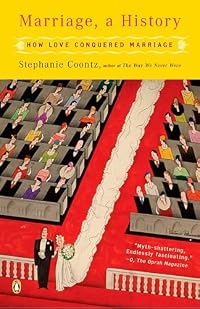
Marriage, a History: from Obedience to Intimacy, or How Love Conquered Marriage
by Stephanie Coontz
On This Page
Description
Just when the clamor over "traditional" marriage couldn't get any louder, along comes this groundbreaking book to ask, "What tradition?" In Marriage, a History, historian and marriage expert Stephanie Coontz takes listeners from the marital intrigues of ancient Babylon to the torments of Victorian lovers to demonstrate how recent the idea of marrying for love is-and how absurd it would have seemed to most of our ancestors. It was when marriage moved into the emotional sphere in the show more nineteenth century, she argues, that it suffered as an institution just as it began to thrive as a personal relationship. This enlightening and hugely entertaining book brings intelligence, perspective, and wit to today's marital debate. show lessTags
Recommendations





Member Recommendations
Member Reviews
This is a sweeping history of the institution of marriage (including how it shifted from being an institution to a relationship). People used to marry for political or economic reasons instead of primarily for love and personal fulfillment: to make an alliance with powerful or wealthy families, or to join together with the person whose farmland was next to yours. The in-laws were as important as the two people in the marriage. Now marriage is generally regarded as a choice two individuals make, and it is becoming more of an equal partnership - not for the first time, but as it used to be.
Quotes
Introduction
In those days there were few two-career marriages. Most people had a two-person, married-couple career that neither could conduct show more alone. (6)
Today most people expect to live their lives in a loving relationship, not a rigid institution. (10)
The Radical Idea of Marrying for Love
...in early modern Europe most people believed that love developed after marriage. (18)
The Invention of Marriage
The story that marriage was invented for the protection of women is still the most widespread myth about the origins of marriage. (35)
I do not believe...that marriage was invented to oppress women any more than it was invented to protect them. (44)
Soap Operas of the Ancient World
...in most cases, marriage was still a matter of practical calculation rather than an arrangement entered into for individual fulfillment and the pursuit of happiness. (65)
For thousands of years...the economic functions of marriage were far more important to the middle and lower classes than were its personal satisfactions, while among the upper classes, the political functions of marriage took first place. (69)
Something Borrowed
The world's first experiment in democratic government did nothing to improve the rights and social status of wives....Athens was one of the few societies in history prior to the nineteenth century that idealized the role of wives as dependent homemakers rather than as work mates for their husbands. (76)
Like many contemporary boosters of the sanctity of marriage, [Octavian/Augustus] did not let his own divorce and many sexual liaisons inhibit him from trying to impose marital virtue and "family values" on others. (83)
How the Other 95 Percent Wed
Women were not necessarily impoverished by divorce in the medieval world. Because no one in the Middle Ages ever claimed that the man was the main breadwinner, a divorced wife was entitled to a percentage of the household estate in line with the labor she had contributed to it. (105)
...until the 17th century the most typical prior consent suit was brought not by a deserted woman or unwed mother by by a man trying to force a woman into marriage after she had rejected him or even married someone else. (109)
In urban as well as rural areas, marriage expanded a man's authority while restricting a woman's....A married woman...was covered by her husband's identity and lacked any legal standing on her own. (115)
From Yoke Mates to Soul Mates
It was harder to dismiss calls to extend equal rights to women when people no longer believed that every relationship had to have a ruler and a subject. (153)
"women's labor was radically undervalued in the world of cash transactions" (Catherine Kelley,156)
The new theory of gender difference divided humanity into two distinct sets of traits. The male sphere encompassed the rational and active ideal, while females represented the humanitarian and compassionate aspects of life. When these two spheres were brought together in marriage, they produced a perfect, well-rounded whole. (156)
"Two Birds Within One Nest"
"Two birds within one nest;
Two hearts within one breast...
A world of strife shut out,
A world of love shut in."
Dora Greenwell, "Home," 1863 (p. 163)
"A Heaving Volcano"
...the conviction that men and women had inherently different natures remained an impediment to the intensification of romantic love and intimacy. (184)
There was a remarkable continuity in the legal subjugation of women from the Middle Ages until the end of the nineteenth century. (186)
"The Time When Mountains Move Has Come"
Traditionalists worried that...changes in sexual expectations might lead women to put their own happiness above that of their husbands. Instead, historian Nancy Cott suggests, "sex appeal" replaced "submission" as a wife's first responsibility to her husband... (204)
The Era of Ozzie and Harriet
The cultural consensus that everyone should marry and form a male breadwinner family was like a steamroller that crushed every alternative view. (229)
At every turn, popular culture and intellectual elites alike discouraged women from seeing themselves as productive members of society. (236)
Winds of Change
It was by reading about what marriage ought to be that many women saw what their own marriages weren't. (252)
Uncharted Territory
The big problem doesn't lie in differences between what men and women want out of life and love. The big problem is how hard it is to achieve equal relationships in a society whose work policies, school schedules, and social programs were constructed on the assumption that male breadwinner families would always be the norm. (299-300)
Over the past century, marriage has steadily become more fair, more fulfilling, and more effective in fostering the well-being of both adults and children than ever before in history. It has also become more optional and more fragile. (301)
Conclusion
This is a recurring pattern in periods of massive historical change. The gains that social change produces in some areas of life are usually inseparable from the losses it produces in others. (308)
Notes
"The Last User of a Secret Woman's Code," NYT, 10/7/2004
"A Language By Women for Women," WaPo, 2/24/2004 show less
Quotes
Introduction
In those days there were few two-career marriages. Most people had a two-person, married-couple career that neither could conduct show more alone. (6)
Today most people expect to live their lives in a loving relationship, not a rigid institution. (10)
The Radical Idea of Marrying for Love
...in early modern Europe most people believed that love developed after marriage. (18)
The Invention of Marriage
The story that marriage was invented for the protection of women is still the most widespread myth about the origins of marriage. (35)
I do not believe...that marriage was invented to oppress women any more than it was invented to protect them. (44)
Soap Operas of the Ancient World
...in most cases, marriage was still a matter of practical calculation rather than an arrangement entered into for individual fulfillment and the pursuit of happiness. (65)
For thousands of years...the economic functions of marriage were far more important to the middle and lower classes than were its personal satisfactions, while among the upper classes, the political functions of marriage took first place. (69)
Something Borrowed
The world's first experiment in democratic government did nothing to improve the rights and social status of wives....Athens was one of the few societies in history prior to the nineteenth century that idealized the role of wives as dependent homemakers rather than as work mates for their husbands. (76)
Like many contemporary boosters of the sanctity of marriage, [Octavian/Augustus] did not let his own divorce and many sexual liaisons inhibit him from trying to impose marital virtue and "family values" on others. (83)
How the Other 95 Percent Wed
Women were not necessarily impoverished by divorce in the medieval world. Because no one in the Middle Ages ever claimed that the man was the main breadwinner, a divorced wife was entitled to a percentage of the household estate in line with the labor she had contributed to it. (105)
...until the 17th century the most typical prior consent suit was brought not by a deserted woman or unwed mother by by a man trying to force a woman into marriage after she had rejected him or even married someone else. (109)
In urban as well as rural areas, marriage expanded a man's authority while restricting a woman's....A married woman...was covered by her husband's identity and lacked any legal standing on her own. (115)
From Yoke Mates to Soul Mates
It was harder to dismiss calls to extend equal rights to women when people no longer believed that every relationship had to have a ruler and a subject. (153)
"women's labor was radically undervalued in the world of cash transactions" (Catherine Kelley,156)
The new theory of gender difference divided humanity into two distinct sets of traits. The male sphere encompassed the rational and active ideal, while females represented the humanitarian and compassionate aspects of life. When these two spheres were brought together in marriage, they produced a perfect, well-rounded whole. (156)
"Two Birds Within One Nest"
"Two birds within one nest;
Two hearts within one breast...
A world of strife shut out,
A world of love shut in."
Dora Greenwell, "Home," 1863 (p. 163)
"A Heaving Volcano"
...the conviction that men and women had inherently different natures remained an impediment to the intensification of romantic love and intimacy. (184)
There was a remarkable continuity in the legal subjugation of women from the Middle Ages until the end of the nineteenth century. (186)
"The Time When Mountains Move Has Come"
Traditionalists worried that...changes in sexual expectations might lead women to put their own happiness above that of their husbands. Instead, historian Nancy Cott suggests, "sex appeal" replaced "submission" as a wife's first responsibility to her husband... (204)
The Era of Ozzie and Harriet
The cultural consensus that everyone should marry and form a male breadwinner family was like a steamroller that crushed every alternative view. (229)
At every turn, popular culture and intellectual elites alike discouraged women from seeing themselves as productive members of society. (236)
Winds of Change
It was by reading about what marriage ought to be that many women saw what their own marriages weren't. (252)
Uncharted Territory
The big problem doesn't lie in differences between what men and women want out of life and love. The big problem is how hard it is to achieve equal relationships in a society whose work policies, school schedules, and social programs were constructed on the assumption that male breadwinner families would always be the norm. (299-300)
Over the past century, marriage has steadily become more fair, more fulfilling, and more effective in fostering the well-being of both adults and children than ever before in history. It has also become more optional and more fragile. (301)
Conclusion
This is a recurring pattern in periods of massive historical change. The gains that social change produces in some areas of life are usually inseparable from the losses it produces in others. (308)
Notes
"The Last User of a Secret Woman's Code," NYT, 10/7/2004
"A Language By Women for Women," WaPo, 2/24/2004 show less
This book made me stop at nearly every paragraph to ponder everything I ever thought I knew about the institution of marriage. (And with quite a lot of varied personal experience in and out of that arena, I had the silly notion that I was beginning to comprehend a good bit.)
Coontz traces the best understandings of the origins of marriage beginning way back in prehistory and describes the amazing variety of forms marriage has taken all around the world. As the narrative moves from prehistory to the present, the scope correspondingly narrows to predominantly north America and western Europe, but that is truly the only short-coming in this deeply resourced study. (Because it was published in 2005, the work ends before the 2015 U.S. Supreme show more Court decision of Obergefell v. Hodges, holding the fundamental right to marry is constitutionally guaranteed to same-sex couples.)
"Marriage, a History" examines marriage from inside and out; the societal, religious, familial, economic, and political forces that act on marriage and the ways in which marriage acts right back; and the hopes, dreams, and expectations that individuals have about and within marriages. Coontz concludes that marriage is no longer and can never again be an institution into which virtually all people can be plunked and expected to remain for the entirety of their adult lives. She reaches this conclusion not out of any subjective or judgmental view about whether marriage is right or wrong, good or bad, but rather as a result of the clear-eyed analysis of the facts gleaned from the history and progression of marriage in the world.
Thanks to my daughter for loaning me this book! show less
Coontz traces the best understandings of the origins of marriage beginning way back in prehistory and describes the amazing variety of forms marriage has taken all around the world. As the narrative moves from prehistory to the present, the scope correspondingly narrows to predominantly north America and western Europe, but that is truly the only short-coming in this deeply resourced study. (Because it was published in 2005, the work ends before the 2015 U.S. Supreme show more Court decision of Obergefell v. Hodges, holding the fundamental right to marry is constitutionally guaranteed to same-sex couples.)
"Marriage, a History" examines marriage from inside and out; the societal, religious, familial, economic, and political forces that act on marriage and the ways in which marriage acts right back; and the hopes, dreams, and expectations that individuals have about and within marriages. Coontz concludes that marriage is no longer and can never again be an institution into which virtually all people can be plunked and expected to remain for the entirety of their adult lives. She reaches this conclusion not out of any subjective or judgmental view about whether marriage is right or wrong, good or bad, but rather as a result of the clear-eyed analysis of the facts gleaned from the history and progression of marriage in the world.
Thanks to my daughter for loaning me this book! show less
I've always questioned what it was that the Religious Right wanted in terms of a "traditional marriage." Did they want to bring back domestic violence as an acceptable form of communication between two people? Or did they want to bring back marriage as a political or property exchange? Either way, I would recommend this history book to someone who voted Yes on Proposition 8 in California.
I've always questioned what it was that the Religious Right wanted in terms of a "traditional marriage." Did they want to bring back domestic violence as an acceptable form of communication between two people? Or did they want to bring back marriage as a political or property exchange? Either way, I would recommend this history book to someone who voted Yes on Proposition 8 in California.
3.5 stars
Love has only been a precursor to marriage the past couple of hundred years or so. Before that, marriage was mostly for financial or political reasons. Love may or may not have come later. So what many call “traditional marriage” is not really as “traditional” as some might have one believe. What’s often seen as traditional or ideal was really only what marriage was (seen as) in the 1950s for just over a decade. Of course, what went on behind closed doors is not exactly what “Ozzie and Harriet” would have us all believe, either.
The author is a family studies professor. The book takes a look at the history of marriage during different times and cultures in history (though the focus, certainly for modern marriages, show more is on the Western world). I found this quite interesting. The book has an extensive “Notes” section at the end for those of us who also like to peruse through it for extra tidbits of information. As someone who has never been married, for some reason, I added this to my tbr ages ago! show less
Love has only been a precursor to marriage the past couple of hundred years or so. Before that, marriage was mostly for financial or political reasons. Love may or may not have come later. So what many call “traditional marriage” is not really as “traditional” as some might have one believe. What’s often seen as traditional or ideal was really only what marriage was (seen as) in the 1950s for just over a decade. Of course, what went on behind closed doors is not exactly what “Ozzie and Harriet” would have us all believe, either.
The author is a family studies professor. The book takes a look at the history of marriage during different times and cultures in history (though the focus, certainly for modern marriages, show more is on the Western world). I found this quite interesting. The book has an extensive “Notes” section at the end for those of us who also like to peruse through it for extra tidbits of information. As someone who has never been married, for some reason, I added this to my tbr ages ago! show less
This seems like a serious treatment of the topic, with fully 98 pages of notes and an 18-page index. The back jacket provides complimentary blurbs from close to a dozen scholars and cultural authorities. With an apparatus like that, I was expecting to be impressed, and for the first few chapters I was. However, as Coontz moved into the early twentieth century (a period I have more than passing familiarity with), I realized exactly how superficial and selective her argument is. Although she provides a breathtaking range of sources and quotations, her analysis of changing gender roles post-WWI is suspect, making me wonder about the solidity of the discussion leading up to it. Beyond her relentless American bias, she ignores many show more significant social facts — for instance, the social impact of the World War One itself and the flu pandemic of the late 1910s. As she moves into the post-war period, her analysis becomes even more glib, as if the facts of our culture are so self-evident as to need no explanation (if that were true, how could she justify writing her book in the first place?). Coontz's final conclusion — that the male breadwinner marriage of the 1950s and early 1960s was a carefully constructed historical aberration unlikely to be seen again in our culture of increasing individualism — is not groundbreaking, and her placid call for patience while the concept of marriage continues to sort itself out feels disappointingly flat after some 300 pages of build-up. I did like her busting of several common marriage myths regularly trotted out by mass media to drive political and economic agendas (for instance, that single women over 35 are more likely to be killed by terrorists than married — obviously untrue, and not because the women are so panicked that they'll marry any man who offers a ring). But in the end I was not impressed by this book. show less
The book gave a good idea of just how many different ways there are of considering marriage. Coontz looks at marriage across different cultures and throughout history. Her thesis is that over time marriage has gone from a public institution with a strict hierarchical structure to a private one based on equality and mutual esteem. If nothing else, the books teaches you that anyone who says that "X is the way marriage has always been" is nearly always wrong.
Members
- Recently Added By
Lists

Read This Next
120 works; 3 members

Books Read in 2014
2,343 works; 86 members
Author Information

11+ Works 2,658 Members
Stephanie Coontz is a social analyst, family historian, writer, and a professor. She teaches at Evergreen State College in Olympia, Washington. Her research interests include the historical accuracy, myths, and facts that surround our present concept of traditional family values. In her book, The Way We Never Were: American Families and the show more Nostalgia Trap, Coontz disputes many of the myths about the decade of the 1950s. Her book, The Way We Really Are: Coming to Terms with America's Changing Families explores new economic and social pressure put on families. Coontz is a frequent commentator on CNN and NBC news programs and has appeared on the Oprah Winfrey Show. She was the keynote speaker at the Thirteenth Annual Maine Women's Studies Conference in 1998. (Bowker Author Biography) show less
Awards and Honors
Notable Lists
Common Knowledge
- Canonical title
- Marriage, a History: from Obedience to Intimacy, or How Love Conquered Marriage
- Original publication date
- 2005
- Dedication
- For the three generations of men in my family: Bill, Will, Kris, and Fred.
- First words
- George Bernard Shaw described marriage as an institution that brings together two people "under the influence of the most violent, most insane, most delusive, and most transient of passions."
- Last words
- (Click to show. Warning: May contain spoilers.)For better of worse, we must adjust our personal expectations and social support systems to this new reality.
- Blurbers
- Quindlen, Anna; Warner, Judith; Prose, Francine
Classifications
- Genres
- Sociology, Nonfiction, History, General Nonfiction, Sexuality and Gender Studies
- DDC/MDS
- 306.8109 — Society, government, & culture Social sciences, sociology & anthropology Social Behavior - Dating, Marriage, Divorce Marriage, partnerships, unions; family Marriage and marital status Biography And History
- LCC
- HQ503 .C66 — Social sciences The family. Marriage, Women and Sexuality The Family. Marriage. Women The family. Marriage. Home
- BISAC
Statistics
- Members
- 949
- Popularity
- 27,816
- Reviews
- 18
- Rating
- (3.86)
- Languages
- English, German, Norwegian (Bokmål), Spanish
- Media
- Paper, Audiobook, Ebook
- ISBNs
- 8
- ASINs
- 4