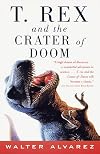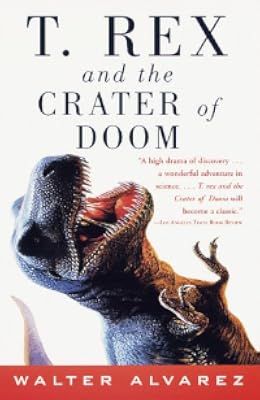
T. Rex and the Crater of Doom
by Walter Alvarez
On This Page
Description
Sixty-five million years ago, a comet or asteroid larger than Mount Everest slammed into the Earth, inducing an explosion equivalent to the detonation of a hundred million hydrogen bombs. Vaporized detritus blasted through the atmosphere upon impact, falling back to Earth around the globe. Disastrous environmental consequences ensued: a giant tsunami, continent-scale wildfires, darkness, and cold, followed by sweltering greenhouse heat. When conditions returned to normal, half the plant and show more animal genera on Earth had perished.This horrific chain of events is now widely accepted as the solution to a great scientific mystery: what caused the extinction of the dinosaurs? Walter Alvarez, one of the Berkeley scientists who discovered evidence of the impact, tells the story behind the development of the initially controversial theory. It is a saga of high adventure in remote locations, of arduous data collection and intellectual struggle, of long periods of frustration ended by sudden breakthroughs, of friendships made and lost, and of the exhilaration of discovery that forever altered our understanding of Earth's geological history. show lessTags
Recommendations
















Member Recommendations

Member Reviews
What a satisfying, scientific tale. Walter Alvarez of the eponymous "Alvarez Hypothesis," the hypothesis that a large impact caused the mass dinosaur extinction could have written many different types of books about his work. This is a deeply humble book that seems to be equally about How To Do Good Science as it is about the deeply fascinating scientific work that Alvarez has done.
The story is just so freaking cool -- both the human and geologic aspects. How could we possible understand what happened to the planet 65 million years ago? Alvarez, as a postdoc, sets out to Italy looking for evidence of plate tectonics by measuring magnetic drift, as anticipated if a plate shifted rotationally. Instead, he finds that the magnetic data from show more his region is too poor to pick up such subtle changes and he can only detect magnetic reversals. Then he realizes that the particular region he picked happens to have other clues in the rock bed (forams) that can be used to date magnetic reversal events, which has never been done before. However, forams were living organisms, and in the process of using them for dating, they noticed an abrupt boundary of absence of large forams, consistent with a mass extinction. Each step along the way is so nicely laid out -- not the way the lay public views science: hypothesis, easy test, confirm results, new hypothesis, the end!. But the real way: totally different hypothesis, interesting observation, new hypothesis, accidental discovery, new hypothesis, need to invent a brand new assay, and endless repeats. To do their work they ended up inventing new ways of performing neutron activation analysis, blowing up the conventional geologic belief in uniformism, rather than catastrophic events and discovering potentially periodic impacts on the earth (the downside to an old book -- the 1997 view of the Nemesis star has largely been discredited, but the discrediting was nearly a decade of work for the astronomy community and has led to new interesting hypotheses about the solar system)
Alvarez is deeply humble about his role in all of this, instead highlighting the many multidisciplinary collaborations he was engaged in with his work. That's another great facet to the book, to hear about all of the geologists, astronomers, paleontologists, archeologists and oceanologists involved. He also discusses the false roads they go down (they only discovered extraterrestrial material in the first place because they had a hypothesis that a nearby supernova was responsible for the mass extinction, a theory they nearly published due to bad data) and circles back when the evidence that pointed them one way later gets solved by something else -- like the shocked quartz that suggested an oceanic impact, which were later explained by secondary impact from debris. Finally, in what turns out to be a prescient move, instead of criticizing his main rival, who believed in a volcanic theory of extinction, Alvarez confirms that there is evidence to support the involvement of volcanic activity at the Declan traps in the extinction event, which would not become part of the mainstream wisdom until 18 years after the book was published.
There are only two major downsides to this book: one is the first 33 pages of front matter about the story as we know it and how science works is relatively dry -- Alvarez should have jumped in with his personal story and then circled back. The second is that 19 years have passed since publication and new discoveries have been made -- read with google handy! show less
The story is just so freaking cool -- both the human and geologic aspects. How could we possible understand what happened to the planet 65 million years ago? Alvarez, as a postdoc, sets out to Italy looking for evidence of plate tectonics by measuring magnetic drift, as anticipated if a plate shifted rotationally. Instead, he finds that the magnetic data from show more his region is too poor to pick up such subtle changes and he can only detect magnetic reversals. Then he realizes that the particular region he picked happens to have other clues in the rock bed (forams) that can be used to date magnetic reversal events, which has never been done before. However, forams were living organisms, and in the process of using them for dating, they noticed an abrupt boundary of absence of large forams, consistent with a mass extinction. Each step along the way is so nicely laid out -- not the way the lay public views science: hypothesis, easy test, confirm results, new hypothesis, the end!. But the real way: totally different hypothesis, interesting observation, new hypothesis, accidental discovery, new hypothesis, need to invent a brand new assay, and endless repeats. To do their work they ended up inventing new ways of performing neutron activation analysis, blowing up the conventional geologic belief in uniformism, rather than catastrophic events and discovering potentially periodic impacts on the earth (the downside to an old book -- the 1997 view of the Nemesis star has largely been discredited, but the discrediting was nearly a decade of work for the astronomy community and has led to new interesting hypotheses about the solar system)
Alvarez is deeply humble about his role in all of this, instead highlighting the many multidisciplinary collaborations he was engaged in with his work. That's another great facet to the book, to hear about all of the geologists, astronomers, paleontologists, archeologists and oceanologists involved. He also discusses the false roads they go down (they only discovered extraterrestrial material in the first place because they had a hypothesis that a nearby supernova was responsible for the mass extinction, a theory they nearly published due to bad data) and circles back when the evidence that pointed them one way later gets solved by something else -- like the shocked quartz that suggested an oceanic impact, which were later explained by secondary impact from debris. Finally, in what turns out to be a prescient move, instead of criticizing his main rival, who believed in a volcanic theory of extinction, Alvarez confirms that there is evidence to support the involvement of volcanic activity at the Declan traps in the extinction event, which would not become part of the mainstream wisdom until 18 years after the book was published.
There are only two major downsides to this book: one is the first 33 pages of front matter about the story as we know it and how science works is relatively dry -- Alvarez should have jumped in with his personal story and then circled back. The second is that 19 years have passed since publication and new discoveries have been made -- read with google handy! show less
Wow, T. Rex and the Crater of Doom. If you've ever read a book with a more titillating title than that then, well, please tell me what it was because clearly you read more titillatingly titled books than I do. (Although [b:this one|15748663|The Dinosaur that Pooped Christmas|Tom Fletcher|https://d.gr-assets.com/books/1391768028s/15748663.jpg|21441168] is certainly a contender.)
Despite sounding like a 1950s B-movie, T. Rex and the Crater of Doom is a popular science book by one of the scientists who proposed the impact hypothesis. This is the theory that a massive meteor strike wiped out the dinosaurs (and three quarters of all the other life on Earth) and that they didn't – as Alan Grant believes – turn into birds. The book show more was written nearly twenty years ago, which in science can represent either the latest new-fangled ideas or be embarrassingly old-fashioned. Here it's a bit of both.
In many ways this book is like Brenda Fowler's [b:Iceman|2840548|Iceman|Brenda Fowler|https://d.gr-assets.com/books/1327171406s/2840548.jpg|897903]. That book is about Ötzi the Iceman, or as he's better known “that frozen 5000 year old guy they found in the Alps a while back”. While Iceman is ostensibly about the science behind finding out more about early man, it was written before a lot of that science had been done so in fact it was more about the scientists involved, and the bitter disputes that arose among them. Similarly with T. Rex and the Crater of Doom, the meteor wasn't officially recognised as being (probably) the cause of the extinction until 2010; and to vilify Alan Grant it's now believed that the avian dinosaurs mostly survived and did turn into birds. Of course, as time passes the line between “avian” and “non-avian” dinosaur has become increasingly blurred. Although this isn't necessarily a bad thing.
Inevitably then, while much of the book concerns the science behind the impact hypothesis, there's plenty of material on the scientists too. A rival theory to the impact hypothesis was that the eruption of the supervolcano beneath India was responsible for the extinction. During the 1980s this hypothesis had the useful advantage that scientists knew the eruption had happened about 65 million years ago, whereas no sufficiently large meteor crater of that age had been found. The biggest difference between the two theories was that a meteor strike would cause an abrupt extinction event, while an eruption would spread things out over possibly hundreds of thousands of years. While “bitter rivalry” isn't a phrase that gives one a warm fuzzy feeling inside, Walter Alvarez takes pains to point out that in science it can be awfully useful. So vehement were the volcano-fans that a meteor was not responsible that they forced the meteor-fans to double check every bit of evidence they found and every hypothesis they came up with. Like some kind of turbo-peer-review, the effect was to refine their findings to a rare degree of precision.
I could write more about the book, about what I learned about geology or chemistry or how Walter Alvarez helped me understand geological time scales; but ultimately there's only one question that needs to be asked with a book like this. Is it better than that hypothetical B-movie of the same name? And the answer is a resounding: maybe. show less
Despite sounding like a 1950s B-movie, T. Rex and the Crater of Doom is a popular science book by one of the scientists who proposed the impact hypothesis. This is the theory that a massive meteor strike wiped out the dinosaurs (and three quarters of all the other life on Earth) and that they didn't – as Alan Grant believes – turn into birds. The book show more was written nearly twenty years ago, which in science can represent either the latest new-fangled ideas or be embarrassingly old-fashioned. Here it's a bit of both.
In many ways this book is like Brenda Fowler's [b:Iceman|2840548|Iceman|Brenda Fowler|https://d.gr-assets.com/books/1327171406s/2840548.jpg|897903]. That book is about Ötzi the Iceman, or as he's better known “that frozen 5000 year old guy they found in the Alps a while back”. While Iceman is ostensibly about the science behind finding out more about early man, it was written before a lot of that science had been done so in fact it was more about the scientists involved, and the bitter disputes that arose among them. Similarly with T. Rex and the Crater of Doom, the meteor wasn't officially recognised as being (probably) the cause of the extinction until 2010; and to vilify Alan Grant it's now believed that the avian dinosaurs mostly survived and did turn into birds. Of course, as time passes the line between “avian” and “non-avian” dinosaur has become increasingly blurred. Although this isn't necessarily a bad thing.
Inevitably then, while much of the book concerns the science behind the impact hypothesis, there's plenty of material on the scientists too. A rival theory to the impact hypothesis was that the eruption of the supervolcano beneath India was responsible for the extinction. During the 1980s this hypothesis had the useful advantage that scientists knew the eruption had happened about 65 million years ago, whereas no sufficiently large meteor crater of that age had been found. The biggest difference between the two theories was that a meteor strike would cause an abrupt extinction event, while an eruption would spread things out over possibly hundreds of thousands of years. While “bitter rivalry” isn't a phrase that gives one a warm fuzzy feeling inside, Walter Alvarez takes pains to point out that in science it can be awfully useful. So vehement were the volcano-fans that a meteor was not responsible that they forced the meteor-fans to double check every bit of evidence they found and every hypothesis they came up with. Like some kind of turbo-peer-review, the effect was to refine their findings to a rare degree of precision.
I could write more about the book, about what I learned about geology or chemistry or how Walter Alvarez helped me understand geological time scales; but ultimately there's only one question that needs to be asked with a book like this. Is it better than that hypothetical B-movie of the same name? And the answer is a resounding: maybe. show less
Wow, T. Rex and the Crater of Doom. If you've ever read a book with a more titillating title than that then, well, please tell me what it was because clearly you read more titillatingly titled books than I do. (Although [b:this one|15748663|The Dinosaur that Pooped Christmas|Tom Fletcher|https://d.gr-assets.com/books/1391768028s/15748663.jpg|21441168] is certainly a contender.)
Despite sounding like a 1950s B-movie, T. Rex and the Crater of Doom is a popular science book by one of the scientists who proposed the impact hypothesis. This is the theory that a massive meteor strike wiped out the dinosaurs (and three quarters of all the other life on Earth) and that they didn't – as Alan Grant believes – turn into birds. The book show more was written nearly twenty years ago, which in science can represent either the latest new-fangled ideas or be embarrassingly old-fashioned. Here it's a bit of both.
In many ways this book is like Brenda Fowler's [b:Iceman|2840548|Iceman|Brenda Fowler|https://d.gr-assets.com/books/1327171406s/2840548.jpg|897903]. That book is about Ötzi the Iceman, or as he's better known “that frozen 5000 year old guy they found in the Alps a while back”. While Iceman is ostensibly about the science behind finding out more about early man, it was written before a lot of that science had been done so in fact it was more about the scientists involved, and the bitter disputes that arose among them. Similarly with T. Rex and the Crater of Doom, the meteor wasn't officially recognised as being (probably) the cause of the extinction until 2010; and to vilify Alan Grant it's now believed that the avian dinosaurs mostly survived and did turn into birds. Of course, as time passes the line between “avian” and “non-avian” dinosaur has become increasingly blurred. Although this isn't necessarily a bad thing.
Inevitably then, while much of the book concerns the science behind the impact hypothesis, there's plenty of material on the scientists too. A rival theory to the impact hypothesis was that the eruption of the supervolcano beneath India was responsible for the extinction. During the 1980s this hypothesis had the useful advantage that scientists knew the eruption had happened about 65 million years ago, whereas no sufficiently large meteor crater of that age had been found. The biggest difference between the two theories was that a meteor strike would cause an abrupt extinction event, while an eruption would spread things out over possibly hundreds of thousands of years. While “bitter rivalry” isn't a phrase that gives one a warm fuzzy feeling inside, Walter Alvarez takes pains to point out that in science it can be awfully useful. So vehement were the volcano-fans that a meteor was not responsible that they forced the meteor-fans to double check every bit of evidence they found and every hypothesis they came up with. Like some kind of turbo-peer-review, the effect was to refine their findings to a rare degree of precision.
I could write more about the book, about what I learned about geology or chemistry or how Walter Alvarez helped me understand geological time scales; but ultimately there's only one question that needs to be asked with a book like this. Is it better than that hypothetical B-movie of the same name? And the answer is a resounding: maybe. show less
Despite sounding like a 1950s B-movie, T. Rex and the Crater of Doom is a popular science book by one of the scientists who proposed the impact hypothesis. This is the theory that a massive meteor strike wiped out the dinosaurs (and three quarters of all the other life on Earth) and that they didn't – as Alan Grant believes – turn into birds. The book show more was written nearly twenty years ago, which in science can represent either the latest new-fangled ideas or be embarrassingly old-fashioned. Here it's a bit of both.
In many ways this book is like Brenda Fowler's [b:Iceman|2840548|Iceman|Brenda Fowler|https://d.gr-assets.com/books/1327171406s/2840548.jpg|897903]. That book is about Ötzi the Iceman, or as he's better known “that frozen 5000 year old guy they found in the Alps a while back”. While Iceman is ostensibly about the science behind finding out more about early man, it was written before a lot of that science had been done so in fact it was more about the scientists involved, and the bitter disputes that arose among them. Similarly with T. Rex and the Crater of Doom, the meteor wasn't officially recognised as being (probably) the cause of the extinction until 2010; and to vilify Alan Grant it's now believed that the avian dinosaurs mostly survived and did turn into birds. Of course, as time passes the line between “avian” and “non-avian” dinosaur has become increasingly blurred. Although this isn't necessarily a bad thing.
Inevitably then, while much of the book concerns the science behind the impact hypothesis, there's plenty of material on the scientists too. A rival theory to the impact hypothesis was that the eruption of the supervolcano beneath India was responsible for the extinction. During the 1980s this hypothesis had the useful advantage that scientists knew the eruption had happened about 65 million years ago, whereas no sufficiently large meteor crater of that age had been found. The biggest difference between the two theories was that a meteor strike would cause an abrupt extinction event, while an eruption would spread things out over possibly hundreds of thousands of years. While “bitter rivalry” isn't a phrase that gives one a warm fuzzy feeling inside, Walter Alvarez takes pains to point out that in science it can be awfully useful. So vehement were the volcano-fans that a meteor was not responsible that they forced the meteor-fans to double check every bit of evidence they found and every hypothesis they came up with. Like some kind of turbo-peer-review, the effect was to refine their findings to a rare degree of precision.
I could write more about the book, about what I learned about geology or chemistry or how Walter Alvarez helped me understand geological time scales; but ultimately there's only one question that needs to be asked with a book like this. Is it better than that hypothetical B-movie of the same name? And the answer is a resounding: maybe. show less
In the last quarter of the 20th Century, Walter Alvarez was one of a select few scientists who had a close hand in discovering the truth about how and why the dinosaurs disappeared some 65 million years ago, and this book recounts that long journey. Detailing what was once believed, and seemingly understood, and moving on to the theories and discoveries that changed those understandings completely, Alvarez takes readers through the earth-shattering change of moving from a sure belief in gradualism--the world changing gradually, including in regard to extinctions--to the point at which he and others came to have faith, instead, in the Impact Theory.
Beginning with the tragedy of the mass extinction of T-Rex and so many of the other show more dinosaurs which called earth home 65 million years ago, Alvarez moves through what is essentially a scientific mystery, exploring and explaining the false starts, the twists, and all of the assumptions, understandings, and discoveries which eventually led to not only faith in the impact theory, but to the discovery of the site of the impact at the Chicxulub Crater.
This is more than a book for people who have a lingering fascination for the dinosaurs they learned about as children. This a book of science, discovery, and patience--and, more than anything, a journey to discover one of our longest-standing mysteries.
Recommended, of course. show less
Beginning with the tragedy of the mass extinction of T-Rex and so many of the other show more dinosaurs which called earth home 65 million years ago, Alvarez moves through what is essentially a scientific mystery, exploring and explaining the false starts, the twists, and all of the assumptions, understandings, and discoveries which eventually led to not only faith in the impact theory, but to the discovery of the site of the impact at the Chicxulub Crater.
This is more than a book for people who have a lingering fascination for the dinosaurs they learned about as children. This a book of science, discovery, and patience--and, more than anything, a journey to discover one of our longest-standing mysteries.
Recommended, of course. show less
Elegant and thrilling play-by-play from theorizing to the search for evidence in the fossil record to the identification of the meteor/comet crater off Yucatan; it's at once a great detective story and a great exposition of the scientific method. The language is clear and the science easy to follow. A great read, loved it.
Walter Alvarez has managed to capture the imagination of the reader by taking them into a journey that started over 65 million years ago - nearly at the time it is widely believed to be when the dinosaurs became extinct.
Explaining the science and the scientific experiments behind the claim in easy to understand language allows readers to get a blitz course in archeology and palentology. Brilliant and amusing at the same time!
Explaining the science and the scientific experiments behind the claim in easy to understand language allows readers to get a blitz course in archeology and palentology. Brilliant and amusing at the same time!
This was an interesting look into the decades long scientific process into determining just what killed the dinosaurs. I enjoyed learning more of the details about the comet's (or maybe asteroid) effects on earth's deeply complex geology, a subject I'm not all that familiar with. Science is hard and full of misleading evidence and even a bit of infighting. I would have liked to hear a little more about the personalities involved in this process. There are hints of interesting conflicts that are mostly glossed over. Perhaps those are destined for another book.
Members
- Recently Added By
Lists

Best Science Books for Non-Scientists
113 works; 57 members

Geology - Fossils/Palentology
12 works; 3 members

Animals in the Title
498 works; 11 members

The Well-Educated Mind, Susan Wise Bauer, 2016
179 works; 3 members
Author Information

2 Works 676 Members
Walter Alvarez is professor of geology at the University of California, Berkeley
Some Editions
Awards and Honors
Distinctions
Series
Belongs to Publisher Series
Common Knowledge
- Canonical title*
- T. Rex & the Crater of Doom
- Original title
- T.rex and the Crater of Doom
- Alternate titles
- T Rex & the Crater of Doom
- Original publication date
- 1997
- Important places
- Mexico
- Important events
- Extinction of the dinosaurs
- Dedication
- This book is affectionately dedicated to Milly Alvarez
A skillful and compassionate leader in her own feld of mental health, and the perfect companion during thirty years of geological expeditions on five continents - First words
- This is the story of one terrible day in the history of the Earth.
- Last words
- (Click to show. Warning: May contain spoilers.)For, as we watched the violence being inflicted on another planet, we were seeing the reenactment of the last spectacle ever witnessed by Tyrannosaurus rex—the deadly flash from the Crater of Doom, on the day the Mesozoic world ended.
- Publisher's editor
- Repcheck, Jack
- Blurbers
- Ferris, Timothy; Clark, Arthur C.; Russell, Dale; Muller, Richard; Eldredge, Niles
- Original language
- English US
*Some information comes from Common Knowledge in other languages. Click "Edit" for more information.
Classifications
Statistics
- Members
- 599
- Popularity
- 49,094
- Reviews
- 18
- Rating
- (3.93)
- Languages
- 8 — Chinese, Dutch, English, French, Italian, Japanese, Spanish, Swedish
- Media
- Paper, Audiobook, Ebook
- ISBNs
- 22
- ASINs
- 9