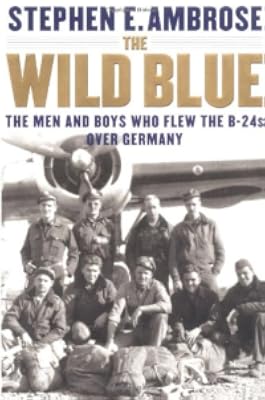
The Wild Blue: The Men and Boys Who Flew the B-24s Over Germany 1944-45
by Stephen E. Ambrose
On This Page
Description
The very young men who flew the B24s over Germany in World War II against terrible odds were an exemplary band of brothers. In The Wild Blue, Stephen Ambrose recounts their extraordinary brand of heroism, skill, daring, and comradeship. Stephen Ambrose describes how the Army Air Forces recruited, trained, and chose those few who would undertake the most demanding and dangerous jobs in the war. These are the boys -- turned pilots, bombardiers, navigators, and gunners of the B24s -- who show more suffered over 50 percent casualties. Ambrose carries us along in the crowded, uncomfortable, and dangerous B24s as their crews fought to the death through thick, black, deadly flak to reach their targets and destroy the German war machine or else went down in flames. Twenty-two-year-old George McGovern who was to become a United States senator and a presidential candidate, flew thirty-five combat missions (all the Army would allow) and won the Distinguished Flying Cross. We meet him and his mates, his co-pilot killed in action, and crews of other planes -- many of whom did not come back. As Band of Brothers and Citizen Soldiers portrayed the bravery and ultimate victory of the American soldier from Normandy on to Germany, The Wild Blue makes clear the contribution these young men of the Army Air Forces stationed in Italy made to the Allied victory. show lessTags
Recommendations











Member Reviews
Interesting and terrifying and edifying in many spots but draggy throughout. It's mostly the story of George McGovern's WWII, and I learned a lot. It's a good read, just not a gripping one- except where it's so scary and you are over enemy territory in the middle of the night and lose your engine.
A rather weak and unworthy effort by Stephen Ambrose, barely comparable to his other books. This book suffers from truthiness and a lack of focus. Ambrose is invested in propagating the Greatest Generation myth. By omission and commission, he offers a wrong picture of history. True, the WWII soldiers were young boys - but so were the soldiers in any other war from the boy colonel in the US Civil War to the baby-faced tankers in the Iraq War. Ambrose's exceptional claim simply is no such thing. The same is true about the mix of the boys from coast to coast. Read any US Civil War account to get a similar picture. Ambrose also paints a too rosy picture about US officers. Can you really hold up Joseph "Catch 22" Heller's claim that there show more were no bad officers with a straight face? These are minor points.
The major distortion, Ambrose engages in, is propagating the effectiveness of strategic bombing. The bombs destroyed many lives and much property, but it didn't cripple the German war engine. Ambrose should have realized this, when he describes the effects on the air raids on Ploesti: Only the Soviet ground forces deprived the Germans of those crucial fuel supplies. The real value of the US airforce was its tactical ground support as flying artillery. This message clashes with Ambrose's intent on glorifying the strategic bomber pilots.
Ambrose further weakens his book by choosing George McGovern as its main protagonist. Through no fault of his own, McGovern enters active war only in the final months of 1944, when the war in Europe was all but over. Whether McGovern and his crew dropped their bombs or not on target, had no effect on the outcome of the war. Furthermore, McGovern's squadron was stationed in Italy, thus in a sideshow theater of war.
Published in 2001 for 26 USD, this book was bought remaindered for 5.34 USD in a Borders store in leafy Scarsdale, NY during 2003, crossed the Atlantic and ended up in a Zurich, Switzerland, used bookstore where I bought it in 2010 for 3.50 CHF/3.75 USD. After the quick plunge, the book manages to tenaciously hold on to its remaining value. show less
The major distortion, Ambrose engages in, is propagating the effectiveness of strategic bombing. The bombs destroyed many lives and much property, but it didn't cripple the German war engine. Ambrose should have realized this, when he describes the effects on the air raids on Ploesti: Only the Soviet ground forces deprived the Germans of those crucial fuel supplies. The real value of the US airforce was its tactical ground support as flying artillery. This message clashes with Ambrose's intent on glorifying the strategic bomber pilots.
Ambrose further weakens his book by choosing George McGovern as its main protagonist. Through no fault of his own, McGovern enters active war only in the final months of 1944, when the war in Europe was all but over. Whether McGovern and his crew dropped their bombs or not on target, had no effect on the outcome of the war. Furthermore, McGovern's squadron was stationed in Italy, thus in a sideshow theater of war.
Published in 2001 for 26 USD, this book was bought remaindered for 5.34 USD in a Borders store in leafy Scarsdale, NY during 2003, crossed the Atlantic and ended up in a Zurich, Switzerland, used bookstore where I bought it in 2010 for 3.50 CHF/3.75 USD. After the quick plunge, the book manages to tenaciously hold on to its remaining value. show less
The prologue to Wild Blue illustrates the constraints to flying a B-24. The very first sentence sets the stage, "The B-24 was built like a 1930s Mack Truck, except that it had an aluminum skin that could be cut with a knife" (p 21). Ambrose goes on to describe the lack of windshield wipers, heat, bathrooms, pressurization, kitchen facilities, or even room to move. Sometimes the airmen are too large for their assigned compartments and had to remove their parachutes in order to fit. Immediately upon reading this you sense the difficulties these airmen faced just flying these planes - never mind the additional dangers of flak, combat, even the weather. Chapter One introduces you to the men (in some most cases, mere boys) responsible for show more flying these dangerous machines. While Ambrose lists many different individuals, his main focus is on the pilots, bombardiers, navigators, radio operators and gunners. With the help of interviews with veterans like George McGovern, Ambrose takes you into the cockpit of every "Dakota Queen" McGovern flew. Subsequent chapters of Wild Blue take us through training, combat missions, D-Day, and the final mission of April 1945. There is a semi-Cinderella happy ending to Wild Blue that was almost too good to be true, but I believed it. show less
Crafty way Ambrose used George McGovern as a proxy for thousands of men who flew B-24s in WWII....personalizes the experience for all of us. The book comprises many small stories, all tied together in a way that makes the reader believe. It's all about the B-24 and the men who flew it. There are many people in the book and sometimes I found myself asking: "who is it, again?" There is some discussion of the argument between strategic bombing and tactical support of the Army--the reason we have a U.S. Air Force.
I finished Stephen Ambrose’s, The Wild Blue: The Men And The Boys Who Flew The B-24’s Over Germany. A short book of only 263 pages. The Title would indicate that this is a history of the use of B-24’s in Europe but it instead focuses on the George McGovern later a senator and presidential candidate who was part of 15th Air Force based out of Italy and his drive to complete his 35 missions so he could rotate home.
A nice niche history but not a big picture of either the 15th Air For e or the use of B-24’s use in Europe. A nice read that is worth your time but probably better to first read a larger history of the use of strategic air in Europe first.
I will rate it as a 4 * read for what the book is, not what it isn’t.
A nice niche history but not a big picture of either the 15th Air For e or the use of B-24’s use in Europe. A nice read that is worth your time but probably better to first read a larger history of the use of strategic air in Europe first.
I will rate it as a 4 * read for what the book is, not what it isn’t.
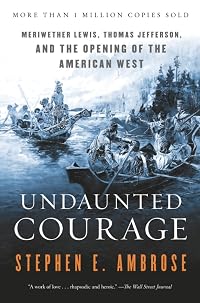
Stephen Ambrose has produced some excellent books - Undaunted Courage, an account of the Lewis and Clark expedition is outstanding - but this historical work felt 'put together', and somehow unconsidered. Still, a worthy tale and not without merit - particularly good description of wartime bombing missions.
Note that I wrote this review before the plagarism controversy. See my review of [b:Wings Over Morning|326862|Wings of Morning The Story of the Last American Bomber Shot Down over Germany in World War II|Thomas Childers|http://photo.goodreads.com/books/1173773838s/326862.jpg|317503]
Ambrose became a widely popular popularizer of World War II history and he has managed to churn out several in the past few years that focus on the common soldier experience. Joseph Heller, author of Catch-22 and himself a bombardier on B-24s, told Ambrose, " never had a bad officer." Ambrose was startled to hear this from the creator of Major Major Major, Colonel Cathcart, and General Dreedle, but Heller, when queried by Ambrose, simply replied they were all show more invention. How they became so good is part of Ambrose' story. The Army Air Corps grew from 26,000 men at the beginning of the war to 2, 400,000 by 1944. American airmen had 360 hours of flight training before entering combat compared with only 110 for the Germans. It was a hazardous business ( four planes went down during a formation flying exercise killing everyone on board, McGovern reported) as the B-24s were very difficult to fly, requiring considerable brute muscle power. Most of the men were still in their teens with only a few officers over twenty-two. Ambrose focuses on the career of George McGovern, a pilot in the 741st Bomb Squadron, based in Cerignola, Italy, who survived flying 35 missions, won several DFCs and was considered a terrific pilot by his crew. Coming from a South Dakota parsonage where airplanes were rarely seen let along flown in, McGovern had extraordinary depth perception that helped him to become such a competent pilot. The plane itself was noisy, unheated, and thin-skinned. By the time he reached Italy, German fighters were not much of a problem as the Germans were running out of fuel and P-51s, flown by the famous African-American Tuskegee squadrons, prevented German fighters from being much of a threat. Flak was another problem. Over the targets the sky would be virtually black except where the shells explosions caused red flashes. The bombers had no choice but to fly right into it, unable to shoot back, make adjustments, or react independently. On one mission, his plane returned with 160 holes, one destroyed engine, no hydraulics — consequently no flaps or brakes — and required every ounce of skill for McGovern to make a safe landing (they tied parachutes to the struts, threw them out the open waist gunner windows, and pulled the ripcords on McGovern' command to slow the plane down after touching the ground). McGovern was 22. The B-24 was manufactured by a consortium of companies that included Ford Motor and Douglas Aircraft. It was called the Liberator and was designed to drop high explosives on enemy positions well behind the front lines — and especially on Berlin. In fact, the B-24 carried a largely payload than the more well-known B-17. The Liberator earned a reputation as an difficuolt beast quite fairly, as Amborses' following description of conditions in the plane attests. "Steering the four-engined airplane was difficult and exhausting, as there was no power except the pilot's muscles. It had no windshield wipers, so the pilot had to stick his head out the side window to see during a rain...there was no heat, despite temperatures that at 20,000 feet and higher got as low as 40 or 50 degrees below zero...the seats were not padded, could not be reclined, and were cramped into so small a space that a man had almost no chance to stretch and none whatsoever to relax. Absolutely nothing was done to make it comfortable for the pilot, co-pilot, or the other eight men in the crew..."
Taking off was always an adventure as even a slight drop in one of the four engine' efficiency might cause a crash since the planes were always overloaded way beyond design capacity. The planes were dangerous places to be — only 50 percent of their crews survived to the war's end. The B-24 Liberator performed better than the B-17 Flying Fortress, but it was less ergonomic and more susceptible to battle damage. They operated out of improvised fields, usually without hangars and formal barracks, surrounded by a civilian population amid ruins and on the edge of starvation There were more B-24's built than any other US airplane and Ambrose says "it would be an exaggeration to say that the B-24 won the war for the Allies. But don't ask how they could have won the war without it." show less
Ambrose became a widely popular popularizer of World War II history and he has managed to churn out several in the past few years that focus on the common soldier experience. Joseph Heller, author of Catch-22 and himself a bombardier on B-24s, told Ambrose, " never had a bad officer." Ambrose was startled to hear this from the creator of Major Major Major, Colonel Cathcart, and General Dreedle, but Heller, when queried by Ambrose, simply replied they were all show more invention. How they became so good is part of Ambrose' story. The Army Air Corps grew from 26,000 men at the beginning of the war to 2, 400,000 by 1944. American airmen had 360 hours of flight training before entering combat compared with only 110 for the Germans. It was a hazardous business ( four planes went down during a formation flying exercise killing everyone on board, McGovern reported) as the B-24s were very difficult to fly, requiring considerable brute muscle power. Most of the men were still in their teens with only a few officers over twenty-two. Ambrose focuses on the career of George McGovern, a pilot in the 741st Bomb Squadron, based in Cerignola, Italy, who survived flying 35 missions, won several DFCs and was considered a terrific pilot by his crew. Coming from a South Dakota parsonage where airplanes were rarely seen let along flown in, McGovern had extraordinary depth perception that helped him to become such a competent pilot. The plane itself was noisy, unheated, and thin-skinned. By the time he reached Italy, German fighters were not much of a problem as the Germans were running out of fuel and P-51s, flown by the famous African-American Tuskegee squadrons, prevented German fighters from being much of a threat. Flak was another problem. Over the targets the sky would be virtually black except where the shells explosions caused red flashes. The bombers had no choice but to fly right into it, unable to shoot back, make adjustments, or react independently. On one mission, his plane returned with 160 holes, one destroyed engine, no hydraulics — consequently no flaps or brakes — and required every ounce of skill for McGovern to make a safe landing (they tied parachutes to the struts, threw them out the open waist gunner windows, and pulled the ripcords on McGovern' command to slow the plane down after touching the ground). McGovern was 22. The B-24 was manufactured by a consortium of companies that included Ford Motor and Douglas Aircraft. It was called the Liberator and was designed to drop high explosives on enemy positions well behind the front lines — and especially on Berlin. In fact, the B-24 carried a largely payload than the more well-known B-17. The Liberator earned a reputation as an difficuolt beast quite fairly, as Amborses' following description of conditions in the plane attests. "Steering the four-engined airplane was difficult and exhausting, as there was no power except the pilot's muscles. It had no windshield wipers, so the pilot had to stick his head out the side window to see during a rain...there was no heat, despite temperatures that at 20,000 feet and higher got as low as 40 or 50 degrees below zero...the seats were not padded, could not be reclined, and were cramped into so small a space that a man had almost no chance to stretch and none whatsoever to relax. Absolutely nothing was done to make it comfortable for the pilot, co-pilot, or the other eight men in the crew..."
Taking off was always an adventure as even a slight drop in one of the four engine' efficiency might cause a crash since the planes were always overloaded way beyond design capacity. The planes were dangerous places to be — only 50 percent of their crews survived to the war's end. The B-24 Liberator performed better than the B-17 Flying Fortress, but it was less ergonomic and more susceptible to battle damage. They operated out of improvised fields, usually without hangars and formal barracks, surrounded by a civilian population amid ruins and on the edge of starvation There were more B-24's built than any other US airplane and Ambrose says "it would be an exaggeration to say that the B-24 won the war for the Allies. But don't ask how they could have won the war without it." show less
Members
- Recently Added By
Lists

Books Read in 2021
5,361 works; 113 members

A Rainbow of Books: Colors in the Title
570 works; 24 members
Author Information

72+ Works 43,999 Members
Historian Stephen E. Ambrose grew up in Wisconsin and attended the University of Wisconsin and the University of Louisiana. Ambrose is considered to be one of the foremost historical scholars of recent times and has been a professor for over three decades. He is also the founder and president of the National D-Day Museum in New Orleans. His works show more include D-Day: June 6, 1944: The Climactic Battle of World War II, Citizen Soldiers: The U. S. Army from Normandy Beaches to the Bulge to the Surrender of Germany, June 7, 1944-May 7, 1945, Band of Brothers: E Company, 506th Regiment, 101st Airborne from Normandy to Hitler's Eagle's Nest and Undaunted Courage: Meriwether Lewis, Thomas Jefferson and the Opening of the American West. Abrose served historical consultant on the motion picture Saving Private Ryan. (Bowker Author Biography) show less
Awards and Honors
Distinctions
Common Knowledge
- Canonical title
- The Wild Blue: The Men and Boys Who Flew the B-24s Over Germany 1944-45
- Original publication date
- 2001; LC 2001020563
- People/Characters
- George McGovern; Ralph Rounds
- Important places
- Europe; Germany
- Important events
- World War II (1939 | 1945)
- Dedication
- For Eleanor
- First words
- PROLOGUE:
The B-24 was built like a 1930s Mack truck, except that it had an aluminum skin that could be cut with a knife. It could carry a heavy load far and fast but it had no refinements. ...
The pilots and crews of the B-24s came from every state and territory in America. They were young, fit, eager. ... They were all volunteers. The U.S. Army Air Corps--after 1942 the Army Air Forces--did not force anyone to fly... (show all). ... - Quotations
- "We chose the name Liberator because this airplane can carry destruction to the heart of the Hun, and thus help you and us to liberate those millions temporarily finding themselves under Hitler's yoke.
- Last words
- (Click to show. Warning: May contain spoilers.)For McGovern, it was "an enormouse release and gratification. It seemed to just wipe clean a slate".
- Blurbers
- King, Larry
Classifications
- Genres
- History, Nonfiction, General Nonfiction
- DDC/MDS
- 940.544973 — History & geography History of Europe History of Europe 1918- Military history of World War II Air operations Operations of specific countries American air operations in WWII
- LCC
- D790 .A786 — History of Europe, Asia, Africa and Oceania History (General) World War II (1939-1945)
- BISAC
Statistics
- Members
- 2,282
- Popularity
- 8,804
- Reviews
- 31
- Rating
- (3.68)
- Languages
- 5 — Dutch, English, Hungarian, Italian, Portuguese
- Media
- Paper, Audiobook, Ebook
- ISBNs
- 29
- UPCs
- 1
- ASINs
- 18