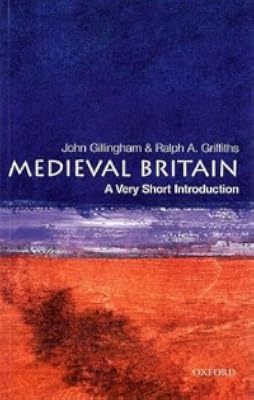
Medieval Britain: A Very Short Introduction
by John Gillingham, Ralph A. Griffiths
On This Page
Description
Covering the establishment of the Anglo-Norman monarchy in the early Middle Ages, through to England's failure to dominate the British Isles and France in the later Middle Ages, this is a short history of medieval England.Tags
Recommendations











Member Reviews
I cannot praise this book highly enough. This volume, covering the years 1066-1485, has half as many pages more than the last and the next volume, but not a page wasted, not a word wasted. I did get confused with the many Edwards and Henrys but there is a very useful chronology two family trees - genealogies of royal lines - to help the reader. With just 14 illustrations, 5 maps and an all-important index, this really is an excellent example of the series properly called A Very Short Introduction.
The last chapter is entitled Towards a Nation. It covers Royal Administration, Parliament, the Anglicized Church, Devotional Writings, Lollardy, the Spread of Literacy and the English Language, English Architecture and English Nationhood. I show more feel I should read it all again, just to try to implant in my memory more of my nation's history, but perhaps there is not time for this!
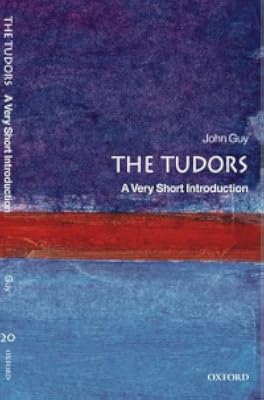
This title is highly recommended. Not only does it make me look forward to reading the next title in the series - The Tudors - but it makes me hope I have time to read more of the longer works about British history, show less
The last chapter is entitled Towards a Nation. It covers Royal Administration, Parliament, the Anglicized Church, Devotional Writings, Lollardy, the Spread of Literacy and the English Language, English Architecture and English Nationhood. I show more feel I should read it all again, just to try to implant in my memory more of my nation's history, but perhaps there is not time for this!
This title is highly recommended. Not only does it make me look forward to reading the next title in the series - The Tudors - but it makes me hope I have time to read more of the longer works about British history, show less
As I embarked on this book, my first thought was that half the middle ages were missing, starting as it did in 1066. A quick examination of the cover revealed that Anglo Saxon Britain had its own Very Short Introduction. As I got the end it was apparent that there was more England than Britain, or at least the discussion of the rest of the British Isles was in the context of English invasion. That said, there is a lot of history crammed into a small format. So much so that it can hardly be recommended for he reader with no familiarity with Medieval history - such a reader is too likely to quickly get lost.
Readable and in a way informative, but with two drawbacks. First, there is two much emphasis on power struggles at the expense of social history. Second, the title is quite misleading, because the book is really concerned with medieval England; Scotland and Wales are (similarly to France and Ireland) rarely mentioned outside of the context of English attempts at ruling these regions as well.
Still very much told from an English viewpoint despite the title. It is basically a reign by reign account of the English monarchs and their doings interspersed with general chapters on social, economic,and religious matters. It is hard to believe that this is entirely due to a paucity of surviving material from the other countries that make up Britain. Having said that, it is a reasonable introduction to the history of England from 1066 to 1485, though the genealogies could have done with being in a larger font.
Another useful introduction to a complicated subject. Parts of the book were a bit tedious and academically written, but in general it was a useful read. Made me want to go out and read more around many of the topics covered.
A Very Short Introduction to Medieval Britain covers the establishment of the Anglo-Norman monarchy in the early Middle Ages, through to England's failure to dominate the British Isles and France in the later Middle Ages. Out of the turbulence came stronger senses of identity in Scotland, Wales, and Ireland. Yet this was an age, too, of growing definition of Englishness and of a distinctive English cultural tradition.
John Gillingham taught history at the London School of Economics, University of London, from 1965 to 1998. His previous publications include The Angevin Empire (Edward Arnold, 1981); Richard Coeur de Lion (Noesis, Paris, 1996), awarded the Prix Guillaume le Conquerant for 1997; Richard I (Yale University Press, 1999); The show more English in the Twelfth Century (Boydell Press, 2000); The Angevin Empire (revised edition of 1981 edition). Ralph A. Griffiths has been Professor of Medieval History, University of Wales, Swansea, since 1982. His previous publications include The Principality of Wales in the later Middle Ages, Vol. I, South Wales, 1277-1536 (University of Wales Press, 1972); The Reign of King Henry VI (Benn and California University Press, 1981; 2nd edn Sutton 1998); The Making of the Tudor Dynasty, with R. S. Thomas (Sutton and Humanities Press, 1985; revised edn 1993); The Oxford Illustrated History of the British Monarchy, with J. Cann. show less
John Gillingham taught history at the London School of Economics, University of London, from 1965 to 1998. His previous publications include The Angevin Empire (Edward Arnold, 1981); Richard Coeur de Lion (Noesis, Paris, 1996), awarded the Prix Guillaume le Conquerant for 1997; Richard I (Yale University Press, 1999); The show more English in the Twelfth Century (Boydell Press, 2000); The Angevin Empire (revised edition of 1981 edition). Ralph A. Griffiths has been Professor of Medieval History, University of Wales, Swansea, since 1982. His previous publications include The Principality of Wales in the later Middle Ages, Vol. I, South Wales, 1277-1536 (University of Wales Press, 1972); The Reign of King Henry VI (Benn and California University Press, 1981; 2nd edn Sutton 1998); The Making of the Tudor Dynasty, with R. S. Thomas (Sutton and Humanities Press, 1985; revised edn 1993); The Oxford Illustrated History of the British Monarchy, with J. Cann. show less
E-books II
Members
- Recently Added By
Author Information

28+ Works 2,688 Members
John Gillingham is emeritus professor of history at the London School of Economics.

17+ Works 635 Members
Ralph A. Griffiths OBE is Emeritus professor of Medieval History at Swansea University, Honorary Vice-President of the Royal Historical Society, and formerly Chairman of the Royal Commission on the Ancient and Historical Monuments of Wales.
Series
Belongs to Publisher Series
Work Relationships
Is contained in
Common Knowledge
- Canonical title
- Medieval Britain: A Very Short Introduction
- Important places
- Great Britain
- First words
- On Christmas Day 1066 Duke William of Normandy was acclaimed king of England in Westminster Abbey.
- Last words
- (Click to show. Warning: May contain spoilers.)But they spoilt their political case by adding that Scotland, Wales, and Ireland were part of the English nation.
- Original language
- English
Classifications
- Genres
- History, Nonfiction, General Nonfiction, Religion & Spirituality
- DDC/MDS
- 941.03 — History & geography History of Europe British Isles Historical periods of British Isles 1154-1399 Period of House of Plantagenet
- LCC
- DA175 .G57 — History of Europe, Asia, Africa and Oceania Great Britain History of Great Britain England History By period Early and medieval to 1485 Celts. Romans. Saxons. Danes. Normans
- BISAC
Statistics
- Members
- 384
- Popularity
- 81,782
- Reviews
- 7
- Rating
- (3.50)
- Languages
- English
- Media
- Paper, Ebook
- ISBNs
- 4
- ASINs
- 2