
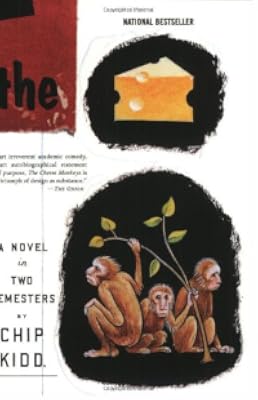
The Cheese Monkeys: A Novel in Two Semesters
by Chip Kidd
On This Page
Description
Chip Kidd's witty and effervescent coming-of-age novel can only be described as a portrait of the designer as a young man. It's 1957, long before computers have replaced the skillful eye and hand, and our narrator at State U is determined to major in Art. After several risible false starts, he ends up by accident in a new class called "Introduction to Graphic Design," taught by the enigmatic professor/guru Winter Sorbeck-equal parts genius, seducer, and sadist. Sorbeck is a bitter yet show more fascinating man whose assignments hurl his charges through a gauntlet of humiliation and heartache, shame and triumph, ego-bashing and enlightenment. By the end of The Cheese Monkeys, the members of Art 127 will never see the world the same way again. And, thanks to Chip Kidd's insights into the secrets of graphic design, neither will you. show lessTags
Recommendations






Member Reviews
I was excited just to see this book on the library shelf. The fantastic, intricate, unique cover was clearly 100% Kidd, and the story inside matched my excitement. The novel follows an unnamed freshman studying Art in the late '50s, and discovering Design. The characters were wildly, obsessively charming, the humor biting, and the conclusion strangely upsetting. Loved it.
Plus, totally an introduction to graphic design. Hit it up!
Plus, totally an introduction to graphic design. Hit it up!
A tale of a guy's first two semesters in college in the 1950s. It centers on a particular art class with a mysterious and often sadistic genius of a teacher. There is also the snooty love interest, the obnoxiously earnest classmate, and the truly talented classmate who must be taken down a peg for no discernible reason. This reads like any number of 1950s coming of age stories, and that's probably intentional. And if I actually enjoyed 1950s coming-of-age stories, I would probably appreciate the satire here more. But mostly it just reminded me of A Separate Peace and The Catcher in the Rye and The Outsiders and Dead Poet's Society and The Secret History (which doesn't take place in the 1950s but might as well have) and I found myself show more just not caring one bit about the characters. Ultimately, I don't think this is the book's problem; I just wasn't the right audience. show less
Feels anachronistic twice over. Shaggy dog tale of somewhat idealised and romanticised 50s US State college life, with some of the details that are romanticised looking very unromantic from present day perspective, even if they came across so in the early 2000s. Funny and diverting enough but no more than that.
Other than an art book or comic, this book, as an object, is the best refutation of an e-reader that I can imagine. Kidd isn't a great novelist, but he's managed to write a compelling book that delivers an education in design in a remarkably painless way.
I picked this up on a whim at Powell's because I liked the title (which doesn't really mean anything, by the way). It's got mixed reviews here on LT, but I don't really understand why. "The Cheese Monkeys" is about a freshman at an unnamed state university in the late 1950s: "Majoring in Art at the state university appealed to me because I have always hated Art, and I had a hunch if any school would treat the subject with the proper disdain, it would be one that was run by the government." He meets another art major, a funny but unbalanced girl named Himillsy, and maybe falls a little in love with her, but she's pretty crazy so you know that's never going to work out. The book pokes a lot of fun at the art world, and at the art worlds show more of provincial universities in particular. And then it turns into some twisted version of "The Dead Poets Society" when they take a class on Graphic Design taught by another possibly crazy person named Winter Sorbeck, who alternately tortures and teaches his students. The last twenty pages are the most perfect rendering that I have ever encountered of a terrible finals week experience, and I almost want to type the whole thing...okay, I'll type part of it:
The third day. You're under the rainbow and the spotlight of the Divine Tragic Absurd shines its black light everywhere and helps you grow like a mushroom. You sharpen a pencil and it's just the saddest thing since the Creation. You verge on weeping--in silent isolation--for five minutes. Then the point snaps against your work top and it puts you into fits of hysteria. Wipe your eyes and proceed. You foolishly take a break and emerge to street level. Mars. Make it to the Caf, to refuel, and you're seeing it for the first time because you realize everyone acts as if they have no idea you've been awake for over seventy-two hours, but they've known all along and can barely contain their horror and admiration. You are fortified and ashamed. You have three helpings of mashed potatoes (so easy to chew!) and a half a glass of Coke. You take an apple and a banana for later, leave them on your tray, and toss them into the garbage as you leave.
When you realize this, halfway back to the VA building, you find the nearest curb and sit. Eyes moist. Innocent fruit--they deserved better.
So alone.
By the end, everybody has gone insane from the art and the stress and natural inclination to madness. If you like books like that, then you will like "The Cheese Monkeys" (I did, a lot). My only criticism is that even though the book is set in the late 1950s, the dialogue and characters seem more modern. The only reason I can think for setting it in the 50s is that a couple of scenes involve registering for classes by getting in long lines and signing up on pieces of paper (ha! the absurdity); also, the students have to hitchhike for a class assignment at one point, which would be impossible now. Kidd probably should have set the book in the 1980s or early 1990s (did people hitchhike then? I'm so young.)
ETA: There's a sequel!
EATA: And it was really bad! show less
The third day. You're under the rainbow and the spotlight of the Divine Tragic Absurd shines its black light everywhere and helps you grow like a mushroom. You sharpen a pencil and it's just the saddest thing since the Creation. You verge on weeping--in silent isolation--for five minutes. Then the point snaps against your work top and it puts you into fits of hysteria. Wipe your eyes and proceed. You foolishly take a break and emerge to street level. Mars. Make it to the Caf, to refuel, and you're seeing it for the first time because you realize everyone acts as if they have no idea you've been awake for over seventy-two hours, but they've known all along and can barely contain their horror and admiration. You are fortified and ashamed. You have three helpings of mashed potatoes (so easy to chew!) and a half a glass of Coke. You take an apple and a banana for later, leave them on your tray, and toss them into the garbage as you leave.
When you realize this, halfway back to the VA building, you find the nearest curb and sit. Eyes moist. Innocent fruit--they deserved better.
So alone.
By the end, everybody has gone insane from the art and the stress and natural inclination to madness. If you like books like that, then you will like "The Cheese Monkeys" (I did, a lot). My only criticism is that even though the book is set in the late 1950s, the dialogue and characters seem more modern. The only reason I can think for setting it in the 50s is that a couple of scenes involve registering for classes by getting in long lines and signing up on pieces of paper (ha! the absurdity); also, the students have to hitchhike for a class assignment at one point, which would be impossible now. Kidd probably should have set the book in the 1980s or early 1990s (did people hitchhike then? I'm so young.)
ETA: There's a sequel!
EATA: And it was really bad! show less
If you read a novel or watch a movie about going to art school this is what you will find:
A fish-out-of-water protagonist who doesn't quite know what to make of the other students who are more creative/intense/interesting than the folks back home.
An attraction to a girl or boy who appears creative, maybe even genius, but is actually damaged somehow.
A scene wherein above mentioned boy or girl trashes the work of a canonical artist such as Picasso.
A benevolently incompetent teacher of an introductory class the students view as a waste of time.
An abusive teacher who was once an enfant terrible but has had to settle on teaching in a second tier art school after failing to live up to early potential. This teacher will drive some students show more away in tears, but he will also inspire others to do their best work.
A revelation that the girl or boy the protagonist was attracted to has had an inappropriately intimate relationship with above mentioned abusive/genius teacher.
A series of events that will lead the protagonist to learn the personal history of the abusive/genius teacher.
The disappearance of the abusive/genius teacher prior to the end of the semester under a cloud of scandal.
This is what happens in the movie Art School Confidential, in the art school plot arc of Six Feet Under and in Chip Kidd's novel The Cheese Monkeys. I enjoyed all three, in spite of their strict adherence to the first year art school formula, but none of them have convinced me that what they have to say about art school is to be taken seriously at all.
Sorry, Mr. Kidd, I just don't buy it. Too many details just don't ring true. The novel's protagonist attends classes with under 20 students during his first year of college, one of them with well under 20. Even in 1958 I'm guessing classes were much larger at state universities. The abusive/genius teacher drives students away even though he doesn't have a tenured position. I doubt he'd keep his job past the second week. I speak as someone who once taught at a state university. All these college co-eds sleeping with their professors novel after novel has always struck me as more wish fulfillment than reality. It's such an over-used plot device than I wouldnt' believe it even if you backed it up with pages of documented research. Needless to say, it never happened to me.
Les Demoiselles d' Avignon by Pablo Picasso
Your attractive but damaged romantic interest attacks Picasso's Les Demoiselles d'Avignon as the work of a misogynist in her art history class. I hate the work of Picasso, really hate it, but even I can come up with a counter argument to this charge. Certainly an art professor could. By 1958 he must have heard this charge more than once. You portray him as flabbergasted by the suggestion. Try what my Yale professor says, are you reading the work of art or is it reading you? Or how about misogyny, like beauty, can be in the eye of the beholder. See, I just came up with two good comebacks and I'm not even an art professor.
I enjoyed the assignments your abusive/genius teacher gave his students. Those I can believe even if the critique scenes later were ridiculous. I was once a creative writing major, my spouse was once an art major, neither of us can recall a professor ever saying anything remotely as mean and derogatory about student work as your abusive/genius teacher does. In fact, I once saw a professor offer words of praise for a student who had assembled a jigsaw puzzle as her final project.
And then there's the faculty art exhibit. You abusive/genius teacher exhibits a sealed cooler full of feces knowing that someone will fail to resist the "DO NOT OPEN" sign thereby releasing an odoriferous comment on the entire exhibit. In a world where artists must get teaching jobs to make ends meet, not crapping where you eat is a good motto to live by. Even self-destructive types know a good meal ticket when they find one. I am afraid you are sacrificing truth for a cheap laugh. It's funny, but it's not real.
However, it turns out the use of human feces as an artistic medium in 1959 is a bit prescient. In 1960 Italian artist Piero Manzoni produced 90 tin cans said to be full of his own excrement. He wanted to sell them for their weight in gold. These cans have accrued in value since the artist's death in 1963. In 2008 Sootheby's sold one at auction for just over 97,000 pounds. However, it has been discovered that the cans were actually filled with plaster. That strikes me as a wonderful critique of modern art--even cans of human excrement are fakes. show less
A fish-out-of-water protagonist who doesn't quite know what to make of the other students who are more creative/intense/interesting than the folks back home.
An attraction to a girl or boy who appears creative, maybe even genius, but is actually damaged somehow.
A scene wherein above mentioned boy or girl trashes the work of a canonical artist such as Picasso.
A benevolently incompetent teacher of an introductory class the students view as a waste of time.
An abusive teacher who was once an enfant terrible but has had to settle on teaching in a second tier art school after failing to live up to early potential. This teacher will drive some students show more away in tears, but he will also inspire others to do their best work.
A revelation that the girl or boy the protagonist was attracted to has had an inappropriately intimate relationship with above mentioned abusive/genius teacher.
A series of events that will lead the protagonist to learn the personal history of the abusive/genius teacher.
The disappearance of the abusive/genius teacher prior to the end of the semester under a cloud of scandal.
This is what happens in the movie Art School Confidential, in the art school plot arc of Six Feet Under and in Chip Kidd's novel The Cheese Monkeys. I enjoyed all three, in spite of their strict adherence to the first year art school formula, but none of them have convinced me that what they have to say about art school is to be taken seriously at all.
Sorry, Mr. Kidd, I just don't buy it. Too many details just don't ring true. The novel's protagonist attends classes with under 20 students during his first year of college, one of them with well under 20. Even in 1958 I'm guessing classes were much larger at state universities. The abusive/genius teacher drives students away even though he doesn't have a tenured position. I doubt he'd keep his job past the second week. I speak as someone who once taught at a state university. All these college co-eds sleeping with their professors novel after novel has always struck me as more wish fulfillment than reality. It's such an over-used plot device than I wouldnt' believe it even if you backed it up with pages of documented research. Needless to say, it never happened to me.
Les Demoiselles d' Avignon by Pablo Picasso
Your attractive but damaged romantic interest attacks Picasso's Les Demoiselles d'Avignon as the work of a misogynist in her art history class. I hate the work of Picasso, really hate it, but even I can come up with a counter argument to this charge. Certainly an art professor could. By 1958 he must have heard this charge more than once. You portray him as flabbergasted by the suggestion. Try what my Yale professor says, are you reading the work of art or is it reading you? Or how about misogyny, like beauty, can be in the eye of the beholder. See, I just came up with two good comebacks and I'm not even an art professor.
I enjoyed the assignments your abusive/genius teacher gave his students. Those I can believe even if the critique scenes later were ridiculous. I was once a creative writing major, my spouse was once an art major, neither of us can recall a professor ever saying anything remotely as mean and derogatory about student work as your abusive/genius teacher does. In fact, I once saw a professor offer words of praise for a student who had assembled a jigsaw puzzle as her final project.
And then there's the faculty art exhibit. You abusive/genius teacher exhibits a sealed cooler full of feces knowing that someone will fail to resist the "DO NOT OPEN" sign thereby releasing an odoriferous comment on the entire exhibit. In a world where artists must get teaching jobs to make ends meet, not crapping where you eat is a good motto to live by. Even self-destructive types know a good meal ticket when they find one. I am afraid you are sacrificing truth for a cheap laugh. It's funny, but it's not real.
However, it turns out the use of human feces as an artistic medium in 1959 is a bit prescient. In 1960 Italian artist Piero Manzoni produced 90 tin cans said to be full of his own excrement. He wanted to sell them for their weight in gold. These cans have accrued in value since the artist's death in 1963. In 2008 Sootheby's sold one at auction for just over 97,000 pounds. However, it has been discovered that the cans were actually filled with plaster. That strikes me as a wonderful critique of modern art--even cans of human excrement are fakes. show less
This is a book I equate with the essence of the best parts if high school. It got passed all around (as a great book should be), and it felt like pretty much required reading for the teenage, slightly self-conscious art students we were.
I let a couple of English majors take a crack at it recently, and they brought up some good points about its flaws. Still a classic, and still worthy of reading if only for the gloriousness that is Winter Sorbeck.
(Fair warning: there is one, infamous part that gets downright weird.)
I let a couple of English majors take a crack at it recently, and they brought up some good points about its flaws. Still a classic, and still worthy of reading if only for the gloriousness that is Winter Sorbeck.
(Fair warning: there is one, infamous part that gets downright weird.)
Members
- Recently Added By
Author Information

30+ Works 4,651 Members
Chip Kidd has designed book jackets for Alfred A. Knopf for over a decade. His work has been featured in "Vanity Fair", "Print", "Entertainment Weekly", "The New Republic", "Time", "The New York Times", "Graphis", "New York", and "ID" magazine. He lives in New York City. (Publisher Provided) Chip Kidd was born in 1964. He is an author, editor and show more graphic designer. He has become known for his book covers. He is the associate art director at Knopf, an imprint of Random House. He first joined the Knopf design team in 1986, when he was hired as a junior assistant. Turning out jacket designs at an average of 75 a year. Kidd also supervises graphic novels at Pantheon, and in 2003 he collaborated with Art Spiegelman on a biography of cartoonist Jack Cole, Jack Cole and Plastic Man: Forms Stretched to Their Limits. His design for Michael Crichton's Jurassic Park novel was carried over into marketing for the film adaptation. Oliver Sacks and other authors have contract clauses stating that Kidd design their books. Publishers Weekly described his book jackets as "creepy, striking, sly, smart, unpredictable covers that make readers appreciate books as objects of art as well as literature." USA Today also called him "the closest thing to a rock star" in graphic design today, while author James Ellroy has called him the world's greatest book-jacket designer. Kidd is as a fan of comic book media, particularly Batman, and has written and designed book covers for several DC Comics publications, including The Complete History of Batman, Superman, and Wonder Woman, The Golden Age of DC Comics: 365 Days, and Jack Cole and Plastic Man. He also designed Mythology: The DC Comics Art of Alex Ross and wrote an exclusive Batman/Superman story illustrated by Ross for the book. In 2014 his title, Go: A Kidd's Guide to Graphic Design, made The New York Times Best Seller List. (Bowker Author Biography) show less
Some Editions
Common Knowledge
- Original publication date
- 2001
- People/Characters
- Maybelle Lee; Dorothy Lee; Himillsy Dodd; Garnett Gray; Winter Sorbeck
Classifications
Statistics
- Members
- 1,198
- Popularity
- 20,735
- Reviews
- 27
- Rating
- (3.64)
- Languages
- English, French
- Media
- Paper, Audiobook, Ebook
- ISBNs
- 16
- ASINs
- 6