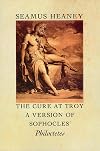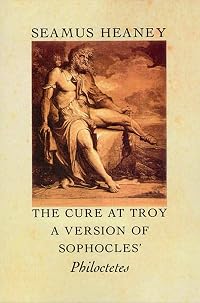
The Cure at Troy: A Version of Sophocles' Philoctetes
by Seamus Heaney
On This Page
Description
The Cure at Troy is Seamus Heaney's version of Sophocles' Philoctetes. Written in the fifth century BC, this play concerns the predicament of the outcast hero, Philoctetes, whom the Greeks marooned on the island of Lemnos and forgot about until the closing stages of the Siege of Troy. Abandoned because of a wounded foot, Philoctetes nevertheless possesses an invincible bow without which the Greeks cannot win the Trojan War. They are forced to return to Lemnos and seek out Philoctetes' show more support in a drama that explores the conflict between personal integrity and political expediency. Heaney's version of Philoctetes is a fast-paced, brilliant work ideally suited to the stage. Heaney holds on to the majesty of the Greek original, but manages to give his verse the flavor of Irish speech and context. show lessTags
Recommendations
















Member Reviews
Rating: 4* of five
The Publisher Says: The Cure at Troy is Seamus Heaney's version of Sophocles' Philoctetes. Written in the fifth century BC, this play concerns the predicament of the outcast hero, Philoctetes, whom the Greeks marooned on the island of Lemnos and forgot about until the closing stages of the Siege of Troy. Abandoned because of a wounded foot, Philoctetes nevertheless possesses an invincible bow without which the Greeks cannot win the Trojan War. They are forced to return to Lemnos and seek out Philoctetes' support in a drama that explores the conflict between personal integrity and political expediency.
Heaney's version of Philoctetes is a fast-paced, brilliant work ideally suited to the stage. Heaney holds on to the show more majesty of the Greek original, but manages to give his verse the flavor of Irish speech and context.
My Review: Okay, I don't want to alarm anybody, but I am reviewing and rating a playscript written by a poet. And with high praise.
No, I'm not pixilated and I have not been stricken by apoplexy and aliens have not trans-reversed my brain.
The story of the abandoned Philoctetes, a minor moment in the Trojan War saga, is another passage from myth that speaks to me, like The Song of Achilles was. I think this, the myth of the abandoned who is rescued, speaks to many if not most people, at least the ones who feel themselves abandoned or left behind because of their essential selves.
Heaney takes a terrible wrong done to a man who committed no crime and defiled himself with no sin, but whose burden to carry included being too much of a burden for his fellows, his companions, to bear, and cast it in terms we can relate to. Philoctetes is no plaster saint, painted in garish and unreal colors, spouting Love and Tolerance and Forgiveness. He's so goddamned mad he can't see straight and he's so clear-sighted that the nature of the world is plainer to him than to anyone else around him:
And there, in a nutshell, is the Problem of Evil. God is good, not evil. Yet evil exists in God's world. What is one to do with that contradiction? (I know my answer; I don't presume to dictate anyone else's; but I will say that, as phrased by Heaney above, isn't the answer glaringly obvious?)
Philoctetes is tormented by hope, Achilles' son has come (with the wily and amoral Odysseus), to charm him out of the sacred can't-miss bow and the sacred must-kill arrows that he had as his inheritance from semi-divine Herakles. Without these weapons (and Philoctetes to wield them), Troy will never fall; and Achilles' son sets himself to woo the angry, hurt, miserable, ill archer back to a war he could never join because Odysseus couldn't bear his flaw, his wound, his agony sent by the gods to burden him.
And now it is that wounded, flawed man who is the only hope of a Greek victory. Ha ha, Odysseus. Ha ha, world at large. And NO THANKS, Philoctetes shouts, no I won't and no you won't make me! Why should I bother with you, you who left me in my pain and with my own company as you were bound for glory? Achilles' son charms him, but there isn't enough charm in the universe to poultice a wound that deep, a wound of rejection of one's essential self, a throwing away of one's future because in the present the body stinks and hurts.
Philoctetes, by any reasonable person's standards, could be found justified in telling the Greeks to go fuck themselves on foot and on horseback, and all their dreams too. He does, and he does again, and he even does in the face of threats to drag him off to meet his destiny by force.
But then Achilles' son shows his true mettle, and settles in to stay with Philoctetes. He repents of his charm, he even ceremoniously offers Philoctetes his bow and arrows back; Odysseus comes at that moment, full of fear at the failing quest and rants, to no avail; and then deus ex machina (or in this case volcana) arrives as Divine Herakles speaks for the Greeks. Philoctetes understands that his wounds will only be healed when he completes his journey to Troy and fixes his destiny. This is how we remember him three thousand years later: He accepts his burdens and experiences his emotions and defies his fate by embracing his destiny.
Exeunt omnes.
This work is licensed under a Creative Commons Attribution-NonCommercial-ShareAlike 3.0 Unported License. show less
The Publisher Says: The Cure at Troy is Seamus Heaney's version of Sophocles' Philoctetes. Written in the fifth century BC, this play concerns the predicament of the outcast hero, Philoctetes, whom the Greeks marooned on the island of Lemnos and forgot about until the closing stages of the Siege of Troy. Abandoned because of a wounded foot, Philoctetes nevertheless possesses an invincible bow without which the Greeks cannot win the Trojan War. They are forced to return to Lemnos and seek out Philoctetes' support in a drama that explores the conflict between personal integrity and political expediency.
Heaney's version of Philoctetes is a fast-paced, brilliant work ideally suited to the stage. Heaney holds on to the show more majesty of the Greek original, but manages to give his verse the flavor of Irish speech and context.
My Review: Okay, I don't want to alarm anybody, but I am reviewing and rating a playscript written by a poet. And with high praise.
No, I'm not pixilated and I have not been stricken by apoplexy and aliens have not trans-reversed my brain.
The story of the abandoned Philoctetes, a minor moment in the Trojan War saga, is another passage from myth that speaks to me, like The Song of Achilles was. I think this, the myth of the abandoned who is rescued, speaks to many if not most people, at least the ones who feel themselves abandoned or left behind because of their essential selves.
...their whole life spent admiring themselves
For their own long-suffering.
Licking their wounds
And flashing them around like decorations.
I hate it, I always hated it, and I am
A part of it myself.
.
.
And a part of you,
For my part is the chorus, and the chorus
Is more or less a borderline between
The you and the me and the it of it
.
.
Between
The gods' and human beings' sense of things.
.
.
And that's the borderline that poetry
Operates on too, always in between
What you would like to happen and what will --
Whether you like it or not.
Heaney takes a terrible wrong done to a man who committed no crime and defiled himself with no sin, but whose burden to carry included being too much of a burden for his fellows, his companions, to bear, and cast it in terms we can relate to. Philoctetes is no plaster saint, painted in garish and unreal colors, spouting Love and Tolerance and Forgiveness. He's so goddamned mad he can't see straight and he's so clear-sighted that the nature of the world is plainer to him than to anyone else around him:
Of course. Of course. What else could you expect?
The gods do grant immunity, you see,
To everybody except the true and the just.
The more of a plague you are, and the crueller,
The better your chances of being turned away
From the doors of death. Whose side are gods on?
What are human beings to make of them?
How am I to keep on praising gods
If they keep disappointing me, and never
Match the good on my side with their good?
And there, in a nutshell, is the Problem of Evil. God is good, not evil. Yet evil exists in God's world. What is one to do with that contradiction? (I know my answer; I don't presume to dictate anyone else's; but I will say that, as phrased by Heaney above, isn't the answer glaringly obvious?)
Philoctetes is tormented by hope, Achilles' son has come (with the wily and amoral Odysseus), to charm him out of the sacred can't-miss bow and the sacred must-kill arrows that he had as his inheritance from semi-divine Herakles. Without these weapons (and Philoctetes to wield them), Troy will never fall; and Achilles' son sets himself to woo the angry, hurt, miserable, ill archer back to a war he could never join because Odysseus couldn't bear his flaw, his wound, his agony sent by the gods to burden him.
And now it is that wounded, flawed man who is the only hope of a Greek victory. Ha ha, Odysseus. Ha ha, world at large. And NO THANKS, Philoctetes shouts, no I won't and no you won't make me! Why should I bother with you, you who left me in my pain and with my own company as you were bound for glory? Achilles' son charms him, but there isn't enough charm in the universe to poultice a wound that deep, a wound of rejection of one's essential self, a throwing away of one's future because in the present the body stinks and hurts.
History says, Don't hope
On this side of the grave.
But then, once in a lifetime
The longed-for tidal wave
Of justice can rise up,
And hope and history rhyme.
.
.
So hope for a great sea-change
On the far side of revenge.
Believe that a further shore
Is reachable from here.
Believe in miracles
And cures and healing wells.
Philoctetes, by any reasonable person's standards, could be found justified in telling the Greeks to go fuck themselves on foot and on horseback, and all their dreams too. He does, and he does again, and he even does in the face of threats to drag him off to meet his destiny by force.
But then Achilles' son shows his true mettle, and settles in to stay with Philoctetes. He repents of his charm, he even ceremoniously offers Philoctetes his bow and arrows back; Odysseus comes at that moment, full of fear at the failing quest and rants, to no avail; and then deus ex machina (or in this case volcana) arrives as Divine Herakles speaks for the Greeks. Philoctetes understands that his wounds will only be healed when he completes his journey to Troy and fixes his destiny. This is how we remember him three thousand years later: He accepts his burdens and experiences his emotions and defies his fate by embracing his destiny.
Now it's high watermark
And floodtide in the heart
And time to go
The sea-nymphs in the spray
Will be the chorus now
What's left to say?
.
.
Suspect too much sweet talk
But never close your mind,
It was a fortunate wind
That blew me here. I leave
Half-ready to believe
That a crippled trust might walk
.
.
And the half-true rhyme is love.
Exeunt omnes.
This work is licensed under a Creative Commons Attribution-NonCommercial-ShareAlike 3.0 Unported License. show less
https://fromtheheartofeurope.eu/the-cure-at-troy-by-seamus-heaney/
The young Neoptolemus is sent by Odysseus to retrieve the bow of Philoctetes, who has been abandoned by the Greeks on the island of Lemnos. Philoctetes’ bow shoots invincible arrows, and the Greeks know that they cannot conquer Troy without it. But the only way to get it from Philoctetes is for Neoptolemus to pretend that he too has fallen out with the Greeks. Eventually a divine intervention helps to resolve the plot into a more cheerful place than seemed likely for most of the duration. (This is not a spoiler; the chorus tells us that it’s going to happen in the first speech of the play.)
It’s often difficult to appreciate a play from the script (well, difficult show more for me at least), but I really enjoyed this, in particular Heaney’s use of Ulster turns of phrase to give a clear voice to the characters. It’s a psychological story which can be told with minimal scenery. I’d certainly pay to see it. show less
The young Neoptolemus is sent by Odysseus to retrieve the bow of Philoctetes, who has been abandoned by the Greeks on the island of Lemnos. Philoctetes’ bow shoots invincible arrows, and the Greeks know that they cannot conquer Troy without it. But the only way to get it from Philoctetes is for Neoptolemus to pretend that he too has fallen out with the Greeks. Eventually a divine intervention helps to resolve the plot into a more cheerful place than seemed likely for most of the duration. (This is not a spoiler; the chorus tells us that it’s going to happen in the first speech of the play.)
It’s often difficult to appreciate a play from the script (well, difficult show more for me at least), but I really enjoyed this, in particular Heaney’s use of Ulster turns of phrase to give a clear voice to the characters. It’s a psychological story which can be told with minimal scenery. I’d certainly pay to see it. show less
A retelling of Sophocles’s Philoctetes which Heaney’s Irish charm. A Snake bitten Philoctetes and his invincible bow left marooned at Sea for 10 years on the orders of Odysseus, and now Achilles’s son Neoptolemus sent by Odysseus to retrieve the invincible bow and Philoctetes as it’ll confirm the Greek victory over Troy.
We see a scarred and hollow of a warrior in Philoctetes, an honest soul in Neoptolemus and a duty bound Odysseus.
We see a scarred and hollow of a warrior in Philoctetes, an honest soul in Neoptolemus and a duty bound Odysseus.
Very emotionally intelligent story. If I was familiar with the myth, I could critique [a:Seamus Heaney|29574|Seamus Heaney|https://d.gr-assets.com/authors/1200407647p2/29574.jpg]'s take of the story and not just the story itself. I really can never appreciate "high" dialog so I have trouble with ancient lit.
I prefer the original but this was well done.
Ratings
Members
- Recently Added By
Author Information

209+ Works 15,807 Members
Seamus Heaney was born in Mossbawn, Ireland on April 13, 1939. He received a degree in English from Queen's College in Belfast in 1961. After earning his teacher's certificate in English from St. Joseph's College in Belfast the following year, he took a position at the school as an English teacher. During his time as a teacher at St. Joseph's, he show more wrote and published work in the university magazine under the pen name Incertus. In 1966, he became an English literature lecturer at Queen's College in Belfast. His first volume of poems, Death of a Naturalist, went on to receive the E.C. Gregory Award, the Cholmondeley Award, the Somerset Maugham Award, and the Geoffrey Faber Memorial Prize. After the death of his parents, Heaney published the poetry volumes The Haw Lantern, which includes a sonnet sequence memorializing his mother, and Seeing Things, a collection containing numerous poems for his father. His other works included Field Work, Opened Ground: Poems 1966-1996, and Human Chain. Heaney was a professor at Harvard from 1981 to 1997 and its Poet in Residence from 1988 to 2006. From 1989 to 1994 he was also the Professor of Poetry at Oxford and in 1996 was made a Commandeur de l'Ordre des Arts et Lettres. Other awards that he received include the Geoffrey Faber Memorial Prize (1968), the E. M. Forster Award (1975), the PEN Translation Prize (1985), the Golden Wreath of Poetry (2001), T. S. Eliot Prize (2006) and two Whitbread Prizes (1996 and 1999). In 2012, he was awarded the Lifetime Recognition Award from the Griffin Trust For Excellence In Poetry. His literary papers are held by the National Library of Ireland. He died following a short illness on August 30, 2013 at the age of 74. Heaney's last words were in a text to his wife Marie, "Noli timere", which means "Do not be afraid." (Bowker Author Biography) Seamus Heaney lives in Dublin and teaches at Harvard University. He was awarded the Nobel Prize in literature in 1995. (Publisher Provided) Seamus Heaney was born in 1939 in Northern Ireland. He was awarded the Nobel Prize in Literature in 1995. A resident of Dublin, he has taught poetry at Oxford University and Harvard University. (Publisher Provided) show less
Work Relationships
Is an adaptation of
Common Knowledge
- Canonical title
- The Cure at Troy: A Version of Sophocles' Philoctetes
- Important events
- Bronze Age; Trojan War
Classifications
- Genres
- Poetry, Fiction and Literature
- DDC/MDS
- 821.914 — Literature & rhetoric English & Old English literatures British Poetry 1900- 1900-1999 1945-1999
- LCC
- PA4414 .P5 .H43 — Language and Literature Greek language and literature. Latin language and literature Greek literature Individual authors Sophocles
- BISAC
Statistics
- Members
- 307
- Popularity
- 104,186
- Reviews
- 5
- Rating
- (4.06)
- Languages
- English
- Media
- Paper, Ebook
- ISBNs
- 6
- ASINs
- 2