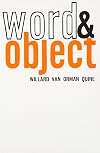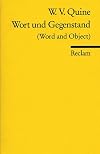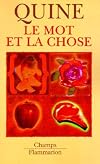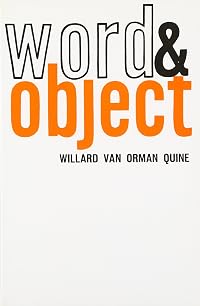
Word and Object
by Willard Van Orman Quine
On This Page
Description
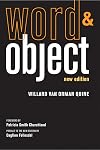
A new edition of Quine's most important work.Willard Van Orman Quine begins this influential work by declaring, "Language is a social art. In acquiring it we have to depend entirely on intersubjectively available cues as to what to say and when." As Patricia Smith Churchland notes in her foreword to this new edition, with Word and Object Quine challenged the tradition of conceptual analysis as a way of advancing knowledge. The book signaled twentieth-century philosophy's turn away from show more metaphysics and what Churchland calls the "phony precision" of conceptual analysis.In the course of his discussion of meaning and the linguistic mechanisms of objective reference, Quine considers the indeterminacy of translation, brings to light the anomalies and conflicts implicit in our language's referential apparatus, clarifies semantic problems connected with the imputation of existence, and marshals reasons for admitting or repudiating each of various categories of supposed objects. In addition to Churchland's foreword, this edition offers a new preface by Quine's student and colleague Dagfinn Follesdal that describes the never-realized plans for a second edition of Word and Object, in which Quine would offer a more unified treatment of the public nature of meaning, modalities, and propositional attitudes. show lessTags
Recommendations









Member Reviews
“One frequently hears it urged that deep differences of language carry with them ultimate differences in the way one thinks, or looks upon the world” (77).
This was not a particularly accessible book, but it was, ultimately, pretty informative. The overarching goal of the book was to investigate how words reference reality, which matters to Quine because he sees the function of philosophy as scientific, a regimented approach to discovering what is true about the world by making sense of what we observe about it.
The challenge Quine addresses is how to understand the construction of true statements, when our only way to access that work is through the language that we use to communicate truth to others. For this reason, the vague, show more opaque, inconsistent, incomplete, and situated ways that language references reality is highly problematic and radically untranslatable.
Quine’s solution, expressed through his “Rabbit/Gavagai” thought experiment, where a linguist is charged with coming up with a manual for translating a totally unknown language, is to recognize that while words do designate a reality, the sentences through which those words are meaningfully assembled are conventional, universal configurations of words that represent the beliefs of discourse communities and the logic by which they build concepts from sensory inputs and relate those concepts to one another. This dissolved barrier between analytic and synthetic approaches to truth and the influence of a discourse community’s “web of belief” is one of Quine’s major contributions.
Quine focuses his energy on enumerating conventional classes of sentences by which discourse communities represent truth in accordance with a prevailing web of beliefs but also in a way that is ultimately responsible to the extensional reality that all words must reference. This presentation of sentence classes is a way of classifying systematic ways that communities express truth. By understanding the sentence classes, the underlying extensional truth claims can be clarified by conversion to a regimenting language (1st order symbolic logic, particularly) that substitutes situated, intensional meaning with verifiable observations. Only in this way can one arrive at truth — direct translation from ordinary language is impossible because it is riddled with perspectival views of the world, infinitely differentiated by time, perspective, bias, belief, etc — wholly unsuitable for seeking truth.
I’m inclined to believe that regimentation is a viable approach to the normalization of propositional knowledge, but I’m not sure I share Quine’s preference for converting sense-supported (i.e., intensional) propositions into symbolic logic because it is the best or most reliable way to determine truth. This just seems like a silly restriction. How do we account for the truth of saying that “here is the border of my state and your state” or “she is the chair of the committee” or “this note represents $50”? These states are consequential in the way that truth propositions are, but their truth does not ground out in sensory data about “borders” or “roles” or “value.” They ground out in how people treat those truths. Do they act like there is a border there or that she is the chair of the committee or that the piece of paper is worth $50? Perhaps that is also allowed in Quine’s formulation, as behavioral observation, but then that suggests that he ought not to disallow intensional meaning from his calculus of truth.
Implications for Translation
I also wonder if Quine is taking a too narrow understanding of translation as a method of converting truth of one language into the truth of another. There are elements of experience and belief that influence our actions and how we treat things as true or not. Perhaps all of this just falls into the penumbra of indeterminacy, where you could have two people responding to the world in incompatible ways (e.g., following Quine’s thought experiment): when two people in a group say “There’s a rabbit” and point at something, do they both mean the same thing or is one person referencing the rabbit as dinner and the other referencing the rabbit as an example of “Rabbithood”)? Both are true, and for the business of identification, it should be enough to get along. But if the goal is to either 1) establish that the entity identified is suitable for dinner or 2) establish that it represents an example of a species, then the proposition is insufficient and needs to be connected to other statements in order to come up with the class of the sentence and the appropriate responses.
There is a depth of meaning in English that is not totally recoverable, even to English speakers because the utterance is made by a person at a moment in time. We just default to the closest norm and hope for the best. Or we default to a classifying language (like logic) that gets to the empirical core of meaning. This is sort of an idealized understanding of meaning where all possible true perceptions eventually funnel into one. But we cannot describe that overarching meaning.
All sentences of beliefs, where predicated objects exist as signs can, with enough patience a detail be filled in with all of the relevant sensory conditions that make it an observable statement (183). Quine is after a pragmatic level of truth where the aim is to develop what is sufficient. As he sees it, this pragmatic outcome can be the only reasonable goal of translation: simplification to a common language that respects the functions of sentences across versions and defaults the nearest extensional norm with enough fidelity to maintain instrumental uptake.
But for things that are not empirical — love, piety, respect, admiration, hate — covering the experience relies on approximation. There is an impossibility of translation here because we can never be accurate in capturing the sense of a statement. And here is where there are implications in Quine’s argument for other kinds of translation, like literary translation, for example. Assuming that complete accuracy was even possible, would we even want or expect that? Are we assuming that writers speak to some ideal version of true experience that transcends their perspective? If so, the solution is not having the expectation of getting this truth from one author but rather from multiple authors, across language divides. Or we admit that this level of ideal understanding is not possible and accept that a functional and pragmatic equivalent is sufficient. show less
"Chiaro, ben scritto e accessibile anche ai non addetti ai lavori". Se tale può considerarsi un enunciato degno di un commento finale sulla lettura. Gli ultimi capitoli hanno fatto letteralmente un ascesa, semantica, di contenuto. :P
Word and Object by Willard Van Orman Quine (1960)
100 QUI 2
Word and Object (Studies in Communication) by Willard Van Orman Quine (1964)
Ratings
Members
- Recently Added By
Lists

Filosofía - Clásicos
217 works; 1 member
Author Information

62+ Works 4,745 Members
W. V. Quine is Edgar Pierce Professor of Philosophy, Emeritus, Harvard University
Some Editions
Awards and Honors
Series
Belongs to Publisher Series
Common Knowledge
- Canonical title
- Word and Object
- Original title
- Word and Object
- Original publication date
- 1960; 1977 (French transl.) (French transl.)
- Epigraph
- Wie Schiffer sind wir, die ihr Schiff auf offener See umbauen müssen, ohne es jemals in einem Dock zerlegen und aus besten Bestandteilen neu errichten zu können. — Otto Neurath
Ontology recapitulates philology. — James Grier Miller - Dedication
- To Rudolf Carnap / Teacher and Friend
- First words
- Language is a social art. In acquiring it we have to depend entirely on intersubjectively available cues as to what to say and when.
- Last words
- (Click to show. Warning: May contain spoilers.)True, no experiment may be expected to settle an ontological issue; but this is only because such issues are connected with surface irritations in such multifarious ways, through such a maze of intervening theory.
- Original language
- English
Classifications
- Genres
- Philosophy, Nonfiction, General Nonfiction
- DDC/MDS
- 149.94 — Philosophy & psychology Philosophical schools of thought Other philosophical systems and doctrines Other systems Linguistic Philosophy
- LCC
- B840 .Q5 — Philosophy, Psychology and Religion Philosophy (General) By period Modern Special topics and schools of philosophy
- BISAC
Statistics
- Members
- 788
- Popularity
- 35,249
- Reviews
- 6
- Rating
- (4.03)
- Languages
- 8 — English, Estonian, French, German, Italian, Portuguese, Russian, Spanish
- Media
- Paper, Ebook
- ISBNs
- 22
- UPCs
- 1
- ASINs
- 8