The Solid Form Of Language: An Essay On Writing And Meaning
by Robert Bringhurst
91 Members (4.19)
On This Page
Description
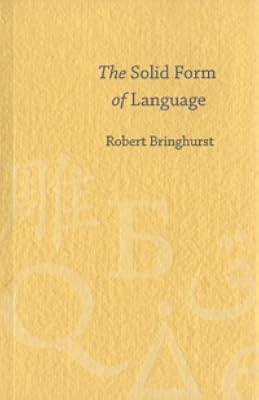
"Drop a word in the ocean of meaning and concentric ripples form. To define a single word means to try to catch those ripples. No one's hands are fast enough." With this concise and broadly informative essay, renowned poet, typographer and linguist Robert Bringhurst presents a brief history of writing and a new way of classifying and understanding the relationship between script and meaning. Beginning with the original relationship between a language and its written script, Bringhurst takes show more us on a history of reading and writing that begins with the interpretation of animal tracks and fast-forwards up to the typographical abundance of more recent times. The first four sections of the essay describe the earliest creation of scripts, their movement across the globe and the typographic developments within and across languages. In the fifth and final section of the essay, Bringhurst introduces his system of classifying scripts. Placing four established categories of written language-semographic, syllabic, alphabetic and prosodic-on a wheel adjacent to one another, he uses the location, size and shape of points on the wheel to show the degree to which individual world languages incorporate these aspects of recorded meaning. Bringhurst's system is based on an appreciation that indeed no one's hands are fast enough and that no single script adheres to or can be understood within the confines of a single method of transcription. Readers will find this combination of anthropology, typography, literature, mathematics, music and linguistics surprisingly accessible and thought provoking. The text is accompanied by diagrams and typographic examples that make for an experiential study of the relationship between writing and meaning. This book is a Smyth-sewn paperback with a letterpress printed jacket. The book was designed by Robert Bringhurst and Andrew Steeves, and printed on Zephyr Laid paper. The cover was hand-printed letterpress on St. Armand handmade paper. show lessTags
Recommendations









Member Recommendations

Member Reviews
Members
- Recently Added By
Lists

Works cited in Palimpsest: A History of the Written Word by Matthew Battles
79 works; 2 members
Author Information

57+ Works 3,449 Members
Robert Bringhurst was born October 16, 1946, in the ghetto of South Central Los Angeles and raised in the mountain and desert country of Alberta, Montana, Utah, Wyoming and British Columbia. He spent ten years as an undergraduate, studying physics, architecture and linguistics at the Massachusetts Institute of Technology, philosophy and oriental show more languages at the University of Utah, and comparative literature at Indiana University, which gave him a Bachelor of Arts in 1973. He had published two books of poems before entering the writing program at the University of British Columbia, which awarded him an MFA in 1975. From 1977 to 1980 he taught writing and English literature at UBC, and after that, made his living as a typographer. He has also been poet-in-residence and writer-in-residence at several universities in North America and Europe. His book, The Elements of Typographic Style is considered a standard text in its field, and Black Canoe is one of the classics in the field of Native American art history. He received the Macmillan Prize for Poetry in 1975. (Bowker Author Biography) show less
Some Editions
Classifications
Statistics
- Members
- 91
- Popularity
- 352,972
- Rating
- (4.19)
- Languages
- English, French, Italian, Portuguese
- Media
- Paper
- ISBNs
- 4