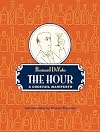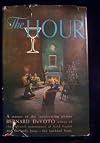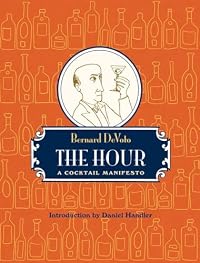
The Hour: A Cocktail Manifesto
by Bernard DeVoto
On This Page
Description
Cooking & Food. Nonfiction. HTML:One part celebration, one part history, two parts manifesto, Bernard DeVoto's The Hour is a comic and unequivocal treatise on how and why we drink — properly. The Pulitzer Prize and National Book Award-winning author turns his shrewd wit on the spirits and attitudes that cause his stomach to turn and his eyes to roll — warning: this book is not for rum drinkers. DeVoto instructs his readers on how to drink like gentlemen and sheds new light on the simple show more joys of the cocktail hour. Daniel Handler's introduction to this reprint of the 1950s classic provides a humorous framework for the modern reader. show lessTags
Recommendations






Member Reviews
Shaking your head over “martinis” which are mere sugary cocktails in martini glasses? Or worse yet, *gasping* in horror over belly shots? Looking forward to that first civilized sip of whiskey as you put a harried work day to an end? I highly recommend the intoxicating writing of Bernard Devoto’s “The Hours: A Cocktail Manifesto.” Originally published in 1948, this slim volume, now in reprint (with an excellent forward by Daniel Handler), is an absolute delight.
A Pulitzer Prize and National Book Award winner, Mark Twain expert, writer for many years for Harper’s Magazine, and a curmudgeon to the core, Devoto has crafted an elegant paean to “the violet hour,” “an hour of diminishing, of slowing down, of quieting” to show more sip a gin martini – one of only two cocktails he countenances (the other a slug of whiskey.) Discussing his favorites, Devoto is truly rhapsodic – “art’s sunburst of imagined delight becoming real” – and offers suggestions for the place (“a martini is a city dweller, a metropolitan”) as well as what to hum as one mixes the first batch (“neither barbershop nor jazz, between the choir and the glee club.”)
Equally quotable is his skewering of his dislikes: “Nothing can be done with people who put olives in martinis, presumably because in some desolate childhood hour someone refused them a pickle;” “Hot drinks are for people who have had skiing accidents, though it is an open question whether anyone who skis is worth giving liquor to or his life worth saving;” or on the topic of Daiquiris –“Mainly it is drunk as all sweet liquors are, in a regressive fantasy, a sad hope of regaining childhood’s joy at the soda fountain.”
Some question the extent to which this is satire. Bernard Devoto’s wife, Avis, was a good friend of Julia Child. I am in the midst of reading the women’s correspondence in "As always, Julia," Joan Reardon, editor. Upon first meeting, Julia won Bernard’s admiration after drinking down two or three of his martinis without turning a hair. On the other hand, Avis notes that Bernard is quite the oenophile, being very good at the parlor game of identifying the vineyard and the year. I believe The Hour was written in good fun. You’ll have as much fun or more when you read it. show less
A Pulitzer Prize and National Book Award winner, Mark Twain expert, writer for many years for Harper’s Magazine, and a curmudgeon to the core, Devoto has crafted an elegant paean to “the violet hour,” “an hour of diminishing, of slowing down, of quieting” to show more sip a gin martini – one of only two cocktails he countenances (the other a slug of whiskey.) Discussing his favorites, Devoto is truly rhapsodic – “art’s sunburst of imagined delight becoming real” – and offers suggestions for the place (“a martini is a city dweller, a metropolitan”) as well as what to hum as one mixes the first batch (“neither barbershop nor jazz, between the choir and the glee club.”)
Equally quotable is his skewering of his dislikes: “Nothing can be done with people who put olives in martinis, presumably because in some desolate childhood hour someone refused them a pickle;” “Hot drinks are for people who have had skiing accidents, though it is an open question whether anyone who skis is worth giving liquor to or his life worth saving;” or on the topic of Daiquiris –“Mainly it is drunk as all sweet liquors are, in a regressive fantasy, a sad hope of regaining childhood’s joy at the soda fountain.”
Some question the extent to which this is satire. Bernard Devoto’s wife, Avis, was a good friend of Julia Child. I am in the midst of reading the women’s correspondence in "As always, Julia," Joan Reardon, editor. Upon first meeting, Julia won Bernard’s admiration after drinking down two or three of his martinis without turning a hair. On the other hand, Avis notes that Bernard is quite the oenophile, being very good at the parlor game of identifying the vineyard and the year. I believe The Hour was written in good fun. You’ll have as much fun or more when you read it. show less
Sharp wit and unassailable truths about the civilized practice of observing the cocktail hour with a perfect martini, or a "slug of whiskey". No other so-called cocktail can be considered, in his opinion, and boyhowdy, does he tell you why. Lots of fun, and a bit of nostalgia for this household where the once-beloved cocktail hour has, of health-related necessity, become a sweet memory.
QUOTE: "...nothing can be done with people who put olives in martinis, presumably because in some desolate childhood hour someone refused them a dill pickle..."
QUOTE: "...nothing can be done with people who put olives in martinis, presumably because in some desolate childhood hour someone refused them a dill pickle..."
This is a series of four essays by the noted historian about cocktails and the cocktail hour. For DeVoto, the Martini and whiskey (bourbon and rye) are the pinnacle of American achievement, and the Martini and whiskey slug are the only two cocktails. (He'll allow you to make an Old Fashioned for a demanding guest, but no Manhattans; and don't get him started on rum.)
It's very much a product of its time, and I don't agree with any of his assertions (I happen to enjoy Manhattans and Scotch), but the writing is so amusing that I can't help but love the book. I'm pretty sure I could find a great quote on just about every page. It's a slim volume that shouldn't take more than an hour or two to read. A must-have for readers of good food writing.
It's very much a product of its time, and I don't agree with any of his assertions (I happen to enjoy Manhattans and Scotch), but the writing is so amusing that I can't help but love the book. I'm pretty sure I could find a great quote on just about every page. It's a slim volume that shouldn't take more than an hour or two to read. A must-have for readers of good food writing.
A wonderful homage to the cocktail hour, martinis, and whiskey. A little dated, but still delightful!
Delightful book. Even though he insults rum right and left, as well as many other drinks, DeVoto makes you feel like one of the chosen by sharing his view of the cocktail hour.
I've won a copy of this book on First Reads and it sounds highly entertaining.
I've won a copy of this book on First Reads and it sounds highly entertaining.
I picked this up on vacation because it looked amusing. And there were a few hilarious lines but most of it was sexist or boring or both. DeVoto believed in only one cocktail, the gin martini, and everything else is anathema. There, now you needn't read it.
500. A master of intoxicating phrase, Bernard DeVoto writes of the cultural importance of hard liquor and the only hour – the cocktail hour. 84 pages. First edition of this classic eulogy for “the violet twilight of each day - cocktail hour.” From the Pulitzer winning historian, critic and editor.
Members
- Recently Added By
Lists

Best "Foodie" Books
114 works; 40 members
Author Information

30+ Works 5,101 Members
A Harvard University graduate and impassioned student and teacher of American history and literature, Utah-born Bernard de Voto held faculty positions at Northwestern University and Harvard University. He was also the second editor of the Saturday Review of Literature and for many years wrote "The Editor's Easy Chair" column in Harper's magazine. show more At Harvard, de Voto was the editor of the Mark Twain manuscripts and produced several works about Twain and his time. He is best known for his trilogy-The Year of Decision: 1846 (1943), Across the Wide Missouri (1947), and The Course of Empire (1952). For Across the Wide Missouri, he personally traced the western trails first blazed by Lewis and Clark. Although recent scholarship has changed many perceptions about the West, de Voto's splendid accounts continue to have wide appeal. (Bowker Author Biography) show less
Awards and Honors
Notable Lists
Work Relationships
Is abridged in
Common Knowledge
- Original publication date
- 1948
- First words
- We are a pious people but a proud one too, aware of a noble lineage and a great inheritance.
- Last words
- (Click to show. Warning: May contain spoilers.)One more, and then with a spirit made whole again in a cleansed world, to dinner.
- Blurbers
- Carter, Graydon; Lapham, Lewis; Stegner, Wallace
Classifications
- Genres
- Nonfiction, Food & Cooking, General Nonfiction
- DDC/MDS
- 641.874 — Applied Science & Technology Home economics & family management Food, Cooking & Recipes / Meals, Picnics Cooking specific kinds of dishes and preparing beverages Preparing beverages Bartending
- LCC
- TX951 .D44 — Technology Home economics Home economics Taverns, barrooms, saloons
- BISAC
Statistics
- Members
- 108
- Popularity
- 299,403
- Reviews
- 9
- Rating
- (3.78)
- Languages
- English
- Media
- Paper, Ebook
- ISBNs
- 3
- ASINs
- 4