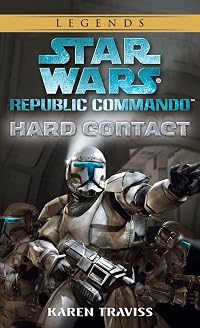
Republic Commando: Hard Contact
by Karen Traviss
Star Wars: Republic Commando (1), Star Wars Novels (22 BBY), Star Wars Universe
On This Page
Description
On a mission to sabotage a nanovirus research facility on a Separatist-held planet, four clone troopers operated under the very noses of their enemies. The commandos are outnumbered and outgunned, deep behind enemy lines with no backup--and working with strangers instead of trusted teammates. Matters don't improve when Darman, the squad's demolitions expert, gets cut off from the others during planetfall. Even Darman's apparent good luck in meeting a Jedi Padawan vanishes once she admits to show more her woeful inexperience. For the isolated clone commandos and stranded Jedi, a long, dangerous journey lies ahead, through hostile territory brimming with Trandoshan slavers, Separatists, and suspicious natives. A single misstep could mean discovery ... and death. It's a virtual suicide mission for anyone--anyone except Republic Commandos. show lessTags
Recommendations

Member Reviews
Ever felt a little distant from the whole 'clone wars' thing? If you're a Star Wars fan, you know the problems associated with the clones, and the unfortunate amount of time we've spent asking questions about who they really are and why we should care. Well, the Republic Commando series seeks to answer those questions and, thank goodness, humanize the clone troopers.
Karen Traviss does an excellent job of putting human faces on the clones, giving us a glimpse behind the mask -- what the clones go through for training, their 'family' structures, their (*gasp*) personalities, and their perspectives on having shortened life expectancies and living with the exact same face as thousands upon thousands of other clones.
The story itself is your show more typical shoot 'em up space adventure, with most of the action taking place on a planet, rather than in a ship or in space. That said, Star Wars has typically focused more on the people involved than the space battles, so you'll find exactly what you're looking for if you're a Star Wars fan.
Admittedly, the Jedi trainee character in the book is a little annoying for the first half, but she does grow over the course of the story. I suspect that if she's in the sequels, she'll utilize her newfound confidence and strength very effectively.
This is honestly one of the best Star Wars novels I've read, and if Traviss is the one writing the sequels, you can bet I'll be picking them up soon. show less
Karen Traviss does an excellent job of putting human faces on the clones, giving us a glimpse behind the mask -- what the clones go through for training, their 'family' structures, their (*gasp*) personalities, and their perspectives on having shortened life expectancies and living with the exact same face as thousands upon thousands of other clones.
The story itself is your show more typical shoot 'em up space adventure, with most of the action taking place on a planet, rather than in a ship or in space. That said, Star Wars has typically focused more on the people involved than the space battles, so you'll find exactly what you're looking for if you're a Star Wars fan.
Admittedly, the Jedi trainee character in the book is a little annoying for the first half, but she does grow over the course of the story. I suspect that if she's in the sequels, she'll utilize her newfound confidence and strength very effectively.
This is honestly one of the best Star Wars novels I've read, and if Traviss is the one writing the sequels, you can bet I'll be picking them up soon. show less
When is a Star Wars novel not a Star Wars novel?
That seems to be one of the questions raised by Republic Commando: Hard Contact. On the surface, it very much seems to be one - you have a group of Commando clone troopers trying to rescue a young Jedi from a Mandalorian warrior, and the Clone Wars are very actively happening in the background of the novel's action. Despite these surface similarities, however, the novel bears very little in common with the rest of the Star Wars universe, and what is the "house style" of the EU (Expanded Universe) novels in general. If a few names and titles had have been changed, this could have very easily been an 'original fiction' title, rather than a tie-in novel. For all of the stories that have been show more written in the Star Wars universe, most of them have focused very heavily on the 'Star' portion of the title, with little if any focus done on the 'Wars' part. Hard Contact changes that by delivering a story of military sci-fi, focusing on an elite group of Commando clones.
Throughout the course of the novel, Traviss does a very good job of developing all of her clone soldiers as distinct individuals. In other parts of the Clone Wars saga, the clones exist more or less as cyphers; in addition to sharing a genetic code, it appeared that they all shared a character (or lack thereof). One of the themes that Traviss explores is the idea of finding both a culture and an individual identity, and the difficulties that would be associated with that, when there are millions of others who share both your physical form and most of your personal past.
I generally try not to be a snob when it comes to liscenced material, but in the past year I've read a few that were really a chore to get through. Hard Contact is the exact opposite of that; with or without the Star Wars name attached to it, it was a really enjoyable piece of fiction writing. show less
That seems to be one of the questions raised by Republic Commando: Hard Contact. On the surface, it very much seems to be one - you have a group of Commando clone troopers trying to rescue a young Jedi from a Mandalorian warrior, and the Clone Wars are very actively happening in the background of the novel's action. Despite these surface similarities, however, the novel bears very little in common with the rest of the Star Wars universe, and what is the "house style" of the EU (Expanded Universe) novels in general. If a few names and titles had have been changed, this could have very easily been an 'original fiction' title, rather than a tie-in novel. For all of the stories that have been show more written in the Star Wars universe, most of them have focused very heavily on the 'Star' portion of the title, with little if any focus done on the 'Wars' part. Hard Contact changes that by delivering a story of military sci-fi, focusing on an elite group of Commando clones.
Throughout the course of the novel, Traviss does a very good job of developing all of her clone soldiers as distinct individuals. In other parts of the Clone Wars saga, the clones exist more or less as cyphers; in addition to sharing a genetic code, it appeared that they all shared a character (or lack thereof). One of the themes that Traviss explores is the idea of finding both a culture and an individual identity, and the difficulties that would be associated with that, when there are millions of others who share both your physical form and most of your personal past.
I generally try not to be a snob when it comes to liscenced material, but in the past year I've read a few that were really a chore to get through. Hard Contact is the exact opposite of that; with or without the Star Wars name attached to it, it was a really enjoyable piece of fiction writing. show less
In a rather ironic moment, Hard Contact is so far the Clone Wars novel that best exemplifies the common conception of the Wars—but it doesn't have the logo on the cover. As befits a novel based on a first-person shooter, Karen Traviss's Hard Contact is not a novel about sitting around and talking, as others have been. Much as MedStar was "a day in the strife" for the non-combatants in the war, Hard Contact does the same for another neglected group: the clones themselves. (Perhaps this is why the earlier novels have seemed peripheral, plotwise: for all their seeming importance, the Jedi don't seem to do much in the war.)
Hard Contact is a showcase for Traviss's abilities. Her worldbuilding talents were used to create the environment of show more Qiilura, with its new flora and fauna that play a non-trivial role in the story. The background of the commandos—of the clones in general—is also essentially produced from whole cloth, and manages to be distinctly, though not overtly, Imperial. She also managed to create distinct characters among the commandos--and provide justification for it, something not really seen before. None of the four come across as cardboard. Another point worth mentioning is the sense of humor—Traviss doesn't go overboard with it, but the clones offer us some of the best quips since the Wraiths.
The same can be said of the other characters, as well. Unlike other recent novels, the "villain" is a complex character in his own right, as are the other antagonists. Traviss does a good job of showing the breadth of the Separatist movement. Some of the minor characters (read: the two-scene cannon fodder) are a bit flat, but there's really not much opportunity to avoid that, either.
All in all, Hard Contact is an excellent read, being what many were expecting from the Clone Wars. Don't be fooled by the ties to a video game; Hard Contact is the best SW novel since Shatterpoint (and perhaps earlier, depending on what you're looking for). We're lucky to have Karen Traviss writing Star Wars. show less
Hard Contact is a showcase for Traviss's abilities. Her worldbuilding talents were used to create the environment of show more Qiilura, with its new flora and fauna that play a non-trivial role in the story. The background of the commandos—of the clones in general—is also essentially produced from whole cloth, and manages to be distinctly, though not overtly, Imperial. She also managed to create distinct characters among the commandos--and provide justification for it, something not really seen before. None of the four come across as cardboard. Another point worth mentioning is the sense of humor—Traviss doesn't go overboard with it, but the clones offer us some of the best quips since the Wraiths.
The same can be said of the other characters, as well. Unlike other recent novels, the "villain" is a complex character in his own right, as are the other antagonists. Traviss does a good job of showing the breadth of the Separatist movement. Some of the minor characters (read: the two-scene cannon fodder) are a bit flat, but there's really not much opportunity to avoid that, either.
All in all, Hard Contact is an excellent read, being what many were expecting from the Clone Wars. Don't be fooled by the ties to a video game; Hard Contact is the best SW novel since Shatterpoint (and perhaps earlier, depending on what you're looking for). We're lucky to have Karen Traviss writing Star Wars. show less
The premise: ganked from BN.com: As the Clone Wars rage, victory or defeat lies in the hands of elite squads that take on the toughest assignments in the galaxy–stone-cold soldiers who go where no one else would, to do what no one else could. . . .
On a mission to sabotage a chemical weapon research facility on a Separatist-held planet, four clone troopers operate under the very noses of their enemies. The commandos are outnumbered and outgunned, deep behind enemy lines with no backup–and working with strangers instead of trusted teammates. Matters don’t improve when Darman, the squad’s demolitions expert, gets separated from the others during planetfall. Even Darman’s apparent good luck in meeting an inexperienced Padawan show more vanishes once Etain admits to her woeful inexperience.
For the separated clone commandos and stranded Jedi, a long, dangerous journey lies ahead, through hostile territory brimming with Trandoshan slavers, Separatists, and suspicious natives. A single misstep could mean discovery . . . and death. It’s a virtual suicide mission for anyone–anyone except Republic Commandos.
My Rating: 5 - It's a Gamble
It's a low rating, sure, but it's not a bad book. It's just going to be a hit or miss for Star Wars readers. Traviss is a good writer, but you can tell she's getting her feet wet here, and since I've already read her Wess'Har series, I had higher expectations than normal. I'd hoped this would wow me, but it didn't. That being said, of all the Star Wars game adaptation books I've read, this is by far the best. Which is good, because this is the one with the most books, so I've got several ahead of me. I did enjoy the work Traviss did in creating distinctive personalities for her clones, and the way the Omega Squad was put together provided nice character-revealing moments and inner sources of conflict. So there's good arcs here, character-wise. I just kept zoning out during the more tactical/military stuff, which doesn't bog down the book, but it doesn't make me want to turn the pages any faster either.
That being said, for someone who wants to get into Star Wars books but wants to start with the prequel Era, and if they don't care about not having the Jedi as the focus, this would be a great place to start. My expectations were just a tick too high, but now that I know what to expect, I'm sure the next installment will be fine.
Spoilers, yay or nay?: Yay. And I also want to point out: there will be spoilers, at any given moment, for the entire run of Star Wars books up until the date the current book was published. So if the Star Wars are something you want to get into, stop now and read THIS instead. I don't recommend anyone reading this review unless they've read the book I'm reviewing now, due to aforementioned spoilers, so stop now or -- if you have read the book -- carry on!
The full review may be found at my blog, and comments and discussion are always welcome. Just click the link below to go directly to the full review!
REVIEW: Karen Traviss' STAR WARS: REPUBLIC COMMANDO: HARD CONTACT
Happy Reading! show less
On a mission to sabotage a chemical weapon research facility on a Separatist-held planet, four clone troopers operate under the very noses of their enemies. The commandos are outnumbered and outgunned, deep behind enemy lines with no backup–and working with strangers instead of trusted teammates. Matters don’t improve when Darman, the squad’s demolitions expert, gets separated from the others during planetfall. Even Darman’s apparent good luck in meeting an inexperienced Padawan show more vanishes once Etain admits to her woeful inexperience.
For the separated clone commandos and stranded Jedi, a long, dangerous journey lies ahead, through hostile territory brimming with Trandoshan slavers, Separatists, and suspicious natives. A single misstep could mean discovery . . . and death. It’s a virtual suicide mission for anyone–anyone except Republic Commandos.
My Rating: 5 - It's a Gamble
It's a low rating, sure, but it's not a bad book. It's just going to be a hit or miss for Star Wars readers. Traviss is a good writer, but you can tell she's getting her feet wet here, and since I've already read her Wess'Har series, I had higher expectations than normal. I'd hoped this would wow me, but it didn't. That being said, of all the Star Wars game adaptation books I've read, this is by far the best. Which is good, because this is the one with the most books, so I've got several ahead of me. I did enjoy the work Traviss did in creating distinctive personalities for her clones, and the way the Omega Squad was put together provided nice character-revealing moments and inner sources of conflict. So there's good arcs here, character-wise. I just kept zoning out during the more tactical/military stuff, which doesn't bog down the book, but it doesn't make me want to turn the pages any faster either.
That being said, for someone who wants to get into Star Wars books but wants to start with the prequel Era, and if they don't care about not having the Jedi as the focus, this would be a great place to start. My expectations were just a tick too high, but now that I know what to expect, I'm sure the next installment will be fine.
Spoilers, yay or nay?: Yay. And I also want to point out: there will be spoilers, at any given moment, for the entire run of Star Wars books up until the date the current book was published. So if the Star Wars are something you want to get into, stop now and read THIS instead. I don't recommend anyone reading this review unless they've read the book I'm reviewing now, due to aforementioned spoilers, so stop now or -- if you have read the book -- carry on!
The full review may be found at my blog, and comments and discussion are always welcome. Just click the link below to go directly to the full review!
REVIEW: Karen Traviss' STAR WARS: REPUBLIC COMMANDO: HARD CONTACT
Happy Reading! show less
I was surprised at how much I enjoyed this entire series. Usually I'm not one for tie-ins (or movie novelizations), but the world and characters that Traviss creates is an amazing one. It almost feels like it is a bubble tucked away within the larger Star Wars universe, one that I would like to revisit again.
This read like a good military space opera that just happens to be set in the Star Wars universe, especially as I like to pretend the Phantom Menace never existed and haven't seen its two sequels. The author has taken the setting (Republic, clone troopers, Jedi, clone wars) and woven an exciting adventure for a squad of clone commandos and a Jedi-in-training.
I really liked the characterisation of the commandos and the exploration of what it's like being inside one of those thousands of identical faces and suits of armour. I was less engaged by the unconfident Jedi trainee Etain, but she does grow over the course of the book. The plot rattles along and comes to a neat conclusion, but one leaving plenty of room for sequels. I will look show more out for them.
http://rmc28.dreamwidth.org/418259.html show less
I really liked the characterisation of the commandos and the exploration of what it's like being inside one of those thousands of identical faces and suits of armour. I was less engaged by the unconfident Jedi trainee Etain, but she does grow over the course of the book. The plot rattles along and comes to a neat conclusion, but one leaving plenty of room for sequels. I will look show more out for them.
http://rmc28.dreamwidth.org/418259.html show less
I really enjoyed getting into these books. The author goes a bit further into making the clones real people with hopes and dreams. What does it feel like to learn that you are a clone? No retirement package. No rights as a human or citizen. But you are to put your life on the line for citizens so they don't have to leave their comfortable lives.
Love the whole delving onto the Mandolorian culture at play throughout the first four books in this series. The author has a goal of creating a whole language for the Mandolorians and I enjoyed picking up a few of them myself.
Having just finished reading The New Jedi Order series (19 books) I found these a nice break. The former started out strong and then lagged towards the middle and finally show more finished up a bit quickly. the four books that have been written on the Clone troopers by this author kept my rapt attention the whole way through. :) show less
Love the whole delving onto the Mandolorian culture at play throughout the first four books in this series. The author has a goal of creating a whole language for the Mandolorians and I enjoyed picking up a few of them myself.
Having just finished reading The New Jedi Order series (19 books) I found these a nice break. The former started out strong and then lagged towards the middle and finally show more finished up a bit quickly. the four books that have been written on the Clone troopers by this author kept my rapt attention the whole way through. :) show less
Members
- Recently Added By
Lists

Star Wars Legends
155 works; 3 members
Author Information

66+ Works 12,212 Members
Karen Traviss is a science fiction author and full-time novelist from Wiltshire, England. Traviss worked as both a journalist and defence correspondent before becoming a writer of fiction. She also served in both the Territorial Army and the Royal Naval Auxiliary Service. Traviss is a graduate of the Clarion Science Fiction and Fantasy workshop. show more Her science fiction novels have focused on a Star Wars series and also a Gears of War series of books. Her title Halo: Glasslands made Publisher's Weekly Best Seller List for 2011. (Bowker Author Biography) show less
Some Editions
Series


Work Relationships
Is contained in
Common Knowledge
- Canonical title
- Republic Commando: Hard Contact
- Original title
- Star Wars Republic Commando: Hard Contact
- Original publication date
- 2004-10-26
- People/Characters
- Darman (Omega Squad, RC-1136); Boss (Delta Squad, RC-1138); Niner (Omega Squad, RC-1309); Atin (Omega Squad, RC-3222); Fi (Omega Squad, RC-8015); Hefrar Birhan (show all 14); Ghez Hokan; Jinart; Bardan Jusik; Maze (ARC trooper Captain, A-26); Etain Tur-Murkan; Arligan Zey; Ovolot Qail Uthan; Valaqil
- First words
- Okay, this is how it happened.
- Last words
- (Click to show. Warning: May contain spoilers.)Etain Tur-Mukan stood up and walked back into the clearing at the edge of the field to watch the gunship lift into the early-morning sky.
Classifications
Statistics
- Members
- 1,124
- Popularity
- 22,540
- Reviews
- 15
- Rating
- (3.99)
- Languages
- 5 — Czech, English, French, German, Italian
- Media
- Paper, Ebook
- ISBNs
- 9
- UPCs
- 1
- ASINs
- 4