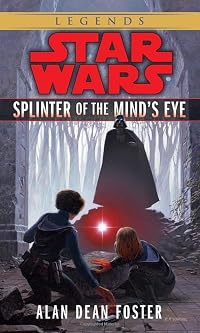
Splinter of the Mind's Eye
by Alan Dean Foster
Star Wars Novels, Star Wars Legends/EU (2), Star Wars Universe
On This Page
Description
The further adventures of Luke Skywalker as he fights for right and justice against the evil Imperial forces on the planet Mimbran.Tags
Recommendations




Member Reviews
Written right after A New Hope was released in theaters, Splinter of the Mind's Eye was meant to act as the framework for a cheap sequel. Set on a single planet with a limited cast of characters (not including Han Solo since it wasn't certain whether or not Harrison Ford was going to be coming back), it would have created a fairly generic (and yet really, really bad) sci-fi action/adventure story. If this book had been made into a movie, Star Wars would probably be a niche 70s thing rather than a decades-spanning, global phenomenon.
I know that a lot of fans have problems reading this book simply because there is some very unsubtle Luke/Leia lusting going on. Personally, I’m not too skeezed out because I am very aware of the fact that show more this book was published immediately after ANH, a movie which was advertised heavily as a romance between Luke and Leia. Of course we now know that Luke and Leia are twins but at the time there was literally no reason whatsoever to believe that ship couldn’t happen except for perhaps a few lines from Han that hinted at a future possibility of something between him and Leia. So while it is a bit creepy, Luke and Leia didn’t know, Alan Dean Foster didn’t know, and the fans didn’t know that Luke and Leia should never ever happen so I just let it slide for the most part. I am however hyper aware of those moments and read through them as fast as humanly possible because while I’ll let it slide it’s still creepy and I don’t want to think about it.
Another thing I’m hyper aware of throughout this book is that it was written in the 70s and it seems based off of the serials that George Lucas wanted to base his movies off of. Every single chapter ends in an ellipsis and a somewhat “forboding” statement about the current or future predicament of our heroes. The general narrative style definitely calls to mind a cheesy, over-dramatic narrator who likes to use metaphors and adjectives in incredibly….interesting ways. For the most part, the narrator annoys me. It’s just not a very well-written book for the most part. The plot is predictable (and not just because I already knew it from the comic; even the first time through you could very very easily guess how everything was going to end) and for the most part there wasn’t much to keep my attention. I kept reading because a few of the issues I’ll discuss below kept me morbidly fascinated.
One thing that drove me crazy throughout the book was poor characterization. Again, I can understand why it happened. Foster had one movie in which we are just being introduced not only to the characters but also to an entirely new galaxy that was completely and utterly different from anything that had been seen before. Foster used stereotypes heavily. Luke wasn’t the idealistic farmboy we know him to be but was instead the intrepid hero that could get he and Leia out of any sticky situation they had landed themselves in (sometimes literally). He studied languages when he was sitting at home, bored, and so can magically speak with this alien species that he has never met before! He can think on his feet and is a great liar! He reacts calmly to blowing the ever loving fuck out of a temple turned prison/office building! He’s strong enough to put aside his lusty feelings for Leia because she is his superior in a hell of a lot of ways! It’s all so unbelievable.
And then there’s Leia. The way he treats Leia makes me want to punch things repeatedly. Throughout the book Leia seems petrified of Imperials. She has a full on panic attack when the prospect of prison was presented to her. Now I’m not gonna say that her experience on the Death Star wouldn’t have had any effect on her because I’m sure it did. But I somehow doubt that effect was to turn her into a simpering damsel in distress. Leia should NEVER be simply a damsel in distress as she was for 90% of this novel. What’s more Leia is a princess, a senator, and a highly respected Rebellion leader. There is no way in hell that she would get into a mud fight with Luke that would draw attention to themselves when they’re supposed to remain incognito. Nor would she continually say the wrong thing and let her temper get the better of her. She would know exactly what was required of her to keep her and Luke out of trouble and have done it, whether she liked it or not. There was pretty much no point throughout the book that I felt like the Leia Foster wrote even remotely resembled the Leia in ANH. And that was incredibly disappointing.
Even more persistent than poor characterization was the incredibly speciest (because I’m going to maintain that’s a word) attitude that not only the Imperials but Luke and Leia as well portrayed. There were some moments where Leia seemed to be trying to get Luke to realize that not all cultures are the same but the way it was done was to imply that other cultures are simply barbaric and not yet mature enough to reach human’s level of civilization. There was also the problem of how the natives of Mimban were referred to. One species was simple called “greenies.” They were given no actual name and they are portrayed as a simpering, subservient race that would do anything, even lick the boots of miners, to get even a drop of alcohol. There is so much wrong there I can’t even begin to get into it. And there’s the fact that another species, the Conway, were occasionally referred to as “it.” THEY ARE A SENTIENT SPECIES WHO CAN AND WILL KICK YOUR FUCKING ASS YOU DO NOT REFER TO THEM AS “IT.” R2-D2 and C-3P0 even get referred to as “he” occasionally why would these people not be similarly designated? Because you don’t speak their language? Because they use spears instead of guns? Because they aren’t up to your level of “civilization” in general? Go fuck yourself, Luke, for that bullshit.
Overall, the book was pretty much awful in every way with no real redeeming factors and more than a few factors that made me want to pull my hair out. show less
I know that a lot of fans have problems reading this book simply because there is some very unsubtle Luke/Leia lusting going on. Personally, I’m not too skeezed out because I am very aware of the fact that show more this book was published immediately after ANH, a movie which was advertised heavily as a romance between Luke and Leia. Of course we now know that Luke and Leia are twins but at the time there was literally no reason whatsoever to believe that ship couldn’t happen except for perhaps a few lines from Han that hinted at a future possibility of something between him and Leia. So while it is a bit creepy, Luke and Leia didn’t know, Alan Dean Foster didn’t know, and the fans didn’t know that Luke and Leia should never ever happen so I just let it slide for the most part. I am however hyper aware of those moments and read through them as fast as humanly possible because while I’ll let it slide it’s still creepy and I don’t want to think about it.
Another thing I’m hyper aware of throughout this book is that it was written in the 70s and it seems based off of the serials that George Lucas wanted to base his movies off of. Every single chapter ends in an ellipsis and a somewhat “forboding” statement about the current or future predicament of our heroes. The general narrative style definitely calls to mind a cheesy, over-dramatic narrator who likes to use metaphors and adjectives in incredibly….interesting ways. For the most part, the narrator annoys me. It’s just not a very well-written book for the most part. The plot is predictable (and not just because I already knew it from the comic; even the first time through you could very very easily guess how everything was going to end) and for the most part there wasn’t much to keep my attention. I kept reading because a few of the issues I’ll discuss below kept me morbidly fascinated.
One thing that drove me crazy throughout the book was poor characterization. Again, I can understand why it happened. Foster had one movie in which we are just being introduced not only to the characters but also to an entirely new galaxy that was completely and utterly different from anything that had been seen before. Foster used stereotypes heavily. Luke wasn’t the idealistic farmboy we know him to be but was instead the intrepid hero that could get he and Leia out of any sticky situation they had landed themselves in (sometimes literally). He studied languages when he was sitting at home, bored, and so can magically speak with this alien species that he has never met before! He can think on his feet and is a great liar! He reacts calmly to blowing the ever loving fuck out of a temple turned prison/office building! He’s strong enough to put aside his lusty feelings for Leia because she is his superior in a hell of a lot of ways! It’s all so unbelievable.
And then there’s Leia. The way he treats Leia makes me want to punch things repeatedly. Throughout the book Leia seems petrified of Imperials. She has a full on panic attack when the prospect of prison was presented to her. Now I’m not gonna say that her experience on the Death Star wouldn’t have had any effect on her because I’m sure it did. But I somehow doubt that effect was to turn her into a simpering damsel in distress. Leia should NEVER be simply a damsel in distress as she was for 90% of this novel. What’s more Leia is a princess, a senator, and a highly respected Rebellion leader. There is no way in hell that she would get into a mud fight with Luke that would draw attention to themselves when they’re supposed to remain incognito. Nor would she continually say the wrong thing and let her temper get the better of her. She would know exactly what was required of her to keep her and Luke out of trouble and have done it, whether she liked it or not. There was pretty much no point throughout the book that I felt like the Leia Foster wrote even remotely resembled the Leia in ANH. And that was incredibly disappointing.
Even more persistent than poor characterization was the incredibly speciest (because I’m going to maintain that’s a word) attitude that not only the Imperials but Luke and Leia as well portrayed. There were some moments where Leia seemed to be trying to get Luke to realize that not all cultures are the same but the way it was done was to imply that other cultures are simply barbaric and not yet mature enough to reach human’s level of civilization. There was also the problem of how the natives of Mimban were referred to. One species was simple called “greenies.” They were given no actual name and they are portrayed as a simpering, subservient race that would do anything, even lick the boots of miners, to get even a drop of alcohol. There is so much wrong there I can’t even begin to get into it. And there’s the fact that another species, the Conway, were occasionally referred to as “it.” THEY ARE A SENTIENT SPECIES WHO CAN AND WILL KICK YOUR FUCKING ASS YOU DO NOT REFER TO THEM AS “IT.” R2-D2 and C-3P0 even get referred to as “he” occasionally why would these people not be similarly designated? Because you don’t speak their language? Because they use spears instead of guns? Because they aren’t up to your level of “civilization” in general? Go fuck yourself, Luke, for that bullshit.
Overall, the book was pretty much awful in every way with no real redeeming factors and more than a few factors that made me want to pull my hair out. show less
This reminds me of that meme: When you tell your mom you want the Star Wars sequel and she says "we have the Star Wars sequel at home" and instead of being Empire Strikes Back, it's Splinter of the Mind's Eye.
An alternate sequel, this book is very much unlike the Star Wars fans have come to know and love. So many base aspects are different and this ultimately feels more like a general science fiction pulp novel than a Star Wars book.
Is it bad as a book? No. Is it bad as a Star Wars book? Yeah, a fair bit. But is it the worst book ever? No. It's fine for a sci-fi adventure story full of sci-fi adventure story cliches. I didn't love it, I didn't hate it. I enjoyed it, even if just as a means of seeing the alternate history it would have show more written had the movie bombed instead of being the huge success that it was. show less
An alternate sequel, this book is very much unlike the Star Wars fans have come to know and love. So many base aspects are different and this ultimately feels more like a general science fiction pulp novel than a Star Wars book.
Is it bad as a book? No. Is it bad as a Star Wars book? Yeah, a fair bit. But is it the worst book ever? No. It's fine for a sci-fi adventure story full of sci-fi adventure story cliches. I didn't love it, I didn't hate it. I enjoyed it, even if just as a means of seeing the alternate history it would have show more written had the movie bombed instead of being the huge success that it was. show less
The Plot
Luke, Leia, C-3P0 and R2-D2 are en-route to meet up with a conclave of resistance movements in order to try to get them to join the Rebel Alliance. En Route Leia's Y-Wing runs into mechanical problems and is forced to set-down on a believed uninhabited planet, Minban, that turns out to be a covert mining colony run by the Empire. I'm not exactly sure why the Empire would need to run a mining colony "covertly". In the course of trying to find parts or transport, Leia and Luke encounter a strange old woman named Hettie, who has a shard of a crystal called the "Kaiburr Crystal", which has the ability to focus the perception of the force in those who can perceive it. Luke touches this shard and his perception is heightened, Leia show more senses nothing. Luke suspects that this "spike" in his awareness in the force could be perceived by other force sensitive people, at some distance, possibly even by The Emperor.
Luke & Leia, when roughhousing playfully (as part of their romantic tension), end up getting the attention of the local garrison and are arrested. Leia has her PTSD (caused by her torture on the Death Star) triggered at the mention of the Imperial Governor, and they're thrown in a cell with two large furry creatures called Yuzzum, which are basically Wookies - who are currently nursing really terrible hangovers. Hettie helps break out Luke & Leia, with Luke and Hettie pooling their force abilities to levitate a food tray to trigger the motion sensors for the door (not very secure), before they escape. The Yuzzum kill some troopers in very gruesome fashions (up to and including beating troopers to death with their own limbs, and the limbs of their comrades).
After travelling across country, they end up encountering some local wildlife, and end up with some of the natives who haven't gotten hooked on booze and drugs by the Empire to keep them docile. Luke succeeds in a trial by combat, just in time for some stormtroopers (and Darth Vader - who also triggers Leia's PTSD), show up and attack. They are pushed back, and our Heroes commandeer an Imperial Transport to reach the temple where the crystal is (with the Yuzzum again literally ripping troopers to shreds). Luke & Leia arrive, but as they're investigating the temple, Vader shows up at the transport and kills the Yuzzum. He arrives in the chamber with the crystal, right after Luke's party does. Leia ends up in a lightsaber duel with Vader, which she loses at, but she is not killed. Luke Force Pulls his lightsaber to him, and manages (with some force assistance by Obi-Wan) to knock Vader into a pit. This does not kill Vader, but he won't be getting out for quite some time - enough time for Leia and Hettie to grab the Kaiburr Crystal and our heroes to escape.
Character Development
Luke Skywalker: Is force sensitive, and has learned a new ability - Force Pull! Is also romantically interested in Princess Leia
Princess Leia Organa: Is not force sensitive. Has really bad PTSD from her time on the Death Star, caused by her torture (not by seeing her home world destroyed), and is triggered by mention of Imperial Governors, and by Darth Vader himself.
C3-P0 & R2-D2: Darth Vader knows the authentication codes to shut them down automatically.
The Emperor: Is Force Sensitive.
Darth Vader: Likes to play with his opponents before killing them - which allows him to be defeated by Luke. Is actively sadistic - gloating about spending a longer time torturing Leia this time. This is the first time we see him kill a subordinate who failed him (he was stopped in A New Hope)
World Building
Other Notes
The book has a foreword by [a:George Lucas|3231|George Lucas|https://d.gr-assets.com/authors/1458677946p2/3231.jpg]George Lucas saying that he's at that time writing the story for the second film (which will be Empire Strikes Back, and he's planned to do 9 films total in the series. Also, both Luke andVader are using Blue lightsabers. I'm assuming that when this book was written, the re-release of the films, with the "Episode IV" in the opening crawl and the re-rotoscoped lightsaber blades hadn't been released yet.
My Thoughts
As stilted as the dialog is in A New Hope, Splinter of The Mind's Eye is soooo much worse. Several of the characters have straight up Silver Age Comics levels of verbosity. This isn't helped by the fact that this, basically, is the second Star Wars work at the time of publication (with the exception of the Marvel comics), so nobody really has anyone else's voice yet. That said, Vader in particular feels somewhat jarringly out of character. Yes, he has a flair for the dramatic, and he's certainly evil. However, his sense of cruelty here is so much more vicious. You know those characters in anime and manga who demonstrate their cruelty by licking the blood from the blade of their sword or knife? Vader, in this book, would be that, if he didn't need his helmet and you could safely lick a lightsaber.
It bears mentioning that this book is also considerably more graphically violent than the films, with considerably more gore. Dismemberments abound, with more than a few people being beaten into unrecognizability as humanoids by the Yuzzum. While Dark Horse did not have to deal with the Comics Code Authority, this still probably would not have flown in much of their books. show less
Luke, Leia, C-3P0 and R2-D2 are en-route to meet up with a conclave of resistance movements in order to try to get them to join the Rebel Alliance. En Route Leia's Y-Wing runs into mechanical problems and is forced to set-down on a believed uninhabited planet, Minban, that turns out to be a covert mining colony run by the Empire. I'm not exactly sure why the Empire would need to run a mining colony "covertly". In the course of trying to find parts or transport, Leia and Luke encounter a strange old woman named Hettie, who has a shard of a crystal called the "Kaiburr Crystal", which has the ability to focus the perception of the force in those who can perceive it. Luke touches this shard and his perception is heightened, Leia show more senses nothing. Luke suspects that this "spike" in his awareness in the force could be perceived by other force sensitive people, at some distance, possibly even by The Emperor.
Luke & Leia, when roughhousing playfully (as part of their romantic tension), end up getting the attention of the local garrison and are arrested. Leia has her PTSD (caused by her torture on the Death Star) triggered at the mention of the Imperial Governor, and they're thrown in a cell with two large furry creatures called Yuzzum, which are basically Wookies - who are currently nursing really terrible hangovers. Hettie helps break out Luke & Leia, with Luke and Hettie pooling their force abilities to levitate a food tray to trigger the motion sensors for the door (not very secure), before they escape. The Yuzzum kill some troopers in very gruesome fashions (up to and including beating troopers to death with their own limbs, and the limbs of their comrades).
After travelling across country, they end up encountering some local wildlife, and end up with some of the natives who haven't gotten hooked on booze and drugs by the Empire to keep them docile. Luke succeeds in a trial by combat, just in time for some stormtroopers (and Darth Vader - who also triggers Leia's PTSD), show up and attack. They are pushed back, and our Heroes commandeer an Imperial Transport to reach the temple where the crystal is (with the Yuzzum again literally ripping troopers to shreds). Luke & Leia arrive, but as they're investigating the temple, Vader shows up at the transport and kills the Yuzzum. He arrives in the chamber with the crystal, right after Luke's party does. Leia ends up in a lightsaber duel with Vader, which she loses at, but she is not killed. Luke Force Pulls his lightsaber to him, and manages (with some force assistance by Obi-Wan) to knock Vader into a pit. This does not kill Vader, but he won't be getting out for quite some time - enough time for Leia and Hettie to grab the Kaiburr Crystal and our heroes to escape.
Character Development
Luke Skywalker: Is force sensitive, and has learned a new ability - Force Pull! Is also romantically interested in Princess Leia
Princess Leia Organa: Is not force sensitive. Has really bad PTSD from her time on the Death Star, caused by her torture (not by seeing her home world destroyed), and is triggered by mention of Imperial Governors, and by Darth Vader himself.
C3-P0 & R2-D2: Darth Vader knows the authentication codes to shut them down automatically.
The Emperor: Is Force Sensitive.
Darth Vader: Likes to play with his opponents before killing them - which allows him to be defeated by Luke. Is actively sadistic - gloating about spending a longer time torturing Leia this time. This is the first time we see him kill a subordinate who failed him (he was stopped in A New Hope)
World Building
- The Empire has rules about the treatment of indigenous populations - rules that are ignored in the case of Minban, the planet in this book.
- The Rebel Alliance is recruiting various other Resistance groups, particularly following their loss of manpower in the wake of the destruction of the Death Star.
- Governors are responsible for whole systems, not just planets.
- The senate being dissolved circa A New Hope has upped the bureaucratic headache of running a system (and the planets therein). Presumably the Death Star would not have included the ability to cut through red tape, so this still would have been a problem.
Other Notes
The book has a foreword by [a:George Lucas|3231|George Lucas|https://d.gr-assets.com/authors/1458677946p2/3231.jpg]George Lucas saying that he's at that time writing the story for the second film (which will be Empire Strikes Back, and he's planned to do 9 films total in the series. Also, both Luke andVader are using Blue lightsabers. I'm assuming that when this book was written, the re-release of the films, with the "Episode IV" in the opening crawl and the re-rotoscoped lightsaber blades hadn't been released yet.
My Thoughts
As stilted as the dialog is in A New Hope, Splinter of The Mind's Eye is soooo much worse. Several of the characters have straight up Silver Age Comics levels of verbosity. This isn't helped by the fact that this, basically, is the second Star Wars work at the time of publication (with the exception of the Marvel comics), so nobody really has anyone else's voice yet. That said, Vader in particular feels somewhat jarringly out of character. Yes, he has a flair for the dramatic, and he's certainly evil. However, his sense of cruelty here is so much more vicious. You know those characters in anime and manga who demonstrate their cruelty by licking the blood from the blade of their sword or knife? Vader, in this book, would be that, if he didn't need his helmet and you could safely lick a lightsaber.
It bears mentioning that this book is also considerably more graphically violent than the films, with considerably more gore. Dismemberments abound, with more than a few people being beaten into unrecognizability as humanoids by the Yuzzum. While Dark Horse did not have to deal with the Comics Code Authority, this still probably would not have flown in much of their books. show less
A quite interesting story, more for the curiosity value of it being the novelisation of a film that (thankfully) was never made. George Lucas's contingency plan in the event Star Wars was a flop was to make a low-budget sequel, of which unnecessary plan this book was the fruit.
That low budget means that there are no big, space-opera battles, with the action all taking place on one planet. The planet being a giant marsh-world, perpetually shrouded in mist, means no expensive back drops, and I visualised Luke and Leia wandering from one studio set to the next, rather than ranging through expansive locations shoots. Harrison Ford, hedging his bets, had not signed on to a sequel at the time of publication, so no Han Solo, and therefore no show more Chewbacca. Artoo and Threepio are along for the ride, but little is made of them. Darth Vader appears, but he's a generic boss-level villain rather than the personification of the dark side of the Force that we love to hate.
If the first film had flopped, a movie of this book would have done nothing to revive the franchise. A quick fun read, but nothing to get too excited about. show less
That low budget means that there are no big, space-opera battles, with the action all taking place on one planet. The planet being a giant marsh-world, perpetually shrouded in mist, means no expensive back drops, and I visualised Luke and Leia wandering from one studio set to the next, rather than ranging through expansive locations shoots. Harrison Ford, hedging his bets, had not signed on to a sequel at the time of publication, so no Han Solo, and therefore no show more Chewbacca. Artoo and Threepio are along for the ride, but little is made of them. Darth Vader appears, but he's a generic boss-level villain rather than the personification of the dark side of the Force that we love to hate.
If the first film had flopped, a movie of this book would have done nothing to revive the franchise. A quick fun read, but nothing to get too excited about. show less
Better than it's given credit for by other reviewers. It was fun reading the first Star Wars book published less than a year after the first SW film, Ep IV: New Hope. I didn't mind the subtle romantic pining of Luke toward Leia because true to the first film Luke did have feelings for the Princess. He just didn't know yet it was his sister!
The only downside to me in the story was the sometimes overwhelming descriptions of the world of Mimban, where Luke and Leia crash-landed. Though Mimban does seem a lot like what was Dagobah in the Empire Strikes Back -- very swampy and bog-like. And the two allies they encounter on Mimban, the Yuzzem, have some characteristics of Wookies, including long arms and short tempers.
In general, surprised show more how much I enjoyed it. It's worth a read for any Star Wars fan. show less
The only downside to me in the story was the sometimes overwhelming descriptions of the world of Mimban, where Luke and Leia crash-landed. Though Mimban does seem a lot like what was Dagobah in the Empire Strikes Back -- very swampy and bog-like. And the two allies they encounter on Mimban, the Yuzzem, have some characteristics of Wookies, including long arms and short tempers.
In general, surprised show more how much I enjoyed it. It's worth a read for any Star Wars fan. show less
This book is very basic, by-the-numbers sf--but with the added thrill of being written right after A New Hope came out. Thus, the entire story is about Luke and Leia's sexual tension. Sure you always intended them to be siblings, Lucas. Sure.
The recent hoopla over the 30th anniversary of the first Star Wars movie put me in the mood to revisit a novel I've not read in probably, oh, 25 years or so: Splinter of the Mind's Eye by Alan Dean Foster.
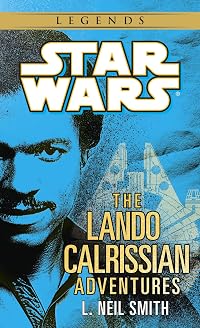
Published in the spring of 1978, while the movie was still playing in many theaters around the country, Splinter of the Mind's Eye by Alan Dean Foster was the very first Star Wars tie-in novel, not counting the novelization of the film itself. (Which, incidentally, was also written by Foster, even though G. Lucas has always been credited as the author.) As such, it is something of a singular curiosity now. Other early tie-ins, such as Brian Daley's trilogy of books about Han Solo's pre-movie adventures, and even L. Neil Smith's show more eccentric trio of Lando Calrissian tales, fit nicely into the "Expanded Universe" framework of the more recent Star Wars novels. Splinter, however, stands alone, uninformed by important character revelations that came in the second and third movies (Episodes V and VI, if we really must) and a bit off-kilter in tone from the well-established Star Wars formula.
Supposedly based on early screenplay drafts for either Star Wars itself or a possible low-budget sequel (depending on which source you consult), Splinter of the Mind's Eye begins with Luke Skywalker, Princess Leia, and the droids en route to a meeting with an underground cell they hope to recruit into the Rebel Alliance. A mechanical problem forces their ships down on a swamp world called Mimban (which bears more than a passing resemblance to Dagobah, lending credence to the idea that much of the novel was borrowed from Lucas' story notes). There, they discover a secret Imperial mining operation and meet Halla, a local eccentric who claims to be Force-sensitive. She convinces Luke to help her in her quest to find the Kaiburr Crystal, a legendary gemstone that is said to help Force-users like Luke focus and enhance their powers; Luke's party and Halla, along with two alien sidekicks, set off across the foggy wilderness in search of the temple where the crystal resides. They are pursued by the sadistic ruler of the mining colony, Captain-Supervisor Grammel, a whole bunch of his stormtroopers, and a certain Dark Lord of the Sith who would like to possess the Kaiburr Crystal for his own purposes.
I remember that Splinter confounded me when I first read it as a kid, for two very large reasons: Han Solo and Chewbacca are conspicuously absent (they are mentioned in passing -- and not even by name -- only at the very end of the book), and there are no space battles. Indeed, the only scene involving spaceships at all is the very first one; once Luke and Leia crash on Mimban, the rest of the action is entirely planetbound.
These days, however, I actually found these aspects of the tale rather refreshing. The Star Wars novels of recent years, while not without their charms, have become extremely formulaic: the fate of the entire galaxy is always at stake, there are always multiple planetary locations and multiple space battles (both dogfights between one-man fighters and titanic slugfests between capital ships), and, between all our old favorites from the movies and all the new characters that have come to inhabit the Expanded Universe, the cast of the average EU novel is freakin' huge, and (for me, anyway) difficult to keep track of. Splinter, by contrast, is a much simpler, much more focused story. I like that it concerns itself only with a small handful of people (and droids and creatures) in a single location with a single purpose in mind.
More problematic, in terms of the overall saga continuity at least, is the ways in which Splinter flat-out contradicts accepted Star Wars lore. The most obvious issue is that the Luke and Leia we see here are most assuredly not siblings. The sexual tension between them is startling and more than a little icky in light of the way the saga developed in the years following 1978. (However, it does support a pet theory of mine, which is that the sibling thing was not planned from the beginning, as the official history now claims, and only came along when Uncle George needed a convenient way to resolve the Luke-Han-Leia love triangle.) In addition, the droids aren't as fully involved in the action as we've come to expect -- they are hardly present in the story at all, actually -- and Darth Vader demonstrates some odd abilities with the Force that aren't supported in any of the six movies and, to my knowledge, haven't been seen in any other EU novel. The only way to reconcile these things with our fully evolved, 30-years-on conception of these characters is to keep in mind when the book was written: before Empire or Jedi, before the prequels, before anyone really knew anything at all about Jedi or the Empire or anything else in the galaxy far, far away.
Turning to more technical matters, I've got to say that Alan Dean Foster isn't one of our better literary stylists; he often comes across as if he's swallowed a thesaurus and is trying desperately to impress us with his knowledge of big words. Also, Splinter came relatively early in his career, so his writing is rather clunky in places. However, I was surprised at how certain specific images from this book have stayed with me all these years, even a couple of which I'd forgotten the origin. For example, I remembered "clean grains [of sand] pressing into Luke's nostrils" as he's drowning at the bottom of a pond, and blood drying to a black crust on a cave floor after a big battle. And I remembered vividly the scene in which Captain-Supervisor Grammel puts out some poor bastard's eye with a plastic recording rod, then offers to let him see the image of it, as well as the bit when Luke dials down his lightsaber blade into a thin stilleto and uses it to open a locked door. That's something I would've liked to see in one of the movies, actually.
Despite its flaws and anachronisms, Splinter of the Mind's Eye remains a very enjoyable read after all these years. It doesn't jibe at all with the Expanded Universe, or even just the later movies, but it is a very pleasant way to revisit a time when Star Wars was fresh and its backstory was still an exciting mystery. And I've got to be honest: I think I prefer Luke and Leia as "a princess and a farmboy" who might become lovers, rather than brother and sister separated at birth. Even when I was twelve, that sibling thing was lame...
One final note that may or may not be interesting to anyone: my edition of the novel has an ad on the back page that shows large black droplets, conveniently labelled "Oil," dangling from tree branches. The predictable caption: "It doesn't grow on trees." How sad is it that 30 years have passed and that plea for conservation remains as timely -- maybe even moreso -- as it was back in the days of Jimmy Carter and the big OPEC gas crunch? show less
Published in the spring of 1978, while the movie was still playing in many theaters around the country, Splinter of the Mind's Eye by Alan Dean Foster was the very first Star Wars tie-in novel, not counting the novelization of the film itself. (Which, incidentally, was also written by Foster, even though G. Lucas has always been credited as the author.) As such, it is something of a singular curiosity now. Other early tie-ins, such as Brian Daley's trilogy of books about Han Solo's pre-movie adventures, and even L. Neil Smith's show more eccentric trio of Lando Calrissian tales, fit nicely into the "Expanded Universe" framework of the more recent Star Wars novels. Splinter, however, stands alone, uninformed by important character revelations that came in the second and third movies (Episodes V and VI, if we really must) and a bit off-kilter in tone from the well-established Star Wars formula.
Supposedly based on early screenplay drafts for either Star Wars itself or a possible low-budget sequel (depending on which source you consult), Splinter of the Mind's Eye begins with Luke Skywalker, Princess Leia, and the droids en route to a meeting with an underground cell they hope to recruit into the Rebel Alliance. A mechanical problem forces their ships down on a swamp world called Mimban (which bears more than a passing resemblance to Dagobah, lending credence to the idea that much of the novel was borrowed from Lucas' story notes). There, they discover a secret Imperial mining operation and meet Halla, a local eccentric who claims to be Force-sensitive. She convinces Luke to help her in her quest to find the Kaiburr Crystal, a legendary gemstone that is said to help Force-users like Luke focus and enhance their powers; Luke's party and Halla, along with two alien sidekicks, set off across the foggy wilderness in search of the temple where the crystal resides. They are pursued by the sadistic ruler of the mining colony, Captain-Supervisor Grammel, a whole bunch of his stormtroopers, and a certain Dark Lord of the Sith who would like to possess the Kaiburr Crystal for his own purposes.
I remember that Splinter confounded me when I first read it as a kid, for two very large reasons: Han Solo and Chewbacca are conspicuously absent (they are mentioned in passing -- and not even by name -- only at the very end of the book), and there are no space battles. Indeed, the only scene involving spaceships at all is the very first one; once Luke and Leia crash on Mimban, the rest of the action is entirely planetbound.
These days, however, I actually found these aspects of the tale rather refreshing. The Star Wars novels of recent years, while not without their charms, have become extremely formulaic: the fate of the entire galaxy is always at stake, there are always multiple planetary locations and multiple space battles (both dogfights between one-man fighters and titanic slugfests between capital ships), and, between all our old favorites from the movies and all the new characters that have come to inhabit the Expanded Universe, the cast of the average EU novel is freakin' huge, and (for me, anyway) difficult to keep track of. Splinter, by contrast, is a much simpler, much more focused story. I like that it concerns itself only with a small handful of people (and droids and creatures) in a single location with a single purpose in mind.
More problematic, in terms of the overall saga continuity at least, is the ways in which Splinter flat-out contradicts accepted Star Wars lore. The most obvious issue is that the Luke and Leia we see here are most assuredly not siblings. The sexual tension between them is startling and more than a little icky in light of the way the saga developed in the years following 1978. (However, it does support a pet theory of mine, which is that the sibling thing was not planned from the beginning, as the official history now claims, and only came along when Uncle George needed a convenient way to resolve the Luke-Han-Leia love triangle.) In addition, the droids aren't as fully involved in the action as we've come to expect -- they are hardly present in the story at all, actually -- and Darth Vader demonstrates some odd abilities with the Force that aren't supported in any of the six movies and, to my knowledge, haven't been seen in any other EU novel. The only way to reconcile these things with our fully evolved, 30-years-on conception of these characters is to keep in mind when the book was written: before Empire or Jedi, before the prequels, before anyone really knew anything at all about Jedi or the Empire or anything else in the galaxy far, far away.
Turning to more technical matters, I've got to say that Alan Dean Foster isn't one of our better literary stylists; he often comes across as if he's swallowed a thesaurus and is trying desperately to impress us with his knowledge of big words. Also, Splinter came relatively early in his career, so his writing is rather clunky in places. However, I was surprised at how certain specific images from this book have stayed with me all these years, even a couple of which I'd forgotten the origin. For example, I remembered "clean grains [of sand] pressing into Luke's nostrils" as he's drowning at the bottom of a pond, and blood drying to a black crust on a cave floor after a big battle. And I remembered vividly the scene in which Captain-Supervisor Grammel puts out some poor bastard's eye with a plastic recording rod, then offers to let him see the image of it, as well as the bit when Luke dials down his lightsaber blade into a thin stilleto and uses it to open a locked door. That's something I would've liked to see in one of the movies, actually.
Despite its flaws and anachronisms, Splinter of the Mind's Eye remains a very enjoyable read after all these years. It doesn't jibe at all with the Expanded Universe, or even just the later movies, but it is a very pleasant way to revisit a time when Star Wars was fresh and its backstory was still an exciting mystery. And I've got to be honest: I think I prefer Luke and Leia as "a princess and a farmboy" who might become lovers, rather than brother and sister separated at birth. Even when I was twelve, that sibling thing was lame...
One final note that may or may not be interesting to anyone: my edition of the novel has an ad on the back page that shows large black droplets, conveniently labelled "Oil," dangling from tree branches. The predictable caption: "It doesn't grow on trees." How sad is it that 30 years have passed and that plea for conservation remains as timely -- maybe even moreso -- as it was back in the days of Jimmy Carter and the big OPEC gas crunch? show less
Members
- Recently Added By
Lists

Star Wars Legends
155 works; 3 members

Books Read in 2014
2,343 works; 89 members

Books With Body Parts in the Title
153 works; 9 members

Books Read in 2022
5,168 works; 114 members

Books Read in 2024
4,623 works; 126 members

Books I Read Before The Invention Of The Internet.
144 works; 1 member

Books Read in 2025
4,091 works; 97 members
Author Information

364+ Works 73,856 Members
Bestselling science fiction writer Alan Dean Foster was born in New York City in 1946, but raised mainly in California. He received a B.A. in Political Science from UCLA in 1968, and a M.F.A. in 1969. Foster enjoys traveling because it gives him opportunities to meet new people and explore new places and cultures. This interest is carried over to show more his writing, but with a twist: the new places encountered in his books are likely to be on another planet, and the people may belong to an alien race. Foster began his career as an author when a letter he sent to Arkham Collection was purchased by the editor and published in the magazine in 1968. His first novel, The Tar-Aiym Krang, introduced the Humanx Commonwealth, a galactic alliance between humans and an insectlike race called Thranx. Several other novels, including the Icerigger trilogy, are also set in the world of the Commonwealth. The Tar-Aiym Krang also marked the first appearance of Flinx, a young man with paranormal abilities, who reappears in other books, including Orphan Star, For Love of Mother-Not, and Flinx in Flux. Foster has also written The Damned series and the Spellsinger series, which includes The Hour of the Gate, The Moment of the Magician, The Paths of the Perambulator, and Son of Spellsinger, among others. Other books include novelizations of science fiction movies and television shows such as Star Trek, The Black Hole, Starman, Star Wars, and the Alien movies. Splinter of the Mind's Eye, a bestselling novel based on the Star Wars movies, received the Galaxy Award in 1979. The book Cyber Way won the Southwest Book Award for Fiction in 1990. His novel Our Lady of the Machine won him the UPC Award (Spain) in 1993. He also won the Ignotus Award (Spain) in 1994 and the Stannik Award (Russia) in 2000. He is the recipient of the Faust, the IAMTW Lifetime achievement award. Alan Dean Foster's Star Wars: The Force Awakens, was a 2015 New York Times bestseller. (Bowker Author Biography) show less
Some Editions
Series


Work Relationships
Has the adaptation
Common Knowledge
- Canonical title
- Splinter of the Mind's Eye
- Original title
- Splinter in the Mind's Eye
- Alternate titles
- Star Wars: Splinter of the Mind's Eye; Splinter of the Mind's Eye: From the Further Adventures of Luke Skywalker
- Original publication date
- 1978-03-01
- People/Characters
- Luke Skywalker; Leia Organa; Darth Vader; R2-D2; C-3PO; Halla
- Important places
- Mimban
- Dedication
- For Dad & Mom Oxley, Louis & Ellie, with all my love, which would fill several universes . . .
- First words
- How beautiful was the universe, Luke thought.
- Last words
- (Click to show. Warning: May contain spoilers.)"Why," the faint, receding voice of a certain 'droid could be heard to say, "do I have the impression that everyone is laughing at me...?"
- Original language
- English
Classifications
Statistics
- Members
- 2,925
- Popularity
- 6,142
- Reviews
- 37
- Rating
- (3.11)
- Languages
- 10 — Dutch, English, Finnish, German, Hungarian, Italian, Norwegian (Bokmål), Polish, Romanian, Spanish
- Media
- Paper, Ebook
- ISBNs
- 26
- UPCs
- 1
- ASINs
- 13