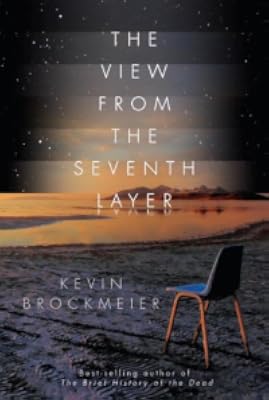
The View from the Seventh Layer
by Kevin Brockmeier
On This Page
Description
In these three stories, a young, asocial woman remembers the oddly honest things she wrote in her high school classmates' yearbooks and contemplates her scarred life, imagining an escape with an apparition she calls the Entity. A formerly dull and turgid pastor is touched by a spirit that turns his sermons into crowd-pleasers--that is, until he discovers his inspiration is a little less than divine. And a choose-your-own-adventure novel for grown-ups concludes the volume.Tags
Recommendations






















Member Reviews
This collection of short stories is simply sublime. There is something about the author’s voice that brought to mind the way one would approach a frightened animal - softly, slowly, and cautiously. Yet at the same time the message of most of the stories was thought-provoking in a “smack you upside the head” sort of way. That dichotomy worked, and it worked very well. The overall tone is melancholy, there are strong messages about society and spirituality, and there is a hint of the supernatural that wafts like smoke from an extinguished candle. And the quality of writing is just perfection.
My favorite stories in the collection:
The Lives of the Philosophers. A man receives an epiphany about his thesis on Thomas Aquinas and show more Friedrich Nietzsche when his girlfriend experiences a tragedy. This story just shattered me. It left me breathless and weepy. I had to go for a walk. I almost took the book to my sister-in-law and demand that she read the story that very second (because I knew she would understand what I felt).
A Fable with Slips of White Paper Spilling from the Pockets. A man purchases a coat at a thrift shop and discovers the pockets of the coat mysteriously fill with scraps of paper on which prayers have been written. This was such a unique concept and there was a such a quiet desperation in the story. Poignant and profound.
Father John Melby and the Ghost of Amy Elizabeth. A priest endures a crisis of faith when he is visited by a ghost. This story is dark and gothic, and so compelling that I couldn’t look away for an instant.
The View from the Seventh Layer. A woman reflects on how her life has been impacted by a childhood visitation from an angel. I loved this story for how it was structured, in a sort of a circular, stream-of-consciousness manner. Beautiful and brilliant.
I also appreciated (but didn’t love) The Human Soul as a Rube Goldberg Device: A Choose-Your-Own-Adventure Story. This one is just very very clever.
There were two clunkers in the book - a StarTrek fan fic piece and one about a television show similar to America’s Funniest Home Videos. These were awful in a “Can I tear these pages out of the book?” way. But ultimately they didn’t detract from my rating of the book because the stories I loved, I loved A LOT. show less
My favorite stories in the collection:
The Lives of the Philosophers. A man receives an epiphany about his thesis on Thomas Aquinas and show more Friedrich Nietzsche when his girlfriend experiences a tragedy. This story just shattered me. It left me breathless and weepy. I had to go for a walk. I almost took the book to my sister-in-law and demand that she read the story that very second (because I knew she would understand what I felt).
A Fable with Slips of White Paper Spilling from the Pockets. A man purchases a coat at a thrift shop and discovers the pockets of the coat mysteriously fill with scraps of paper on which prayers have been written. This was such a unique concept and there was a such a quiet desperation in the story. Poignant and profound.
Father John Melby and the Ghost of Amy Elizabeth. A priest endures a crisis of faith when he is visited by a ghost. This story is dark and gothic, and so compelling that I couldn’t look away for an instant.
The View from the Seventh Layer. A woman reflects on how her life has been impacted by a childhood visitation from an angel. I loved this story for how it was structured, in a sort of a circular, stream-of-consciousness manner. Beautiful and brilliant.
I also appreciated (but didn’t love) The Human Soul as a Rube Goldberg Device: A Choose-Your-Own-Adventure Story. This one is just very very clever.
There were two clunkers in the book - a StarTrek fan fic piece and one about a television show similar to America’s Funniest Home Videos. These were awful in a “Can I tear these pages out of the book?” way. But ultimately they didn’t detract from my rating of the book because the stories I loved, I loved A LOT. show less
i love Brockmeier's writing style, and for the most part this collection was no exception; the fables in particular I adore, along with the collection's eponymous story, the View from the Seventh Layer and the interesting the Air is Full of Little Holes. I don't know how the thinly disguised trekkie fanfic made it into the book - it was the only disappointing story in the collection and this (along with Andrea is Changing her Name which just fell flat for me) are the primary reason the rating is only 4 starts, and not 5. Overall - excellent collection, well worth the time. And read before bed, it inspires some interesting dreamscapes.
An odd but well-written set of short stories that usually weren't really to my taste. I appreciated the skill at work but rarely found them satisfying, perhaps because I'm just not familiar enough with the modern literate short story. Many of them seem to end hanging on a moment of quiet that can come off as ambivalent but is probably really intended to be subtlety.
I did enjoy a few stories, notably "Father John Melby and the Ghost of Amy Elizabeth" and "A Fable with Slips of White Paper Spilling from the Pockets."
I did enjoy a few stories, notably "Father John Melby and the Ghost of Amy Elizabeth" and "A Fable with Slips of White Paper Spilling from the Pockets."
I really like Kevin Brockmeier's writing style. I like how he makes language feel like it is softly overtaking you and there is just nothing you can or want to do about it. These stories were just like that, all encompassing. I completely lost track of time while reading them.
I think my favourites were:
The Year of Silence - which felt almost like reading Jose Saramago.
The Human Soul as a Rube Goldberg Device: A Choose-Your-Own-Adventure
Story - so much fun! One could easily get lost in this one for days.
A Fable with Slips of White Paper Spilling from the Pockets - such a great concept and so well realized. Loved the ending.
I think my favourites were:
The Year of Silence - which felt almost like reading Jose Saramago.
The Human Soul as a Rube Goldberg Device: A Choose-Your-Own-Adventure
Story - so much fun! One could easily get lost in this one for days.
A Fable with Slips of White Paper Spilling from the Pockets - such a great concept and so well realized. Loved the ending.
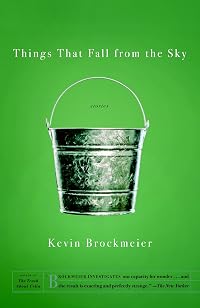
If you're looking for a great short story writer, Kevin Brockmeier is your man. However, if you are looking for his very best work as far as short stories go, I would recommend Things That Fall From the Sky over this one. Still, the first half of this collection is quite flawless. Brockmeier takes us on a journey of a town obsessed with sound and the man who was mute but raised parakeets ("A Fable Ending in the Sound of a Thousand Parakeets") to the story of a world which craves the ending of all sound "The Year of Silence"). He writes of other dimensions in a way that somehow doesn't seem hokey (The View from the Seventh Layer). There's also a grand adult choose your own adventure segment (" The Human Soul as a Rube Goldberg Device: A show more Choose Your Own Adventure Story") that made me remember some very fond memories of childhood.
Where Brockmeier lost me a little bit was the love affair in space "The Lady With the Pet Tribble" though he redeems the second half a bit with "A Fable Containing a Reflection" which is about a whole town that doesn't make eye contact, and "Home Videos" about breaking the cycle and system of commonplace and inane comedies that get aired on television. "A Fable With Slips of White Paper Spilling from the Pockets" is an interesting story about a man with God's coat and who therefore gets all of the prayers meant for him.
Brockmeier manages to come up with some unique and creative ideas, which is more difficult than one might think in this day and age, and he achieves such a virtuosity with language in so much of his work. I have to review some of Brockmeier's work that I've been ruminating on for quite some time...the man makes you think and feel, which is rare indeed.
Favorite quotes:
pg. 3-4 "In this city there lived a mute, the only person who was unable to lend his voice to the great chorus of song that filled the air...In some communities there is a man who sells whistles by the courthouse or paper kites down by the river. In others there is a woman who decorates her home with multicolored lights and streamers every holiday. Usually these people are no more than small figures at the periphery of everyone's attention, but when they die, it can be more surprising than the death of a prominent leader or a renowned artist, because no one has ever regarded them carefully enough to consider what their absence might mean."
pg. 9-10 "In a thousand different tones, a thousand different inflections, they reproduced all the sounds of the mute's daily life, from the steady beat of his footsteps to the whistle of his coffeepot to the slow, spreading note of his final breath. It sounded for all the world like a symphony."
pg. 12 "Dozens of half-closed umbrellas lay discarded over the glistening brown boards, their handles glowing in the flawless white light. The local children collected them like flowers."
pg. 14 "Nothing was secure from one minute to the next. She did not remember her dreams when she woke in the morning."
pg. 14-15 "She had read somewhere that the best way to reset your circadian clock was to illuminate the backs of your knees, and so every night, after she took sleeping pills, she was careful to shield the lower half of her body from the light."
pg. 15 "Then something went wrong, and she was no longer able to concentrate on the novels she brought home with her. Everything about them seemed imaginary, insubstantial, built on a tissue of fog and lies-and not just the settings and the characters, wither, but the very words on the page. They might have been invented just that second by somebody who had never so much as set foot in the world."
pg. 19 "But the conscience of every house-she believed-the conscience of every house was the bookshelves."
pg. 20 "Olivia had heard somewhere that the hour from midnight to one o'clock was called the witching hour because that was when the witches were supposed to be active, but she had heard somewhere else that the witching hour was simply that hour of the day when everything always went wrong."
pg. 21 "Once, a tourist who had just returned from an aquatic sightseeing trip told her that there were schools of fish that followed the shadows like newborn babies trying to keep their mother in reach. He said that the fish were the color of Dijon mustard. Olivia was more interested in the clouds that she was in the water, and she was more interested in the shadows than she was in the clouds. She did not know when she had become so unlike other people."
pg. 24 "People who read Tolstoy found it difficult to be alive because they are reasonable, while people who read Dostoevsky find it difficult to be alive because they are not."
pg. 30 "As far as Olivia could tell, the structure had an unending capacity to withstand assault without suffering harm. It was as though it presented itself so modestly to the world that the world had decided it was not worth destroying."
pg. 34 "Olivia thought that surely the library was the conscience of the island."
pg. 38 "She had started out strong and beautiful, and she was not sure when she had changed. But surely anything that could change once, and change so dramatically, could swing back around and change again."
pg. 41 "The change machine? Jacob pictures something straight out of a science fiction novel, an immense apparatus of hatches, levers, and conveyer belts that allows you to step in as one human being and step out as another, in which atheists change into Christians, stock car drivers change into politicians, great beauties change into wallflowers.:
pg. 60 "And after their (Aquinas's and Nietzsche's) visions were disclosed to them, they folded their hands together and never wrote another word. They wished their ideas had never been set to paper...The past is irreparable and so is the future."
pg. 76 "We had lost some of the difficulty of our lives and we wanted it back."
pg. 82 "Other people's homes present you with the same ornate sense of emptiness. This is never so obvious as when the people who live there have gone away."
pg. 115 "See, I hate this idea that everything needs to be traded in for something else. I can't imagine a better way to waste a life."
pg. 120-121 "You remember having friends who used to lampoon the world so effortlessly, crouching at the verge of every joke and waiting to pounce on it, and you remember how they changed as they grew older and the joy of questioning everything slowly became transformed into the pain of questioning everything, like a star consuming its own core.
Who was it who said that every virtue contains its corresponding vice? C.S. Lewis? Virgina Woolf? You forget. But it has always worried you that what the virtue of wit contained was the vice of scorn."
pg. 146-147 "It will be several thousand years before the human race develops a procedure to retrieve the memories of the dead from their bodies. By then the age in which you lived will be recollected as a time of barbarism and brute physical destruction, of interest only to historians of cultural degradation. But in the name of scientific research, a few sample bodies from your century will be exhumed for memory reclamation, and among those selected will be yours."
pg. 224 "Neurologically speaking, the hiccup is just the final stage of laughter."
pg. 237 "The parchments teach us that we see the world only from the back, which is why everything appears so imperfect to our eyes. There is no leaf on a tree that is not a leaf seen from behind, no star in the sky that is not a star seen from behind, no man and no woman who are not souls seen from behind. But occasionally, by the grace of God, the world turns its face to us, uncovering its perfection, and though the glimpse we are given never lasts longer than an instant, we remember it for the rest of our lives."
pg. 248 "She would drop a joke into the conversation, and he would screw his eyes shut and grin, producing a slow growing laugh out of the privacy of his consciousness, the kind of laugh that seemed to have a bell ringing somewhere inside it." show less
Where Brockmeier lost me a little bit was the love affair in space "The Lady With the Pet Tribble" though he redeems the second half a bit with "A Fable Containing a Reflection" which is about a whole town that doesn't make eye contact, and "Home Videos" about breaking the cycle and system of commonplace and inane comedies that get aired on television. "A Fable With Slips of White Paper Spilling from the Pockets" is an interesting story about a man with God's coat and who therefore gets all of the prayers meant for him.
Brockmeier manages to come up with some unique and creative ideas, which is more difficult than one might think in this day and age, and he achieves such a virtuosity with language in so much of his work. I have to review some of Brockmeier's work that I've been ruminating on for quite some time...the man makes you think and feel, which is rare indeed.
Favorite quotes:
pg. 3-4 "In this city there lived a mute, the only person who was unable to lend his voice to the great chorus of song that filled the air...In some communities there is a man who sells whistles by the courthouse or paper kites down by the river. In others there is a woman who decorates her home with multicolored lights and streamers every holiday. Usually these people are no more than small figures at the periphery of everyone's attention, but when they die, it can be more surprising than the death of a prominent leader or a renowned artist, because no one has ever regarded them carefully enough to consider what their absence might mean."
pg. 9-10 "In a thousand different tones, a thousand different inflections, they reproduced all the sounds of the mute's daily life, from the steady beat of his footsteps to the whistle of his coffeepot to the slow, spreading note of his final breath. It sounded for all the world like a symphony."
pg. 12 "Dozens of half-closed umbrellas lay discarded over the glistening brown boards, their handles glowing in the flawless white light. The local children collected them like flowers."
pg. 14 "Nothing was secure from one minute to the next. She did not remember her dreams when she woke in the morning."
pg. 14-15 "She had read somewhere that the best way to reset your circadian clock was to illuminate the backs of your knees, and so every night, after she took sleeping pills, she was careful to shield the lower half of her body from the light."
pg. 15 "Then something went wrong, and she was no longer able to concentrate on the novels she brought home with her. Everything about them seemed imaginary, insubstantial, built on a tissue of fog and lies-and not just the settings and the characters, wither, but the very words on the page. They might have been invented just that second by somebody who had never so much as set foot in the world."
pg. 19 "But the conscience of every house-she believed-the conscience of every house was the bookshelves."
pg. 20 "Olivia had heard somewhere that the hour from midnight to one o'clock was called the witching hour because that was when the witches were supposed to be active, but she had heard somewhere else that the witching hour was simply that hour of the day when everything always went wrong."
pg. 21 "Once, a tourist who had just returned from an aquatic sightseeing trip told her that there were schools of fish that followed the shadows like newborn babies trying to keep their mother in reach. He said that the fish were the color of Dijon mustard. Olivia was more interested in the clouds that she was in the water, and she was more interested in the shadows than she was in the clouds. She did not know when she had become so unlike other people."
pg. 24 "People who read Tolstoy found it difficult to be alive because they are reasonable, while people who read Dostoevsky find it difficult to be alive because they are not."
pg. 30 "As far as Olivia could tell, the structure had an unending capacity to withstand assault without suffering harm. It was as though it presented itself so modestly to the world that the world had decided it was not worth destroying."
pg. 34 "Olivia thought that surely the library was the conscience of the island."
pg. 38 "She had started out strong and beautiful, and she was not sure when she had changed. But surely anything that could change once, and change so dramatically, could swing back around and change again."
pg. 41 "The change machine? Jacob pictures something straight out of a science fiction novel, an immense apparatus of hatches, levers, and conveyer belts that allows you to step in as one human being and step out as another, in which atheists change into Christians, stock car drivers change into politicians, great beauties change into wallflowers.:
pg. 60 "And after their (Aquinas's and Nietzsche's) visions were disclosed to them, they folded their hands together and never wrote another word. They wished their ideas had never been set to paper...The past is irreparable and so is the future."
pg. 76 "We had lost some of the difficulty of our lives and we wanted it back."
pg. 82 "Other people's homes present you with the same ornate sense of emptiness. This is never so obvious as when the people who live there have gone away."
pg. 115 "See, I hate this idea that everything needs to be traded in for something else. I can't imagine a better way to waste a life."
pg. 120-121 "You remember having friends who used to lampoon the world so effortlessly, crouching at the verge of every joke and waiting to pounce on it, and you remember how they changed as they grew older and the joy of questioning everything slowly became transformed into the pain of questioning everything, like a star consuming its own core.
Who was it who said that every virtue contains its corresponding vice? C.S. Lewis? Virgina Woolf? You forget. But it has always worried you that what the virtue of wit contained was the vice of scorn."
pg. 146-147 "It will be several thousand years before the human race develops a procedure to retrieve the memories of the dead from their bodies. By then the age in which you lived will be recollected as a time of barbarism and brute physical destruction, of interest only to historians of cultural degradation. But in the name of scientific research, a few sample bodies from your century will be exhumed for memory reclamation, and among those selected will be yours."
pg. 224 "Neurologically speaking, the hiccup is just the final stage of laughter."
pg. 237 "The parchments teach us that we see the world only from the back, which is why everything appears so imperfect to our eyes. There is no leaf on a tree that is not a leaf seen from behind, no star in the sky that is not a star seen from behind, no man and no woman who are not souls seen from behind. But occasionally, by the grace of God, the world turns its face to us, uncovering its perfection, and though the glimpse we are given never lasts longer than an instant, we remember it for the rest of our lives."
pg. 248 "She would drop a joke into the conversation, and he would screw his eyes shut and grin, producing a slow growing laugh out of the privacy of his consciousness, the kind of laugh that seemed to have a bell ringing somewhere inside it." show less
Some thought provoking stories that occasionally felt a little overwritten (for me) but still wrestled with themes I liked -- death, forgiveness, alien visitation (maybe), trauma and babies.
This collection of thirteen stories is hard to describe. There are fables (“A Fable Ending in the Sound of a Thousand Parakeets” is stunning), some are science fiction (“The Lady with the Pet Tribble” is probably best example of Brockmeier’s humor), and one is a choose your own adventure format (but is not in the least tacky). The stories aren’t all the same format or genre, aren’t more or less the same length — what they have in common is that they are well written, and they’ll make you think.
http://12frogs.com/reading/reviews/2009/12/view-from-the-seventh-layer/
http://12frogs.com/reading/reviews/2009/12/view-from-the-seventh-layer/
Members
- Recently Added By
Lists

Magic Realism
371 works; 52 members

Top Five Books of 2014
1,064 works; 397 members

5 Best 5 Years
71 works; 4 members

Favorite Books by Mid-List Authors
25 works; 8 members
Author Information

29+ Works 4,504 Members
Kevin Brockmeier won an O. Henry Award in 2001 for "These Hands". He has published stories in the Georgia Review. The Carolina Quarterly, The Chicago Tribune (as a Nelson Algren award recipient) & Writing on the Edge (as an Italo Calvino Short Fiction Award Winner). He is a 1999-2000 recipient of a James Michener-Paul Engle Fellowship. Kevin lives show more in Little Rock, Arkansas where he teaches Creative Writing. (Bowker Author Biography) show less
Common Knowledge
- Original publication date
- 2008
- Dedication
- In memory of my grandfather, William Sirico, and his last words: "Well, I'm dying now. It was a pleasure to know you."
- First words
- Once there was a city where everyone had the gift of song.
- Last words
- (Click to show. Warning: May contain spoilers.)Oh make me happy.
- Blurbers
- Millet, Lydia; O'Nan, Stewart; Baker, Kevin; Russell, Karen; Chaon, Dan; Singleton, George
- Original language
- English
Classifications
Statistics
- Members
- 276
- Popularity
- 116,481
- Reviews
- 11
- Rating
- (3.98)
- Languages
- English
- Media
- Paper, Ebook
- ISBNs
- 3
- ASINs
- 4