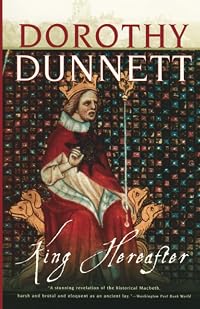
King Hereafter
by Dorothy Dunnett
On This Page
Description
Back in print by popular demand--"A stunning revelation of the historical Macbeth, harsh and brutal and eloquent." --Washington Post Book World. With the same meticulous scholarship and narrative legerdemain she brought to her hugely popular Lymond Chronicles, our foremost historical novelist travels further into the past.nbsp;nbsp;In King Hereafter, Dorothy Dunnett's stage is the wild, half-pagan country of eleventh-century Scotland.nbsp;nbsp;Her hero is an ungainly young earl with a show more lowering brow and a taste for intrigue.nbsp;nbsp;He calls himself Thorfinn but his Christian name is Macbeth. Dunnett depicts Macbeth's transformation from an angry boy who refuses to accept his meager share of the Orkney Islands to a suavely accomplished warrior who seizes an empire with the help of a wife as shrewd and valiant as himself.nbsp;nbsp;She creates characters who are at once wholly creatures of another time yet always recognizable--and she does so with such realism and immediacy that she once more elevates historical fiction into high art. show lessTags
Recommendations




Member Reviews
If George Mackay Brown’s Vinland was the kind of historical novel that uses history to make a statement about the present, then King Hereafter is the kind that attempts to immerse its readers as fully as possible in the past, not just by describing historical events but by trying to recreate the mindset of their chosen period, by making their readers think, feel and see the way their characters did, ideally without having a present point of view intrude on the scene at all. Nobody (at least nobody I have read so far) does this type of historical novel better than Dorothy Dunnett: her novels grab the reader and dunk them up to their eyebrows in the sights, sounds and smells of a distant epoch, barely letting them come up for air. This show more can prove quite challenging for readers who find themselves often called to actually work at understanding what is happening in her novels, retracing an intrigue from casually dropped hints or piecing together hidden conflicts by following up apparently innocuous references. King Hereafter is particularly dense even for Dorothy Dunnett and some parts (like the ecclesiastical factions and their power-games at the beginning of Part 3) proved particularly impenetrable.
In fact, this complete immersion seems to me to achieve for the historical novel what the stream of consciousness technique did for the modernist novel (most famously, James Joyce and Virginia Woolf), namely a radical perspectivism that abstains from all obvious auctorial intervention, leaving readers with no outside frame of reference and forcing them to puzzle things out and construct that frame on their own. Of course, that effect of immediacy – of an individual mind in stream of consciousness, of a historical period in Dunnett’s case – needs to be arranged, requires in fact a great deal of artifice and considerable skill to pull off successfully. And while she might not be quite up with the likes of Joyce and Woolf, Dorothy Dunnett without any doubt deserves to be considered among the greatest historical novelists of the twentieth century.
King Hereafter is somewhat unusual among Dunnett’s novels – for one thing, it is not part of a series but a stand-alone, for another, it is her only novel that has an actual historic figure as its main character. Or possibly two, for the novel has also something like a thesis, namely that Thorfinn, Earl of Orkney was identical with MacBeth, King of Alba (best known from Shakespeare’s play, of course). Apparently, that view is not shared by all historians, but whatever its historical plausibility, Dunnett makes it work for King Hereafter – work on several levels, even. Thorfinn does come across as a convincing, well-rounded character – he does remind one somewhat of Lymond at the start, but I suppose that was unavoidable even though Dorothy Dunnett goes out of her way to make him look different and keeps reminding her readers that he is dark-haired and not particularly good-looking. I would not even put it beyond her that she made the characters intentionally similar, just to then be able to show how they are changed by time and circumstances into two very different people – Thorfinn is changed by being a ruler (this is even one of the themes of the novel) and while the whole of the Lymond saga encompasses only a couple of years, events in King Hereafter span several decades so that we follow Thorfinn as he matures with age.
But even as she merges her two historical originals seamlessly into a single, convincing and fascinating character, there is a split running through King Hereafter – but one that is quite intentional and in fact constitutive for the novel’s basic structure. King Hereafter is divided into four parts, but is really two-part in structure – the first part is about the protagonist’s rise until he becomes secure in his position as King of Alba, the second part describes his rule and eventual downfall; one might say that the first one is about Thorfinn, Earl of Orkney, and the second about MacBeth, King of Alba. At first sight, one might suspect that it is here that the seams where Dunnett stitched her protagonist together become visible, but far from that, for as it turns out the novel is precisely about the movement from small, tribal communities to larger, centralised societies as well as (hardly a coincidence of course) from Pagan polytheism to Christian monotheism. Thorfinn embodies that shift – you really have to read the novel to appreciate just how wonderful a job Dunnett does with this – even though we see him consistently from an outside perspective the novel conveys how he is not so much torn as rather stretched between two epochs and two ways of living, both an earl and a king , a pagan at heart but still trying to come to terms with rising Christendom. And even though it costs him his life, he does in way succeed in the end, achieving the both the opposing goals of managing to keep Orkney an independent earldom while forging Scotland into a kingdom that will endure even after his death. By having its protagonist have a leg in both periods, so to speak, King Hereafter manages to impressively show what is gained and what is lost by the shift from one to the other. And it mirrors it on a formal linguistic level as well – while the first part of the novel is clearly modelled after Icelandic Sagas, telling about heroic deeds and single combat in a language that is both simple but flexible and highly rhythmic, the second part resembles more a historical chronicle, recording diplomatic maneuvers and battles between armies in a language that seems visual rather than verbal, written rather than recited – sound and rhythm being replaced by sight and colour.
I seem to remember reading somewhere that Dunnett herself considered King Hereafter her best work, but I’m inclined to take that as an author’s fondness for her least popular work. As I’m writing this, I have yet to read her House of Niccolo series, but I think overall this novel falls somewhat short of the Lymond Chronicles at their best. King Hereafter certainly has a grander, by far more epic sweep than the earlier series, but precisely because of that lacks somewhat in the fine details that made the Lymond novels stand out so brightly and vividly. Having said that, I hasten to add that King Hereafter is a splendid novel, and worth several dozen minor novels on Vikings, Scotland or medieval history in general. As is usual with Dorothy Dunnett, the novel boasts several unforgettable set pieces, the oar-walking at the beginning alone – breathtakingly exciting and wonderfully exhilarating – is sure to remain in every reader’s memory. I really, really need to start on her Niccolo series soon. show less
In fact, this complete immersion seems to me to achieve for the historical novel what the stream of consciousness technique did for the modernist novel (most famously, James Joyce and Virginia Woolf), namely a radical perspectivism that abstains from all obvious auctorial intervention, leaving readers with no outside frame of reference and forcing them to puzzle things out and construct that frame on their own. Of course, that effect of immediacy – of an individual mind in stream of consciousness, of a historical period in Dunnett’s case – needs to be arranged, requires in fact a great deal of artifice and considerable skill to pull off successfully. And while she might not be quite up with the likes of Joyce and Woolf, Dorothy Dunnett without any doubt deserves to be considered among the greatest historical novelists of the twentieth century.
King Hereafter is somewhat unusual among Dunnett’s novels – for one thing, it is not part of a series but a stand-alone, for another, it is her only novel that has an actual historic figure as its main character. Or possibly two, for the novel has also something like a thesis, namely that Thorfinn, Earl of Orkney was identical with MacBeth, King of Alba (best known from Shakespeare’s play, of course). Apparently, that view is not shared by all historians, but whatever its historical plausibility, Dunnett makes it work for King Hereafter – work on several levels, even. Thorfinn does come across as a convincing, well-rounded character – he does remind one somewhat of Lymond at the start, but I suppose that was unavoidable even though Dorothy Dunnett goes out of her way to make him look different and keeps reminding her readers that he is dark-haired and not particularly good-looking. I would not even put it beyond her that she made the characters intentionally similar, just to then be able to show how they are changed by time and circumstances into two very different people – Thorfinn is changed by being a ruler (this is even one of the themes of the novel) and while the whole of the Lymond saga encompasses only a couple of years, events in King Hereafter span several decades so that we follow Thorfinn as he matures with age.
But even as she merges her two historical originals seamlessly into a single, convincing and fascinating character, there is a split running through King Hereafter – but one that is quite intentional and in fact constitutive for the novel’s basic structure. King Hereafter is divided into four parts, but is really two-part in structure – the first part is about the protagonist’s rise until he becomes secure in his position as King of Alba, the second part describes his rule and eventual downfall; one might say that the first one is about Thorfinn, Earl of Orkney, and the second about MacBeth, King of Alba. At first sight, one might suspect that it is here that the seams where Dunnett stitched her protagonist together become visible, but far from that, for as it turns out the novel is precisely about the movement from small, tribal communities to larger, centralised societies as well as (hardly a coincidence of course) from Pagan polytheism to Christian monotheism. Thorfinn embodies that shift – you really have to read the novel to appreciate just how wonderful a job Dunnett does with this – even though we see him consistently from an outside perspective the novel conveys how he is not so much torn as rather stretched between two epochs and two ways of living, both an earl and a king , a pagan at heart but still trying to come to terms with rising Christendom. And even though it costs him his life, he does in way succeed in the end, achieving the both the opposing goals of managing to keep Orkney an independent earldom while forging Scotland into a kingdom that will endure even after his death. By having its protagonist have a leg in both periods, so to speak, King Hereafter manages to impressively show what is gained and what is lost by the shift from one to the other. And it mirrors it on a formal linguistic level as well – while the first part of the novel is clearly modelled after Icelandic Sagas, telling about heroic deeds and single combat in a language that is both simple but flexible and highly rhythmic, the second part resembles more a historical chronicle, recording diplomatic maneuvers and battles between armies in a language that seems visual rather than verbal, written rather than recited – sound and rhythm being replaced by sight and colour.
I seem to remember reading somewhere that Dunnett herself considered King Hereafter her best work, but I’m inclined to take that as an author’s fondness for her least popular work. As I’m writing this, I have yet to read her House of Niccolo series, but I think overall this novel falls somewhat short of the Lymond Chronicles at their best. King Hereafter certainly has a grander, by far more epic sweep than the earlier series, but precisely because of that lacks somewhat in the fine details that made the Lymond novels stand out so brightly and vividly. Having said that, I hasten to add that King Hereafter is a splendid novel, and worth several dozen minor novels on Vikings, Scotland or medieval history in general. As is usual with Dorothy Dunnett, the novel boasts several unforgettable set pieces, the oar-walking at the beginning alone – breathtakingly exciting and wonderfully exhilarating – is sure to remain in every reader’s memory. I really, really need to start on her Niccolo series soon. show less
Using the perhaps obscure, to people outside of Scotland and Orkney, conceit that the Orkney Earl Thorfinn and the the Scottish King Macbeth (he of the Scottishplay) were one and the same person, Dunnett launches boldly like the Vikings of old on a magnificent epic, challenging in its depth and scope, dense with the tangled undergrowth of family and allegiance and geography and history and politics and strategies and power. The young Thorfinn has interest only in preserving his Earldom, the older Thorfinn, having secured it, becomes King of Alba in spite of himself, and only reluctantly assumes the role, but when he does he commits himself to an ambitious programme of nation-building that will encompass decades of effort, and may not, show more in the end, ever be enough.
Rich with allusions and scraps of learning, heedless of obscurity, it does not resemble the famous play, though there are plenty of references scattered around in the often tart and hilarious dialogue, but does ponder, in brief pauses from the more practical business of marying widows of men you've had killed, and all the fighting and the maneuvering and the wrangling and the general husbandry, how men are remembered long after they are gone, and the thorny questions of legend, symbolism and prophecy. There are battles on land and sea, there is hardly a page without intrigue of some sort, there is romance, and there is an extraordinary pilgrimage across Europe to Rome, all driven by an extraordinary man haunted by the knowledge that he will never know whether he will succeed or not. A tragedy, of course, but it made me laugh out loud no less than three times, and the Scottishplay never managed that.
Listened again. Still epic and heartbreaking, layered with irony. show less
Rich with allusions and scraps of learning, heedless of obscurity, it does not resemble the famous play, though there are plenty of references scattered around in the often tart and hilarious dialogue, but does ponder, in brief pauses from the more practical business of marying widows of men you've had killed, and all the fighting and the maneuvering and the wrangling and the general husbandry, how men are remembered long after they are gone, and the thorny questions of legend, symbolism and prophecy. There are battles on land and sea, there is hardly a page without intrigue of some sort, there is romance, and there is an extraordinary pilgrimage across Europe to Rome, all driven by an extraordinary man haunted by the knowledge that he will never know whether he will succeed or not. A tragedy, of course, but it made me laugh out loud no less than three times, and the Scottishplay never managed that.
Listened again. Still epic and heartbreaking, layered with irony. show less
How do you review a book you’ve lived with for two months, a book you loved at first, a book that let you down? I’ll try, I’ll try ;)
The life of historical Macbeth is quite different from Shakespeare’s version, and I was excited to read a novel about him. The writing hooked me, it felt so right for the times and the characters – there was a cadence of Icelandic sagas in the background, which was lovely. I am not an expert on European history of the 11th century, so there was a lot of fascinating stuff in the book: the end of the Viking Age; the melting-pot of cultures and languages in Northern Europe; kings and queens and earls and bishops and emperors and popes. Let’s not forget the intrigues and the battles (naval battles show more with longships!).
I loved Thorfinn (Macbeth) and Groa his wife. The romance was cringy, to be honest-“I’m treating you abominably, because I am in love with you and I am afraid of loving you.” Sigh.
Their marriage, after”the Macbeths”learned how to relationship, was wonderfully described and made me feel for them both. (My favourite part was Groa ruling her own lands by herself, though.)
My buddy readers disliked the chapters about Thorfinn’s journey to Rome. I think that my fascination with and love for Rome helped in this case. The descriptions were beautiful, despite the political maneuvering that went on and on, chapter after chapter.
“The voices rose, and fresco and mosaic gave them back. Gold sparkled and winked through the mists of burned spices.”
“Below the liquid eyes of the Prophets, among the clear peacock wings of the angels, his men stood behind in the aisles and forgot who they were and where they came from.”
But why the disappointment?
This is a very ambitious book, with a lot of passion for history, and for Scotland’s nation-building. Unfortunately, it means that as the book went on and the author forgot about her editors (if she had them in the first place, which I doubt), there was more and more history and less and less historical fiction. In the meantime, I just wanted “a Dorothy Dunnett novel”, with characters that I would love, hate, despise, admire, root for, cry over. This is what the first four books of the Lymond Chronicles taught me to expect. Nope, it wasn't to be. The characters kept getting flatter and flatter and flatter. They were crushed by the weight of history, I suppose. Ha ha! The endless info dumps made my head swim, my eyes glazed over. I couldn’t tell all the secondary characters and historical figures apart any more.
It’s interesting that history started crushing everything after Rognvald (an amazing character, he was very Dunnett ;) ) disappeared from the book. I’m guessing that it was the end of the Viking age for the other characters, so that they could go about nation-building. This insight doesn’t help me much, the info dumps were still boring and unnecessary. It was frustrating to find flashes of brilliance in there, and imagine what this book could have been like.
The last two chapters were excellent, they made my heart ache. But now what I mostly feel is “Phew. Freedooom! Freedoooom! Freedooooom!” show less
The life of historical Macbeth is quite different from Shakespeare’s version, and I was excited to read a novel about him. The writing hooked me, it felt so right for the times and the characters – there was a cadence of Icelandic sagas in the background, which was lovely. I am not an expert on European history of the 11th century, so there was a lot of fascinating stuff in the book: the end of the Viking Age; the melting-pot of cultures and languages in Northern Europe; kings and queens and earls and bishops and emperors and popes. Let’s not forget the intrigues and the battles (naval battles show more with longships!).
I loved Thorfinn (Macbeth) and Groa his wife. The romance was cringy, to be honest-“I’m treating you abominably, because I am in love with you and I am afraid of loving you.” Sigh.
Their marriage, after”the Macbeths”learned how to relationship, was wonderfully described and made me feel for them both. (My favourite part was Groa ruling her own lands by herself, though.)
My buddy readers disliked the chapters about Thorfinn’s journey to Rome. I think that my fascination with and love for Rome helped in this case. The descriptions were beautiful, despite the political maneuvering that went on and on, chapter after chapter.
“The voices rose, and fresco and mosaic gave them back. Gold sparkled and winked through the mists of burned spices.”
“Below the liquid eyes of the Prophets, among the clear peacock wings of the angels, his men stood behind in the aisles and forgot who they were and where they came from.”
But why the disappointment?
This is a very ambitious book, with a lot of passion for history, and for Scotland’s nation-building. Unfortunately, it means that as the book went on and the author forgot about her editors (if she had them in the first place, which I doubt), there was more and more history and less and less historical fiction. In the meantime, I just wanted “a Dorothy Dunnett novel”, with characters that I would love, hate, despise, admire, root for, cry over. This is what the first four books of the Lymond Chronicles taught me to expect. Nope, it wasn't to be. The characters kept getting flatter and flatter and flatter. They were crushed by the weight of history, I suppose. Ha ha! The endless info dumps made my head swim, my eyes glazed over. I couldn’t tell all the secondary characters and historical figures apart any more.
It’s interesting that history started crushing everything after Rognvald (an amazing character, he was very Dunnett ;) ) disappeared from the book. I’m guessing that it was the end of the Viking age for the other characters, so that they could go about nation-building. This insight doesn’t help me much, the info dumps were still boring and unnecessary. It was frustrating to find flashes of brilliance in there, and imagine what this book could have been like.
The last two chapters were excellent, they made my heart ache. But now what I mostly feel is “Phew. Freedooom! Freedoooom! Freedooooom!” show less
A very odd book. I was enjoying it very much at the beginning, and quite liked Thorfinn, barbaric but clever pagan viking that he was, when suddenly he turned into Francis Crawford of Lymond. Oh well.I wonder, is Dunnett only capable of writing that sort of hypercompetant, ultra-energetic Great Man character, or is it only that she thinks that is the only type of character worth writing about? They make me tired, and I never quite believe in them.But Thorfinn wasn't quite Crawford, for which I was grateful. First, he was wrong occasionally. Several times, in the end, when everything started to go bad. And I liked his stubborn paganness, while at the same time slightly despising his political using of christianity.And Groa. Why on earth, show more if he loved her, did he neglect, avoid, and insult her for five years running? I must be missing something.I liked Thorkel. In some ways he was more heroic than Thorfinn, more to my liking. A little too devoted, like . . . A kickable dog.Were death rates really so high, amongst early-medieval royalty? A wonder anyone wanted to become king, if it meant lisence for all other claimants to burn your house around you, marry your wife on your deathbed and slaughter your family as potential rivals who would do the same in their turn. show less
King Hereafter by Dorothy Dunnett is Lady Dunnett’s exhaustively researched historical novel that postulates that Earl Thorfinn of Orkney and the historical Macbeth were one and the same man. Dunnett reached this conclusion after several years of study of every book she could find on the period (1000 – 1060) as well as source documents found throughout Europe. The novel took six years to complete, and tells the story of the Viking leader of Orkney, Earl Thorfinn, and his eventual rise to power as King of Alba (Scotland). It is also the love story of Thorfinn and his wife Groa.
The story tells of Thorfinn’s consolidation of the Orkney Islands and the northern-most part of the mainland of Scotland, which he inherited from his show more father, and his eventual conquest of most of the rest of current Scotland. Incredible detail of the history of all of Northern Europe is provided throughout the novel. It’s like reading a dwell-written history of the late Dark Ages and includes some of the early history of William the Conqueror, who is still only the Duke of Normandy when this story is set.
The characters in this book are full of the life you would expect from a Dunnett character. I felt as if I could have reached out and touched any one of them. Perhaps that could be counted as a flaw, since I don’t believe we would have much in common with a person living at that time in Europe, since they were probably very different from us psychologically. However, one feels a great deal of sympathy with the characters and this made the book very easy to read. Thorfinn and Groa are the main characters, but all of the secondary characters are great, too. It’s a little hard to keep track of all of them at first, but I found it easier as the book went along and I got to know them better.
King Hereafter was written after Dunnett completed the Lymond Chronicles and her plotting skills are well advanced here. She uses a lot of the same elements from her other historical novels, to include the betrayals and extreme loyalties of dear friends, a growing love between the two main characters, well choreographed action sequences, and breath-taking scenic descriptions. It contains all the nuanced delight in language of Dunnett’s other books.
Overall, this book is Dunnett’s masterpiece. I savored every word and hope to have time to read it again someday. I like the Lymond Chronicles best of all of Dunnett’s books, but this is an amazing work of scholarship disguised as a great novel. show less
The story tells of Thorfinn’s consolidation of the Orkney Islands and the northern-most part of the mainland of Scotland, which he inherited from his show more father, and his eventual conquest of most of the rest of current Scotland. Incredible detail of the history of all of Northern Europe is provided throughout the novel. It’s like reading a dwell-written history of the late Dark Ages and includes some of the early history of William the Conqueror, who is still only the Duke of Normandy when this story is set.
The characters in this book are full of the life you would expect from a Dunnett character. I felt as if I could have reached out and touched any one of them. Perhaps that could be counted as a flaw, since I don’t believe we would have much in common with a person living at that time in Europe, since they were probably very different from us psychologically. However, one feels a great deal of sympathy with the characters and this made the book very easy to read. Thorfinn and Groa are the main characters, but all of the secondary characters are great, too. It’s a little hard to keep track of all of them at first, but I found it easier as the book went along and I got to know them better.
King Hereafter was written after Dunnett completed the Lymond Chronicles and her plotting skills are well advanced here. She uses a lot of the same elements from her other historical novels, to include the betrayals and extreme loyalties of dear friends, a growing love between the two main characters, well choreographed action sequences, and breath-taking scenic descriptions. It contains all the nuanced delight in language of Dunnett’s other books.
Overall, this book is Dunnett’s masterpiece. I savored every word and hope to have time to read it again someday. I like the Lymond Chronicles best of all of Dunnett’s books, but this is an amazing work of scholarship disguised as a great novel. show less
King Hereafter is the story of Macbeth, king of Alba. That’s right, Macbeth of the three witches, Birnam Wood, and “Is this a dagger I see before me?” Except that Dunnett’s version of this man has very little in common with Shakespeare’s ambitious murderer.
Dunnett’s version of this 11th-century king is actually the same man as Thorfinn, the Earl of Orkney. I know next to nothing about the history of this period, but I understand that she arrived at this conclusion after doing extensive research into the period. I can’t speak to the likelihood of her being correct, but I can tell you that her version of the man is an exciting figure whose story took my breath away when I first delved into it years ago.
Even better is show more Dunnett’s version of Lady Macbeth, Groa, a Norwegian beauty previously wed to one of Macbeth’s political rivals, Gillacomghain of Moray. Thorfinn initially takes Groa as a war prize after he defeats Gillacomghain, but she soon becomes a full partner of his mind and his heart. The scenes between the two of them are the heart and soul of the novel. Although I love this relationship, and it’s the thing that stands out most clearly from my first reading of the book, I don’t want to give the idea that this is a historical romance. Far from it. Political machinations, battle plans, and religious transformations also get ample page time.
As much as I love this book, I must warn potential readers that it can be hard going. In fact, on this second read I found myself wondering several times in the early chapters why I loved it so much on the first read. Aside from a rip-roaring footrace along the oars of a longboat, I didn’t find much to excite me in the first 200 pages, and at times I felt utterly lost. Dunnett just throws readers into this entirely new and alien world of 11th-century Scotland without much in the way of help. I have learned with Dunnett that sometimes the best thing to do is to figure out who the central figures are and just worry about them.
So with this in mind, I read on, and at about page 200, it clicked. I remembered what I loved so much, and I started to see patterns that I hadn’t noticed on the first read, when the close relationships were my main interest. Not every section is equally interesting, and there are plenty of things I still don’t quite get, but I think that’s a testimony to the richness of Dunnett’s narrative, rather than to any muddiness in the storytelling.
See my complete review at Shelf Love. show less
Dunnett’s version of this 11th-century king is actually the same man as Thorfinn, the Earl of Orkney. I know next to nothing about the history of this period, but I understand that she arrived at this conclusion after doing extensive research into the period. I can’t speak to the likelihood of her being correct, but I can tell you that her version of the man is an exciting figure whose story took my breath away when I first delved into it years ago.
Even better is show more Dunnett’s version of Lady Macbeth, Groa, a Norwegian beauty previously wed to one of Macbeth’s political rivals, Gillacomghain of Moray. Thorfinn initially takes Groa as a war prize after he defeats Gillacomghain, but she soon becomes a full partner of his mind and his heart. The scenes between the two of them are the heart and soul of the novel. Although I love this relationship, and it’s the thing that stands out most clearly from my first reading of the book, I don’t want to give the idea that this is a historical romance. Far from it. Political machinations, battle plans, and religious transformations also get ample page time.
As much as I love this book, I must warn potential readers that it can be hard going. In fact, on this second read I found myself wondering several times in the early chapters why I loved it so much on the first read. Aside from a rip-roaring footrace along the oars of a longboat, I didn’t find much to excite me in the first 200 pages, and at times I felt utterly lost. Dunnett just throws readers into this entirely new and alien world of 11th-century Scotland without much in the way of help. I have learned with Dunnett that sometimes the best thing to do is to figure out who the central figures are and just worry about them.
So with this in mind, I read on, and at about page 200, it clicked. I remembered what I loved so much, and I started to see patterns that I hadn’t noticed on the first read, when the close relationships were my main interest. Not every section is equally interesting, and there are plenty of things I still don’t quite get, but I think that’s a testimony to the richness of Dunnett’s narrative, rather than to any muddiness in the storytelling.
See my complete review at Shelf Love. show less
This doorstopper tome of a novel is the story of the Earl (and, yes, King later) Thorfinn of Orkney. It suggests that Thorfinn was in fact the historical character we know of as Macbeth. The story takes place in roughly 1050 AD in what we would call Scotland, which was known as Moray, Caithness, Orkney, and (a bit later) Alba.
This is definitely literary historical fiction. I had mixed feelings upon reaching the conclusion (which, reading every night, still took over a month to do!). On the positive side, several of the characters, most notably Thorfinn himself, are well-portrayed, interesting and complex. Thorfinn is analytical, moody, and tends to be cold emotionally (though this latter changes a bit as the story opens up). The show more analysis of 11th century politics is deep, complex, and probably very accurate. The plot is anything but straightforward. There's a lot of depth here, which serious readers will like. King Hereafter could easily be characterized as "deep reading". For these readers, this might well be a 5-star read.
On the flip side, well, there might be rather TOO much depth for many. There are pages (and pages and pages) of description of political plotting and obscure genealogical points, which the plot often hinges upon. By the time I'd reached the book's halfway point I felt very weary of reading political analysis. Also, battles are most often rendered with a few simple sentences, rather than getting into the thick of things. (Though there are a few exceptions, notably the last 20% or so of the book.) Coming at 11th century English historical fiction from more of a Bernard Cornwell type POV, this was hard to adjust to. In short, this is far from a "real page-turner".
In summary, those looking for some serious literary historical fiction may well enjoy sinking their teeth into this. Those looking for something a bit easier to dip into, or detailed descriptions of medieval warfare, should probably look elsewhere. show less
This is definitely literary historical fiction. I had mixed feelings upon reaching the conclusion (which, reading every night, still took over a month to do!). On the positive side, several of the characters, most notably Thorfinn himself, are well-portrayed, interesting and complex. Thorfinn is analytical, moody, and tends to be cold emotionally (though this latter changes a bit as the story opens up). The show more analysis of 11th century politics is deep, complex, and probably very accurate. The plot is anything but straightforward. There's a lot of depth here, which serious readers will like. King Hereafter could easily be characterized as "deep reading". For these readers, this might well be a 5-star read.
On the flip side, well, there might be rather TOO much depth for many. There are pages (and pages and pages) of description of political plotting and obscure genealogical points, which the plot often hinges upon. By the time I'd reached the book's halfway point I felt very weary of reading political analysis. Also, battles are most often rendered with a few simple sentences, rather than getting into the thick of things. (Though there are a few exceptions, notably the last 20% or so of the book.) Coming at 11th century English historical fiction from more of a Bernard Cornwell type POV, this was hard to adjust to. In short, this is far from a "real page-turner".
In summary, those looking for some serious literary historical fiction may well enjoy sinking their teeth into this. Those looking for something a bit easier to dip into, or detailed descriptions of medieval warfare, should probably look elsewhere. show less
Members
- Recently Added By
Lists

Best Historical Fiction
620 works; 262 members

Best Contemporary Literary Fiction (Around the Last 30 Years)
400 works; 124 members

Recommend the 20 best books you've read in the last five years
2,168 works; 609 members

Top Five Books of 2022
736 works; 272 members

Shakespeare Quote Titles
112 works; 12 members
Books That Made Us Cry
278 works; 145 members
Author Information

35+ Works 18,123 Members
Dorothy Dunnett was born on August 25, 1923 in Dunfermline, Fife, Scotland. She attended Gillespie's High School for Girls. After graduation she attended Edinburgh College of Art, and transferred, upon her marriage, to Glasgow School of Art. From 1940-1955, she worked for the Civil Service as a press officer. Her first novel, The Game of Kings, show more was published in the United States in 1961 and in the United Kingdom the year after. During her lifetime, she wrote over 20 books including King Hereafter, the six-part Lymond Chronicles, and the eight-part House of Niccolo series. She was also a professional portrait painter and exhibited at the Royal Scottish Academy. In 1992 she was awarded the Office of the British Empire for services to literature. She died from cancer on November 9, 2001 at the age of 78. (Bowker Author Biography) show less
Some Editions
Awards and Honors
Awards
Notable Lists
Common Knowledge
- Canonical title
- King Hereafter
- Original publication date
- 1982-05
- People/Characters
- Macbeth; Duncan
- Important places
- Scotland, UK
- Epigraph
- Wealth dies.
Kinsmen die.
A man himself must likewise die.
But word-fame
Never dies
For him who achieves it well.
Wealth dies.
Kinsmen die.
A man himself must likewise die.
But one thing I know... (show all)
That never dies--
The verdict on each man dead.
(Hávamál) - First words
- When the year one thousand came, Thorkel Amundason was five years old, and hardly noticed how frightened everyone was.
- Last words
- (Click to show. Warning: May contain spoilers.)'Of course,' she said; and, rising, walked out at his side, and faced her stricken peoples, and saw the hope and the pity born together once more in their eyes.
Classifications
Statistics
- Members
- 873
- Popularity
- 31,202
- Reviews
- 23
- Rating
- (4.20)
- Languages
- English
- Media
- Paper, Audiobook, Ebook
- ISBNs
- 11
- ASINs
- 7