On This Page
Description
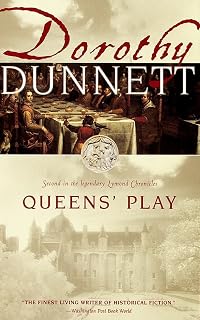
This second book in the legendary Lymond Chronicles follows Francis Crawford of Lymond who has been abruptly called into the service of Mary Queen of Scots. Though she is only a little girl, the Queen is already the object of malicious intrigues that extend from her native country to the court of France. It is to France that Lymond must travel, exercising his sword hand and his agile wit while also undertaking the most unlikely of masquerades, all to make sure that his charge's royal show more person stays intact. show lessTags
Recommendations

Member Recommendations
Member Reviews
Here we go again. Hello, Lymond. So, you are going to France? I smell intrigues, entertainment, and a great deal of heartbreak.
It is lovely and refreshing how different this novel is from The Game of Kings. The prose style is as intricate and intellectually surprising as in the first book, but lighter in architecture. The sheer compelling readability of Queen’s Play brought me joy, and my five stars reflect this; it is also an attempt to forgive the faults that are unquestionably there.
The beginning has the feel of a picaresque novel, with comic relief galore (I was having a blast). But the experienced reader of Lymond will know that there are darker undercurrents just waiting to burst forth.
We are swimming in a sea of intrigues, show more where nothing is what it seems. Lymond’s disguise was preposterous, unbelievable, and provocative. But it worked in this book’s universe. I was going to rant about a couple of incongruities, but then Dunnett explained those away (a shame: I had prepared a good rant). Anyway, the French Court deserves to be given the finger, and Lymond does it brilliantly.
“Then, the goal reached, he hardened his long fingers in their entrails of icing and sugar and began to twist.”
“Lymond’s behaviour, as always, went to the limits of polite usage and then hurtled off into space.” :D
My adrenaline levels were off the chart throughout. The royal hunt! Assassination attempts! The rooftop steeplechase (I loved it)! Innovative uses of circus elephants! And so on and so forth…
The darker things are becoming quite a crowd, as the plot thickens. People are used and puppeteered. People are circling each other, influencing, bruising, and changing each other in subtle and tragic ways.
Oonagh’s storyline is one of the book’s biggest faults. She is something of a Milady cliché, only without the charm and with less sense. Why is O’LiamRoe so smitten, I keep wondering? (Here is a wonderful person with a great story arc, I wish him every good thing in the world!) To be fair, she is also bound to a horrible abusive “relationship” that she justifies with her great cause. (Stockholm syndrome detected.) It is annoying in the extremehow Dunnett uses that misogynic plot device that assumes that in order to be freed/to start mending her ways a woman just needs some good time in the sack. Gaaaah.
Another fault is racial/ethnic stereotyping that rubbed me the wrong way. Piedar Dooly is a stupid asshole, but he could have been that without being “trapped in his passionate Irish soul.” Come on!
Yet, ultimately, this book is about realizing that you are responsible for other people, always. You are responsible for everyone you influence, no matter how little or how greatly.
“The issue is that Francis Crawford set out to capture the mind of this man, and having used it, dismissed it as one of his whores.”
I loved O’LiamRoe so much when he lectured Lymond:
“And that is what leadership means. It means fortifying the fainthearted and giving them the two sides of your tongue while you are at it. It means suffering weak love and schooling it till it matures. It means giving up your privacies, your follies and your leisure. It means you can love nothing and no one too much, or you are no longer a leader, you are the led.”
I feel somewhat deprived after finishing this. I know, I know, there are four more books. Still, I find it difficult to let go. show less
It is lovely and refreshing how different this novel is from The Game of Kings. The prose style is as intricate and intellectually surprising as in the first book, but lighter in architecture. The sheer compelling readability of Queen’s Play brought me joy, and my five stars reflect this; it is also an attempt to forgive the faults that are unquestionably there.
The beginning has the feel of a picaresque novel, with comic relief galore (I was having a blast). But the experienced reader of Lymond will know that there are darker undercurrents just waiting to burst forth.
We are swimming in a sea of intrigues, show more where nothing is what it seems. Lymond’s disguise was preposterous, unbelievable, and provocative. But it worked in this book’s universe. I was going to rant about a couple of incongruities, but then Dunnett explained those away (a shame: I had prepared a good rant). Anyway, the French Court deserves to be given the finger, and Lymond does it brilliantly.
“Then, the goal reached, he hardened his long fingers in their entrails of icing and sugar and began to twist.”
“Lymond’s behaviour, as always, went to the limits of polite usage and then hurtled off into space.” :D
My adrenaline levels were off the chart throughout. The royal hunt! Assassination attempts! The rooftop steeplechase (I loved it)! Innovative uses of circus elephants! And so on and so forth…
The darker things are becoming quite a crowd, as the plot thickens. People are used and puppeteered. People are circling each other, influencing, bruising, and changing each other in subtle and tragic ways.
Oonagh’s storyline is one of the book’s biggest faults. She is something of a Milady cliché, only without the charm and with less sense. Why is O’LiamRoe so smitten, I keep wondering? (Here is a wonderful person with a great story arc, I wish him every good thing in the world!) To be fair, she is also bound to a horrible abusive “relationship” that she justifies with her great cause. (Stockholm syndrome detected.) It is annoying in the extreme
Another fault is racial/ethnic stereotyping that rubbed me the wrong way. Piedar Dooly is a stupid asshole, but he could have been that without being “trapped in his passionate Irish soul.” Come on!
Yet, ultimately, this book is about realizing that you are responsible for other people, always. You are responsible for everyone you influence, no matter how little or how greatly.
“The issue is that Francis Crawford set out to capture the mind of this man, and having used it, dismissed it as one of his whores.”
I loved O’LiamRoe so much when he lectured Lymond:
“And that is what leadership means. It means fortifying the fainthearted and giving them the two sides of your tongue while you are at it. It means suffering weak love and schooling it till it matures. It means giving up your privacies, your follies and your leisure. It means you can love nothing and no one too much, or you are no longer a leader, you are the led.”
I feel somewhat deprived after finishing this. I know, I know, there are four more books. Still, I find it difficult to let go. show less
Queen's Play deepened my belief that Dunnett was writing the Lymond Chronicles just for me. Because not only did it have the same wonderful dialogue and attention to historical detail, the same wit and Byzantine plotting as The Game of Kings, this one had Irish characters. Or, to be more specific, it had Phelim O'LiamRoe, who just happens to be Prince of the exact part of Ireland I come from. My tiny, historically unimportant part of Ireland.
I think Trin can attest to the 'oh my god for serious?' text message she received when I reached that part of the novel. Dunnett's attention to detail is so good that I literally read the first couple of the O'LiamRoe's titles, and thought 'hey, that must mean that he's related to my clans'; the show more fact that he then turned out to be the Prince of the Slieve Blooms wasn't so surprising, though it still did make me shriek with glee. She did, admittedly, mess up the vocative case for those occasional times she used Irish; but I think I can forgive her for it, especially considering the fact that the difference in stress between Irish and Scots Gaelic was actually an element in this at one point. The stresses are one of the ways in which you can tell whether or not an Irish speaker is a native or not, but that's such a rare thing to pick up on.
Now, of course, it's just a matter of tracking down the next volume in the series. I still can't understand why the first volume is in print, and the fourth, but none of the rest. show less
I think Trin can attest to the 'oh my god for serious?' text message she received when I reached that part of the novel. Dunnett's attention to detail is so good that I literally read the first couple of the O'LiamRoe's titles, and thought 'hey, that must mean that he's related to my clans'; the show more fact that he then turned out to be the Prince of the Slieve Blooms wasn't so surprising, though it still did make me shriek with glee. She did, admittedly, mess up the vocative case for those occasional times she used Irish; but I think I can forgive her for it, especially considering the fact that the difference in stress between Irish and Scots Gaelic was actually an element in this at one point. The stresses are one of the ways in which you can tell whether or not an Irish speaker is a native or not, but that's such a rare thing to pick up on.
Now, of course, it's just a matter of tracking down the next volume in the series. I still can't understand why the first volume is in print, and the fourth, but none of the rest. show less
It took me an entire week to negotiate this installment of the Lymond Chronicles, as I am almost entirely occupied with writing my PhD thesis at the moment. It made a very pleasant respite, though. As with the previous book, Lymond spent a great deal of time disguised, foiled plots, enthralled men, women, children, and exotic animals, and narrowly escaped death (in this case by fire, poison, debauchery, horse-related misadventure, elephant-related misadventure, explosion, and execution by breaking on a wheel, not to mention various fights). The majority of events take place in France, at the dissolute court of King Henri. I found this locale somewhat less pleasant and more oppressive than Scotland’s moors and castles, so did not enjoy show more 'Queens’ Play' quite as much as [b:The Game of Kings|112077|The Game of Kings (The Lymond Chronicles, #1)|Dorothy Dunnett|https://images.gr-assets.com/books/1342486295s/112077.jpg|2219130]. Nonetheless, Lymond continues to be an enthralling and irresistible character, with apparently endless convenient talents. His misadventures are wonderfully melodramatic and intermittently farcical. Perhaps my favourite moment was the rooftop race, or the wonderful business in the illegal press. The amazingly florid seduction scene also greatly amused me - 'His hands searched her, touching her passions one by one and shaping with his musician's fingers the growing, thunderous chord,' indeed! show less
“For those of easy tongues, she said. Remember, some live all their lives without discovering this truth; that the noblest and most terrible power we possess is the power we have, each of us, over the chance-met, the stranger, the passer-by outside your life and your kin. Speak, she said, as you would write: as if your words were letters of lead, graven there for all time, for which you must take the consequences. And take the consequences.”
O’LiamRoe, an Irish minor noble, is speaking here, paraphrasing to the protagonist, Francis Coulter (Lymond) the words of Margaret Erskine (nee Fleming), a member of the Dowager Queen of Scotland’s train. That message struck home so hard I had to stop reading and think about it for several show more minutes. What does it say in the modern age, that a book written 50 or more years ago, about a time frame more than 400 years ago, should be so applicable to our leaders today?
This novel, the second of the Lymond Chronicles, was set in the French court of Henri II (mostly – there are parts that take place in England as well). The court travels around the country, which provides natural sections to the book named after the locations – Rouen, St. Germaine, Bloix, Aubigny, Chateaubriant. (There is also a section in the middle where Lymond and O'LiamRoe spend some time in London.)
In a way, this book was much easier for me than the first book in the series (which is set almost entirely in Scotland), as the court was familiar to me - this is the court chronicled in the first French novel, The Princess of Cleves, by Mme de Lafayette, which was also one of the first non-abridged works I ever read in the French language, right before college. The amount of ceremony and the many factions (“partis” - of the Queen, the King’s mistress the Duchess de Valentinois, the King’s own loyalists who he rewarded or released upon his accession, the De Guises, and many others) are realistically drawn, engaging and fascinating.
There is a hunting scene that I think an epic poem could be based on. Descriptions just to die for! "Earth and animals wore the same livery. Jazerained in its berries, the oak tree matched their pearls, and paired their brilliant-sewn housings with low mosses underfoot, freshets winking half-ice in the pile."
Each chapter starts with an epigram from the ancient Irish Brehon laws. I found these epigrams really added a lot to my enjoyment of the novel. They usually had a tangential but clear application to the theme of their chapter (as a single example, a chapter centered on the Irish beauty Oonaugh O’Dwyer had an epigram about the medieval assumptions about women’s consent).
Lymond grows a great deal in this book, and O’LiamRoe is one of my favorite characters of any book I've read in the past ten years or more. Other characters were memorable as well. If you enjoy intricate, ever-changing characters, you should read this book, and probably the entire series, on the strength of the character development alone. But more than that, this series is a truly great way to get an idea of how dynamic statecraft during the Renaissance really was.
Very highly recommended. show less
O’LiamRoe, an Irish minor noble, is speaking here, paraphrasing to the protagonist, Francis Coulter (Lymond) the words of Margaret Erskine (nee Fleming), a member of the Dowager Queen of Scotland’s train. That message struck home so hard I had to stop reading and think about it for several show more minutes. What does it say in the modern age, that a book written 50 or more years ago, about a time frame more than 400 years ago, should be so applicable to our leaders today?
This novel, the second of the Lymond Chronicles, was set in the French court of Henri II (mostly – there are parts that take place in England as well). The court travels around the country, which provides natural sections to the book named after the locations – Rouen, St. Germaine, Bloix, Aubigny, Chateaubriant. (There is also a section in the middle where Lymond and O'LiamRoe spend some time in London.)
In a way, this book was much easier for me than the first book in the series (which is set almost entirely in Scotland), as the court was familiar to me - this is the court chronicled in the first French novel, The Princess of Cleves, by Mme de Lafayette, which was also one of the first non-abridged works I ever read in the French language, right before college. The amount of ceremony and the many factions (“partis” - of the Queen, the King’s mistress the Duchess de Valentinois, the King’s own loyalists who he rewarded or released upon his accession, the De Guises, and many others) are realistically drawn, engaging and fascinating.
There is a hunting scene that I think an epic poem could be based on. Descriptions just to die for! "Earth and animals wore the same livery. Jazerained in its berries, the oak tree matched their pearls, and paired their brilliant-sewn housings with low mosses underfoot, freshets winking half-ice in the pile."
Each chapter starts with an epigram from the ancient Irish Brehon laws. I found these epigrams really added a lot to my enjoyment of the novel. They usually had a tangential but clear application to the theme of their chapter (as a single example, a chapter centered on the Irish beauty Oonaugh O’Dwyer had an epigram about the medieval assumptions about women’s consent).
Lymond grows a great deal in this book, and O’LiamRoe is one of my favorite characters of any book I've read in the past ten years or more. Other characters were memorable as well. If you enjoy intricate, ever-changing characters, you should read this book, and probably the entire series, on the strength of the character development alone. But more than that, this series is a truly great way to get an idea of how dynamic statecraft during the Renaissance really was.
Very highly recommended. show less
In 1550, Francis Crawford of Lymond arrives in France, incognito, to protect Scotland’s queen, seven-year-old Mary.
I enjoyed this, even though I am not very interested in the antics of the French court and I thought that The Game of Kings benefited from having more characters who I found wholly likeable and/or who matter, personally, to Lymond.
Dunnett is an impressive storyteller -- vivid descriptions, lively dialogue, nuanced characters and twists that take me by surprise. Moreover, those satisfying puzzle pieces explain the plots and intrigue, give insight into personalities and develop the narrative’s themes (here, the consequences of power).
“What, in the event, did Margaret Erskine say? Now, if ever, seems the time to tell show more me.”
O’LiamRoe looked up, sweat spilled in the soft cup of his throat. “Ah, dhia... Have I not attacked you enough? It was a piece of advice only, and aimed at myself as much, I suppose, as at you.—For those of easy tongues, she said. Remember, some live all their lives without discovering this truth; that the noblest and most terrible power we possess is the power we have, each of us, over the chance-met, the stranger, the passer-by outside your life and your kin. Speak, she said, as you would write: as if your words were letters of lead, graven there for all time, for which you must take the consequences. And take the consequences.” show less
I enjoyed this, even though I am not very interested in the antics of the French court and I thought that The Game of Kings benefited from having more characters who I found wholly likeable and/or who matter, personally, to Lymond.
Dunnett is an impressive storyteller -- vivid descriptions, lively dialogue, nuanced characters and twists that take me by surprise. Moreover, those satisfying puzzle pieces explain the plots and intrigue, give insight into personalities and develop the narrative’s themes (here, the consequences of power).
“What, in the event, did Margaret Erskine say? Now, if ever, seems the time to tell show more me.”
O’LiamRoe looked up, sweat spilled in the soft cup of his throat. “Ah, dhia... Have I not attacked you enough? It was a piece of advice only, and aimed at myself as much, I suppose, as at you.—For those of easy tongues, she said. Remember, some live all their lives without discovering this truth; that the noblest and most terrible power we possess is the power we have, each of us, over the chance-met, the stranger, the passer-by outside your life and your kin. Speak, she said, as you would write: as if your words were letters of lead, graven there for all time, for which you must take the consequences. And take the consequences.” show less
In 1550, Mary Queen of Scots was just 8 years old and living with the Queen Mother at the court of France’s King Henri II. She was betrothed to the the King’s eldest son Francis to unite France and Scotland under Henri. However, the political landscape was quite volatile. Scotland and England had been at cross purposes for some time, and England was actively seeking to control Ireland. France had a similar desire to expand their realm; in 1550 France and England were in the midst of negotiating peace. In the midst of all this political maneuvering, there were factions who wanted to remove Mary from the Scottish throne.
Concerned for Mary’s safety, her mother engages Francis Lymond to come to the French court specifically to show more protect Mary. Lymond, disguised as the secretary to an Irish prince, uncovers a plot to poison Mary. His efforts to foil the plot and bring the perpetrators to justice unfold over more than 500 pages. As with the previous book, there’s a huge cast of characters, and enough plot twists to make your head spin. And just when you think you’re figuring things out, the good guys turn out to be bad guys or vice versa.
I enjoyed this book, but found it dragged a bit compared to the first novel. Lymond identified the man behind the poison plot pretty quickly, and the chase took too long, with a diversion to go after his accomplice. But I’m enjoying the history, and the way Dunnett places her characters in the middle of actual events, so I’ll be reading the third book soon. show less
Concerned for Mary’s safety, her mother engages Francis Lymond to come to the French court specifically to show more protect Mary. Lymond, disguised as the secretary to an Irish prince, uncovers a plot to poison Mary. His efforts to foil the plot and bring the perpetrators to justice unfold over more than 500 pages. As with the previous book, there’s a huge cast of characters, and enough plot twists to make your head spin. And just when you think you’re figuring things out, the good guys turn out to be bad guys or vice versa.
I enjoyed this book, but found it dragged a bit compared to the first novel. Lymond identified the man behind the poison plot pretty quickly, and the chase took too long, with a diversion to go after his accomplice. But I’m enjoying the history, and the way Dunnett places her characters in the middle of actual events, so I’ll be reading the third book soon. show less
After the riotous, roisterous introduction to Lymond and his family struggles, his personal goals seemingly take a back seat as he takes a commission from the Queen Dowager to protect the young Queen Mary at the court of her French fiancé.
I love the split personalities of Lymond the austere and his seemingly carefree slovenly alter-ego. And the set pieces in this book glitter so brightly, even the darkest ones, so many personal journeys on the way, and the rawest of all at Robin Stewarts cottage at the end hardening Lymond's character for the future.
I love the split personalities of Lymond the austere and his seemingly carefree slovenly alter-ego. And the set pieces in this book glitter so brightly, even the darkest ones, so many personal journeys on the way, and the rawest of all at Robin Stewarts cottage at the end hardening Lymond's character for the future.
Members
- Recently Added By
Lists

Books Read in 2016
4,666 works; 199 members
Author Information

35+ Works 18,124 Members
Dorothy Dunnett was born on August 25, 1923 in Dunfermline, Fife, Scotland. She attended Gillespie's High School for Girls. After graduation she attended Edinburgh College of Art, and transferred, upon her marriage, to Glasgow School of Art. From 1940-1955, she worked for the Civil Service as a press officer. Her first novel, The Game of Kings, show more was published in the United States in 1961 and in the United Kingdom the year after. During her lifetime, she wrote over 20 books including King Hereafter, the six-part Lymond Chronicles, and the eight-part House of Niccolo series. She was also a professional portrait painter and exhibited at the Royal Scottish Academy. In 1992 she was awarded the Office of the British Empire for services to literature. She died from cancer on November 9, 2001 at the age of 78. (Bowker Author Biography) show less
Some Editions
Series

Work Relationships
Is contained in
Contains
Has as a reference guide/companion
Common Knowledge
- Canonical title
- Queens' Play
- Original publication date
- 1964
- People/Characters
- Francis Crawford of Lymond and Sevigny; Thady Boy Ballagh; Marie de Guise; Mary, Queen of Scots; Catherine de Medici; Richard Crawford, Baron Culter (show all 15); Phelim O'Liam Roe; Margaret Lennox; Robin Stewart; Henri II, King of France (1519-1559); Oonagh O'Dwyer; Archie Abernethy; Jenny Fleming; George Douglas; Cormac O'Connor
- Important places
- France; Rouen, Seine-Maritime, Normandy, France; Blois, Indre-et-Loire, Centre-Val de Loire, France
- Dedication
- Dedicated, for their passing entertainment, to the Dunnetts, who are stuck with reading it, anyway: George Sinclair Dunnett, Alastair Mactavish Dunnett, Doris Macnicol Dunnett Paterson
- First words
- She wanted Crawford of Lymond.
- Last words
- (Click to show. Warning: May contain spoilers.)'… Mair nor ye daur come and see.'
Classifications
Statistics
- Members
- 1,503
- Popularity
- 15,490
- Reviews
- 31
- Rating
- (4.34)
- Languages
- English, French, German, Italian
- Media
- Paper, Audiobook, Ebook
- ISBNs
- 33
- ASINs
- 12