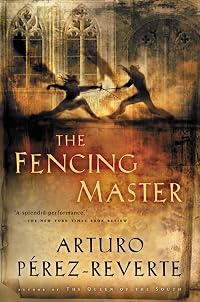
The Fencing Master
by Arturo Pérez-Reverte
On This Page
Description
The unstoppable thrust is the arcane fencing technique known only by Don Jaime--and the deadly maneuver that a beautiful young woman wants him to teach her.What begins as a rather bold request leads Don Jaime into the shadowy politics and violence of mid-nineteenth-century Madrid.Tags
Recommendations

















Member Recommendations

nessreader Fencing Master is about a woman who learns to use the foil: That Lady is about an older woman, scarred in an old fight, who suffers the fallout of passion. Both set in Spain, both literary melodramas, both brilliant.
Member Reviews
This is a standalone crime story set in Madrid in the torrid summer of 1868 (or 1968, as whoever wrote the the dust-jacket copy for the Spanish first printing seems to believe!), with support for Isabella II crumbling and talk of revolution everywhere. Unmoved in the middle of all the upheaval is the upright and somewhat hidebound middle-aged fencing-master Jaime Astarloa, who is far less interested in politics than in the theory and traditions of his art. He has nothing but contempt for those who are trying to turn fencing into a sport, rather than a skill true gentlemen have to learn for those (hopefully rare) occasions when they are obliged by honour and decency to kill each other.
Needless to say, Don Jaime is horrified when a young show more woman asks to be taken on for a course of advanced lessons, but of course she manages to convince him that she is no dilettante, he agrees to teach her, and before long he's hopelessly in love, and embroiled in a complex affair of murder, blackmail and betrayal...
Lots of 19th century Madrid atmosphere, some enjoyably caustic Pérez-Reverte comments on the political situation, and a lot of very technical descriptions of sword fights, with and without buttons on the ends of the foils. And even a bit of Errol Flynn-style jumping off roofs. Fun, and a nice study of a man at the end of his professional career, and of the impossibility of being honourable in a dishonourable society. show less
Needless to say, Don Jaime is horrified when a young show more woman asks to be taken on for a course of advanced lessons, but of course she manages to convince him that she is no dilettante, he agrees to teach her, and before long he's hopelessly in love, and embroiled in a complex affair of murder, blackmail and betrayal...
Lots of 19th century Madrid atmosphere, some enjoyably caustic Pérez-Reverte comments on the political situation, and a lot of very technical descriptions of sword fights, with and without buttons on the ends of the foils. And even a bit of Errol Flynn-style jumping off roofs. Fun, and a nice study of a man at the end of his professional career, and of the impossibility of being honourable in a dishonourable society. show less
Set in 1860's in Spain, in the eve of what is to be known as Glorious Revolution this book tells a story about a man so much out of time he lives in that it almost cost him dearly.
Don Jaime is a man I fully understand and can relate to - professional, working as renowned fencing master (in times when fencing starts to be treated more like a sport than serious skill that can save ones life) he is as far away from everyday political life and events that he might as well live in parallel world. Only contact with the outside world is through his friends in a local bar - mix of characters that so much echo people from world over (and across ages) in time of crisis - they are all experts and they are the only ones that know the ultimate show more truth.
So when his life routine gets interrupted by visitation from a beautiful and enigmatic girl Don Jaime finds himself in very strange place. On one hand he is attracted to this woman but he is also acutely aware that his age (mid 50's) ensures nothing can happen here. On the other hand girl is more than capable fencer and Don Jaime gets excited because he finally gets a student that he feels he can teach his more advanced techniques. And then one day girl asks him about one of his students, local baron, and as sudden as she entered Don Jaime's life she leaves it.
What happens next is such a good detective/crime/revenge story that it got me glued to the very end. I wont go into details here because I do not want to ruin experience for others.
Characters are given so vividly - starting from the group in the bar, bartender well versed into current state of affairs and bored by once-upon-a-time-priest, now revolutionary journalist, music teacher that struggles from day to day and finally member of lower nobility, loud supporter of monarchy. Very character of Don Jaime is excellent - man who found his calling as a sword master in Paris, man living only in professional sense, without wife and kids, totally devoted to his work and students and total unknown to everyone around him. He is so disgusted by the politics of the moment that he just ignores what happens around him - if it is not work he is not interested in it. Because of this he is considered something of a weirdo and thought of as a little bit .... naive and stupid would be the correct phrase I guess. One could feel bad for Don Jaime, but in the end he chose this monk style of life and came to peace with it.
But what a surprise is there for the people coming for Don Jaime - this is a book that shows what happens when person is underestimated. Always beware the wrath of the quiet man.
Author's style is pure joy. Once I started reading the book I could not stop 'til the end.
Excellent book, highly recommended. show less
Don Jaime is a man I fully understand and can relate to - professional, working as renowned fencing master (in times when fencing starts to be treated more like a sport than serious skill that can save ones life) he is as far away from everyday political life and events that he might as well live in parallel world. Only contact with the outside world is through his friends in a local bar - mix of characters that so much echo people from world over (and across ages) in time of crisis - they are all experts and they are the only ones that know the ultimate show more truth.
So when his life routine gets interrupted by visitation from a beautiful and enigmatic girl Don Jaime finds himself in very strange place. On one hand he is attracted to this woman but he is also acutely aware that his age (mid 50's) ensures nothing can happen here. On the other hand girl is more than capable fencer and Don Jaime gets excited because he finally gets a student that he feels he can teach his more advanced techniques. And then one day girl asks him about one of his students, local baron, and as sudden as she entered Don Jaime's life she leaves it.
What happens next is such a good detective/crime/revenge story that it got me glued to the very end. I wont go into details here because I do not want to ruin experience for others.
Characters are given so vividly - starting from the group in the bar, bartender well versed into current state of affairs and bored by once-upon-a-time-priest, now revolutionary journalist, music teacher that struggles from day to day and finally member of lower nobility, loud supporter of monarchy. Very character of Don Jaime is excellent - man who found his calling as a sword master in Paris, man living only in professional sense, without wife and kids, totally devoted to his work and students and total unknown to everyone around him. He is so disgusted by the politics of the moment that he just ignores what happens around him - if it is not work he is not interested in it. Because of this he is considered something of a weirdo and thought of as a little bit .... naive and stupid would be the correct phrase I guess. One could feel bad for Don Jaime, but in the end he chose this monk style of life and came to peace with it.
But what a surprise is there for the people coming for Don Jaime - this is a book that shows what happens when person is underestimated. Always beware the wrath of the quiet man.
Author's style is pure joy. Once I started reading the book I could not stop 'til the end.
Excellent book, highly recommended. show less
The Fencing Master is set in Madrid in 1868, when political plots are being hatched by every faction in the government. Don Jaime is removed from all this; he is an aging fencing master with one goal: to find the unstoppable thrust and write down his life-work. He is a very reserved, traditional, and almost ascetic man, and no one is more surprised than himself when he agrees to teach a woman his famous killing thrust. But Adela de Otero is not an ordinary woman, and her mysterious past soon involves Don Jaime in a murderous political plot, with opponents who will do far worse than simply kill him.
This book reminded me of Carlos Ruiz Zafón's The Shadow of the Wind, but it is not quite as good. It has the same gritty feel, though show more Pérez-Reverte never quite indulges in the graphic descriptions of sexual desire that Zafón explores. There are a few interesting character studies and the book has an undeniable atmosphere to it. Pérez-Reverte obviously did his homework about the different methods of fencing.
But in the end, I can't say this book and I were really good friends. I was hard-put to it to really like any of the characters, and the big revelation at the end wasn't even all that clear. I'm sure I missed something that was set up in earlier chapters, but when we finally got to read the incriminating letter, it wasn't even shocking; to be honest, I couldn't make much of it.
I'm glad to have read this, so that I have a better understanding of the author's style. But it isn't a book I really cared for, and I'm putting it up on PaperBackSwap because I don't think I will ever reread it. show less
This book reminded me of Carlos Ruiz Zafón's The Shadow of the Wind, but it is not quite as good. It has the same gritty feel, though show more Pérez-Reverte never quite indulges in the graphic descriptions of sexual desire that Zafón explores. There are a few interesting character studies and the book has an undeniable atmosphere to it. Pérez-Reverte obviously did his homework about the different methods of fencing.
But in the end, I can't say this book and I were really good friends. I was hard-put to it to really like any of the characters, and the big revelation at the end wasn't even all that clear. I'm sure I missed something that was set up in earlier chapters, but when we finally got to read the incriminating letter, it wasn't even shocking; to be honest, I couldn't make much of it.
I'm glad to have read this, so that I have a better understanding of the author's style. But it isn't a book I really cared for, and I'm putting it up on PaperBackSwap because I don't think I will ever reread it. show less
This is my favourite of Perez-Reverte's books that I've read thus far. The stoic fencing maestro Jaime Astarloa is living out his remaining days of quiet desperation with a philosophical stiff upper lip as he watches the way of life he has devoted himself to fade into unlamented obscurity. Don Jaime spends his days teaching bratty aristocrats the art of the sword, an art they appear to no longer need or care about, and marking time with his few acquaintances in the Cafe Progresso; a sad group of older men watching their decline in disbelief, each a victim of their own inability to make anything meaningful of their lives.
Into this quiet decline comes the unexpected appearance of a beautiful and mysterious woman, Adela de Otero, a show more veritable whirlwind of transformation whose request to learn from him the deadly "two hundred escudo thrust" plunges the hapless fencing master into a world of danger and intrigue quite at variance with his expectations for his sunset years, though not, perhaps, wholly against his secret wishes.
The political turmoil and colour of 19th century Madrid is brought to vivid life by Perez-Reverte and Don Jaime's position as a virtual outsider within his own society make him an excellent viewpoint character for the reader. The poignant decline of Don Jaime, along with his perseverence despite the obstacles put before him, make him sympathetic despite his relatively cool nature. I really enjoyed reading this book and come back to it often to simply soak in the atmosphere so effectively created by Perez-Reverte.
***
April 2012 re-read: Still love it. Don Jaime is a great character and Adela de Otero is almost worthy to be classed with Milady de Winter. Awesome sense of time and place as well and all wrapped up in a fairly unconventional swashbuckler. show less
Into this quiet decline comes the unexpected appearance of a beautiful and mysterious woman, Adela de Otero, a show more veritable whirlwind of transformation whose request to learn from him the deadly "two hundred escudo thrust" plunges the hapless fencing master into a world of danger and intrigue quite at variance with his expectations for his sunset years, though not, perhaps, wholly against his secret wishes.
The political turmoil and colour of 19th century Madrid is brought to vivid life by Perez-Reverte and Don Jaime's position as a virtual outsider within his own society make him an excellent viewpoint character for the reader. The poignant decline of Don Jaime, along with his perseverence despite the obstacles put before him, make him sympathetic despite his relatively cool nature. I really enjoyed reading this book and come back to it often to simply soak in the atmosphere so effectively created by Perez-Reverte.
***
April 2012 re-read: Still love it. Don Jaime is a great character and Adela de Otero is almost worthy to be classed with Milady de Winter. Awesome sense of time and place as well and all wrapped up in a fairly unconventional swashbuckler. show less
In a mystery-suspense novel about a man who teaches fencing, you know that sooner or later the fencing is going to be for real. Arturo Perez-Reverte does not disappoint in “The Fencing Master,” one of his earliest and best novels (1988).
Don Jaime, a man of advanced middle age, is a respected fencing master in Madrid in 1868, a time when a sword is no longer the weapon of choice. Fencing is being seen more as a sport or a physical fitness routine than as means of self-defense or the way to settle matters of honor. He misses the old days, but continues to teach a few students.
These are restless times in Spain as talk of rebellion against the queen is heard on the streets and in the cafes. Don Jaime has little interest in all that.
Then show more he gets an unexpected pupil, a beautiful woman, already skilled in fencing, who asks him to teach her a certain maneuver he has taught only a few, a dangerous but usually effective way to decide a fight with another skilled opponent. With some reluctance, for as a traditionalist Don Jaime believes swordsmanship is a man's business, he agrees. She is, after all, very beautiful.
When he introduces her to another of his students, he loses her to him. Then that man is found dead, a victim of a wound from a sword like what would result from the trick Don Jaime taught the woman. He doesn't tell the police, but suspects she might be the killer. That is, until a woman's body is recovered and identified as the woman in question.
From there the plot moves along at a fast pace, culminating in the most exciting sword fight not found in “The Princess Bride.“ show less
Don Jaime, a man of advanced middle age, is a respected fencing master in Madrid in 1868, a time when a sword is no longer the weapon of choice. Fencing is being seen more as a sport or a physical fitness routine than as means of self-defense or the way to settle matters of honor. He misses the old days, but continues to teach a few students.
These are restless times in Spain as talk of rebellion against the queen is heard on the streets and in the cafes. Don Jaime has little interest in all that.
Then show more he gets an unexpected pupil, a beautiful woman, already skilled in fencing, who asks him to teach her a certain maneuver he has taught only a few, a dangerous but usually effective way to decide a fight with another skilled opponent. With some reluctance, for as a traditionalist Don Jaime believes swordsmanship is a man's business, he agrees. She is, after all, very beautiful.
When he introduces her to another of his students, he loses her to him. Then that man is found dead, a victim of a wound from a sword like what would result from the trick Don Jaime taught the woman. He doesn't tell the police, but suspects she might be the killer. That is, until a woman's body is recovered and identified as the woman in question.
From there the plot moves along at a fast pace, culminating in the most exciting sword fight not found in “The Princess Bride.“ show less
Set in 1868 in Spain, this novel is an exquisitely detailed portrait of a world that is changing, leaving behind the old arts – like fencing – and the old men who practice them, such as the main character: the Fencing Master, Don Jaime. The trouble is that the plot isn’t as well conceived as the setting.
Ostensibly a mystery, the story takes far too long to progress to the first murder, which should be the real beginning. After that, events occur way too quickly, allowing no time for suspense to build up. The solution to the puzzle is quite obvious by the time the second murder is discovered, so the climactic revelation comes as no surprise. With such fine writing to back it up, the lackluster plot is a great disappointment.
Ostensibly a mystery, the story takes far too long to progress to the first murder, which should be the real beginning. After that, events occur way too quickly, allowing no time for suspense to build up. The solution to the puzzle is quite obvious by the time the second murder is discovered, so the climactic revelation comes as no surprise. With such fine writing to back it up, the lackluster plot is a great disappointment.
How is this guy such a good writer? Have a read of that first fencing encounter between Jaime and Adela and their conversation afterwards and tell me that isn't a little masterpiece. I've previously read a couple of his later novels and they're rather postmodern. I may be missing something (he can be incredibly subtle), but this seems like a straight novel. There is a reference to Dumas, which I take as a self-referential comment on the structure of the earlier part of the novel with it's alternation of serious and comic episodes (see The Three Musketeers), but otherwise... Unless I'm missing something in the historical setting. All I know about the closing year of Isabel II's reign is from 20 minutes on Wikipaedia. Well, I'm blathering show more on. Something that Perez-Reverte never does. show less
Members
- Recently Added By
Lists

Books I've Read More Than Once
602 works; 49 members

EU Fiction: 1950-2022
223 works; 68 members

Fiction For Men
142 works; 11 members

Las 100 Mejores Novelas en Castellano del Siglo XX
105 works; 13 members

Books Read in 2002
197 works; 8 members

Europe
205 works; 6 members
Author Information

72+ Works 37,847 Members
Novelist and former journalist Arturo Pérez-Reverte Gutiérrez was born in Cartagena, Spain on November 25, 1951. He started his journalistic career writing for the Spanish newspaper Pueblo and later for Television Espanola - the Spanish state owned television, in the role of war correspondant. He worked as a war correspondent from 1973 to1994 show more before becoming a full-time writer. His first novel, El húsar, which was set in the Napoleonic Wars, was published in 1986, and he is well-known internationally for his popular Captain Alatriste fiction series, which takes place in 17th-century Europe. Pérez-Reverte has been elected to the Spanish Royal Academy. (Bowker Author Biography) show less
Some Editions
Awards and Honors
Series
Belongs to Publisher Series
Work Relationships
Has the adaptation
Has as a student's study guide
Common Knowledge
- Canonical title
- The Fencing Master
- Original title
- El maestro de esgrima
- Original publication date
- 1988
- People/Characters
- Don Jaime Astarloa; Luis de Ayala (Marques de los Alumbres); Dona Adela de Otero; Agapito Carceles; Jenaro Campillo
- Important places
- Madrid, Spain
- Important events*
- Revolutionary period in Spain (1868-1875)
- Related movies
- El maestro de esgrima (1992 | IMDb)
- Epigraph
- I am the most courteous man in the world. I pride myself on never having once been rude, in this land full of the most unutterable scoundrels, who will come and sit down next to you and tell you their woes and even declaim th... (show all)eir poetry to you.
—Heinrich Heine, Reisebilder - Dedication
- For Carlota. And for the Knight of the Yellow Doublet.
- First words
- The plump brandy glasses reflected the candles burning in the silver candelabra. (English translation.)
- Last words
- (Click to show. Warning: May contain spoilers.)Absorbed in himself, he was trying to remember, fixing in his mind—uninterested in anything else that the universe might contain around him—all the phases that, linked with absolute precision, with mathematical certainty, would (he was sure of this now) to the most perfect thrust ever conceived by the human mind. (English translation.)
- Blurbers
- Massie, Allan; Craig, Amanda; Merritt, Stephanie
*Some information comes from Common Knowledge in other languages. Click "Edit" for more information.
Classifications
- Genres
- Fiction and Literature, General Fiction, Historical Fiction, Mystery
- DDC/MDS
- 813 — Literature & rhetoric American literature in English American fiction in English
- LCC
- PQ6666 .E765 .M3413 — Language and Literature French, Italian, Spanish and Portuguese literatures Spanish literature Individual authors, 1961-2000
- BISAC
Statistics
- Members
- 2,627
- Popularity
- 7,149
- Reviews
- 44
- Rating
- (3.64)
- Languages
- 15 — Catalan, Czech, Danish, English, Finnish, French, German, Hungarian, Italian, Polish, Romanian, Russian, Spanish, Turkish, Portuguese (Portugal)
- Media
- Paper, Audiobook, Ebook
- ISBNs
- 81
- ASINs
- 22