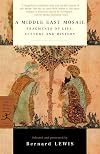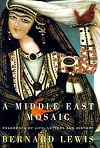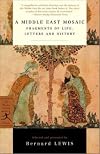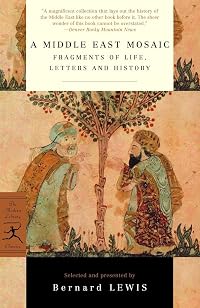
A Middle East Mosaic: Fragments of Life, Letters and History (Modern Library Classics)
by Bernard Lewis
On This Page
Description
In times of war and in peace, from the earliest days of the Roman Empire to our own, Westerners have journeyed to the lands of the middle east, bringing back accounts of their adventures and impressions. Yet it was never a one way exchange. From the first Arab embassy to the Vikings in the 9th century to the internet musings of the Taliban,A Middle East Mosaiccollects a rich, boisterous literature of cultural exchange.We see the American Revolution through the eyes of a Moroccan Ambassador show more and the French Revolution through a series of Imperial Ottoman proclamations. We find surprising portraits of Napoleon ("a brigand chief"), TE Lawrence and Ataturk. We learn what George Washington and Machiavelli through t of Turkish politics and hear Flaubert and Thackeray rail against eastern crime and punishment. We peer into Voltaire's business correspondence and follow the footsteps of Mark Twain, Richard Burton, Gertrude Bell and Ibn Battutta, the Marco Polo of the east. Great discoveries are recorded - an Egyptian Ambassador is introduced to electricity and dismisses the spectacle as "frankish trickery;" another pronounces the invention of a secure mail system most useful for assignations. We enter the harem with a 16th century organ maker and emerge with Ottoman reform.It was not until the sixteenth century that the first middle eastern rulers entered into diplomatic relations with European rulers, but trade often precede diplomatic relations. Business men from the days of the crusades against Saladin to the oil prospecting of Samuel Cox and his descendents have seen great possibilities in the markets of the middle east. And throughout the centuries we have been united by war. We witness the outbreak of the Crimean war with Karl Marx and enter Egypt with Napoleon. We observe Arab customs with George Patton and visit Baghdad and Cairo with George F. Kennan in the second world war. When Usama bin Ladin rails against "Jews and crusaders" occupying the holy land, he is rehearsing a grievance with a long history.This symphony of voices, full of wit and wisdom, spite and wonder, suspicion, befuddlement and occasional insight, is ordered and explained by our foremost living historian of the middle east. The fruit of a lifetime of scholarship and erudition,A Middle East Mosaicis a dazzling capstone to a brilliant career. In a spirited reappraisal of western views of the east and eastern views of the west over the last two thousand years, Bernard Lewis gives us a brilliant over-view of 2,000 years of commerce, diplomacy, war and exploration.This book is a delight, a treasury of stories drawn from letters, diaries and histories, but also from unpublished archives and previously untranslated accounts. Diplomats and interpreters, slaves, soldiers, pilgrims and missionaries, princes and spies, businessmen, doctors and priests all pour forth their stories of the people and events that shaped history.A Middle East Mosaiccannot fail to appeal to anyone with an appetite for history and a curiosity about the vagaries of cultural exchange.From the Hardcover edition. show lessTags
Recommendations




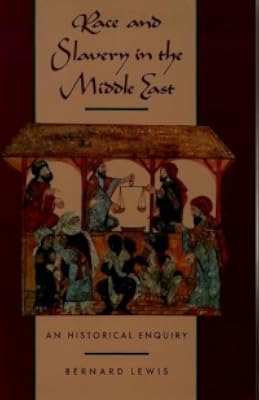
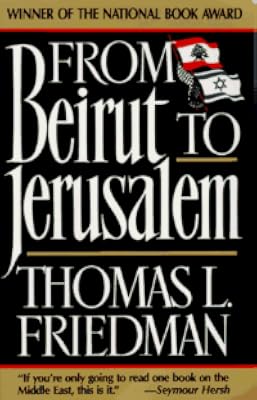

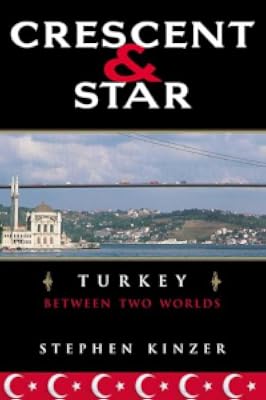
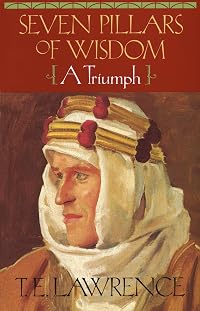











Member Recommendations
Member Reviews
Poor delightfully readable, learned, scholarly Bernard Lewis has spent the most of nearly 100 years in trying to educate us about the values and the mores of Eastern (read Islamic) cultures. Lets give him as many more decades as he wants to complete his hopeful mission!
Regretfully, he can not really succeed in his objective as each time he validates his viewpoint and teaches us (as he admittedly does) the value of such a vast historical learning we are confronted with yet another aspect of Islam.
Today, the 13th, anniversary of the astoundingly well-planned attack of 9/11 I am reading his work, offering a 'mosaic' of the middle east culture as ISIS demonstrate little progress in humanity with live video recordings of brutal, archaice, show more beastal beheadings of the innocents with a penknife.
An opening line in the introduction states that no longer is the West, the Greenwich Meridian, the principal center of a viewpoint of the world. I think most of us would claim that it is, at least that of equality, of suffrage, of just law, of human rights and of a certain sense of humanity. Until that is Sharia law applies in Birmingham (seriously muted) and Paris, until there is an accepted alternative to amputation and death by stoning to civil breaches in the middle east, the Western mores must surely prevail.
The author promises in his opening to offer the reader Islamic examples of those universal values of humour and reason.
We can only hope these still exist. show less
Regretfully, he can not really succeed in his objective as each time he validates his viewpoint and teaches us (as he admittedly does) the value of such a vast historical learning we are confronted with yet another aspect of Islam.
Today, the 13th, anniversary of the astoundingly well-planned attack of 9/11 I am reading his work, offering a 'mosaic' of the middle east culture as ISIS demonstrate little progress in humanity with live video recordings of brutal, archaice, show more beastal beheadings of the innocents with a penknife.
An opening line in the introduction states that no longer is the West, the Greenwich Meridian, the principal center of a viewpoint of the world. I think most of us would claim that it is, at least that of equality, of suffrage, of just law, of human rights and of a certain sense of humanity. Until that is Sharia law applies in Birmingham (seriously muted) and Paris, until there is an accepted alternative to amputation and death by stoning to civil breaches in the middle east, the Western mores must surely prevail.
The author promises in his opening to offer the reader Islamic examples of those universal values of humour and reason.
We can only hope these still exist. show less
Ratings
Members
- Recently Added By
Published Reviews
The many citations range from the Jewish, Christian, and Muslim scriptures to famous figures throughout the centuries (e.g., Ibn Khaldun, Ataturk, Napoleon) as well as many others known only to specialists. All selections are dated, so the reader can discern continuities or changes over time. Not surprisingly, many of the strangest statements are by outsiders describing Middle Easterners or show more vice versa. A book that can be read through or dipped into at any point, A Middle East Mosaic will surely be mined by professors and public speakers. show less
added by John_Vaughan
Author Information

69+ Works 11,196 Members
Bernard Lewis was born in London, England on May 31, 1916. He graduated with honors in history from the School of Oriental Studies at the University of London in 1936 with special reference to the Middle East. In 1938, he was named an assistant lecturer at the University of London, where he received a Ph.D. the next year. In 1940, he was drafted show more into the British armed forces and assigned to the Army tank corps. He was soon transferred to intelligence. He taught at the University of London for 25 years. In 1974, he accepted joint appointments at the Institute for Advanced Study in Princeton, New Jersey and Princeton University. He also taught at Cornell from 1984 to 1990. He became an American citizen in 1982. He was a scholar of Middle Eastern history and a prolific writer. His books included The Emergence of Modern Turkey, What Went Wrong?: The Clash between Islam and Modernity in the Middle East, and From Babel to Dragomans: Interpreting the Middle East. Because he was considered an expert on interactions between the Christian and Islamic worlds, his view helped shape American foreign policy under President George W. Bush. He died on May 19, 2018 at the age of 101. (Bowker Author Biography) show less
Common Knowledge
- Important places
- Middle East
- Original language
- English
Classifications
- Genres
- Nonfiction, History, General Nonfiction, Religion & Spirituality, Biography & Memoir
- DDC/MDS
- 956 — History & geography History of Asia Middle East Asia: Turkey, Iraq, Syria, Lebanon, Israel, Jordan
- LCC
- DS63.2 .E8 .M53 — History of Europe, Asia, Africa and Oceania Asia History of Asia Middle East. Southwestern Asia. Ancient Orient. History
- BISAC
Statistics
- Members
- 154
- Popularity
- 212,581
- Reviews
- 1
- Rating
- (3.42)
- Languages
- English
- Media
- Paper, Ebook
- ISBNs
- 4
- ASINs
- 3