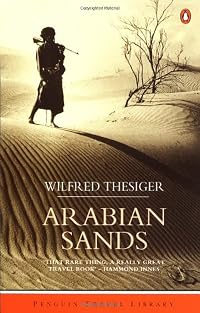
Arabian Sands
by Wilfred Thesiger
On This Page
Description
Arabian Sands is Wilfred Thesiger's stunning account of five years spent crossing the Arabian Peninsula by foot and on camels, with nomadic Bedouin tribesmen as guides. Traveling between 1945 and 1950, the British explorer treks through Yemen, The Empty Quarter, Oman and parts of the then Trucial States, crossing and re-crossing around 250,000 miles of this most inhospitable terrain. He was the first European ever to set eyes on the dunes and wadis of these deserts. Faced with constant show more challenges and trials beneath the punishing sun, his journey is also spiritual and enriching, as it requires the utmost courage, patience, generosity and humor. In clear and evocative prose, Thesiger documents a journey of unimaginable hardship and startling beauty, as well as a time, place and people on the cusp of change. show lessTags
Recommendations





















Member Recommendations


Member Reviews
Exploring is normally a rather egotistical activity. You travel through antres vast and deserts idle in order to boast about your achievements afterwards: to publish books and make films about how intrepid you are, to make money for your sponsor, or (like Othello) to help you chat up girls.
The wonderful thing about Thesiger as an explorer is how modest he is. You get the idea that he would really have preferred to keep the whole thing quiet. When word gets out about where he's been, he's more likely to have problems with the local authorities next time around, and he also knows that other people will emulate his journeys and spoil the fragile, pristine ecologies he has had the privilege of seeing. In the case of his Arabian journeys, show more he was only persuaded to write a book ten years after the event, much against his better judgement. By this time it was becoming clear that the life of the Bedu in the deserts of southern Arabia had already been changed irreversibly by the discovery of oil.
Despite his reluctance to commit himself to the printed page, Thesiger turns out to be a wonderful travel writer. His work has a rather different slant from what we are used to seeing: much less about moving accidents by flood and field or rough quarries, rocks and hills whose heads touch heaven, but much more about his travelling companions. The Bedu who cross the Empty Quarter with him are presented more like characters in a novel than colourful extras in a travel book. They are all very clear-cut individuals, with their own backgrounds, worries, ambitions, families, habits endearing and otherwise, and so on. Thesiger makes sure we understand how they fit into Bedu society, how the economy and ecology of the desert works, how social customs are linked to the particular constraints of living in a decentralised, tribal and nomadic society. It's an affectionate, sympathetic account, with none of T.E. Lawrence's lyrical bombast (and certainly none of Lawrence's "Me! Me! Me!"). Thesiger does admittedly let himself go a little bit when he's talking about the beauty of the two teenage tribesmen who travel with him, but judging by the photographs he's got some reason for that... He does make it quite clear that the Bedu, contrary to what Lawrence leads us to believe, don't go in for hanky-panky in the desert, and includes a rather grisly (second-hand) description of an execution for "sodomy" in Riyadh.
The real joy of this book, for me, are Thesiger's descriptions of the inconsequential everyday discussions in camp or on the march, the endless debates about the qualities of different camels, and the infinitely recursive nature of Bedu storytelling. Even a simple request for information about the travelling time between two wells has to be answered with a detailed description of the journey, the ancestries of the camels involved, the Arabs met in the way and the reasons for their journeys, etc. show less
The wonderful thing about Thesiger as an explorer is how modest he is. You get the idea that he would really have preferred to keep the whole thing quiet. When word gets out about where he's been, he's more likely to have problems with the local authorities next time around, and he also knows that other people will emulate his journeys and spoil the fragile, pristine ecologies he has had the privilege of seeing. In the case of his Arabian journeys, show more he was only persuaded to write a book ten years after the event, much against his better judgement. By this time it was becoming clear that the life of the Bedu in the deserts of southern Arabia had already been changed irreversibly by the discovery of oil.
Despite his reluctance to commit himself to the printed page, Thesiger turns out to be a wonderful travel writer. His work has a rather different slant from what we are used to seeing: much less about moving accidents by flood and field or rough quarries, rocks and hills whose heads touch heaven, but much more about his travelling companions. The Bedu who cross the Empty Quarter with him are presented more like characters in a novel than colourful extras in a travel book. They are all very clear-cut individuals, with their own backgrounds, worries, ambitions, families, habits endearing and otherwise, and so on. Thesiger makes sure we understand how they fit into Bedu society, how the economy and ecology of the desert works, how social customs are linked to the particular constraints of living in a decentralised, tribal and nomadic society. It's an affectionate, sympathetic account, with none of T.E. Lawrence's lyrical bombast (and certainly none of Lawrence's "Me! Me! Me!"). Thesiger does admittedly let himself go a little bit when he's talking about the beauty of the two teenage tribesmen who travel with him, but judging by the photographs he's got some reason for that... He does make it quite clear that the Bedu, contrary to what Lawrence leads us to believe, don't go in for hanky-panky in the desert, and includes a rather grisly (second-hand) description of an execution for "sodomy" in Riyadh.
The real joy of this book, for me, are Thesiger's descriptions of the inconsequential everyday discussions in camp or on the march, the endless debates about the qualities of different camels, and the infinitely recursive nature of Bedu storytelling. Even a simple request for information about the travelling time between two wells has to be answered with a detailed description of the journey, the ancestries of the camels involved, the Arabs met in the way and the reasons for their journeys, etc. show less
Wilfred Thesiger was driven to go where others had not. He had a strong desire to test his limits and, where others shied away from them, unique challenges excited him. Nothing motivated him more than to say, "I know that no European had ever been here before me." He sailed to Bahrain in a dhow simply because he wanted to have the same experience as an Arab sailor. He remembered his childhood as an explanation for his wanderlust spirit for his mother loved Africa.
In Arabian Sands Thesiger reported the Arabia he traveled in 1959 was unrecognizable from his earlier expeditions. He talked of long treks into the desert where "now" (in 1959) there were marring roads instead of endless stretches of dusty sand. [As an aside, what would he show more think of the region today? I am sure it has changed even more so since 1959.]
As a locust officer on behalf of the Locust Research Centre at the Natural History Museum, Thesiger was free to travel across the Empty Quarter. Although he showed no fear of danger wherever he went he had to hide behind a Syrian façade because of his Christianity. He absorbed the strange and fascinating culture of harsh people in a violent landscape. For example - the Islam faith. It regulated one's religious observance, a man's interactions with society and even the detailed routines of his daily life. Thesiger described the confusion of trying to identify various tribes by their saddles. It was important to know friend or foe to protect the camels from constant theft. Thesiger became friends with Hamdu Uga who admitted he had just murdered three men. Thesiger casually reported that a mere two days later the young chief was murdered as well. show less
In Arabian Sands Thesiger reported the Arabia he traveled in 1959 was unrecognizable from his earlier expeditions. He talked of long treks into the desert where "now" (in 1959) there were marring roads instead of endless stretches of dusty sand. [As an aside, what would he show more think of the region today? I am sure it has changed even more so since 1959.]
As a locust officer on behalf of the Locust Research Centre at the Natural History Museum, Thesiger was free to travel across the Empty Quarter. Although he showed no fear of danger wherever he went he had to hide behind a Syrian façade because of his Christianity. He absorbed the strange and fascinating culture of harsh people in a violent landscape. For example - the Islam faith. It regulated one's religious observance, a man's interactions with society and even the detailed routines of his daily life. Thesiger described the confusion of trying to identify various tribes by their saddles. It was important to know friend or foe to protect the camels from constant theft. Thesiger became friends with Hamdu Uga who admitted he had just murdered three men. Thesiger casually reported that a mere two days later the young chief was murdered as well. show less
Thesiger was one of the last British "gentleman explorers" and spent a lifetime traveling the globe, but found no other place as beautiful as Arabia. He traveled through the desert within a desert, the Empty Quarter of southern Saudia Arabia, living with, and as, the Beduin nomads for 5 years and 10s of thousands of miles by camel. He was the first European to see and map many parts of the desert. Incredible insights into Arabian culture and mindset. I suspect this book was the inspiration for Frank Herberts "Dune", it is very other-worldy, yet real and gripping. A short book at 300 pages covering 5 years of high adventure it can be an exhausting read. It is considered an all-time classic of the travel literature genre.
As Thesiger says show more the most interesting part of his journey was not the trip, but the circumstances. Since "infidals" are not allowed in many parts of "The Sands" he was constantly under-cover, on the run, fighting raiders, jailed, sailing on ships maned by African slaves, dealing with quicksands, starvation, wolves, cold, thirst, etc.. he understates much of it, but the number of close calls and near-death encounters and sheer luck are amazing. As well the Arab culture, mindset and way of life is revealed here in a way I have never read or seen before.
A common theme throughout is how modern industrial culture is destroying the nomadic way of life, how Thesiger saw in those 5 years the first oil exploration companies changing the way of life for people who have not changed in 7000 years or more. Thesiger documented a culture and society at the cusp of its destruction, that no longer exists. Although the book was written in 1959, much of the current world events involving radical Islam can be better understood by understanding where the Arabian, and Muslim, culture used to be not so long ago. show less
As Thesiger says show more the most interesting part of his journey was not the trip, but the circumstances. Since "infidals" are not allowed in many parts of "The Sands" he was constantly under-cover, on the run, fighting raiders, jailed, sailing on ships maned by African slaves, dealing with quicksands, starvation, wolves, cold, thirst, etc.. he understates much of it, but the number of close calls and near-death encounters and sheer luck are amazing. As well the Arab culture, mindset and way of life is revealed here in a way I have never read or seen before.
A common theme throughout is how modern industrial culture is destroying the nomadic way of life, how Thesiger saw in those 5 years the first oil exploration companies changing the way of life for people who have not changed in 7000 years or more. Thesiger documented a culture and society at the cusp of its destruction, that no longer exists. Although the book was written in 1959, much of the current world events involving radical Islam can be better understood by understanding where the Arabian, and Muslim, culture used to be not so long ago. show less
This guy was just nuts, in an amazing way. I read his obit in the Guardian awhile back, and had to check out one of his books. He grew up as a foreign service brat in what is now Ethiopia, and then went to school at Eton. Upon graduating at like 22, he promptly decided to go explore a corner of Ethiopia that had never been mapped, because it was populated by cannibalistic tribes. And pulled it off. Then he traveled all over the Sudan and the Sahara, and throughout the Middle East during WWII in the British foreign service and military.
After all of that, he decided to take on a real challenge(ha!) and explore the Empty Quarter of the Arabian Peninsula, an almost waterless sand desert where only two Westerners had travelled before in show more modern memory. Upon arriving at the more hospitable and populous southern coast of Arabia, he immediately sought out the Bedu tribes who were the only ones who could brave the desert interior, and adapted to their almost inhuman ways remarkably quickly and ably. The book tells the story of his adventures among them, and it’s a tale evocatively, humanely, and at times poignantly told.
It’s a classic adventure/exploration tale, but it’s also very aware that it’s one of the last such tales, and that the door is closing on a world in which such places and cultures exist untouched by the modern world. show less
After all of that, he decided to take on a real challenge(ha!) and explore the Empty Quarter of the Arabian Peninsula, an almost waterless sand desert where only two Westerners had travelled before in show more modern memory. Upon arriving at the more hospitable and populous southern coast of Arabia, he immediately sought out the Bedu tribes who were the only ones who could brave the desert interior, and adapted to their almost inhuman ways remarkably quickly and ably. The book tells the story of his adventures among them, and it’s a tale evocatively, humanely, and at times poignantly told.
It’s a classic adventure/exploration tale, but it’s also very aware that it’s one of the last such tales, and that the door is closing on a world in which such places and cultures exist untouched by the modern world. show less
Thesiger found his deep-down nomad soul when he explored the Empty Quarter with the Bedu. I wish he had not included the sentence "I shot 70 lions" but overall his writing is beautiful and fills me with nostalgia for a life I could never have known. Lots of interesting information about camels, too.
Wonderful descriptions of a way of life that disappeared so soon after Thesiger described it. His respect for the Bedu is evident and the author himself is clearly a man born in the wrong country at the wrong time. The last few pages are particularly poignant as he bids farewell to a life and men he knows he will never see again.
After the Second World War, Thesiger spent five years criss-crossing the deserts of Arabia in particular the 'Empty Quarter'. He had an unconventional life; born in Addis Ababa in Abyssinia, he spent the war in the region ending up in the SAS, before falling in love with the place and deciding to spend more time exploring it. He travelled with the Bedouin people, or as he calls them Bedu, experiencing their daily challenges of extreme heat, ice cold nights, long treks with camels under the relentless sun and the daily challenge of hunger and thirst. In most places he visited, he was the first European ever to set eyes on the dunes and wadis of those deserts. He immersed himself into their life, sharing food and water, hardship and show more company.
The Bedu were a people he had a deep respect for; he never ceased to be amazed by the way they could look at footprints in the sand and tell him who was riding the camels as well as picking up the subtle differences in the sands. The account of his travels across these lands show a harsh way of life that was about to vanish forever with the discovery of huge oilfields below the Arabian peninsular. It was dangerous too; whilst some welcomed him warmly, others considered him an infidel even going as far to threaten his life at times.
Thesiger has written a fascinating account of a landscape and culture of a people that is long gone. The writing has little emotion, instead the author conveys events as they happened, even when he was in the most danger, in an almost clinical way. The way that he immersed himself in the desert way of life gives us an insight that very few other authors have been able to gain since. The region has undergone massive changes since that time and this vanished way of life may never return. A traveller in the modern Arabia would not be able to have access to the deserts in the way that Thesiger did, and this fine book is a worthy tribute to a traditional society. Now I want to read The Marsh Arabs by him. show less
The Bedu were a people he had a deep respect for; he never ceased to be amazed by the way they could look at footprints in the sand and tell him who was riding the camels as well as picking up the subtle differences in the sands. The account of his travels across these lands show a harsh way of life that was about to vanish forever with the discovery of huge oilfields below the Arabian peninsular. It was dangerous too; whilst some welcomed him warmly, others considered him an infidel even going as far to threaten his life at times.
Thesiger has written a fascinating account of a landscape and culture of a people that is long gone. The writing has little emotion, instead the author conveys events as they happened, even when he was in the most danger, in an almost clinical way. The way that he immersed himself in the desert way of life gives us an insight that very few other authors have been able to gain since. The region has undergone massive changes since that time and this vanished way of life may never return. A traveller in the modern Arabia would not be able to have access to the deserts in the way that Thesiger did, and this fine book is a worthy tribute to a traditional society. Now I want to read The Marsh Arabs by him. show less
Members
- Recently Added By
Lists

Best of Travel Narratives
142 works; 28 members

Best Travel Narrative
32 works; 20 members
Adventure Travel & Exploration In Asia
31 works; 8 members

Top Five Books of 2014
1,064 works; 398 members

Wish to read
6 works; 1 member

Books Read in 2016
4,666 works; 197 members

Books Read in 2020
4,379 works; 123 members

Michael Dirda's Desert Island Books
62 works; 5 members

Mustich's 1000 Books to Read Before You Die: A Life Changing List
1,001 works; 19 members

el
1,139 works; 1 member
Author Information

19+ Works 3,012 Members
Some Editions
Awards and Honors
Series
Belongs to Publisher Series
Work Relationships
Is contained in
Common Knowledge
- Canonical title*
- Le désert des déserts. Avec les Bédouins, derniers nomades de l’Arabie du Sud
- Original title
- Arabian Sands
- Original publication date
- 1959
- People/Characters
- Wilfred Thesiger; Bertram Thomas; Salim Tamtaim; Sultan, of the Bait Kathir; Musallim bin Tafl; Mabkhaut (show all 31); Musallim bin al Kamam; Salim bin Kabina; Bin Turkia; Bin Anauf; Said, of the Bait Kathir; Muhammad al Auf; Amair; Mahsin; Salim bin Mautlauq; Bin Shuas; Bin Kalut; Muhammad, of the Rashid; Salim bin Ghabaisha; Bin Duailan; Salih, of the Saar; Sadr; Bin Tahi; Al Jabari; Mahalhal; Hamaid; Salim bin Habarut; Ahmad, of the Wahiba; Sultan, of the Wahiba; Yasir; Huaishil
- Important places
- Rub' al Khali (Empty Quarter); Africa; Ethiopia; Middle East; Oman; Saudi Arabia (show all 15); Somalia; Sudan; United Arab Emirates; Yemen; The Trucial Coast; Abyssinia; Sudan and Dhaufar; Hadhramaut; Arabia
- Dedication
- To bin Kabina and bin Ghabaisha
- First words
- A cloud gathers, the rain falls, men live; the cloud disperses without rain, and men and animals die.
- Quotations
- Here in the desert I had found all that I had asked....Some people maintain that they [the Bedu] will be better off when they have exchanged the hardship and poverty of the desert for the security of a materialistic world. Th... (show all)is I do not believe. I shall always remember how often I was humbled by those illiterate herdsmen who possessed, in so much greater measure than I, generosity and courage, endurance, patience, and light-hearted gallantry. Among no other people have I ever felt the same sense of personal inferiority. [310]
- Last words
- (Click to show. Warning: May contain spoilers.)As the plane climbed over the town and swung out above the sea I knew how it felt to go into exile.
- Publisher's editor*
- Malaurie, Jean (Directeur de collection)
- Disambiguation notice*
- THESIGER, WILFRED, Le Désert des déserts. Avec les Bédouins, derniers nomades de l’Arabie du Sud,
Traduit de l'anglais par Michèle Bouchet-Forner, Introduction de l'auteur, Plon, 1978.
Edition originale en an... (show all)glais en 1959, Arabian Sands, Longman Green & Co.: Londres.
*Some information comes from Common Knowledge in other languages. Click "Edit" for more information.
Classifications
- Genres
- Travel, Nonfiction, General Nonfiction, Biography & Memoir
- DDC/MDS
- 915.3 — History & geography Geography & travel Geography of and travel in Asia Arabian Peninsula and adjacent areas
- LCC
- DS208 .T48 — History of Europe, Asia, Africa and Oceania Asia History of Asia Arabian Peninsula. Saudi Arabia
- BISAC
Statistics
- Members
- 1,393
- Popularity
- 16,986
- Reviews
- 26
- Rating
- (4.14)
- Languages
- 9 — Arabic, Chinese, Dutch, English, French, German, Italian, Portuguese, Spanish
- Media
- Paper, Audiobook, Ebook
- ISBNs
- 39
- ASINs
- 38