
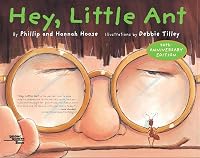
Hey, Little Ant
by Phillip M. Hoose
On This Page
Description
A song in which an ant pleads with the kid who is tempted to squish it.Tags
Recommendations

Member Reviews
Hey, Little Ant is, hands down, in my top three favorite picture books. Both the text and illustrations are creative, and unlike any other picture book that I have encountered. The poetic text alternates from being across the long side of the page to being across the short side. The illustrations, which are done in pen and water colors, follow the same style and most importantly, show the ant world in a big way.
The book is a favorite in my preschool classroom and would certainly be great for children anywhere from 2 to 7. It is helpful in allowing students to consider the perspective of those beside themselves, be it ants or other human beings.
The book is a favorite in my preschool classroom and would certainly be great for children anywhere from 2 to 7. It is helpful in allowing students to consider the perspective of those beside themselves, be it ants or other human beings.
What would you do if the ant you were about to step on looked up and started talking? Would you stop and listen? What if your friends saw you hesitate? That’s what happens in this funny, thought-provoking book. Originally a song by a father-daughter team, this conversation between two creatures, large and small, is bound to inspire important discussions. It might even answer that classic childhood question: To squish or not to squish?
A compelling story with strong arguments on two sides, this book leaves the reader with an important question at the end. Nice mentor text for argument.
I loved this book personally. I loved the rhyming throughout the whole story. It made the story more fun and delightful to read. The first couple lines went:
hey, little ant down in the crack, can you hear me? Can you talk back? See my shoe, can you see that? Well, now it's gonna squish you flat!"
Writing with rhymes keeps the reader interested and it gives the story a little more spunk. The illustrations were also very well fitted to the story and it enhanced the story by creating the image of the boy and the little ant. It was very appropriate for the mood. This book also pushes readers to think about tough situations. In the book, the boy comes to a dilemma of whether or not he should squish the little ant because all his friends show more squish them. "But all my friends squish ants each day, squishing ants is a game we play. They're all looking at me--they're listening too. They all say I should squish you".
This situation puts in the boy in a difficult position and the book actually creates a page if the reader (us) thinks if the ant should get squished. "Should the ant get squished? Should the ant go free?" The whole purpose of this story was to test the morals of young children. Is it right to kill innocent, harmless animals? Even though if everyone does it, should you be doing it? It makes the reader question some of their actions but does this in a very subtle way. This is a very enjoyable book. show less
hey, little ant down in the crack, can you hear me? Can you talk back? See my shoe, can you see that? Well, now it's gonna squish you flat!"
Writing with rhymes keeps the reader interested and it gives the story a little more spunk. The illustrations were also very well fitted to the story and it enhanced the story by creating the image of the boy and the little ant. It was very appropriate for the mood. This book also pushes readers to think about tough situations. In the book, the boy comes to a dilemma of whether or not he should squish the little ant because all his friends show more squish them. "But all my friends squish ants each day, squishing ants is a game we play. They're all looking at me--they're listening too. They all say I should squish you".
This situation puts in the boy in a difficult position and the book actually creates a page if the reader (us) thinks if the ant should get squished. "Should the ant get squished? Should the ant go free?" The whole purpose of this story was to test the morals of young children. Is it right to kill innocent, harmless animals? Even though if everyone does it, should you be doing it? It makes the reader question some of their actions but does this in a very subtle way. This is a very enjoyable book. show less
In Hey, Little Ant by Phillip and Hannah Hoose and illustrated by Debbie Tilley, the themes are sympathy, taking different perspectives, peer pressure, and responsibility. The ant in the story is trying to make the kid feel sympathetic towards him, so the kid does not squish him. Even though the kid has family and friends, the kid has to look into the ant’s perspective and learn that the ant has family and friends too. Someone could look different, however, that does not mean their lives, traditions, or beliefs are different from others. Then, the kid takes peer pressure from his friends because they tell him to squish the ant. Finally, I love how the story ends with an open question for young readers to think about what the kid show more should do. If he should take responsibility to keep the ant alive or squish it.
The illustrations in this book fit the perfect perspective between the kid and ant. It shows how it looks from the ant’s perspective looking up at the kid and vice versa. Another example is when the illustrations show the ant in the kids shoes as a giant and the kid as tiny as an ant. This explains how the kid would feel if the roles were reversed and the ant wanted to squish the kid. That would hopefully teach the kid to not squish the ant because it would hurt to die.
I can personally relate to this book because when I was little, I was made fun of for my height and how small I was. Throughout the years I was used to it, however, just because someone is smaller, taller, bigger, or smaller than someone, does not give the right to another person to make fun of them. show less
The illustrations in this book fit the perfect perspective between the kid and ant. It shows how it looks from the ant’s perspective looking up at the kid and vice versa. Another example is when the illustrations show the ant in the kids shoes as a giant and the kid as tiny as an ant. This explains how the kid would feel if the roles were reversed and the ant wanted to squish the kid. That would hopefully teach the kid to not squish the ant because it would hurt to die.
I can personally relate to this book because when I was little, I was made fun of for my height and how small I was. Throughout the years I was used to it, however, just because someone is smaller, taller, bigger, or smaller than someone, does not give the right to another person to make fun of them. show less
This is a great little story of a bullish kid who wants to stomp a little ant. The ant has a debate with the boy and finally asks if the roles were reversed if he would want to be stomped by the ant. The story lets you come to your own conclusion for an ending.
I really liked the verse of this book, the fact of that this story could be sung. I like books where it is good versus bad.
A great classroom extension would be to use this book to let kids see that living things have feelings too. A ant farm could be brought in for the kids to see how they spend their days for a nature unit.
I really liked the verse of this book, the fact of that this story could be sung. I like books where it is good versus bad.
A great classroom extension would be to use this book to let kids see that living things have feelings too. A ant farm could be brought in for the kids to see how they spend their days for a nature unit.
In my opinion, Hey, Little Ant by Phillip and Hannah Hoose is a great children’s book. This modern fantasy book tells the story from both an ant’s perspective, and a young boy’s perspective, explaining the differences in how creatures see the world. It brings up the important topic of who or what deserves respect. Often times people overlook things before understanding the purpose, which is what the boy does to the ant. For example, the boy says ants are rude for stealing food from their picnic, but the ant explains how only one chip can feed his whole town. One reason I liked the book is because of the illustrations. On pages when the ant is talking, the illustrator emphasizes how big the world looks from an ant’s eye. When the show more boy is talking, the ant’s world looks very tiny. This stresses how having more power can seem more important than something less powerful. In this case, the boy is much bigger than the ant so he can easily use his power to squish the ant. Another reason I liked the book was for the plot. Although this book is modern fantasy, the plot is very logical when explaining how the ant lives. The ant says, “My nest mates need me ‘cause I am strong. I dig our net and feed baby ants, too, I must not die beneath your shoe.” Clearly ants do not talk, but conveying this message to humans is important. All creatures have important tasks, despite size, shape, or type. show less
Members
- Recently Added By
Lists

Reading Rainbow
193 works; 10 members

Youth: Personal Values
252 works; 1 member

Newbery Adjacent
747 works; 3 members
Author Information

16+ Works 6,133 Members
Phillip M. Hoose is the widely acclaimed author of books, essays, stories, songs, and articles, including the National Book Award-winning book, Claudette Colvin. TwiceToward Justice. He is also the author of the multi-award-winning title, The Race to Save the Lord God Bird, the National Book Award Finalist We Were There Too!: Young People in U.S. show more History, and the Christopher Award-winning manual for youth activism. It's Our World Too! show less
Awards and Honors
Classifications
- Genres
- Children's Books, Picture Books
- DDC/MDS
- 782.421640268 — Arts & recreation Music Vocal Music, Singing Secular forms of vocal music Songs General principles and musical forms Traditions of secular songs {genres} Western popular songs Miscellany [formerly Songs composed for Children ?] Texts; treatises on music scores and recordings Librettos, lyrics, poems, screenplays, texts of Western popular songs
- LCC
- PZ8.3 .H774 .H — Language and Literature Fiction and juvenile belles lettres Fiction and juvenile belles lettres Juvenile belles lettres
- BISAC
Statistics
- Members
- 2,520
- Popularity
- 7,589
- Reviews
- 61
- Rating
- (4.13)
- Languages
- 5 — Dutch, English, French, German, Spanish
- Media
- Paper, Audiobook
- ISBNs
- 17
- UPCs
- 2
- ASINs
- 7