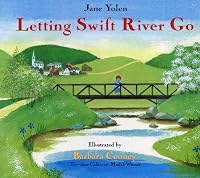
Letting Swift River Go
by Jane Yolen
On This Page
Description
Relates Sally Jane's experience of changing times in rural America, as she lives through the drowning of the Swift River towns in western Massachusetts to form the Quabbin Reservoir.Tags
Recommendations












Member Reviews
Look at those names; what a team. And the story is a success. The text is almost a poem, the pictures are among Cooney's best. Great addition to any social studies curriculum. I would have liked a bit more history, but the focus was on the feelings, especially of the girl and her father, so ok.
A reminiscent account by the character Sally Jane, who recalls her childhood in a small village along the Swift River, and the decision to flood her village and the surrounding area to make a dam for nearby Boston. She remembers the sad disfigurement as trees were chopped down and houses demolished. They row out on the Quabbin Reservoir that drowned her village and Sally Jane sees the land that once was her home, and she remembers. And finally, she lets go.
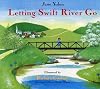
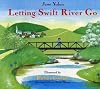
The illustrations are done in watercolor with some pencil and pastel. The resulting look is surreal and hazy, with just bits of picture in focus. The style suits the flashback nature of the story, evoking memories that can be blurred with odd details jumping in to clarity.
Beautiful show more text accompanies the lovely illustrations and vividly evokes the nostalgic remembrances of a childhood in the countryside. The story is not simply a retelling of the creation of Quabbin Reservoir, but is more about the struggle of the young main character to understand why her precious village is being demolished just to serve the energy needs of a bigger city. Her observations and questions raise the issue of trade offs that come with growth and expansion, and the fact that not all deals are fair, even if they are for the best. While Sally Jane recognizes that her loss was not a fair trade, she realizes that life must go on, and she releases the pain of the past and enjoys the new beauty that is in Quabbin Reservoir. show less
The illustrations are done in watercolor with some pencil and pastel. The resulting look is surreal and hazy, with just bits of picture in focus. The style suits the flashback nature of the story, evoking memories that can be blurred with odd details jumping in to clarity.
Beautiful show more text accompanies the lovely illustrations and vividly evokes the nostalgic remembrances of a childhood in the countryside. The story is not simply a retelling of the creation of Quabbin Reservoir, but is more about the struggle of the young main character to understand why her precious village is being demolished just to serve the energy needs of a bigger city. Her observations and questions raise the issue of trade offs that come with growth and expansion, and the fact that not all deals are fair, even if they are for the best. While Sally Jane recognizes that her loss was not a fair trade, she realizes that life must go on, and she releases the pain of the past and enjoys the new beauty that is in Quabbin Reservoir. show less
I've long been a fan of Jane Yolen and her wonderful, lovely books.
When Sally Jane was six years old, she roamed the area named Swift River. There were acres of maple trees with beautiful red/orange leaves in the fall. It all felt magically safe. The wind was her friend. Walking to school along a winding black top area taking her past the Old Stone Mill, a Grange Hall, a lovely country church, and a pond to fish on hot summer days.
Even playing in the graveyard felt protective and safe, and a wonderful place to play games. At night, it was not unusual to sleep outside under the stars where the sound of the cricket, the screech owl and the far awy trains brought solace and peace.
All too soon everything became different. Water was needed show more in Boston, MA. Sixth miles away, they wanted the clear, clean water of Swift River. It seemed the quickly, the old ways were gone, and with this came a scaring of the fields, the roads and even the houses and structures were either moved manually, or torn down and bulldozed to make way for a large holding area.
It happened so fast that Sally Jane and her friends did not get the chance to say goodbye to all. Many years later, Sally Jean and her father came to visit the area that was known as Swift River. Now, they found a large lake. And, as they calmly rowed throughout the night waters, and if they looked hard enough, perhaps their imagination would allow them to see the Grange Hall, the church, and the Old Stone Mill buried way deep.
This is a lovely book to explain the changes that occur when what was old was no longer. And, what was new wasn't all bad, it was just different -- VERY different.
Five Stars show less
When Sally Jane was six years old, she roamed the area named Swift River. There were acres of maple trees with beautiful red/orange leaves in the fall. It all felt magically safe. The wind was her friend. Walking to school along a winding black top area taking her past the Old Stone Mill, a Grange Hall, a lovely country church, and a pond to fish on hot summer days.
Even playing in the graveyard felt protective and safe, and a wonderful place to play games. At night, it was not unusual to sleep outside under the stars where the sound of the cricket, the screech owl and the far awy trains brought solace and peace.
All too soon everything became different. Water was needed show more in Boston, MA. Sixth miles away, they wanted the clear, clean water of Swift River. It seemed the quickly, the old ways were gone, and with this came a scaring of the fields, the roads and even the houses and structures were either moved manually, or torn down and bulldozed to make way for a large holding area.
It happened so fast that Sally Jane and her friends did not get the chance to say goodbye to all. Many years later, Sally Jean and her father came to visit the area that was known as Swift River. Now, they found a large lake. And, as they calmly rowed throughout the night waters, and if they looked hard enough, perhaps their imagination would allow them to see the Grange Hall, the church, and the Old Stone Mill buried way deep.
This is a lovely book to explain the changes that occur when what was old was no longer. And, what was new wasn't all bad, it was just different -- VERY different.
Five Stars show less
This book is, like so many of Jane Yolen's books, a treasure on multiple levels. The book uses such vivid imagery that readers and writers will be inspired to craft beautiful sentences of their own. Time passes in this book so smoothly, like the river, that I would model that writing element and more. A personal note - my aunt gave this book to my mom not long before my aunt passed away, so during my grand conversation, I would want to make that text to self connection that makes books like this even more powerful. I LOVE Ms Yolen's ability to write a book that knows no age or gender boundaries. She is my new favorite children's author!
4 1/2 - I grabbed this up at the thrift store as I absolutely love Barbara Cooney's folk art illustrations of historic Americana. The story is wonderful, I love picture books that teach and open a child's eyes to a subject, little glimpses of history for example. The destruction of seven towns to create a reservoir and the process involved and emotions felt by the people is a fabulous example. I think O found it very interesting. Someday when she sees the massive Hover Damn she might think back to this story.
In a story "drawn from history," little Sally Jane describes her town and its landscape, her friends and their activities. In the illustrations, the people are small in the landscape, as changes occur: "So it was voted in Boston to drown our towns / that the people in the city might drink." The four Swift River towns - Dana, Enfield, Greenwich, and Prescott - were drowned to create the Quabbin reservoir (1927-1946). Years later, a grown Sally Jane rows out on the Quabbin with her father, looking down into the water and imagining what used to lie beneath.
Author's note
See also: Cascade by Maryanne O'Hara (adult fiction)
Author's note
See also: Cascade by Maryanne O'Hara (adult fiction)
In my opinion Letting Swift River Go was a well written book, but I did not enjoy reading it. The pages were often plain with a good amount of text, and the text wasn't presented in a creative way. I think that this could deter young readers from enjoying the books, as it did for me. I also felt as though the story wasn't "juicy" it was more boring than anything. The illustrations were nicely done and often coincided nicely with surrounding text. The gist of the story was to explain how industrialization impacted the lives of some people. All in all this wasn't one of my favorite books.
Members
- Recently Added By
Lists

Honey For a Child's Heart
1,152 works; 25 members

Flood, dam/reservoir -- children's/young adult fiction
24 works; 2 members

Rising water
19 works; 6 members
Author Information

661+ Works 104,422 Members
Jane Yolen was born February 11, 1939 in New York City. She received a bachelor's degree from Smith College in 1960 and a master's degree in education from the University of Massachusetts in 1976. After college, she became an editor in New York City and wrote during her lunch break. She sold her first children's book, Pirates in Petticoats, at the show more age of 22. Since then, she has written over 300 books for children, young adults, and adults. Her other works include the Emperor and the Kite, Owl Moon, How Do Dinosaurs Say Goodnight? and The Devil's Arithmetic. She has won numerous awards including the Kerlan Award, the Regina Medal, the Keene State Children's Literature Award, the Caldecott Medal, two Nebula Awards, two Christopher Medals, the World Fantasy Award, three Mythopoeic Fantasy Awards, the Golden Kite Award, the Jewish Book Award, the World Fantasy Association's Lifetime Achievement Award, and the Association of Jewish Libraries Award. (Bowker Author Biography) show less
All Editions
Awards and Honors
Distinctions
Classifications
Statistics
- Members
- 715
- Popularity
- 39,803
- Reviews
- 11
- Rating
- (4.21)
- Languages
- English, French
- Media
- Paper
- ISBNs
- 14
- ASINs
- 4