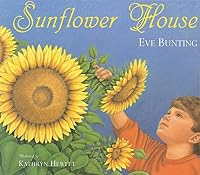
Sunflower House
by Eve Bunting
On This Page
Description
A young boy creates a summer playhouse by planting sunflowers and saves the seeds to make another house the next year.Tags
Recommendations






Member Reviews
I liked this book for two reasons. First, the language is descriptive and patterned.Though the book is not considered poetry, it follows a rhyme that tells the story of a boy growing his sunflowers. The language is very descriptive and provides the audience with ample detail to visualize the sunflowers blooming. For example, the author writes, "All frilly yellow, big and bright, mammoth is the word, all right" (p. 8). This descriptive language enhances the overall effectiveness of the book. The detailed language provides the audience with a detailed image in their minds of the sunflowers growing. I also liked this book because the illustrations enhance the story. The realistic and charcoal illustrations provide the audience with a show more realistic image as the story goes on. The illustrations are detailed and portray the emotions of the character, which enhances the story altogether. The illustrations are both bright and vivid, and provide the audience with the internal feelings of the characters that are not explicitly stated in the text. Overall, the big idea of this book is to look at friendship and working together to accomplish something. show less
A delightful read for children perhaps before they plant their first garden or plant. The boy plants a large ring of sunflower's, worries/wonders if they'll ever come up (don't we all?), enjoys a "fort" of sorts inside this circle of tall sunflowers, mournfully watches them die, and picks the seeds to do it all over again next spring.
My favorite lines:
"It's neat to think when something's gone/
a part of it goes on and on."
This little book is a celebration of a good, old-fashioned, small-town childhood.
My favorite lines:
"It's neat to think when something's gone/
a part of it goes on and on."
This little book is a celebration of a good, old-fashioned, small-town childhood.
Sunflower house is about a young boy who plants sunflowers with his parents. He meticulously takes care of his plants protecting them from birds and making sure they have enough water. Once the plants finally grow, the boy enjoys laying inside the ring of planted sunflowers. He and his friends use the sunflowers as a playhouse because adults cannot fit inside. As the flowers begin to die, the boy is disappointed until he realizes he can take the seeds from the flowers to plant more for next year. I think this book is very cute and very original. I think the book as a whimsical aspect to it that I enjoyed as well.
“Sunflower House” encourages children to use their imaginations. In this day in age children are obsessed over their phones, video games and computers, however they are missing out on all that nature has to offer them. During the summer, the young boy plants a circle of sunflower seeds and once they grow the children use it as a house. They play in it everyday and have snacks. They even have sleepovers in this flower house. This shows children that they too can go outside, use their imaginations and have fun. This also shows children that even when something is gone a part of it can continue to carry on. Even though the sunflowers started dying, the children could pull the seeds out of the middle to save to plant next year. This is show more an important concept for kids to always know because they could apply it to other situations. If someone they know moves away or passes away a part of them will always be with them. show less
Sunflowers are one of my favorite flowers, so I enjoyed this book a lot! I like that the father encouraged imagination in planting the sunflower seeds in a circle, and that the children expanded their own imaginations in while playing in their "sunflower house." There's also a seasonal "circle of life" message here. Another nice one by Eve Bunting.
Sunflower House is a heartwarming story about a boy who grows a circle of sunflowers and shares the joy of it with his friends. The story’s message is that even when things come to pass, a part of it still lives on. Sunflower House uses rhyming couplets in order to tell the story and at major points will shout a single word before the page turn. For example, “My friend Bernice says, ‘There’s no way.’ ‘You don’t know everything,’ I say. ‘WAIT!’” The children within the book are realistic and do things that children would do such as trying to tie dead stalks up or glue them in place.
This book reminded me of Paul Fleishman's Weslandia, This is a great book to supplement a science lesson. It shows the life cycle in the form of a story, so students are getting a scientific reference without realizing it. It shows the magic of nature, growth, and the life cycle. In today's technological age it is easy for kids to forget about the greatness that nature has to offer. This book makes simple sunflowers sound more exciting than any ipad or xbox game. It is crucial to make students aware of the world around them. This type of book could be used in class with an activity of the class/students growing their own plant/lower to follow up.
Members
- Recently Added By
Author Information

274+ Works 51,637 Members
Eve Bunting was born in 1928 in Maghera, Ireland, as Anne Evelyn Bunting. She graduated from Northern Ireland's Methodist College in Belfast in 1945 and then studied at Belfast's Queen's College. She emigrated with her family in 1958 to California, and became a naturalized citizen in 1969. That same year, she began her writing career, and in 1972, show more her first book, "The Two Giants" was published. In 1976, "One More Flight" won the Golden Kite Medal, and in 1978, "Ghost of Summer" won the Southern California's Council on Literature for Children and Young People's Award for fiction. "Smokey Night" won the American Library Association's Randolph Caldecott Medal in 1995 and "Winter's Coming" was voted one of the 10 Best Books of 1977 by the New York Times. Bunting is involved in many writer's organizations such as P.E.N., The Authors Guild, the California Writer's Guild and the Society of Children's Book Writers. She has published stories in both Cricket, and Jack and Jill Magazines, and has written over 150 books in various genres such as children's books, contemporary, historic and realistic fiction, poetry, nonfiction and humor. (Bowker Author Biography) show less
All Editions
Awards and Honors
Common Knowledge
- Canonical title
- Sunflower House
Classifications
Statistics
- Members
- 1,052
- Popularity
- 24,370
- Reviews
- 26
- Rating
- (3.90)
- Languages
- English, French
- Media
- Paper
- ISBNs
- 10