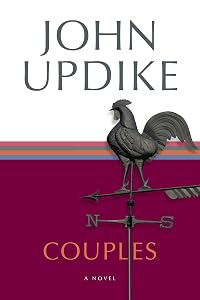
Couples
by John Updike
On This Page
Description
"Trapped in their cozy catacombs, the couples have made sex by turns their toy, their glue, their trauma, their therapy, their hope, their frustration, their revenge, their narcotic, their main line of communication and their sole and pitiable shield against the awareness of death."--Time One of the signature novels of the American 1960s, Couples is a book that, when it debuted, scandalized the public with prose pictures of the way people live, and that today provides an engrossing epitaph show more to the short, happy life of the "post-Pill paradise." It chronicles the interactions of ten young married couples in a seaside New England community who make a cult of sex and of themselves. The group of acquaintances form a magical circle, complete with ritualistic games, religious substitutions, a priest (Freddy Thorne), and a scapegoat (Piet Hanema). As with most American utopias, this one's existence is brief and unsustainable, but the "imaginative quest" that inspires its creation is eternal. Praise for Couples "Couples [is] John Updike's tour de force of extramarital wanderlust."--The New York Times Book Review "Ingenious . . . If this is a dirty book, I don't see how sex can be written about at all."--Wilfrid Sheed, The New York Times Book Review show lessTags
Recommendations
















Member Recommendations

Member Reviews
John Updike sure can write!!
By sally tarbox on 14 April 2018
Format: Kindle Edition
This is the most amazing read; set in a middle-class New England town in the 60s, the couples are married, most with kids; they socialize,live their daily lives and get caught up in liaisons.
This is emphatically not a book to lend your mother, it's outspoken and based around sex, yet it's far from being a shallow, raunchy read. The characters are believable - we might disapprove of their actions but we get their motivations. And while at one point I was thinking "oh, no more!", you have to read it through to the end, the denouement, the ripples from it; the jealousies, broken friendships...
As our adulterous, charming lead character, building contractor show more (and church-goer) Piet Hanema observes: "God is not mocked."
Despite what you think as you read it, ultimately a moral message; fantastic writing. show less
By sally tarbox on 14 April 2018
Format: Kindle Edition
This is the most amazing read; set in a middle-class New England town in the 60s, the couples are married, most with kids; they socialize,live their daily lives and get caught up in liaisons.
This is emphatically not a book to lend your mother, it's outspoken and based around sex, yet it's far from being a shallow, raunchy read. The characters are believable - we might disapprove of their actions but we get their motivations. And while at one point I was thinking "oh, no more!", you have to read it through to the end, the denouement, the ripples from it; the jealousies, broken friendships...
As our adulterous, charming lead character, building contractor show more (and church-goer) Piet Hanema observes: "God is not mocked."
Despite what you think as you read it, ultimately a moral message; fantastic writing. show less
Reading this book was in some ways like stepping back into the era of my childhood (although technically I was born just after this story ends). While my parents didn't indulge in the lifestyle that the couples in this novel had, I recognized and really enjoyed much of the period detail.
This is definitely an adult novel, and not everyone will appreciate it. It's not just about sex: it's also about marriage, friendships, families, religion, and death.
Updike's prose is a joy to read. It was an interesting story of an era when many changes were occurring in society.
Few of the main characters were particularly likable, I must say, and at first I had a hard time keeping track of all the many couples in the book. My only other real show more complaint is probably the ending. I felt like the destruction of the church might have been a more fitting place to end the novel. I wasn't sure why Piet ended up with Foxy after all, as I thought he had tired of her. But perhaps, in the end, that was the point that Updike was making. show less
This is definitely an adult novel, and not everyone will appreciate it. It's not just about sex: it's also about marriage, friendships, families, religion, and death.
Updike's prose is a joy to read. It was an interesting story of an era when many changes were occurring in society.
Few of the main characters were particularly likable, I must say, and at first I had a hard time keeping track of all the many couples in the book. My only other real show more complaint is probably the ending. I felt like the destruction of the church might have been a more fitting place to end the novel. I wasn't sure why Piet ended up with Foxy after all, as I thought he had tired of her. But perhaps, in the end, that was the point that Updike was making. show less
60's wife swapping in New England - hence rather confusing at first re who is married to who, who is having an affair with who, who children belong to etc. Wonderfully poignant and evocative metaphors and descriptive passages; other bits are deliberately disjointed, more like stream-of-consciousness.
Updike is a strange old coot. I think his writing has these weird flashes of brilliance interrupted by flashy, show-off-y styling, and galling sexism. I kind of enjoy seeing how far he can go. Okay, I've only read Couples, so my statement is made based on a sample of one book.
The review of The Terrorist in The Nation has this enlightening quote: "Updike [...] cannot introduce a woman without extending the same courtesy to her breasts." I have to admit that his over the top sexuality is part of what I like about him. Why pretend that he doesn't notice the boobs as much as he does? It is a bit laughable the way he describes women and men in Couples.
The review of The Terrorist in The Nation has this enlightening quote: "Updike [...] cannot introduce a woman without extending the same courtesy to her breasts." I have to admit that his over the top sexuality is part of what I like about him. Why pretend that he doesn't notice the boobs as much as he does? It is a bit laughable the way he describes women and men in Couples.
Gee, were things really like this in the 1960s? No wonder the 'women's liberation' movement began with so much energy and anger and books like Marilyn French's "The Women's Room" changed so many lives (mine included).
This story of a bunch of couples living in the New England region of the USA was painful for me to read in some parts because it reminded me of my own earlier years (although lived around ten years later than the setting of this novel). It's a story of male dominance and female (largely 'willing') submission. Sex drives the men and they don't seem to understand, or wish to understand, why they do it, just as they might go to church without any perceptible impact on their life, except perhaps a vague feeling of nostalgia show more when the church burns down after a lightning strike. Having sex with lots of women in the group of couples is not a problem unless the woman gets pregnant *and* your paternity is discovered. This isn't much of a problem because this time is one in which the newly marketed contraceptive pill is releasing *men* from that fear.
I'm not sure what Updike wants us to make of this story. I'm going to read another of his books ("Rabbit, Run") before I pass judgment...and maybe the others in the "Rabbit" series which won Pulitzer Prizes. show less
This story of a bunch of couples living in the New England region of the USA was painful for me to read in some parts because it reminded me of my own earlier years (although lived around ten years later than the setting of this novel). It's a story of male dominance and female (largely 'willing') submission. Sex drives the men and they don't seem to understand, or wish to understand, why they do it, just as they might go to church without any perceptible impact on their life, except perhaps a vague feeling of nostalgia show more when the church burns down after a lightning strike. Having sex with lots of women in the group of couples is not a problem unless the woman gets pregnant *and* your paternity is discovered. This isn't much of a problem because this time is one in which the newly marketed contraceptive pill is releasing *men* from that fear.
I'm not sure what Updike wants us to make of this story. I'm going to read another of his books ("Rabbit, Run") before I pass judgment...and maybe the others in the "Rabbit" series which won Pulitzer Prizes. show less
באיחור גדול מאוד זה האפדייק הראשון שלי והאמת, הוא עשה חשק לעוד. מישהו אמר עליו כי הוא סופר מינורי עם סגנון מז'ורי וזה ללא ספק נכון. מזמן כבר לא בדקתי כל כך הרבה מילים במילון כמו בספר הזה. אבל יחד עם זאת, אחרי התחלה קצת קשה להיכנס אליה, הספר סוחף מרתק ומעורר געגועים לתקופה שבה העולם היה תמים יותר ואנחנו כולנו היינו הרבה יותר צעירים ומלאי תשוקות.
John Updike, author of "Couples" died from cancer in 2009 at the age of 76. He never won the Nobel Prize for literature but many critics and writers felt he should have. He wrote 21 novels, including the four famed "Rabbit" books, as well as poems, short stories, essays, children's books, a play and a memoir.
"Couples" was written in 1968; the 458 page story takes place in the early 60's in the fictional community of Tarbox, somewhere outside Boston. Tarbox is a community of 30-something couples, coupling with each others' spouses, not exactly "wife-swapping", nor is the word "swinging" precise. Some characters used the term "adultery", while others were more comfortable with "affairs". There were a lot of affairs, lots of coupling and show more uncoupling with each other but generally everybody was rather north-easternly civil about it; virtually no punches nor naughty words are thrown. Nor were there whips nor sex toys nor legal abortions - this was the early 60s. While there are about a dozen couples who pop up from time to time, going to dinners, cocktail parties, ski events, etc. "Couples" focuses mainly on a half dozen or so of them.
This was a very racy story for its time, and contrary to some reader reviews still racy for 2017; it's sex scenes are often lengthy and detailed though without being grotesquely graphic. And the writing is just excellent. In the background, Updike reminds us of the political and social upheavals of the day - the Cuba crisis, the Assassination, women's evolving role in the workplace, the Viet Nam war.
Though the book is about couples, it is not a romance. You don't see the word "love" much at all; there are no heroes. There are lots of community flaws exposed - it's about married life, it's about relationships, it's about sex, it's about the 60s. Highly recommended. show less
"Couples" was written in 1968; the 458 page story takes place in the early 60's in the fictional community of Tarbox, somewhere outside Boston. Tarbox is a community of 30-something couples, coupling with each others' spouses, not exactly "wife-swapping", nor is the word "swinging" precise. Some characters used the term "adultery", while others were more comfortable with "affairs". There were a lot of affairs, lots of coupling and show more uncoupling with each other but generally everybody was rather north-easternly civil about it; virtually no punches nor naughty words are thrown. Nor were there whips nor sex toys nor legal abortions - this was the early 60s. While there are about a dozen couples who pop up from time to time, going to dinners, cocktail parties, ski events, etc. "Couples" focuses mainly on a half dozen or so of them.
This was a very racy story for its time, and contrary to some reader reviews still racy for 2017; it's sex scenes are often lengthy and detailed though without being grotesquely graphic. And the writing is just excellent. In the background, Updike reminds us of the political and social upheavals of the day - the Cuba crisis, the Assassination, women's evolving role in the workplace, the Viet Nam war.
Though the book is about couples, it is not a romance. You don't see the word "love" much at all; there are no heroes. There are lots of community flaws exposed - it's about married life, it's about relationships, it's about sex, it's about the 60s. Highly recommended. show less
Members
- Recently Added By
Lists

The Guardian's 1000 Novels Everyone Must Read
1,005 works; 549 members

501 Must-Read Books
529 works; 71 members

1960s, Best books published therein
254 works; 22 members

Julie Parson’s Old Books
52 works; 4 members

Publisher's Weekly Bestsellers - Part II - 1940 - 1979
355 works; 6 members

End of Your Life Book Club
134 works; 4 members

Lucy's Long List
69 works; 1 member

The Atlantic's The Great American Novel
136 works; 12 members

Best Sellers / Popular 1968
237 works; 5 members
Author Information

343+ Works 53,899 Members
American novelist, poet, and critic John Updike was born in Reading, Pennsylvania on March 18, 1932. He received an A.B. degree from Harvard University, which he attended on a scholarship, in 1954. After graduation, he accepted a one-year fellowship to study painting at the Ruskin School of Drawing and Fine Art in Oxford, England. After returning show more from England in 1955, he worked for two years on the staff of The New Yorker. This marked the beginning of a long relationship with the magazine, during which he has contributed numerous short stories, poems, and book reviews. Although Updike's first published book was a collection of verse, The Carpentered Hen and Other Tame Creatures (1958), his renown as a writer is based on his fiction, beginning with The Poorhouse Fair (1959). During his lifetime, he wrote more than 50 books and primarily focused on middle-class America and their major concerns---marriage, divorce, religion, materialism, and sex. Among his best-known works are the Rabbit tetrology---Rabbit, Run (1960), Rabbit Redux (1971), Rabbit Is Rich (1981), and Rabbit at Rest (1988). Rabbit, Run introduces Harry "Rabbit" Angstrom as a 26-year-old salesman of dime-store gadgets trapped in an unhappy marriage in a dismal Pennsylvania town, looking back wistfully on his days as a high school basketball star. Rabbit Redux takes up the story 10 years later, and Rabbit's relationship with representative figures of the 1960s enables Updike to provide social commentary in a story marked by mellow wisdom and compassion in spite of some shocking jolts. In Rabbit Is Rich, Harry is comfortably middle-aged and complacent, and much of the book seems to satirize the country-club set and the swinging sexual/social life of Rabbit and his friends. Finally, in Rabbit at Rest, Harry arrives at the age where he must confront his mortality. Updike won the Pulitzer Prize for both Rabbit Is Rich and Rabbit at Rest. Updike's other novels range widely in subject and locale, from The Poorhouse Fair, about a home for the aged that seems to be a microcosm for society as a whole, through The Court (1978), about a revolution in Africa, to The Witches of Eastwick (1984), in which Updike tries to write from inside the sensibilities of three witches in contemporary New England. The Centaur (1963) is a subtle, complicated allegorical novel that won Updike the National Book Award in 1964. In addition to his novels, Updike also has written short stories, poems, critical essays, and reviews. Self-Consciousness (1989) is a memoir of his early life, his thoughts on issues such as the Vietnam War, and his attitude toward religion. He was elected to the American Academy of Arts and Letters in 1977. He died of lung cancer on January 27, 2009 at the age of 76. (Bowker Author Biography) John Updike was born in 1932, in Shillington, Pennsylvania. Since 1957 he has lived in Massachusetts. His novels have won the Pulitzer Prize, the National Book Award, the National Book Critics Circle Award, & the Howells Medal. (Publisher Provided) John Updike was born in 1932 and attended Harvard College and the Ruskin School of Drawing and Fine Art in Oxford, England. Form 1955 to 1957 he was a staff member of The New Yorker, which he contributed numerous writings. Updike's art criticism has appeared in publications including Arts and Antiques, The New Republic, The New York Times Book Review, and Realites, among many others. He is the author of such best-selling novels as Rabbit Run and Rabbit is Rich. His many works of fiction, poetry and criticism have been awarded the Pulitzer Prize, the National Book Award, the American Book Award, and the National Book Critics Circle Award. For the past 40 years he has lived in Massachusetts. (Publisher Provided) John Updike is the author of some 50 books, including collections of short stories, poems, & criticism. His novels have won the Pulitzer Prize, the National Book Award, the National Book Critics Circle Award, & the Howells Medal. Born in Shillington, Pennsylvania, in 1932, he has lived in Massachusetts since 1957. (Publisher Provided) show less
Some Editions
Awards and Honors
Distinctions
Series
Belongs to Publisher Series
Work Relationships
Common Knowledge
- Canonical title
- Couples
- Original title
- Couples
- Original publication date
- 1968-01
- People/Characters
- Piet Hanema; Angela Hanema née Hamilton; Foxy Whitman; Ken Whitman; Marcia Little-Smith; Harold Little-Smith (show all 20); Janet Appleby; Frank Appleby; Irene Saltz; Ben Saltz; Carol Constantine; Eddie Constantine; Georgene Thorne; Freddie Thorne; Bernadette Ong; John Ong; Terry Gallagher; Matt Gallagher; Bea Guerin; Roger Guerin
- Important places
- Tarbox, Massachusetts, USA; Massachusetts, USA
- Important events
- 1960s; 1962
- Epigraph
- There is a tendency in the average citizen, even if he has a high standing in his profession, to consider the decisions relating to the life of the society to which he belongs as a matter of fate on which he has no influen... (show all)ce - like the Roman subjects all over the world in the period of the Roman empire, a mood favorable for the resurgence of religion but unfavorable for the preservation of a living democracy.
PAUL TILLICH,
The Future of Religions
We love the flesh: its taste, its tones,
Its charnel odour, breathed through Death's jaws. ...
Are we to blame if your fragile bones
Should crack beneath our heavy, gentle paws?
ALEXANDER BLOK,
"T... (show all)he Scythians" - Dedication
- To Mary
- First words
- "What did you make of the new couple?"
- Quotations
- Sex is like money; only too much is enough.
- Last words
- (Click to show. Warning: May contain spoilers.)The Hanemas live in Lexington, where, gradually, among people like themselves, they have been accepted, as another couple.
- Publisher's editor
- Jones, Judith
- Original language
- English
Classifications
Statistics
- Members
- 1,863
- Popularity
- 11,643
- Reviews
- 21
- Rating
- (3.55)
- Languages
- 15 — Czech, Danish, Dutch, English, Finnish, French, German, Hungarian, Italian, Multiple languages, Norwegian (Bokmål), Portuguese, Russian, Spanish, Swedish
- Media
- Paper, Audiobook, Ebook
- ISBNs
- 43
- ASINs
- 29