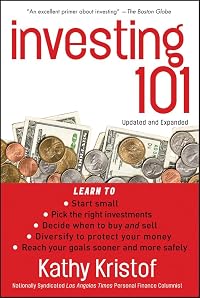
Investing 101
by Kathy Kristof
On This Page
Description
"The fully updated and expanded edition of Investing 101 offers basic advice to market newcomers. Subjects include: stocks, bonds, mutual funds, retirement planning, college savings, and tax strategies. This new edition removes roadblocks and offers low-maintenance portfolios that put investors on the path to investment success"--Provided by publisher.Tags
Recommendations

Member Reviews
This review is about the updated and expanded 2008 edition of Investing 101 by Kathy Kristof, nationally syndicated Personal Finance Columnist for the Los Angeles Times.
I approached this book from two perspectives, first, as a teacher (retired) of technical subject matter and, second, as a self-reliant investor (active) who is living out of his retirement funds.
View One
As a teacher, I had three objectives for students who took my courses. I expected students who completed my courses to come away with: (1) an appreciation for the discipline, (2) an understanding of the subject matter, and (3) a proficiency for putting the discipline into practice. If I were teaching Investing 101, could I realistically expect my students to achieve these show more same objectives with Kristof's composition as their textbook? The answer is Yes, Yes, and Yes. (And, yes, I know that Investing 101 was not written as a textbook, but please bear with me for the sake of this review.)
First, I believe my Investing 101 students will come away with a positive attitude toward the discipline of do-it-yourself investing. The FUD factor (fear, uncertainty, and doubt about private investing) is more than adequately addressed by Kristof in the first chapter of her book. I am convinced that an attitude check at the beginning of my make-believe course compared with the same attitude check at the end of the course would show that anxieties toward individual investing will be allayed because of Kristof's practical advice.
Second, I believe my students will come away with a clear comprehension of what investing is about, not only the buying and selling of stocks, bonds, mutual funds, and real estate investment trusts, but understanding these matters in relation to retirement planning and tax strategies. I believe that students who study Kristof's book and complete the paper-and-pencil assignments (worksheets spaced throughout the book) will finish this introductory investing course with enough fiscal savvy to be able to explain their financial goals, buy and sell strategies, and preferred portfolio allocations to their spouse, friends, financial adviser, and tax man.
Third, I believe my students will come away with a proficiency for setting up and maintaining investment portfolios on their own. I believe these portfolios will be wisely allocated between cash, stocks, and bonds so that principal will be protected and grow, income will be provided, and inflation will be hedged. I believe these portfolios, different for each student, will thrive in good markets and survive bad markets.
Overall, I believe my pretend students will benefit by the way Kristof's book is laid out. Each chapter is prefaced with a pedagogically sound "Quick Take" page. Kristof briefly tells the reader "What You'll Learn," "What You'll Do," and "How You'll Use This." If this were a theology book instead of a secular book, I would rename these headings as "Facts to be Believed," "Commands to be Obeyed," and "Promises to be Enjoyed."
View Two
As a self-reliant, active investor who is living out of his retirement funds, I looked for but could not find any ill-advised, slipshod action plans in this book. Kristof writes unambiguously about real financial problems and genuine investment solutions. Her explanations and illustrations are clear and to the point.
On the one hand, I found no investment topics so simple or elementary that they had no place in this book. On the other hand, I found no esoteric discussions of financial topics that were beyond a novice investor's level of appreciation, understanding, and ability.
My Favorite Chapter: I especially liked Chapter 14, "The Lazy Investor's Portfolio Planner." ("Lazy Portfolio" is a hot topic on the Internet. I got 366,000 hits with a Google search.) In this chapter, Kristof tells the reader how to take everything they've learned in Chapters 1-13 and apply it to a "hands-off" portfolio. Once a Lazy Portfolio is set up and running, it really and truly takes only a few minutes of your time once a year to rebalance it, then leave it to run on its own until next year -- no muss, no fuss, no anxiety. Paul B. Ferrell's research at MarketWatch bears witness that Lazy Portfolios consistently outperform the S&P 500 in their 1-year, 3-year, and 5-year annualized returns. See http://www.marketwatch.com/lazyportfolio
My Favorite Kristof Quote: "Do the math."
Bottom Line: I recommend Investing 101, the 2008 updated and expanded edition, both as a tutorial for the newbie investor and as a review guide and reference manual for the intermediate investor. show less
I approached this book from two perspectives, first, as a teacher (retired) of technical subject matter and, second, as a self-reliant investor (active) who is living out of his retirement funds.
View One
As a teacher, I had three objectives for students who took my courses. I expected students who completed my courses to come away with: (1) an appreciation for the discipline, (2) an understanding of the subject matter, and (3) a proficiency for putting the discipline into practice. If I were teaching Investing 101, could I realistically expect my students to achieve these show more same objectives with Kristof's composition as their textbook? The answer is Yes, Yes, and Yes. (And, yes, I know that Investing 101 was not written as a textbook, but please bear with me for the sake of this review.)
First, I believe my Investing 101 students will come away with a positive attitude toward the discipline of do-it-yourself investing. The FUD factor (fear, uncertainty, and doubt about private investing) is more than adequately addressed by Kristof in the first chapter of her book. I am convinced that an attitude check at the beginning of my make-believe course compared with the same attitude check at the end of the course would show that anxieties toward individual investing will be allayed because of Kristof's practical advice.
Second, I believe my students will come away with a clear comprehension of what investing is about, not only the buying and selling of stocks, bonds, mutual funds, and real estate investment trusts, but understanding these matters in relation to retirement planning and tax strategies. I believe that students who study Kristof's book and complete the paper-and-pencil assignments (worksheets spaced throughout the book) will finish this introductory investing course with enough fiscal savvy to be able to explain their financial goals, buy and sell strategies, and preferred portfolio allocations to their spouse, friends, financial adviser, and tax man.
Third, I believe my students will come away with a proficiency for setting up and maintaining investment portfolios on their own. I believe these portfolios will be wisely allocated between cash, stocks, and bonds so that principal will be protected and grow, income will be provided, and inflation will be hedged. I believe these portfolios, different for each student, will thrive in good markets and survive bad markets.
Overall, I believe my pretend students will benefit by the way Kristof's book is laid out. Each chapter is prefaced with a pedagogically sound "Quick Take" page. Kristof briefly tells the reader "What You'll Learn," "What You'll Do," and "How You'll Use This." If this were a theology book instead of a secular book, I would rename these headings as "Facts to be Believed," "Commands to be Obeyed," and "Promises to be Enjoyed."
View Two
As a self-reliant, active investor who is living out of his retirement funds, I looked for but could not find any ill-advised, slipshod action plans in this book. Kristof writes unambiguously about real financial problems and genuine investment solutions. Her explanations and illustrations are clear and to the point.
On the one hand, I found no investment topics so simple or elementary that they had no place in this book. On the other hand, I found no esoteric discussions of financial topics that were beyond a novice investor's level of appreciation, understanding, and ability.
My Favorite Chapter: I especially liked Chapter 14, "The Lazy Investor's Portfolio Planner." ("Lazy Portfolio" is a hot topic on the Internet. I got 366,000 hits with a Google search.) In this chapter, Kristof tells the reader how to take everything they've learned in Chapters 1-13 and apply it to a "hands-off" portfolio. Once a Lazy Portfolio is set up and running, it really and truly takes only a few minutes of your time once a year to rebalance it, then leave it to run on its own until next year -- no muss, no fuss, no anxiety. Paul B. Ferrell's research at MarketWatch bears witness that Lazy Portfolios consistently outperform the S&P 500 in their 1-year, 3-year, and 5-year annualized returns. See http://www.marketwatch.com/lazyportfolio
My Favorite Kristof Quote: "Do the math."
Bottom Line: I recommend Investing 101, the 2008 updated and expanded edition, both as a tutorial for the newbie investor and as a review guide and reference manual for the intermediate investor. show less
 This review was written for LibraryThing Early Reviewers.
Investing 101 is a great book for anyone whether just starting out or you have been investing for a while and need to refresh what you know. This book explains many different aspects of investing. The explanations are easy to follow and detailed.
there are however, a couple of drawbacks with the book. First if the book came out today in Dec 2008 the examples of the worst and best days of the stock market would be different. Secondly many of the examples deal with inflation. I wish this book would talk about how to prepare for recessions, depressions and other calamities that could hit. How can someone prepare for any impending financial crisis would be nice if only a few pages.
Finally the problem with a book like this is that the show more information can become dated. i imagine that if I had read this book a year ago the information would have been dead on and the example would have been great. Today one just does not know how the market will go. show less
there are however, a couple of drawbacks with the book. First if the book came out today in Dec 2008 the examples of the worst and best days of the stock market would be different. Secondly many of the examples deal with inflation. I wish this book would talk about how to prepare for recessions, depressions and other calamities that could hit. How can someone prepare for any impending financial crisis would be nice if only a few pages.
Finally the problem with a book like this is that the show more information can become dated. i imagine that if I had read this book a year ago the information would have been dead on and the example would have been great. Today one just does not know how the market will go. show less
This review was written for LibraryThing Early Reviewers.Investing 101 by Kathy Kristof is full of easy to understand information for the financial novice. Each chapter begins with a "quick take" that outlines what the reader will learn, what the reader should do (i.e. identify personal problems), and how the reader can use the information. Kristof makes even the most confusing investment possibilities easy so that the reader can sit back and think, "ah....now I get it." Included throughout the book are worksheets that help reinforce the information being given. The book begins with fixing your money problems and goes all the way to helping the reader create his/her own portfolio. Investing 101 is written in such a manner that even young people would be able to grasp the concepts and become show more more fiscally savvy. show less
This review was written for LibraryThing Early Reviewers.As the title says, this is definitely structured as a basic personal finance book, to assist those who wish to understand the incoming and outgoing process, in a very hands-on, non-technical approach. Beneficial to all as a good resource to check on various aspects of the financial jungle, as we attempt to balance our budgets - maybe the government should read this book!
This review was written for LibraryThing Early Reviewers.An excellent starting point for anyone with questions about the basics of investing. Kristof starts off with a chapter on finding the money to invest and how to change attitudes toward saving and investing. She includes tips for addressing universal problems as well as guidance on gender specific money problems ("emotional spending" for women and "competing with strangers" for men). One of the most informative parts of the book was the section in chapter 8 about "How to Read a Financial Statement." Even after years of reading those closely printed statements they can be overwhelming. Kristof tells you which sections to look at and what to look for to determine if the company is worth investing in. Chapter 14 - "The Lazy Investor's show more Portfolio Planner" shows you how to put all the lessons together to determine your goals and how to reach them. Simply a well written and accessable guide to taking those first steps into investing and what to do once you get there. show less
This review was written for LibraryThing Early Reviewers.The book is entitled Investing 101 (revised and updated), and what an appropriate title. I have been teaching my 14-year-old some of the ins and outs of investing, and this is a sound resource for us to have on hand.
Whether the reader knows nothing about investing, or has been dabbling for some time now, there is something to be learned--or, at least reminded--from this book. Concepts such as diversifying a portfolio are demonstrated with real numbers and percentages of gains and losses, reflecting the differences (between a diversified and not-so-diversified portfolio) in a way that I had never seen done so well.
It's the basics, and more; in layman's terminology with excellent examples. Couldn't recommend it more!
Whether the reader knows nothing about investing, or has been dabbling for some time now, there is something to be learned--or, at least reminded--from this book. Concepts such as diversifying a portfolio are demonstrated with real numbers and percentages of gains and losses, reflecting the differences (between a diversified and not-so-diversified portfolio) in a way that I had never seen done so well.
It's the basics, and more; in layman's terminology with excellent examples. Couldn't recommend it more!
This review was written for LibraryThing Early Reviewers.Received the book as part of LibraryThing Early Reviewers/Member Giveaway. Practical primer that addresses immediate investor concerns and questions. I especially enjoyed the straightforward elements in each chapter, such as specific questions and answers to money problems; self-assessments on, for example, risk tolerance; and easy-to-use financial formulas (e.g., tax implications of selling too soon).
This review was written for LibraryThing Early Reviewers.Members
- Recently Added By
Author Information

4 Works 85 Members
Kathy Kristof writes a twice-weekly personal finance column for the Los Angeles Times, which is nationally syndicated to more than 40 million readers in major newspapers across the country. She appears frequently on radio and television, including regular appearances on PBS's Nightly Business Report. And as the mother of two, she, too, is facing show more down the tuition tiger! show less
Classifications
Statistics
- Members
- 69
- Popularity
- 452,408
- Reviews
- 13
- Rating
- (3.97)
- Languages
- English
- Media
- Paper, Audiobook, Ebook
- ISBNs
- 9
- ASINs
- 1