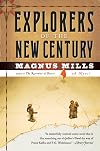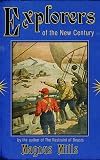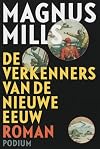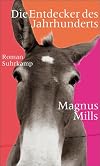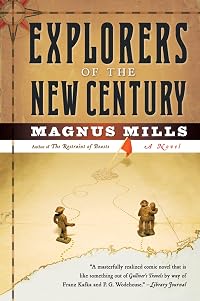
Explorers of the New Century
by Magnus Mills
On This Page
Description
It is the beginning of the century, and two teams of explorers are racing across a cold, windswept, deserted land to reach the furthest point from civilisation. It is, they find, 'an awfully long way'. Johns and his men take the western route, along a rocky scree, gossiping, bickering and grumbling as they go. Meanwhile, Tostig's men make their way along the dry riverbed in the east - they are fewer, with just five men and ten mules, and better organised than their rivals. But with Johns' show more team keeping apace in the distance, the race is on to reach the Agreed Furthest Point...... show lessTags
Recommendations











Member Reviews
I blazed through this magnificently deadpan little novel. At first it seems like straightforward exploration story, gently mocking the 'gentlemen explorers' of Victorian times. More than halfway through, though, certain hints come together and the reader realises just what sort of satire they're really reading. The revelation is brilliantly done, throwing new light on everything that went before. The gentility of the narrative suddenly appears transformed. Don't worry, I wouldn't be so cruel as to spoil it! In fear of doing just that, I won't say more. Just that this is a subtle but breath-takingly effective satire. My favourite of Mills' novels that I've read so far, definitely, and highly recommended.
Today has been a great day for show more novel-reading, in fact. show less
Today has been a great day for show more novel-reading, in fact. show less
A marvellous novel; just when you think you know where a book is going - wham, it throws you right off course and you have to replay the whole book and re-think assumptions. As usual Magnus Mills is very clever, writes fantastically and is very funny. Why has this man not won the Booker Prize?
In which two expeditions attempt to find the remotest spot on earth in which to carry out a mysterious polar assignment. There are some parallels with the Scott-Amundsen Antarctic expeditions, but, although one of the expeditions is manned by a crew with British sounding names and the other with vaguely Scandinavian names, there are no other obvious parallels. As usual with Mills, the main point is more to describe the meaningless and vacuity of contemporary life; when the purpose of the expedition finally begins to be explicated, their purpose seems if anything all the more depressing.
Two teams of men set off with their mules to reach the furthest point of civilisation. John's men are amateurs, Tostig's professionals. Pompous leaders, sycophantic subordinates, whiners, workers and snobs struggle through endless night, dust, wild winds and cold. Like being at work, really. There are a couple of big surprises, the purpose of the expedition and .......
Comic lunacy.
Comic lunacy.
You know it's hard to review a book without mentioning the plot? Where to summarise it either under sells it or ruins it compelety? Well this is one books that relies on not knowing much about it beforehand.. and here's my attempt
at a non spoiler review.
Riffing off the Scott and Amundson's antartic race, we get two groups racing for the "agreed furthest point". Tongue firmly set in cheek there is much Victorian stiff up lip, a strictly enforced class system and much cultural superiority. It's a short book, filled to the brim with deadpan humour, sparse prose, an economical setting and characters that sit on the right side of wonderful pastiche. If I have any criticism it's a bit short and the intentional sense of wrongness can be be show more just well a bit too odd. However is it high enough recommendation that I wanted to reread straight after I finished it?
So go and try but be wary of other reviews because to know to much would ruin it. show less
at a non spoiler review.
Riffing off the Scott and Amundson's antartic race, we get two groups racing for the "agreed furthest point". Tongue firmly set in cheek there is much Victorian stiff up lip, a strictly enforced class system and much cultural superiority. It's a short book, filled to the brim with deadpan humour, sparse prose, an economical setting and characters that sit on the right side of wonderful pastiche. If I have any criticism it's a bit short and the intentional sense of wrongness can be be show more just well a bit too odd. However is it high enough recommendation that I wanted to reread straight after I finished it?
So go and try but be wary of other reviews because to know to much would ruin it. show less
'Now is this rope quite secure at the other end?'
Thegn assured him that it was, and then Thorsson was asked to bring up the first mule from the camp at Lintel Rock. Meanwhile, Thegn was sent back along the ropeway with a secondary line. The moment Thorsson arrived with the mule, Snaebjorn seized it by one ear and forced it to the ground. Quickly it was trussed up and rendered immobile, then slung under the rope and hauled across the river. Guthrum had joined Thegn on the far bank and was charged with leading each mule away. The process of moving them one by one was necessarily slow, but after a couple of hours the men had succeeded in getting all ten mules transferred.
Initially the story seems like a replay of the historical race to show more the South Pole, with the 'agreed furthest point from civilisation' replacing the pole as the objective of the British and Scandanavian teams, but at certain moments things didn't seem quite right.
It reminded me of watching "Fight Club" in a way, as I knew something was wrong, but wasn't sure what, although in this book you don't have to wait right until the end to find out what is happening. show less
Thegn assured him that it was, and then Thorsson was asked to bring up the first mule from the camp at Lintel Rock. Meanwhile, Thegn was sent back along the ropeway with a secondary line. The moment Thorsson arrived with the mule, Snaebjorn seized it by one ear and forced it to the ground. Quickly it was trussed up and rendered immobile, then slung under the rope and hauled across the river. Guthrum had joined Thegn on the far bank and was charged with leading each mule away. The process of moving them one by one was necessarily slow, but after a couple of hours the men had succeeded in getting all ten mules transferred.
Initially the story seems like a replay of the historical race to show more the South Pole, with the 'agreed furthest point from civilisation' replacing the pole as the objective of the British and Scandanavian teams, but at certain moments things didn't seem quite right.
It reminded me of watching "Fight Club" in a way, as I knew something was wrong, but wasn't sure what, although in this book you don't have to wait right until the end to find out what is happening. show less
Very different from Mills' other books, this one doesn't feature a nameless narrator and seems to have a more conventional plot about the race between two teams of explorers to reach the furthest point. But all is not as it seems...
As I had certain expectations from Mills' writing, I found this rather hard-going, with the details of the explorers journeys not being of that much interest to me. But I'm glad I stuck with it as it turns out to be about something else entirely and in the end is not a boys own adventure story, but something rather more chlling.
As I had certain expectations from Mills' writing, I found this rather hard-going, with the details of the explorers journeys not being of that much interest to me. But I'm glad I stuck with it as it turns out to be about something else entirely and in the end is not a boys own adventure story, but something rather more chlling.
Members
- Recently Added By
Lists

Racism and Race Relations in Literature
48 works; 9 members
Author Information

22+ Works 3,309 Members
Magnus Mills lives in London. (Publisher Provided) Magnus Mills is the author of A Cruel Bird Came to the Nest and Looked In and six other novels, including The Restraint of Beasts, which won the McKitterick Prize and was shortlisted for both the Booker Prize and the Whitbread (now the Costa) First Novel Award in 1999. His most recent novel, A show more Cruel Bird Came to the Nest and Looked In, was published to great critical acclaim. His books have been translated into twenty languages. His title, The Field of the Cloth of Gold, made the Goldsmiths Prize shortlist 2015. (Bowker Author Biography) show less
Common Knowledge
- Original publication date
- 2005
- Dedication
- For S. M. P.
- First words
- 'He's a thoroughly decent man,' said Johns.
- Last words
- (Click to show. Warning: May contain spoilers.)Cease work on the boat. We're going back.'
Classifications
Statistics
- Members
- 275
- Popularity
- 117,221
- Reviews
- 12
- Rating
- (3.85)
- Languages
- Dutch, English, German, Norwegian (Bokmål)
- Media
- Paper, Ebook
- ISBNs
- 9
- ASINs
- 4