On This Page
Description
Murders present meet murders past in P.D. James's latest harrowing, thought-provoking thriller. Life imitates art. The redoubtable Commander Adam Dalgliesh is on the trail of a murderer whose MO mimics a museum exhibit. The Dupayne, a small London museum devoted to the interwar years 1919-1939, is in turmoil. As its trustees argue over whether it should be closed, one of them is murdered. Yet even as Dalgliesh investigates this mysterious killing, a second corpse is discovered. Thus paired, show more the two murders look uncannily similar to the crimes in the museum's "Murder Room" gallery. As Dalgliesh attempts to unravel this increasingly urgent puzzle, its complications impinge more and more upon the relationship he is developing with Emma Lavenham. And as he moves closer to a solution, he grows further from commitment to Emma. show lessTags
Recommendations




Member Reviews
Dalgliesh tries to find time for a new love interest, as he leads the investigation into a gruesome murder of one of the trustees of a family museum. Interesting characters (although one or two of them are slightly stock-y), lots of threads to untangle. The clearest motivations are not necessarily the ones to trust, of course, but I thought James dropped a sneaky clue near the beginning, especially when chapters and chapters went by without much attention being paid to that particular possibility. Naturally I was all wrong. I've never yet figured her out, and that's the fun of it.
I don't generally read murder mysteries, but this premise drew me in. The 'Murder Room' is an exhibit in a museum with content dedicated to murders of the past. Some creepy person gets the idea of recreating a few of the stories from its exhibits. What I didn't expect was the enormous trouble of creating well-rounded characters, making me feel this mystery was only the latest incident in their lives and that those lives will carry on after the story's end. I think I appreciated that aspect more than I did the mystery itself. In fact I was less concerned about who might have dunnit than I was fervently hoping certain characters had not.
I've been spoiled by Agatha Christie, the one mystery author I've read quite a bit of. In her stories show more all the pieces are there. In this novel and others like it, the detectives pull out five or ten pieces at the end which they've never shown you. It's not the same thing, and it doesn't have the same effectiveness. I would also have liked more sewing together between what goes on during the mystery - what personal revelations it might unlock for the detective as he does his work - and what conclusions he reaches about how to handle his private matters. But time and again the novel tells me that Dalgliesh keeps his work and private life strictly separate, so I guess that precludes the possibility of making these parts of the novel feel more like a whole. show less
I've been spoiled by Agatha Christie, the one mystery author I've read quite a bit of. In her stories show more all the pieces are there. In this novel and others like it, the detectives pull out five or ten pieces at the end which they've never shown you. It's not the same thing, and it doesn't have the same effectiveness. I would also have liked more sewing together between what goes on during the mystery - what personal revelations it might unlock for the detective as he does his work - and what conclusions he reaches about how to handle his private matters. But time and again the novel tells me that Dalgliesh keeps his work and private life strictly separate, so I guess that precludes the possibility of making these parts of the novel feel more like a whole. show less
Murders in the Museum
A review of the Vintage Canada Kindle eBook edition (June 28, 2011) of the Faber & Faber hardcover original (2003).
I am continuing my current Long Books Challenge with several GR friends and using it to complete my P.D. James / Adam Dalgliesh binge from 2023 which went into hiatus after I read A Certain Justice (Adam Dalgliesh #10 - 1997). The increasing lengths of the later novels caused me to show more lose heart at the time, but now I was happy to tackle 416 pages in this Vintage Canada edition.
The Murder Room finds Adam Dalgliesh and his team investigating a brutal murder by fire at the Dupayne Museum near Hampstead Heath in London. The victim had been intending to close the Museum and the death meant that the jobs of the trustees & staff were saved. The museum contains a so-called "Murder Room" with historical crime exhibits. The newly discovered murder appears to be a copycat of one of the historical crimes. Then yet another body is found in the museum itself. Can Dalgliesh and company solve the crimes before there are further fatalities?
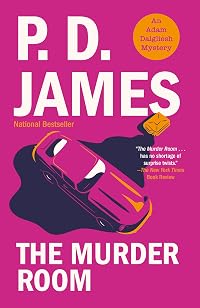
See front cover at https://upload.wikimedia.org/wikipedia/en/8/80/Themurderroom.jpg
The front cover of the original Faber & Faber hardcover (2003). Image sourced from Wikipedia.
The Murder Room was another satisfactory read in this series. It concluded with a major event in Dalgliesh's relationship with Cambridge professor Emma Lavenham which made me happy for both of them. I have moved on immediately to The Lighthouse (Adam Dalgliesh #13 -2005).
The book had a short bonus essay Why Detection? as an Afterword. P.D. James discusses her decision to write literary novels in the form of detective fiction and makes some interesting comments and observations:
Trivia and Links
The Murder Room has had two TV series adaptations.
The first was the BBC's adaptation in 2004 with Martin Shaw in his 2nd and final appearance in the role of Adam Dalgliesh (the role had previously been played for 10 seasons by Roy Marsden on ITV). You can watch the entire episode on YouTube here (the link may not be permanent, but was active as of November 2025).
The second adaptation was as part of Acorn TV's reboot series Dalgleish (2021-ongoing?) with Bertie Carvel as Adam Dalgleish as Season 2's Episodes 5 and 6. See the opening clip from Episode 5 on YouTube here. show less
A review of the Vintage Canada Kindle eBook edition (June 28, 2011) of the Faber & Faber hardcover original (2003).
Dalgliesh thought, Hasn’t it always been like this? People tell me things. I don’t need to probe or question, they tell. It had begun when he was a young detective sergeant and then it had surprised and intrigued him, feeding his poetry, bringing the half-shameful realization that for a detective it would be a useful gift.
I am continuing my current Long Books Challenge with several GR friends and using it to complete my P.D. James / Adam Dalgliesh binge from 2023 which went into hiatus after I read A Certain Justice (Adam Dalgliesh #10 - 1997). The increasing lengths of the later novels caused me to show more lose heart at the time, but now I was happy to tackle 416 pages in this Vintage Canada edition.
The Murder Room finds Adam Dalgliesh and his team investigating a brutal murder by fire at the Dupayne Museum near Hampstead Heath in London. The victim had been intending to close the Museum and the death meant that the jobs of the trustees & staff were saved. The museum contains a so-called "Murder Room" with historical crime exhibits. The newly discovered murder appears to be a copycat of one of the historical crimes. Then yet another body is found in the museum itself. Can Dalgliesh and company solve the crimes before there are further fatalities?
See front cover at https://upload.wikimedia.org/wikipedia/en/8/80/Themurderroom.jpg
The front cover of the original Faber & Faber hardcover (2003). Image sourced from Wikipedia.
The Murder Room was another satisfactory read in this series. It concluded with a major event in Dalgliesh's relationship with Cambridge professor Emma Lavenham which made me happy for both of them. I have moved on immediately to The Lighthouse (Adam Dalgliesh #13 -2005).
The book had a short bonus essay Why Detection? as an Afterword. P.D. James discusses her decision to write literary novels in the form of detective fiction and makes some interesting comments and observations:
But perhaps the greatest problem, and one which Dorothy L. Sayers thought prevented the detective story from being regarded as literature, is to explore the compulsions and complexities of the murderer’s mind without revealing until the final chapter that he or she is indeed the murderer.
E. M. Forster has written: ‘The king died and then the queen died is a story. The king died and the queen died of grief is a plot. The queen died and no one knew why until they discovered it was of grief is a mystery, a form capable of high development.’ To that I would add: the queen died and everyone thought it was of grief until they discovered the puncture wound in her throat. That is a murder mystery and, in my view, it too is capable of high development.
Trivia and Links
The Murder Room has had two TV series adaptations.
The first was the BBC's adaptation in 2004 with Martin Shaw in his 2nd and final appearance in the role of Adam Dalgliesh (the role had previously been played for 10 seasons by Roy Marsden on ITV). You can watch the entire episode on YouTube here (the link may not be permanent, but was active as of November 2025).
The second adaptation was as part of Acorn TV's reboot series Dalgleish (2021-ongoing?) with Bertie Carvel as Adam Dalgleish as Season 2's Episodes 5 and 6. See the opening clip from Episode 5 on YouTube here. show less
A disappointing effort from P.D. James, in spite of the presence of the likeable Scotland Yard Commander Adam Dalgliesh. The action centers around The Dupayne, a boutique museum devoted to England's interwar years of 1919 to 1939. Three siblings are the trustees of the museum, but one of them, Neville Dupayne, will not agree on the lease extension that all three of them must sign. Neville is soon extinguished in flames, followed by two other victims in what appear to be "copycat" murders from the Dupayne's "Murder Room." The plot, the characters, and even the language seem more tired than the usual James book. I would like to say that the ending parodied the movies made in the interwar years, but I didn't get the impression James was show more enough on top of her game for that to excuse the trite treacle of the epilogue. (JAF) show less
Written in 2003 this, the 12th in the Adam Dalgliesh crime fiction series by PD James, is preceded by an excerpt from TS Eliot’s poem ‘Burnt Norton’:
‘Time present and time past
Are both perhaps present in time future,
And time future contained in time past.’
Time is a theme layered throughout this book. Its setting is the Dupayne Museum on Hampstead Heath, so historical time is represented by the exhibits at the museum. Time, recently passed, is examined and re-examined as part of the murder investigation. Time future, is represented by the theme of Adam Dalgliesh’s love for Emma and his courtship of her, a path not easy or untroubled.
Like all Dalgliesh novels, murder happens within a tight community. The Dupayne Museum has a show more small community of owners, staff and visitors. At first glance the victims are not clearly attached to the museum, but this is a James novel: of course they are, we just don’t know how yet.
The murder doesn’t happen for quite a while as James takes her time introducing us to the circle of potential victims and criminals, their connection to the museum and their life outside it. There is an air of the past about it, as if it was written in the thirties, an antidote to modern fast-paced modern crime novels so in itself representing a portrait of changing crime fiction. Time is given to characterization, setting, motivation, and not to dramatic action scenes: more Christie and Sayers than James or Rankin.
In the course of reading ‘The Murder Room’, I considered why I enjoy reading detective novels and what I take from them. I like the mystery, the tension of the chase, the fitting together of disparate elements. I do not like violence, graphic sex or language. But most of all, I like the examination of human nature, the contradictions, the surprises, the privacy of the mind laid bare. PD James excels at all of this; she remains my favourite author of crime fiction, and Adam Dalgliesh my favourite detective.
Read more of my book reviews at http://www.sandradanby.com/book-reviews-a-z/ show less
‘Time present and time past
Are both perhaps present in time future,
And time future contained in time past.’
Time is a theme layered throughout this book. Its setting is the Dupayne Museum on Hampstead Heath, so historical time is represented by the exhibits at the museum. Time, recently passed, is examined and re-examined as part of the murder investigation. Time future, is represented by the theme of Adam Dalgliesh’s love for Emma and his courtship of her, a path not easy or untroubled.
Like all Dalgliesh novels, murder happens within a tight community. The Dupayne Museum has a show more small community of owners, staff and visitors. At first glance the victims are not clearly attached to the museum, but this is a James novel: of course they are, we just don’t know how yet.
The murder doesn’t happen for quite a while as James takes her time introducing us to the circle of potential victims and criminals, their connection to the museum and their life outside it. There is an air of the past about it, as if it was written in the thirties, an antidote to modern fast-paced modern crime novels so in itself representing a portrait of changing crime fiction. Time is given to characterization, setting, motivation, and not to dramatic action scenes: more Christie and Sayers than James or Rankin.
In the course of reading ‘The Murder Room’, I considered why I enjoy reading detective novels and what I take from them. I like the mystery, the tension of the chase, the fitting together of disparate elements. I do not like violence, graphic sex or language. But most of all, I like the examination of human nature, the contradictions, the surprises, the privacy of the mind laid bare. PD James excels at all of this; she remains my favourite author of crime fiction, and Adam Dalgliesh my favourite detective.
Read more of my book reviews at http://www.sandradanby.com/book-reviews-a-z/ show less
A fairly enjoyable P.D. James: nothing very special, but the setting in a small private museum is quite interesting, and the links to great murders of the twenties and thirties are fun, if not as well developed as one might have expected. As usual, the main interest is with the development of the characters ad the gradual filling in of their backgrounds and interactions.
In James' mysteries there are no penetrating interviews by hardened detectives, no rushing around, no plodding research. Instead this is a stately, measured account of murder in the cultivated setting of a private museum and school. Commander Adam Dalgliesh, the detective in charge, writes poetry so naturally it offers a suitably cultivated air. But the upper crust can commit heinous crimes as well as anyone else. P.D. James is hard to beat.
Members
- Recently Added By
Published Reviews
ThingScore 65
The éminence grise of British detective fiction, James delivers another ruminative puzzler, generous in character, graceful in prose.
added by christiguc
James writes with such ease and juggles her plots and characters with such control that none of this gets out of hand. . . Alas, James's efforts to inject suspense into Dalgliesh's romantic life are less effective. . .
added by christiguc
There is no mistaking P. D. James's latest mystery for the work of a younger writer. . . Her characters are confused by euros and annoyed by mobile phones. . . Despite her elegiac frame of mind, Ms. James has not lost her taste for a good throttling.
added by christiguc
Lists

501 Must-Read Books
529 works; 72 members

Detective Stories
343 works; 5 members

Books Read in 2015
3,299 works; 129 members

Books Read in 2020
4,379 works; 124 members
Author Information

149+ Works 69,710 Members
P. D. James, pseudonym of Phyllis Dorothy James White, was born on August 3, 1920 in Oxford, England. During World War II, she served as a Red Cross nurse. She worked in administration for 19 years with the National Health Service. After the death of her husband in 1964, she took a Civil Service examination and became an administrator in the show more forensic science and criminal law divisions of the Department of Home Affairs. She spent 30 years in British Civil Service. She became Baroness James of Holland Park in 1991. Her first novel, Cover Her Face, was published in 1962. She wrote approximately 20 books during her lifetime including the Adam Dalgliesh Mystery series, the Cordelia Gray Mystery series, and Death Comes to Pemberley. She became a full-time writer in 1979. Three titles in the Adam Dalgliesh Mystery series received the Silver Dagger award--Shroud for a Nightingale, The Black Tower, and A Taste for Death. In 2000, she published her autobiography, Time to Be in Earnest. Her dystopian novel, The Children of Men, was adapted into a movie in 2006. She received the Diamond Dagger award for lifetime achievement. She died on November 27, 2014 at the age of 94. (Bowker Author Biography) P. D. James served in the forensic & criminal justice departments of Great Britain's Home Office until her retirement in 1979. She was made a Life Peer in 1991. Her detective novels include "Cover Her Face", "An Unsuitable Job for a Woman", "Death of an Expert Witness", "A Taste for Death", "Original Sin", & "A Certain Justice", many of which have been adapted for television. Her autobiography, "Time to be in Earnest", was published in 2000. (Publisher Provided) show less
Some Editions
Awards and Honors
Distinctions
Notable Lists
Series

Belongs to Publisher Series
Work Relationships
Common Knowledge
- Canonical title
- The Murder Room
- Original title
- The Murder Room
- Original publication date
- 2003-11-18
- People/Characters
- Adam Dalgliesh; Emma Lavenham; Kate Miskin; Piers Tarrant; Marcus Dupayne; Neville Dupayne (show all 14); Caroline Dupayne; Muriel Godby; Tally Clutton; Angela Faraday; Marie Strickland; James Calder-Hale; Ryan Archer; Conrad Ackroyd
- Important places
- Hampstead, London, England, UK; London, England, UK; Dupayne Museum; Swathling's
- Related movies
- The Murder Room (2004 | IMDb)
- Epigraph
- Time present and time past
Are both perhaps present in time future,
And time future contained in time past.
T. S. Eliot, Burnt Norton - Dedication
- To my two sons-in-law
Lyn Flook
Peter Duncan McLeod - First words
- On Friday 25 October, exactly one week before the first body was discovered at the Dupayne Museum, Adam Dalgliesh visited the museum for the first time.
- Last words
- (Click to show. Warning: May contain spoilers.)"Then let's go home."
- Original language
- English
Classifications
Statistics
- Members
- 3,884
- Popularity
- 4,086
- Reviews
- 71
- Rating
- (3.73)
- Languages
- 14 — Czech, Danish, Dutch, English, Estonian, Finnish, French, German, Italian, Lithuanian, Norwegian (Bokmål), Portuguese, Spanish, Swedish
- Media
- Paper, Audiobook, Ebook
- ISBNs
- 73
- UPCs
- 2
- ASINs
- 21