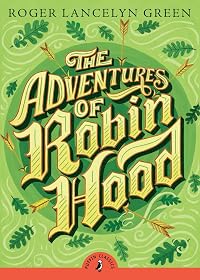
The Adventures of Robin Hood
by Roger Lancelyn Green
On This Page
Description
Recounts the life and adventures of Robin Hood, who, with his band of followers, lived as an outlaw in Sherwood Forest dedicated to fighting tyranny.Tags
Recommendations



Member Reviews
Another battered and dog-eared book from my childhood, just as much a favourite as the King Arthur book by this author. I particularly like the author's note at the beginning explaining his sources and the difficulties of finding accurate material: there is a lot more out there about King Arthur than about Robin Hood! I liked too that Green made sure to include Marian's feats of archery and swordsmanship, although she and Bettris, the wife of George-a-Greene, are the only named women of the Merry Men (Allin-a-Dale's wife doesn't get a name, from what I remember). I like the style of this retelling very much and will definitely read it or give copies to my friends' kids if they want the stories!
A beautifully rendered tale of Robin Hood pieced together from a variety of folk poems and ballads, updated from Olde English, and weaved into a single coherent narrative. Though there is no one "canonical" text for Robin Hood, I feel like this one does justice to the spirit of the story by utilizing these original sources and not (seemingly) straying too far from them. As a result, each chapter reads like a tiny adventure on its own, roughly tied together with the chapter in front and behind. This made it an easy book to read, as there was little fear you might lose a thread.
My experience with Robin Hood is almost entirely formed by Hollywood and Disney. Though there is no "canonical" text for the story, I walked away from Lancelyn show more Green's novel feeling as though I learned something new about the legend of Robin Hood. Is there any basis in truth for these tales? History.com writes "English legal records suggest that, as early as the 13th century, Robehod, Rabunhod and other variations had become common epithets for criminals. But what had inspired these nicknames: a fictional tale, an infamous bandit or an amalgam of both?"
We're unlikely to ever know, but this is part of the mystery that makes Robin Hood so enticing, and has allowed for so many interpretations (for good or for bad). Going back to something closer to the original tales, however, was a pleasant and enlightening escape. show less
My experience with Robin Hood is almost entirely formed by Hollywood and Disney. Though there is no "canonical" text for the story, I walked away from Lancelyn show more Green's novel feeling as though I learned something new about the legend of Robin Hood. Is there any basis in truth for these tales? History.com writes "English legal records suggest that, as early as the 13th century, Robehod, Rabunhod and other variations had become common epithets for criminals. But what had inspired these nicknames: a fictional tale, an infamous bandit or an amalgam of both?"
We're unlikely to ever know, but this is part of the mystery that makes Robin Hood so enticing, and has allowed for so many interpretations (for good or for bad). Going back to something closer to the original tales, however, was a pleasant and enlightening escape. show less
Live fast, die young.
I read this book aaaaages ago. Middle school? I think that's when I read a bunch of these Puffin Classics. This is definitely exciting action adventure, with Green giving the action most of the emphasis. We're told often that Robin robs the rich and gives to the poor, but despite hearing how he takes hundreds of pounds from corrupt church officials, we don't get much indication of where that money goes. At one point he's raising a ransom of King Richard, and later we're told he sent it, but...when and how did it go?
In Green's telling, Robin's adventures are concise and quick--the chapters would make excellent campfire reading.
As an older reader, there were several interesting undercurrents I picked up on:
>> The show more simmering tensions between the Saxons and the Normans. In history class, invasions, occupations, and colonization often ends up seeming like a done deal, but here's the evidence that all is not well even a hundred years after 1066. I was rather impressed that at two points, Norman fathers whose daughters had married Saxons eventually chose to give up their anger for the sake of family.
>> Clergy were almost entirely corrupt, including Friar Tuck--I remembered (okay, okay, with help from the Russel Crowe movie) that he wasn't exactly a paragon of virtue, but he extorted tolls from travelers! How was that much better than the other clergy?
>> I was happy to see that Marian had as active a role as I remembered--yeah, it's not modern feminism, but she was basically her own action star AND she had some women friends as well, one of whom weilds a mean cudgel.
>> It was also interesting to see how often Robin was beaten by others, and how often he took it in good cheer and invited them to join him, not something you'd associate with gung-ho masculinity these days.
>> I picked up, too, on some dissatisfaction in the ranks for how often Robin Hood would get bored with the regular robbing-the-rich routine and wander off into trouble.
>> He's also not a perfect angel in contrast to the villains, though most movies make him out to be so: in one particularly dark scene (though I'm sure we're meant to see it as justice) he shoots down fifteen men tangentally involved in the death of his good friend.
>> There's more than a whiff of British classism showing through Green's interpretations, with the strict heirarchy of serf, yeoman, judge, knight, lord, etc., treated as the natural order of things; no one who's not insisting that Robin's an outlaw doubts that he is rightfully a lord. King Richard remains a perfect ideal from a distance, despite the fact that he--unlike Robin Hood--cannot escape but needs to be ransomed. And the King is, of course, stronger than Friar Tuck, Little John, and Robin Hood together. Like Robin, despite his responsibilities, he faffs around playing at the Black Knight before announcing himself. Way to get back to work, dude!
But most of the stories are light and airy, tales about Robin winning competitions; going in disguise to humiliate the Sherriff of Nottingham, the local bishop, and Prince John, rescuing friends (he doesn't actually rescue Maid Marian--she gets away from her father, Guy of Gisborne, and Prince John all by herself); and getting into friendly fights that end with a new recruit. There is a weird story with a witch in it, which just seems wildly different from all the rest, and stuck out so much from the other stories that I remembered bits of it over the years even if I didn't remember Will Scarlett or Allan-a-Green, etc. The biggest story of Robin's giving-to-the-poor kindness is when he helps a knight pay off a debt on his lands; other than that, it's all telling rather than showing.
I remember being surprised when I read this book for the first time that it actually ended with Robin's early death. He doesn't get a happily ever after: King John gets his revenge, forcing Robin, Marian, and Little John to flee their estate. In escaping, Robin is mortally wounded, though he somehow manages to play pirate with severe internal injuries before limping his way to the nunnery where Marian has holed up. At least he manages to see her and Little John on his deathbed.
All in all, good fun. Now I can read some of the Robin Hood retellings that I've been meaning to get to! show less
I read this book aaaaages ago. Middle school? I think that's when I read a bunch of these Puffin Classics. This is definitely exciting action adventure, with Green giving the action most of the emphasis. We're told often that Robin robs the rich and gives to the poor, but despite hearing how he takes hundreds of pounds from corrupt church officials, we don't get much indication of where that money goes. At one point he's raising a ransom of King Richard, and later we're told he sent it, but...when and how did it go?
In Green's telling, Robin's adventures are concise and quick--the chapters would make excellent campfire reading.
As an older reader, there were several interesting undercurrents I picked up on:
>> The show more simmering tensions between the Saxons and the Normans. In history class, invasions, occupations, and colonization often ends up seeming like a done deal, but here's the evidence that all is not well even a hundred years after 1066. I was rather impressed that at two points, Norman fathers whose daughters had married Saxons eventually chose to give up their anger for the sake of family.
>> Clergy were almost entirely corrupt, including Friar Tuck--I remembered (okay, okay, with help from the Russel Crowe movie) that he wasn't exactly a paragon of virtue, but he extorted tolls from travelers! How was that much better than the other clergy?
>> I was happy to see that Marian had as active a role as I remembered--yeah, it's not modern feminism, but she was basically her own action star AND she had some women friends as well, one of whom weilds a mean cudgel.
>> It was also interesting to see how often Robin was beaten by others, and how often he took it in good cheer and invited them to join him, not something you'd associate with gung-ho masculinity these days.
>> I picked up, too, on some dissatisfaction in the ranks for how often Robin Hood would get bored with the regular robbing-the-rich routine and wander off into trouble.
>> He's also not a perfect angel in contrast to the villains, though most movies make him out to be so: in one particularly dark scene (though I'm sure we're meant to see it as justice) he shoots down fifteen men tangentally involved in the death of his good friend.
>> There's more than a whiff of British classism showing through Green's interpretations, with the strict heirarchy of serf, yeoman, judge, knight, lord, etc., treated as the natural order of things; no one who's not insisting that Robin's an outlaw doubts that he is rightfully a lord. King Richard remains a perfect ideal from a distance, despite the fact that he--unlike Robin Hood--cannot escape but needs to be ransomed. And the King is, of course, stronger than Friar Tuck, Little John, and Robin Hood together. Like Robin, despite his responsibilities, he faffs around playing at the Black Knight before announcing himself. Way to get back to work, dude!
But most of the stories are light and airy, tales about Robin winning competitions; going in disguise to humiliate the Sherriff of Nottingham, the local bishop, and Prince John, rescuing friends (he doesn't actually rescue Maid Marian--she gets away from her father, Guy of Gisborne, and Prince John all by herself); and getting into friendly fights that end with a new recruit. There is a weird story with a witch in it, which just seems wildly different from all the rest, and stuck out so much from the other stories that I remembered bits of it over the years even if I didn't remember Will Scarlett or Allan-a-Green, etc. The biggest story of Robin's giving-to-the-poor kindness is when he helps a knight pay off a debt on his lands; other than that, it's all telling rather than showing.
I remember being surprised when I read this book for the first time that it actually ended with Robin's early death. He doesn't get a happily ever after: King John gets his revenge, forcing Robin, Marian, and Little John to flee their estate. In escaping, Robin is mortally wounded, though he somehow manages to play pirate with severe internal injuries before limping his way to the nunnery where Marian has holed up. At least he manages to see her and Little John on his deathbed.
All in all, good fun. Now I can read some of the Robin Hood retellings that I've been meaning to get to! show less
3.5
I was really surprised by this book. I wasn't expecting it to be a retelling for some reason, I guess because it was a puffin classic, but I should have expected it because it is an actual book not a ballad or epic poem. This book is really different than all the Robin Hood adaptations. Maid Marian is the biggest example. I was pleasantly surprised by it. I can see where the silly comedies came from because this book has a very light tone to it and being a children's book the characters are rather flat, but they are more nuanced and developed than in the films I've seen. Also, Robin Hood is not a buffoon in this. Though stick fighting might seem weird to us today, it's made very clear in the book that it's a way of earning respect show more and you can see who the villain are and who will join the merry men based on how they fight the battles. I would highly recommend this. show less
I was really surprised by this book. I wasn't expecting it to be a retelling for some reason, I guess because it was a puffin classic, but I should have expected it because it is an actual book not a ballad or epic poem. This book is really different than all the Robin Hood adaptations. Maid Marian is the biggest example. I was pleasantly surprised by it. I can see where the silly comedies came from because this book has a very light tone to it and being a children's book the characters are rather flat, but they are more nuanced and developed than in the films I've seen. Also, Robin Hood is not a buffoon in this. Though stick fighting might seem weird to us today, it's made very clear in the book that it's a way of earning respect show more and you can see who the villain are and who will join the merry men based on how they fight the battles. I would highly recommend this. show less
Initially, I wasn't too sure what to make of this. There's a lot of action going on, as everyone knows of Robin Hood, but the writing doesn't really have that sort of tone. And, because he collected the stories from the various places that they're found and put them essentially in order, to try to make a fairly chronological account come together to make a novel, some of it is a little repetetive and a little disjointed. But, I started to get a lot more into it more around halfway in, and found it more engaging. Plus I had no idea that the "real" Marion was so amazing!! All the movies stick her in the trite old damsel in distress role (ugh!), but as it turns out, she's every bit as badass as Robin, and probably even more clever. I was show more astonished, and thrilled! Also, Green put pieces from the old text/songs at the start of each "adventure," which I thought was interesting and clever.
This wasn't one of my top favorite reads, but I'm really glad that I picked it up, and I'd encourage others to do the same! show less
This wasn't one of my top favorite reads, but I'm really glad that I picked it up, and I'd encourage others to do the same! show less
An excellent retelling of Robin Hood's story (minus one chapter with magical elements, and one unnecessary swear word). Funny, exciting, and using many different versions of the legends. I really enjoyed the quotations at the beginning of each chapter.
A note at the end of the ebook pointed out that Green was one of the Inklings, which is interesting.
A note at the end of the ebook pointed out that Green was one of the Inklings, which is interesting.
This book was a good version of the Robin Hood tale. I especially liked the occasional black and white illustrations added to the text since it broke up the long read. It allowed you to construct your own visualizations of the characters and setting, but brought you back on track for some clarification and extra details here and there. I also liked the way that he wrote Marian's character differently than most. In this version, Marian was a fighter, and didn't just fill the role of pretty girl needing to be rescued. The big idea of this book is not lawless-ness, but the need for righteousness!
Members
- Recently Added By
Lists

Favorite Childhood Books
1,651 works; 515 members

Family Read Aloud
2 works; 1 member

Folio Society
831 works; 53 members

Puffin Books 70th anniversary handbook recommendations
537 works; 10 members

Huxley's Reading Log 2018
37 works; 1 member

Beautiful Feet Books
304 works; 7 members

The Story of the World: History for the Classical Child: Activity Book Two
415 works; 2 members

el
1,139 works; 1 member
Author Information

Roger Lancelyn Green was born in England in 1918, where his family has lived for more than 900 years. He was often sick as a child and spent long periods confined to his room devouring Greek myths, medieval romances, and fairy tales. Green began a lifelong fascination with Greece and Greek culture when he first visited that country in 1935. He show more went on to compile and retell many Greek stories, including "Old Greek Fairy Tales," and "Jason and the Golden Fleece." Green also wrote his own stories, but he is better known for his retellings of folk tales from around the world. Roger Lancelyn Green died in 1987 (Bowker Author Biography) show less
Some Editions
Awards and Honors
Awards
Series
Belongs to Publisher Series
Common Knowledge
- Canonical title
- The Adventures of Robin Hood
- Original title
- The Adventures of Robin Hood
- Original publication date
- 1956
- People/Characters
- Robin Hood; Little John; Maid Marian; Friar Tuck; John, King of England; Richard I, King of England
- Important places
- Sherwood Forest, Nottinghamshire, England, UK; Nottingham, Nottinghamshire, England, UK; Nottinghamshire, England, UK; England, UK
- Important events
- Middle Ages; 12th century
- Epigraph
- Robin Hood is here again: all his merry thieves
Hear a ghostly bugle-note shivering through the leaves...
The dead are coming back again, the years are rolled away
In Sherwood, in Sherwood, about the break of day.
- ALFRED NOYES - Dedication
- To 'Buss' ( Miss A. L. Mansfield) in memory of 'Robin Hood' and many other end-of-term plays at Knockaloe, Poulton and Lane End
- First words
- So little is left of the England that Robin Hood and his merry men knew that it is doubtful if any-one of to-day would recognize it if it were possible to go to sleep in our England and to wake up in his.
- Last words
- (Click to show. Warning: May contain spoilers.)To such as these, Robin Hood and his merry men will never die, though the dust of many years is blown above their graves.
Classifications
- Genres
- Fiction and Literature, Kids, Children's Books
- DDC/MDS
- 398.22 — Society, government, & culture Customs, etiquette & folklore Folklore & Folktales Folk literature Legends
- LCC
- PZ8.1 .G77 .A — Language and Literature Fiction and juvenile belles lettres Fiction and juvenile belles lettres Juvenile belles lettres
- BISAC
Statistics
- Members
- 2,761
- Popularity
- 6,697
- Reviews
- 25
- Rating
- (3.94)
- Languages
- 6 — Dutch, English, Greek, Polish, Portuguese, Spanish
- Media
- Paper, Audiobook, Ebook
- ISBNs
- 34
- ASINs
- 23